





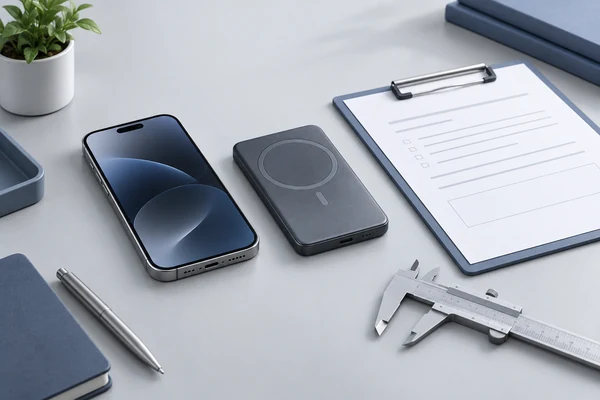
How to Verify Qi2 Magnetic Power Bank Wireless Output Before an OEM Order
Before ordering a Qi2 magnetic power bank, verify its model-specific certification, wireless output under agreed test conditions, temperature-related changes, and power allocation when USB-C and wireless charging operate together. Keep the approved specification, test report and sample configuration linked to the same model. A peak wattage on a quotation is only a starting point.
This guide gives OEM/ODM buyers a practical review plan. The proposed checks are procurement recommendations, not a replacement for certification testing. Agree the equipment, conditions and acceptance criteria with the supplier or test laboratory before comparing results.
Why the wireless output rating is the first thing to pin down
Qi2 branding alone does not identify one power level. The Wireless Power Consortium introduced the original Qi2 at 15W and announced Qi v2.2.1, branded Qi2 25W, in July 2025. Use the WPC announcement to distinguish those generations, then check the particular product you intend to purchase.
Ask the supplier for its WPC identification number and compare the exact model with the WPC certified-product database. WPC states that certified products receive an identification number and a database listing. A magnet, a wireless-charging icon or a certificate for a different model does not establish the status of your proposed order.
Record the model number, hardware revision, wireless module and firmware version on the sample approval sheet. If the supplier proposes a private-label version, ask how that version relates to the listed product. Resolve discrepancies before approving packaging claims. Keep evidence of the check with the purchasing file so a later component substitution can be reviewed against it.
Confirm the target phone models separately. A pack’s advertised maximum does not establish what every phone will receive. Request a compatibility list that identifies the phone, software version, case and conditions behind each performance claim.
What “rated output” actually means on a magnetic pack
Separate capability from measured behaviour. Your specification should distinguish wireless-only output, output during simultaneous USB-C charging, and any supported pass-through mode while the power bank itself recharges. Ask which measurement point each wattage describes and whether the figure is a maximum or an agreed operating result.
Belkin provides a useful model-specific example. Its BoostCharge Slim Magnetic Power Bank 5K with Stand Qi2 15W support page lists up to 15W wireless charging alone and up to 15W USB-C plus 5W wireless in shared charging. Those figures apply to that Belkin model; they are not limits for all magnetic power banks or specifications for a YULIDA product.
For an OEM quotation, request the equivalent mode-by-mode breakdown rather than adding the two individual maximum ratings together. Include any dependence on the pack’s charge level. If a supplier has not measured one mode, record it as unverified and arrange a test before making a retail claim about it.
Thermal behaviour: where rated output and real output diverge
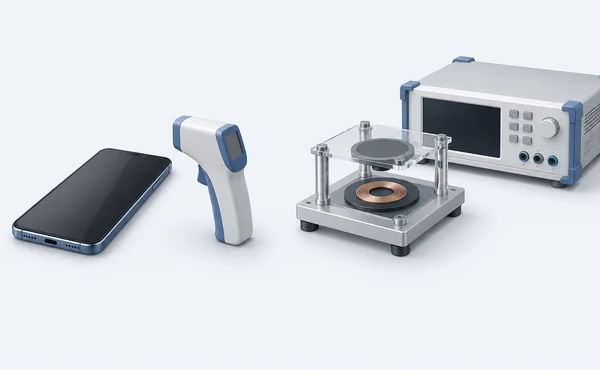
A charging slowdown does not identify its cause. Both the phone’s charging controls and the power bank’s behaviour need consideration. Apple explains that an iPhone can reduce or pause charging when its temperature is too high or too low, including during wireless charging, in its thermal charging guidance.
Ask the supplier what its thermal report actually measures. A case-surface temperature is different from an internal cell or component temperature. Record sensor locations and the equipment used. Avoid accepting a chart labelled only “temperature” or “power” without an explanation of where those values came from.
For comparing samples, keep the starting conditions consistent: phone and pack charge levels, phone settings, case, ambient conditions and test duration. Allow equipment to return to the agreed starting condition between runs. Otherwise, a warm second sample may appear worse simply because the comparison was uncontrolled.
Buyer-recommended thermal check on a sample
- Define the question first: sustained electrical output, phone charging time, surface temperature, or performance in a particular case.
- For an electrical wattage claim, request a laboratory method that identifies the wireless receiver or test fixture, measurement point, instrument accuracy and load conditions.
- For a phone-use comparison, record starting and ending charge levels, elapsed time, charging interruptions and displayed thermal warnings. These observations describe the experience; they do not directly measure wireless output watts.
- Record surface temperatures at consistent, identified locations. Do not report them as internal cell temperatures.
- Repeat the agreed scenario and retain the raw results, including any interrupted run and the reason it was interrupted.
Do not treat a charging animation, a third-party phone estimate or the pack’s display as independent proof of its wireless rating. A USB-C meter on the pack’s input measures that wired input, not the wireless power reaching the phone. For acceptance of a wattage claim, agree a suitable measurement arrangement with a qualified laboratory.
Simultaneous wired and wireless output
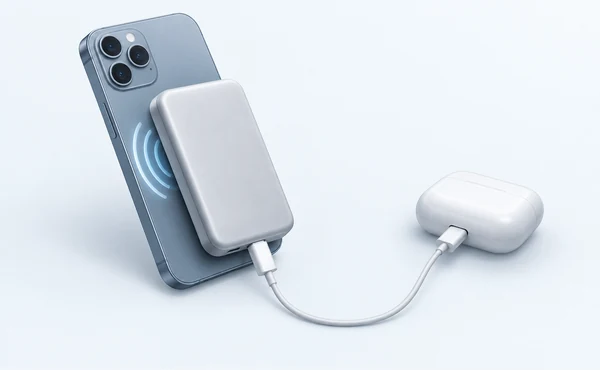
Build a separate acceptance case for charging two devices. Start with the agreed wireless-only setup, then connect the specified USB-C device or load and record what changes. Repeat the connection sequence in the opposite order. This is a buyer-proposed functional comparison, not a universal certification procedure.
Ask whether either connection restarts, which output has priority, and how the pack reports any change. Test the combination customers are likely to use. An unspecified second device makes it difficult to reproduce an apparent failure.
If pass-through charging is advertised, test it as a distinct mode with the approved input adapter and cable. Ask the supplier to state the permitted outputs and operating conditions. Do not infer pass-through support from the presence of an input/output USB-C port.
Shared-output questions for the supplier brief
- What wireless and USB-C outputs are supported together?
- Which devices or loads were used to establish those figures?
- Does the allocation change with battery level or operating temperature?
- Can either connection pause or restart when another device is attached?
- Which modes have test records for this exact hardware and firmware?
A comparison table for your specification review
Use the table below to compare quotations. A missing answer should remain an open item until the supporting evidence is supplied.
| Item to confirm | Anzufordernde Nachweise | Decision it supports |
|---|---|---|
| Certification and model identity | WPC entry and matching model/configuration information | Whether the proposed product supports the intended claim |
| Wireless-only output | Report identifying conditions and measurement point | Which performance statement can be approved |
| Performance over time | Time-based results with temperature and charge-state records | Whether sustained behaviour meets the agreed requirement |
| Gleichzeitige Ausgänge | Separate wireless and USB-C results under a defined combined load | How to describe dual-device operation |
| Case compatibility | Exact case or case specification used in the test | Which accessory combinations to include in the compatibility claim |
| Production equivalence | Controlled component list and change-approval procedure | How to keep production aligned with the approved sample |
How to structure the sample verification
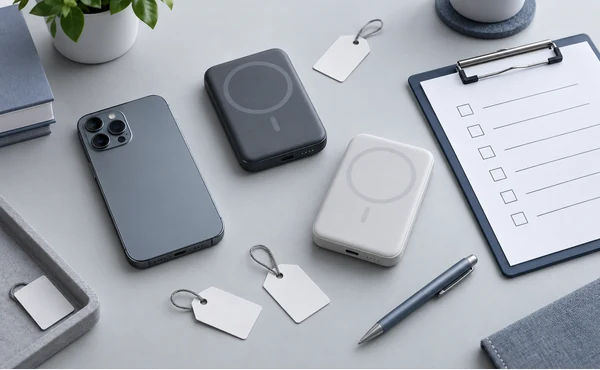
Assign each sample an identifier. Photograph the label and record the supplied configuration before testing. Keep the approval sheet, measurement records and retained sample together. Specify which checks the supplier performs and which the buyer or independent laboratory repeats.
Der von YULIDA veröffentlichte Qualitätskontrollprozess includes electrical-function checks covering simultaneous output, display accuracy and wireless charging. It ties limits to the approved specification and sample and calls for review when components such as the wireless module or firmware change. Confirm the applicable records and agreed test scope for the model under quotation.
Alignment and case fit also deserve a separate check. The related guide, Magnetic power bank alignment: 7 checks before bulk orders, covers that part of sample evaluation. Keep mechanical fit observations distinct from measured electrical results.
Hypothetical example: two samples, same label
Suppose two suppliers quote the same wireless maximum. Supplier A provides a report identifying its receiver fixture, measurement point and combined-load behaviour. Supplier B sends a photograph of a phone showing a charging icon. Both samples may charge the phone, but the available evidence answers different questions.
The buyer asks Supplier B to repeat the agreed measurement and supply the missing conditions. Approval remains open until the reports can be compared. This avoids choosing a winner from an unsupported number or rejecting a workable design because its documentation was initially incomplete.
For the approved supplier, the buyer then defines which checks will be repeated on production samples. A retained development sample is useful as a reference, but it does not prove that every shipment matches it.
Troubleshooting matrix for output problems
Use observations to choose the next check. Each possible cause below needs verification; the table does not diagnose a defective unit by itself.
| Beobachtung | What to check | Useful next action |
|---|---|---|
| A wattage claim cannot be reproduced | Receiver capability, setup and measurement point | Compare the test method with the supplier’s report before comparing numbers |
| Charging slows during the run | Phone charge state, thermal warnings and pack behaviour | Repeat under controlled starting conditions and examine the time records |
| Wireless behaviour changes after connecting USB-C | Documented shared-output allocation | Repeat with the agreed load and connection sequence |
| A case changes the result | Case identity, fit and test conditions | Compare bare-phone and specified-case runs under the same protocol |
| A later batch behaves differently | Hardware, firmware and component revisions | Compare lot records with the approved configuration before accepting a substitution |
What to put in the supplier brief
Send a short written brief with the quotation request. Make every performance claim traceable to a test or document.
- Target phone models, software versions and intended cases.
- Required certification and exact product/configuration identification.
- Wireless-only performance requirement with defined measurement conditions.
- Required simultaneous wireless and USB-C operation.
- Pass-through requirements, if that function is part of the product brief.
- Test duration, starting charge levels and temperature observations to record.
- Sample quantity and acceptance criteria agreed with the test provider.
- Required reports, raw results and traceability information.
- Written change-control and production recheck arrangements.
Agree how discrepancies will be resolved before ordering. For example, define who reviews a failed repeat test, which setup takes precedence, and what evidence is needed before a changed component is accepted. These are contractual project choices; no single sampling quantity or test duration fits every product.
Limitations of this approach
A functional sample review, an electrical measurement and a certification check serve different purposes. Passing one does not automatically establish the other two. Keep their reports distinct and avoid turning a short sample test into a promise about every phone, environment or production unit.
Specify the conditions under which results apply. If your customers use a different phone, case or charging combination, additional checks may be needed. Product and software revisions should trigger a review of the compatibility claims they could affect.
FAQ: verifying Qi2 magnetic power bank output
1. Is a magnetic power bank automatically Qi2 certified?
No. Check the exact model in WPC’s database. Keep the identification number and configuration information with the purchasing record rather than relying on magnetic attachment or a generic sales statement.
2. How do I confirm whether a pack supports 15W or 25W?
Compare the model’s certification information and specification, then review a suitable electrical test report. A phone-use test is useful for compatibility and charging experience, but a charging icon cannot establish either wattage.
3. Why does charging slow after a few minutes?
Check the phone’s charge state and thermal messages as well as the pack’s operating conditions. A slowdown alone does not prove pack overheating. Repeat the agreed scenario and compare the recorded conditions before assigning a cause.
4. What happens when I also use the USB-C port?
The answer is model-specific. Ask for the combined-output specification and test the intended device combination. Do not assume the separately advertised wireless and wired maxima are both available at once.
5. Does case thickness affect the test plan?
Yes: use the intended case in the compatibility checks. Belkin specifies MagSafe-compatible cases up to 3 mm for the cited model. That is a product-specific condition, not a universal allowance for other packs or cases.
6. Can the pack’s display verify its wireless rating?
A display is a useful observation, but first establish what it reports and how its accuracy was checked. Ask for an appropriate independent measurement if the displayed wattage is being used to accept a contractual performance claim.
7. What evidence should be ready before a bulk order?
Keep the approved specification, model identity, certification check, relevant test reports, sample approval and change-control agreement together. Leave unresolved operating modes or compatibility claims visible on the approval sheet until they are settled.
8. Is a higher wireless rating always the better purchase?
No. Compare performance with the intended devices, compatibility, size, cost and documented behaviour. A higher maximum may be valuable for one customer group without improving another group’s charging experience.
Nächster Artikel step
Send your target phone list, intended cases and required charging modes with the supplier brief. For a YULIDA OEM/ODM project, use the Kontaktseite to request the specification, sample plan and available documents for the proposed model. Approve public claims only after the supporting evidence matches that configuration.
Offizielle Quellen und Nachweise
Diese Primärquellen stützen die Aussagen dieses Artikels zu Normen, Kompatibilität, Sicherheit und Transport. Prüfen Sie die aktuellen Anforderungen für das genaue Produktmodell und den jeweiligen Zielmarkt.
- Wireless Power Consortium — Qi- und Qi2-Standards, Zertifizierung und Informationen zum kabellosen Laden.
- Wireless Power Consortium — Qi- und Qi2-Standards, Zertifizierung und Informationen zum kabellosen Laden.
- Apple Support : Voraussetzungen und Anwendungshinweise für kabelloses Laden.
