





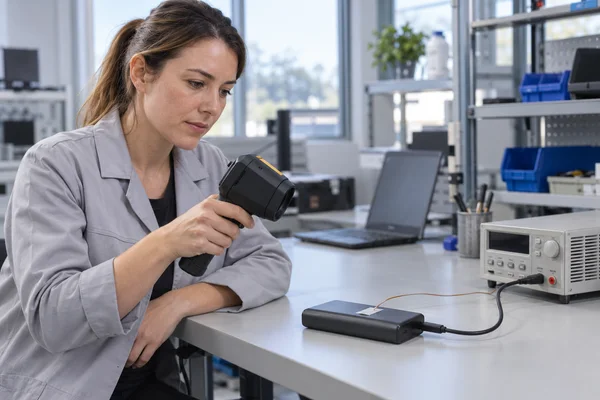
How to Test Power Bank Temperature Rise Before a Bulk Order ?
To test power bank temperature rise, run the finished product under defined charging and discharging conditions, measure temperature at identified locations, and log power on the same timeline. Record the ambient temperature, starting battery state, charger, cable, load and test duration. Then compare the results with the limits and performance requirements agreed for that SKU.
A warm enclosure does not tell a buyer whether the battery is within its operating range or whether the power bank can sustain its advertised output. Approval needs both temperature measurements and an electrical record. A factory report that says only “temperature normal” leaves the buyer without a result that another inspector can reproduce.
What does temperature rise tell an OEM buyer?
Temperature rise is the difference between a measured temperature and the reference ambient temperature specified by the method:
Temperature rise = measured temperature − ambient temperature
For example, a surface at 47°C in a 25°C environment has a temperature rise of 22°C. Those numbers illustrate the calculation; they are not a product result or an acceptance limit. Keep the absolute temperature in the report as well. The same rise in a warmer room produces a hotter surface, and a change in ambient conditions can also change the controller’s behavior.
The measurement location matters just as much. Enclosure temperature, cell temperature and charger-chip junction temperature describe different parts of the product. A cool reading on one face of the enclosure cannot establish the condition of a connector or the battery inside. Identify which temperature each channel measures before interpreting the chart.
For procurement, the test should answer a practical question: under the specified conditions, does the product stay within the applicable limits while delivering the performance the buyer approved?
Fix the sample and test conditions first
Start with a production-intent sample identified by SKU, capacity version and sample number. Record the cell model, PCBA revision, firmware and enclosure construction. Cable assemblies and wireless modules belong in that record when fitted. Different capacity variants may have different internal layouts, so document the basis for any decision to use one variant’s results for another.
Define the operating ambient range and the particular conditions used for each test. Record sample orientation, supporting surface, airflow, connected accessories and starting battery state. Allow the sample to reach the initial condition specified in the plan. A unit taken straight from a cool storage room should not be compared with one that has just finished a discharge run.
Keep nearby chargers and electronic-load exhaust from warming the ambient sensor or cooling the sample. If a fan forms part of the test setup, its use needs to be specified and repeatable. Photograph the arrangement so the factory and inspection company can recreate it.
Put these conditions in the purchase documents. Der YULIDA-Leitfaden zu power bank product-specification guide provides a framework for defining the configuration and acceptance requirements before sample approval.
Where should temperatures be measured?
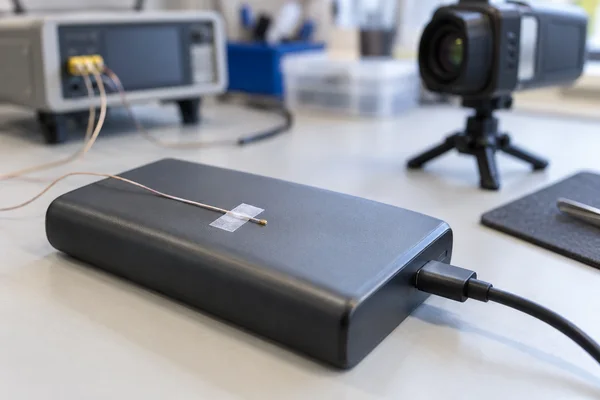
Choose locations from the construction and intended use. An initial thermal survey can help find surface hot spots, followed by measurements at documented points. The test laboratory should decide how internal measurements can be taken without materially changing the heat flow.
| Measurement | What to identify in the report | Was damit belegt werden kann |
|---|---|---|
| Ambient | Sensor location and distance from heat sources | The reference condition for the test |
| Accessible enclosure | Face, position, surface material and sensor attachment | Temperature at the selected user-contact location |
| Connector or built-in cable | Port, plug or cable-exit location and connected load | Local heating in that connection |
| Cell or battery pack | Instrumented location and measurement method | Temperature at the monitored battery location |
| Controller or power stage | Physical measurement point or identified diagnostic channel | The thermal condition reported by that measurement |
A contact sensor needs a repeatable attachment method. Record how it touches the surface and whether tape, adhesive or a fixture affects the reading. Opening an enclosure or adding wires can alter heat transfer; disclose an instrumented sample and explain how it relates to the intact production unit.
Thermal cameras are helpful for mapping surface temperature, but their readings need interpretation. FLIR explains that accuracy depends on factors including emissivity, distance and ambient conditions; glossy metals are poor emitters. Record the camera settings and confirm critical readings with an appropriate method, particularly on a reflective enclosure. A thermal camera measures the visible surface, not the hidden cell. See FLIR’s thermal-camera measurement guidance.
If the power bank displays a temperature, ask what its sensor measures and where that sensor sits. A screen value should not be labeled “battery temperature” in the inspection report unless its meaning has been established.
Which operating modes need a temperature test?
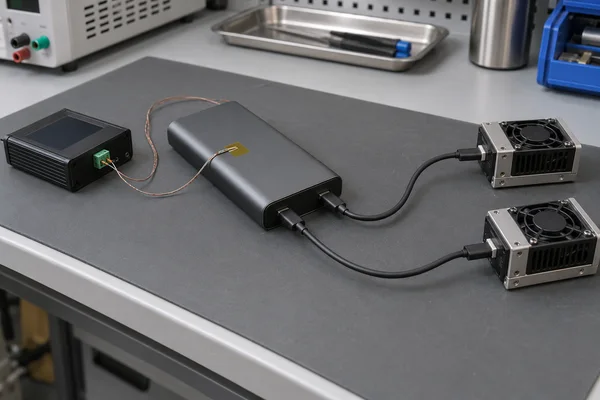
Charging the power bank and powering a device place different demands on its circuitry. Test the supported modes separately, then check combinations that appear in the approved specification.
| Operating mode | Conditions to define | Results to record |
|---|---|---|
| Recharging the power bank | Input port, charger profile, cable and starting battery state | Input power, temperatures and time to the defined charge endpoint |
| Single-port output | Port, negotiated profile, load and battery-state range | Sustained output, temperatures and any power reduction |
| Multiple outputs | Named port combination, per-port loads and total allocation | Each output’s behavior and the thermal result for that combination |
| Wireless output, where fitted | Target device, alignment, case and approved power mode | Charging behavior and temperatures at relevant contact locations |
| Pass-through operation, where supported | Input/output pairing, adapter capability and loads | Input and output power, battery behavior and temperatures |
Use a controlled electrical load for repeatable output testing and representative devices for the compatibility checks. A phone can change its demand as its own battery fills or heats up. That behavior needs to be distinguished from a power-bank limit.
The highest nameplate wattage is not enough to select every thermal test. Different voltage profiles or port combinations can use different conversion paths. Ask the engineer or laboratory to identify the demanding conditions for the actual design, then document the selection.
Der YULIDA-Leitfaden zu fast-charging test guide explains how to verify negotiated profiles and sustained output. For simultaneous input and output, use the supported combinations described in the pass-through charging guide.
Log the whole run, including changes in power
Record temperatures, voltage, current and power on a common timeline. Choose a logging interval that can show the behavior being assessed, and retain event records for disconnects or protocol changes that a slow temperature log might miss.
Continue to the endpoint specified by the method. Depending on the purpose, that may be a complete charge or discharge, a defined operating duration, or a stated thermal-stability criterion. If the report claims a stable temperature, it should define the permitted rate of change and observation interval. A single reading taken after an arbitrary wait cannot establish a plateau.
During a discharge, retain the record as battery state changes. During recharge, record the charging stages and the agreed full-charge endpoint. Note any movement of the sample, cable reconnection or interruption to the setup. These events can explain a change in the curve.
Keep the original data file with the summary chart. The buyer should be able to connect a temperature peak with the power delivered at that moment. If the unit became cooler because output fell, the report needs to show both changes.
How should power reduction and recovery be evaluated?
A controller may reduce power to manage temperature. Das BQ25895 datasheet, for example, describes charge-current reduction when its junction-temperature regulation limit is reached, along with separate thermal shutdown and battery-temperature monitoring functions. These are features of that component, not proof of the circuitry or settings in a particular YULIDA power bank. See the TI BQ25895 datasheet.
Ask the supplier to identify the approved product’s control behavior: which sensor triggers a response, what changes, and how operation resumes. Where diagnostic records are available, retain them alongside the external measurements.
A drop in power can also come from charging taper, a weak adapter, cable loss, a connected device’s demand or a low battery. Temperature and power moving together are evidence to investigate; they do not establish the cause on their own. Compare the electrical conditions and available controller status before calling an event thermal derating.
Define acceptable sustained performance and any permitted reduction in the specification. If a product reduces output during a claimed operating mode, the buyer needs to know the timing, remaining power and recovery behavior. An approved protective response still has to be compatible with the product claim.
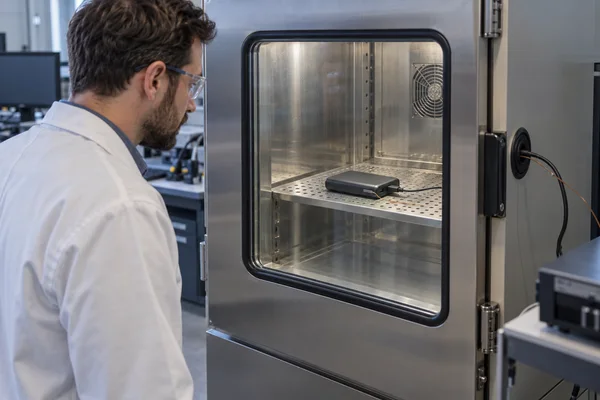
For a documented shutdown event, record the conditions before it occurred, the affected outputs and the restart sequence. The laboratory should assess recovery under its approved procedure, including whether operation repeatedly cycles on and off. Keep protection enabled throughout the evaluation.
Agree the pass rules before placing the order
There is no single temperature number that approves every power bank, every measurement location and every operating mode. The laboratory should identify the applicable safety requirements for the finished construction and market. Cell and component operating limits also need to be respected. Buyer-specific performance criteria belong alongside those requirements.
UL Solutions includes thermal safety among the subjects addressed by UL 2056 for power banks. Its overview helps explain the scope; it does not supply a universal surface-temperature limit for every purchase order. Use the relevant method and edition in the actual evaluation. See UL Solutions’ explanation of UL 2056 testing.
For each condition, specify the measurement location, applicable limit, load, ambient condition and test endpoint. State what power must be sustained and how any approved reduction is evaluated. Include measurement uncertainty and the decision rule used near a limit, so a borderline reading receives consistent treatment.
Routine temperature-rise checks and deliberate fault tests have different purposes. A competent laboratory should perform overtemperature or other abnormal-condition tests under the applicable procedure. Der YULIDA-Leitfaden zu power bank safety-testing guide covers that broader evaluation.
What thermal evidence should accompany the production lot?
Qualification establishes the behavior of the approved construction. Shipment inspection checks whether the finished lot matches it. Agree the sampling plan and lot-level checks before production, including how samples are selected and what happens after a failure.
Request the sample IDs, production lot, configuration revisions, test setup photographs, instrument and calibration records, measurement locations and original logs. The report should show the maximum recorded temperatures, associated power and any interruption or reduction. Retain failed results and the investigation that followed them.
A change to the cell, power stage, firmware, sensor placement or enclosure can affect the thermal result. Thermal-interface materials and assembly methods can matter too. Review the change and decide which tests need repeating before accepting results from the earlier build.
For a YULIDA OEM inquiry, include the chosen model, required input and output modes, intended operating conditions and sustained-power expectations. Request thermal evidence for that configuration and agree how the production lot will be checked. This gives the quotation and sample-approval process a measurable target.
Häufig gestellte Fragen
1. What is an acceptable power bank temperature?
The limit depends on what is being measured, the operating condition and the applicable requirements. Enclosure, connector, cell and chip temperatures need separate interpretation. Ask the supplier and test laboratory to identify the limits for the exact construction, then put them in the approved test plan.
2. Can a thermal camera prove the battery inside is within its limit?
A thermal camera measures the visible surface. Internal battery temperature requires an appropriate internal measurement or a validated diagnostic channel with a known sensor location. Reflective surfaces also require care when interpreting infrared readings.
3. Is automatic power reduction a test failure?
Judge it against the approved behavior and performance requirement. Record when the reduction occurs, the power that remains and how the unit recovers. A protective response may be intended, while still falling short of a claim that the buyer expected the product to sustain.
4. Is testing at room temperature enough?
A room-temperature result covers the conditions recorded in that test. It does not establish operation across a wider claimed ambient range. Have the laboratory select the additional conditions needed for the specification and applicable evaluation.
5. Can one thermal report cover several capacity versions?
Only with a documented basis for the coverage. Cell arrangement, enclosure space, power limits and thermal paths may differ between versions. Ask the laboratory or responsible engineer to explain which construction was tested and why its results cover the other variants.
Offizielle Quellen und Nachweise
Diese Primärquellen stützen die Aussagen dieses Artikels zu Normen, Kompatibilität, Sicherheit und Transport. Prüfen Sie die aktuellen Anforderungen für das genaue Produktmodell und den jeweiligen Zielmarkt.
- UL Solutions — Normen zur Batteriesicherheit und technische Sicherheitsinformationen.
