





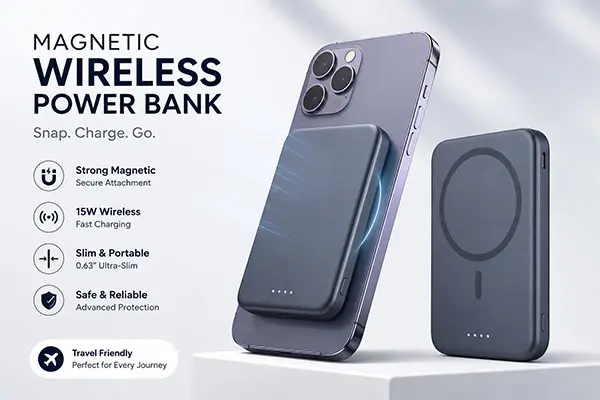
What Is the Best Wireless Magnetic Power Bank? A B2B Buyer’s Guide
The best wireless magnetic power bank combines a verified wireless-charging standard, capacity and output matched to the intended use, stable magnetic alignment, and model-specific safety and transport evidence. For B2B buyers, “best” also means consistent production, documented quality control, responsive OEM/ODM support, and a competitive total cost beyond the FOB price.
Search results for the “best wireless magnetic power bank” are dominated by consumer reviews. They rank models by how fast they charge an iPhone or whether they look good on a desk. That framework works for end users shopping on Amazon. It falls short for the importers, brand owners, and corporate gift buyers who source thousands of units at a time.
As a manufacturer at YULIDA Power, we see the gap firsthand. A distributor who picks a model based on a 4.5-star rating can still end up with a 4% return rate, a batch that fails customs inspection, o a product that loses Qi2 certification mid-production. The criteria that actually matter at scale are different from what consumer reviewers test.
The global power bank magnético inalámbrico market is projected to grow from $1.85 billion to $3.79 billion at a CAGR of 10.8%, according to un estudio de mercado sobre power banks magnéticos inalámbricos from QYResearch. That growth is pulling in new buyers who need a procurement framework, not another top-ten list.
This guide is that framework — seven criteria, buyer-type recommendations, a specs comparison, factory vetting steps, and sourcing Preguntas frecuentess. If you are asking what is a magnetic power bank and which one is best for your business, the answer starts with measurable procurement standards, not star ratings.
What Makes a Wireless Magnetic Power Bank “The Best”? 7 B2B Evaluation Criteria
Para las compras B2B, el mejores power banks magnéticos inalámbricos no se define por la estética ni por las afirmaciones de marketing, sino por especificaciones medibles que afectan al coste, al cumplimiento normativo y a la satisfacción del cliente. Estos son los siete criterios que importan cuando se compra a gran escala.
Certificación Qi2: el requisito básico no negociable
Qi2 is the Wireless Power Consortium’s latest open standard. It uses Magnetic Power Profile (MPP) technology to deliver 15W wireless charging to compatible iPhones, up from the 7.5W cap that older Qi chargers were limited to with Apple devices. This is not a minor spec bump. It cuts charging time by roughly 40% and enables true alignment-based efficiency.
La base de datos de productos con certificación Qi currently lists over 2,665 Qi2-certified products across all categories. Power banks account for 22.85% of that total, with 609 certified models from 264 brands. That number is growing rapidly, and it signals a clear market direction: retailers and carriers increasingly require Qi2 certification for shelf placement.
Qi2 certification carries two direct cost implications for your procurement budget. First, certification adds $1.50 to $3.00 per unit to FOB cost, covering WPC membership fees ($18,000 per year for adopter members) and authorized lab testing. Second, uncertified products labeled “Qi2 compatible” face rejection from premium retail channels in North America and Europe. A product without a valid WPC registration number cannot legally display the Qi2 logo.
If you are sourcing compatibilidad de los power banks inalámbricos destinados a mercados con varios tipos de dispositivos, Qi2 es la base que garantiza el funcionamiento con iPhone 12 y posteriores, además de los dispositivos Android compatibles con Qi2.
Capacidad de la batería y energía útil real
A 10,000mAh power bank does not deliver 10,000mAh to a phone. Conversion efficiency through the wireless charging coil, voltage regulation, and thermal losses typically reduces usable output to 55 to 60% of rated capacity. A 10,000mAh unit realistically delivers 5,500 to 6,000mAh to a device. A 5,000mAh unit delivers about 2,750 to 3,000mAh, roughly one full charge for a standard smartphone.
The capacity decision should be driven by your target market segment:
- Uso diario y desplazamientos: 5.000 mAh es el punto de equilibrio: formato delgado, una carga completa y fácil transporte en el bolsillo.
- Viajes y uso intensivo: 10.000 mAh ofrece de dos a tres cargas completas. Es algo más grueso, pero sigue siendo fácil de llevar.
- Regalos corporativos: 5.000 mAh a un precio más bajo permite destinar más presupuesto a la personalización de la marca.
Battery cell chemistry also affects your B2B decision. Lithium-polymer (Li-Po) cells dominate the market due to their thin profile and reasonable cost. Semi-solid state batteries are emerging as a premium option, offering better energy density and safety margins.
LFP (lithium iron phosphate) cells provide superior cycle life (2,000+ cycles vs. 300 to 500 for Li-Po) but are heavier and less common in slim magnetic designs. For most consumer-facing magnetic power banks, Li-Po remains the practical B2B choice, with semi-solid as an upgrade path for premium positioning.
Fuerza y precisión de la alineación magnética
The magnetic system is what separates a magnetic power bank from a standard wireless pad. Without proper alignment, charging efficiency drops by 15 to 25% and heat generation increases significantly.
The industry standard for magnetic power banks uses N52 or N52H grade neodymium (NdFeB) magnets. N52 offers the strongest magnetic force at room temperature, while N52H maintains performance under higher heat conditions, making it preferable for devices that run warm during wireless charging.
For procurement specifications, the key metric is pull force. A quality power bank magnético inalámbrico de calidad debe ofrecer:
- Teléfono sin funda: fuerza de sujeción mínima de 8 N para evitar desplazamientos durante el uso.
- Teléfono con funda: fuerza mínima de 10 N para mantener la alineación a través del material de la funda.
- Precisión del anillo magnético: alineación entre bobinas con una tolerancia máxima de 1,5 mm.
Weak magnets cause two problems in the field. The power bank shifts during use, interrupting charging and triggering the foreign object detection (FOD) safety cutoff. And misaligned coils waste energy as heat, which reduces battery lifespan and triggers thermal throttling.
At YULIDA, we have tested magnets from over a dozen suppliers. The difference between a genuine N52 magnet array and a lower-grade alternative is immediately visible in alignment consistency testing. We specify N52H across our magnetic product line because the thermal stability margin matters during sustained 15W charging sessions.
Arquitectura de gestión térmica
Wireless charging is inherently less efficient than wired charging. Energy loss through the wireless coil runs 20 to 30%, compared to approximattely 10% for wired USB-C PD. That lost energy converts to heat, and heat is the primary enemy of lithium battery lifespan and user safety.
There are two approaches to thermal management in magnetic power banks:
Passive cooling uses thermally conductive matterials like graphene films, aluminum backings, and thermal silicone pads to dissipate heat away from the coil and battery. This is the standard approach for slim consumer designs. Graphene thermal films can reduce surface temperature by 5 to 8 degrees Celsius compared to designs without dedicated thermal management.
Active cooling adds a micro-fan or Peltier element. This is rare in power banks due to thickness and noise constraints, but some gaming-oriented models use it.
The critical question is not which thermal approach the factory uses but whether they can prove it works. Request third-party thermal test reports showing surface temperature measurements during sustained 15W charging at full battery capacity. A well-designed unit should maintain surface temperature below 42 degrees Celsius during continuous operation. If a supplier cannot provide thermal data, that is a red flag.
Conjunto de certificaciones de seguridad
Safety certifications are not optional for international distribution. They are legal requirements that determine whether your shipment clears customs and whether your product can be sold on major platforms.
The essential certification stack for a magnetic power bank includes:
| Certificación | Finalidad | Alcance del mercado |
|---|---|---|
| CE | Cumplimiento de la seguridad del producto | Unión Europea |
| FCC | Cumplimiento electromagnético | Estados Unidos |
| RoHS | Restricción de las sustancias peligrosas | UE + otros |
| UN38.3 | Seguridad del transporte de baterías | Transporte mundial |
| UL 2056 | Seguridad del sistema de baterías | Gama prémium de Norteamérica |
Cada certificación añade coste y plazo. CE y FCC juntas suelen sumar entre 0,50 y 1,50 dólares por unidad. Los ensayos UN38.3 cuestan entre 300 y 500 dólares por modelo de batería, importe que se amortiza en el lote. UL 2056 es la más cara y suele añadir entre 2 y 4 dólares por unidad, pero abre el acceso a cuentas minoristas prémium de Norteamérica que la exigen; consulte UL’s battery safety testing program for certification scope).
Missing certifications create real business risk. Shipments without UN38.3 can be detained by air freight carriers. Products without Marcado CE face customs seizure at EU borders. Amazon and other platforms increasingly require FCC documentation for listing approval, and products pulled for non-compliance face account-level penalties.
La estándar de seguridad IEC 62368-1 is the underlying technical standard that most of these certifications reference. Understanding it helps you evaluate whether a factory’s safety testing is genuine or surface.
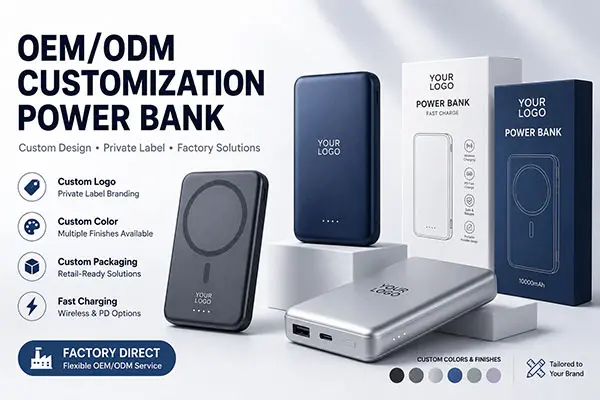
Profundidad de personalización OEM/ODM
B2B buyers rarely want a cookie-cutter product. The ability to customize packaging, branding, and even hardware specifications is a core differentiator when choosing a manufacturer.
Customization typically falls into three tiers:
Standard OEM (MOQ: 500 units, lead time: 15 to 20 days): Your logo on an existing product model with standard specifications. This is the fastest and lowest-cost entry point. The factory provides an existing certified platform, and you add branding.
Light Customization (MOQ: 1,000 units, lead time: 20 to 25 days): Beyond logo printing, you can adjust packaging design, include a custom manual, add a gift box, o modify color schemes. The core hardware remains standard, but the presentation is tailored to your brand.
Deep ODM (MOQ: 2,000 units, lead time: 30 to 35 days): You define the product. Custom mold design, unique form factor, specific battery capacity, integrated cables, kickstand features, o proprietary color Pantones. The factory handles tooling, prototyping, and certification under your brand.
A European distributor learned this the hard way. They ordered a standard OEM run of 2,000 units, only to discover that three competitors at the same retail trade show were selling identical units with different logos. The product was technically fine, but the lack of differentiation killed their premium pricing strategy.
They switched to a light customization tier on their next order, adding a unique gift box and integrated cable design. Same factory, slightly higher MOQ, but their retail partners saw a distinct product rather than a commodity.
Descubra nuestros Servicios de fabricación OEM/ODM para saber qué nivel se ajusta al calendario y al presupuesto de su proyecto.
Coste total de propiedad más allá del precio FOB
El precio FOB es el punto de partida, no el coste final. El coste real de comprar un power bank magnético incluye:
- Coste FOB por unidad: entre 5 y 22 dólares según capacidad, funciones y personalización
- Amortización de certificaciones: entre 0,50 y 4,00 dólares por unidad según el conjunto requerido
- Transporte y logística: 8-15 % del coste FOB por mar y 25-40 % por aire
- Coste de las devoluciones: el gasto oculto
The return rate differential between quality and budget suppliers is dramatic. Tier-1 manufacturers with proper quality control maintain defect rates below 0.3%. Budget suppliers cutting corners on cells, magnets, o assembly can see return rates exceed 3%. At a 2,000-unit order, that is the difference between 6 returns and 60 returns.
Each return costs you not just the product replacement but also reverse logistics, customer service time, and reputational damage. A buyer we work with in the Middle East initially sourced from the lowest bidder. Their FOB price was 30% below market average. Within six months, their return rate hit 4.2%. The cost of processing returns, issuing refunds, and managing customer complaints erased their entire savings and then some. They switched to a mid-tier supplier (YULIDA) with a 0.2% defect rate. The higher FOB price was recovered within one quarter through reduced after-sales costs.
Want to see how YULIDA’s quality standards translate to real TCO savings? Browse YULIDA’s magnetic power bank product catalog y solicite una muestra para compararla con la de su proveedor actual.
Mejor power bank magnético inalámbrico según el tipo de comprador
Los diferentes tipos de compradores necesitan diferentes especificaciones. Esto es lo que importa para cada segmento.
Para Importadores y Distribuidores
Importers and distributors need volume, consistency, and broad market appeal. The recommended specification is a 10,000mAh Qi2-certified unit with 15W wireless output and 20W USB-C PD wired output. This dual-mode approach ensures compatibility with the widest range of devices, from iPhone 12+ to Samsung Galaxy S25 to Google Pixel.
The FOB price range for this configuration runs $8 to $14 per unit at a 1,000-unit MOQ. The dual charging mode is a key selling point because it covers users who want wireless convenience and users who need fast wired charging in one SKU. Distributors who carry a single well-specced model can serve multiple retail channels without fragmenting their inventory.
Para propietarios de marcas —marca privada—
Brand owners need differentiation. Upgrading to a 10,000mAh Qi2 unit with an integrated charging cable, a built-in phone stand, and premium packaging creates a product that stands apart on retail shelves and justifies a higher price point.
FOB pricing for this configuration ranges from $14 to $22 per unit. The integrated cable eliminates the most common user complaint (forgotten cables), and the stand adds functionality that converts the power bank from a battery into a desktop accessory. For private label brands targeting premium positioning, these features are worth the additional cost.
Para los compradores de regalos corporativos
Corporate gift buyers prioritize cost efficiency, portability, and branding space. A 5,000mAh Qi2 unit in an ultra-thin form factor keeps FOB cost in the $5 to $8 range, leaving budget for custom logo printing, branded packaging, and gift presentation.
The slim profile of a 5,000mAh magnetic power bank (typically 8 to 12mm thick) makes it an ideal corporate gift item. It fits in a greeting card envelope, slides into a conference swag bag, and sits unobtrusively on a desk. For bulk corporate orders, the combination of useful technology, compact size, and customization potential is hard to beat.
Comparación de especificaciones de power banks magnéticos inalámbricos
En la tabla siguiente se comparan los rangos de especificación entre tres niveles de posicionamiento de productos. Piense en estos como rangos de referencia de compras, no en un ranking de marca.
| Especificación | Uso diario | Viajes prémium | Regalo corporativo |
|---|---|---|---|
| Capacidad | 5.000 mAh | 10.000 mAh | 5.000 mAh |
| Salida inalámbrica | Qi2 15 W | Qi2 15 W | Qi2 15 W |
| Salida por cable | USB-C 20 W PD | USB-C 20 W PD + cable integrado | USB-C 18W |
| Grado magnético | N52 | N52H | N52 |
| Espesor | 8 a 12 mm | 14 a 18 mm | 8 a 12 mm |
| Peso | 90 a 130g | 200 a 280g | 90 a 130g |
| Certificaciones | CE, FCC, RoHS, UN38.3 | CE, FCC, RoHS, UN38.3, UL 2056 | CE, FCC, RoHS, UN38.3 |
| Rango de precio FOB | $5 a $8 | 14 dólares a 22 dólares | $5 a $8 |
Cómo evaluar una fábrica de power banks magnéticos inalámbricos
Elegir la especificación adecuada es la mitad del trabajo; elegir la fábrica capaz de fabricarla es la otra mitad. Una gran ficha técnica no sirve de nada si el proveedor no mantiene la uniformidad en una producción de 5.000 unidades.
Proceso de evaluación de proveedores en 5 pasos
- Verify factory certifications. ISO 9001 quality management certification is the minimum. BSCI (Business Social Compliance Initiative) audit compliance is increasingly required by European retail buyers. Request current certificates and verify them against the issuing body’s database. Expired or forged certificates are more common than you might expect.
- Request third-party thermal test reports. A factory that has invested in proper thermal engineering will have test data ready. Ask for reports from independent labs (not the factory’s own quality department) showing surface temperature readings during sustained 15W wireless charging. The data should cover multiple ambient temperatures and include infrared thermal imaging.
- Check battery cell suppliers. Tier-1 cell manufacturers include ATL (Amperex Technology Limited), CATL (Contemporary Amperex Energy Technology), BYD, and Samsung SDI. These suppliers provide traceable batch numbers, matterial safety data sheets, and consistent quality. If a factory uses unbranded cells or cannot identify their cell supplier, walk away. The battery cell is 40 to 60% of the product’s cost and 90% of its safety risk.
- Confirme el protocolo de envejecimiento. Las fábricas de calidad realizan pruebas de burn-in de 72 horas antes del embalaje para detectar fallos tempranos que acabarían en devoluciones. Durante una auditoría, pida ver la zona de envejecimiento. Una fábrica sin este equipo omite una etapa esencial del control de calidad.
- Empiece con un pedido de prueba de 500 unidades. Antes de comprometerse con 5.000 o 10.000 unidades, valide la fábrica con un lote pequeño. Pruebe las unidades con su propio protocolo de aceptación. Si aparecen problemas, habrá limitado la exposición; si el lote pasa, podrá avanzar con confianza.
Para obtener una visión más amplia del panorama de fabricación, nuestra guía de guía de las principales fábricas de power banks inalámbricos abarca los criterios de evaluación en profundidad.
Señales de alerta de un mal proveedor
Preste atención a estas señales durante la evaluación:
- “Qi2 compatible” with no WPC registration number. This means the product has not been officially certified. The factory is using the Qi2 name without paying for testing. Your products will not have a valid Qi2 ID and cannot legally display the Qi2 logo.
- Negativa a facilitar los lotes de las celdas. Si la fábrica no identifica quién fabricó las celdas, puede estar usando componentes de baja calidad o proveedores no regulados. En ambos casos aumenta su exposición a responsabilidades de seguridad.
- Ausencia de equipos de envejecimiento. Visite la fábrica: si no hay una zona de burn-in con bastidores de unidades en carga, el control de calidad es superficial.
- Presupuestos más de un 30 % inferiores a la media. Si las demás fábricas cotizan entre 10 y 14 dólares por una unidad Qi2 de 10.000 mAh y una ofrece 6 dólares, está recortando en celdas, imanes, certificaciones o montaje. El ahorro se multiplicará en devoluciones y daño reputacional.
Tendencias del mercado de power banks magnéticos inalámbricos que los compradores B2B deben conocer
Procurement decisions made today need to hold up for 18 to 24 months on retail shelves. These trends shape what that shelf looks like.
Qi2.2 and 25W adoption is accelerating. The WPC has already introduced the Qi2.2 standard, which pushes wireless charging power to 25W. Certificación Qi2 continues to expand, with 328 member companies now participating in the WPC ecosystem. As more smartphone models support higher wireless charging speeds, power banks that only deliver 7.5W or 10W will feel increasingly outdated. Specifying Qi2 15W as your minimum ensures your procurement stays relevant.
Semi-solid state battery technology is emerging. Semi-solid state batteries offer higher energy density (more capacity in a thinner profile) and improved safety margins compared to traditional Li-Po cells. While still more expensive, the price gap is narrowing. For premium product positioning, semi-solid state is worth evaluating as a differentiator.
Android magnetic ecosystem is expanding. Samsung Galaxy and Google Pixel are adding native magnetic module support, reducing reliance on magnetic cases for alignment. This opens the Android market to magnetic power banks in a way that was not possible when only iPhone had native MagSafe. For B2B buyers, this means Qi2 magnetic power bank demand will grow beyond the Apple ecosystem, expanding your addressable market.
Integrated cable designs are becoming standard. The most common user complaint about power bank inalámbricos is the need to carry a separate cable for wired charging or recharging the bank itself. Models with integrated USB-C cables are becoming a market expectation rather than a premium feature. Consider specifying integrated cable designs for your next procurement cycle.
Market growth trajectory remains strong. The power bank magnético inalámbrico market research from QYResearch projects the market to grow from $1.85 billion to $3.79 billion at a 10.8% CAGR. Global production exceeds 41 million units annually with an average price of $45 per unit and gross margins of 30 to 50% for leading manufacturers. This is a growing, profitable market with room for new entrants who get the fundamentals right.
Understanding the power bank inalámbrico frente a cargador inalámbrico también ayuda a posicionar correctamente la gama para cada caso de uso.
Preguntas frecuentes: What Is the Best Wireless Magnetic Power Bank? A B2B Buyer’s Guide
Estas son las preguntas más frecuentes sobre el mejor power bank magnético inalámbrico.
¿Cuál es el mejor power bank magnético inalámbrico para iPhone?
El mejor power bank magnético inalámbrico para iPhone ofrece carga de 15 W con certificación Qi2, una capacidad de 5.000-10.000 mAh y alineación magnética N52 compatible con iPhone 12 y posteriores. La certificación Qi2 es decisiva porque habilita los 15 W completos en iPhone; los cargadores sin Qi2 están limitados a 7,5 W. Para compradores B2B de accesorios para iPhone, exigir Qi2 garantiza la velocidad que espera el usuario y que los minoristas solicitan cada vez más para el lineal.
¿Merece la pena un power bank magnético inalámbrico?
Sí. Merece la pena para quienes valoran la comodidad sin cables y una alineación precisa de las bobinas, que mejora la eficiencia entre un 15 y un 25 % frente a una base Qi no magnética. La fijación magnética elimina el problema más habitual de la carga inalámbrica: una mala alineación que ralentiza o interrumpe la carga. Para un comprador B2B, el retorno de la inversión debe incluir mayor atractivo en retail, menos devoluciones por errores de colocación y una demanda creciente. La guía de compra de power banks magnéticos cubre el análisis costo-beneficio con más detalle.
What’s the difference between Qi2 and MagSafe?
Qi2 is an open wireless charging standard by the WPC that delivers 15W to all compatible devices, while MagSafe is Apple’s proprietary ecosystem limited to iPhone 12+ with magnetic alignment and accessory ecosystem integration. Para compradores B2B, la diferencia práctica es la compatibilidad. Qi2 funciona con iPhone y Android, mientras que MagSafe se limita al iPhone. La certificación Qi2 cuesta menos por tratarse de un estándar abierto y prepara el producto para el crecimiento del ecosistema magnético Android. Integrar MagSafe añade requisitos de licencia específicos de Apple.
¿Puede un power bank magnético cargar teléfonos Android?
Sí. Puede cargarlos de forma inalámbrica hasta 15 W mediante Qi2, pero la mayoría de los dispositivos Android necesita una funda magnética para alinearse correctamente, salvo que incorpore un módulo magnético nativo. Samsung Galaxy y Google Pixel están incorporando compatibilidad magnética nativa, por lo que la funda dejará de ser necesaria de forma gradual. Para compradores B2B dirigidos a Android, incluir una funda magnética o indicar compatibilidad con fundas MagSafe amplía considerablemente el mercado potencial.
¿Cuánto dura un power bank magnético inalámbrico?
Un power bank magnético inalámbrico de calidad dura entre 300 y 500 ciclos completos y conserva aproximadamente el 80 % de su capacidad original después de 300 ciclos, siempre que cuente con una gestión adecuada de la batería. La vida útil depende de la calidad de las celdas, los hábitos de carga y el sistema BMS. Las celdas de primer nivel de ATL o CATL superan de forma constante a las alternativas sin marca. Para compradores B2B, la práctica habitual es exigir al menos 12 meses de garantía y confirmar que el BMS protege contra sobrecarga, sobredescarga y temperatura excesiva.
¿Qué capacidad de power bank magnético debo comprar?
Para desplazamientos diarios, 5.000 mAh proporciona una carga completa. Para viajar o un uso intensivo, 10.000 mAh ofrece de dos a tres cargas sin dejar de ser fácil de transportar. Recuerde que la capacidad útil real es el 55-60 % de la nominal por las pérdidas de conversión. Una unidad de 5.000 mAh entrega cerca de 3.000 mAh, suficiente para una carga de la mayoría de los iPhone. La opción de 10.000 mAh conviene a quien carga varios dispositivos o necesita varias cargas lejos de un enchufe.
¿Son seguros los power banks magnéticos para el uso diario?
Sí. Los modelos con certificaciones CE, FCC y UN38.3 son seguros para el uso diario e incorporan protección contra sobrecorriente, sobretensión y apagado térmico. La clave es comprar a fabricantes que utilicen circuitos de seguridad reales, no solo documentación. Solicite el esquema del BMS y los datos de las pruebas térmicas. Los riesgos habituales proceden de celdas falsificadas, la ausencia de FOD y una gestión térmica insuficiente; trabajar con un fabricante certificado reduce estos riesgos.
¿Cómo elijo un fabricante de power banks magnéticos?
Verifique su certificación ISO 9001, solicite informes térmicos de terceros, confirme que utiliza celdas de primer nivel y empiece con un pedido de prueba de 500 unidades. El marco es sencillo, pero exige diligencia. Revise auditorías, visite la línea de producción si es posible y pruebe muestras antes de comprometer volumen. Nuestra página de servicios OEM/ODM explica la documentación y el proceso de muestras que utilizamos para que los compradores puedan evaluar a YULIDA como socio fabricante.
Conclusión
La mejores power banks magnéticos inalámbricos for B2B buyers is not the one with the highest consumer rating. It is the one that combines Qi2 15W certification, appropriate capacity for the target market, N52-grade magnets, a complete safety certification stack, and reliable OEM/ODM manufacturing with defect rates below 0.3%.
The framework matters because the market is moving fast. Qi2 is becoming the baseline, not a premium feature. The Android magnetic ecosystem is opening up. Buyers who apply these seven criteria now will be positioned to capture that growth.
Ready to source the best wireless magnetic power bank for your business? Empiece con un pedido de prueba de 500 unidades de YULIDA Power para comentar sus especificaciones, solicitar muestras y gestionar los requisitos de certificación. Nuestro equipo de ingeniería le ayudará con las opciones de personalización y los protocolos de aseguramiento de la calidad desde el primer día.
Fuentes oficiales y verificación
Estas fuentes primarias respaldan las afirmaciones sobre normas, compatibilidad, seguridad o transporte tratadas en este artículo. Confirme el requisito vigente para el modelo exacto de producto y el mercado de destino.
- Wireless Power Consortium — Estándares Qi y Qi2, certificación e información sobre carga inalámbrica.
- UL Solutions — Normas de seguridad de baterías e información técnica de seguridad.
- International Electrotechnical Commission — Normas electrotécnicas internacionales y alcance de las normas.
- Wireless Power Consortium — Estándares Qi y Qi2, certificación e información sobre carga inalámbrica.
