






Quelles certifications sont nécessaires pour les batteries externes ? Guide CE, FCC, RoHS, UN 38.3 et IEC 62133 pour les importateurs (2026)
Aucun certificat unique ne permet de commercialiser une batterie externe sur tous les marchés. Un modèle filaire de 10 000 mAh expédié par mer vers l’Allemagne et un modèle magnétique sans fil envoyé par avion aux États-Unis peuvent nécessiter des justificatifs différents.
Toute batterie externe lithium-ion destinée au transport commercial doit reposer sur des essais UN 38.3 valides et disposer d’un résumé d’essais. Les produits vendus dans l’Union européenne doivent respecter les exigences applicables aux batteries, à la compatibilité électromagnétique et à RoHS, et porter le marquage CE approprié. Aux États-Unis, les produits dotés d’une recharge sans fil ou d’autres fonctions radiofréquences peuvent nécessiter une autorisation d’équipement FCC. IEC 62133-2 et UL 2056 sont des normes de sécurité souvent demandées, mais elles ne remplacent pas la conformité au transport ou aux exigences propres à chaque marché.
Pour un importateur, l’ordre des vérifications compte. Confirmez d’abord la référence exacte du produit. Vérifiez ensuite les documents de transport, les règles du marché visé, l’étiquetage et le contrôle des modifications de production, avant d’approuver l’échantillon ou de verser un acompte.
Aperçu des exigences de certification des batteries externes
| Exigence | Marché ou usage concerné | Périmètre | Statut habituel |
|---|---|---|---|
| UN 38.3 | Transport international | Sécurité des batteries au lithium dans les conditions de transport | Requis pour l’expédition commerciale du type de batterie |
| Règlement européen sur les batteries | Union européenne | Sécurité, conformité, marquage et informations sur les batteries, obligations des importateurs | Obligatoire lors de la mise sur le marché de l’UE |
| Marquage CE | Espace économique européen | Conformité à toute la législation européenne applicable | Obligatoire lorsque les règles européennes applicables l’exigent |
| RoHS | Union européenne et marchés appliquant des règles équivalentes | Substances soumises à restriction dans les équipements électriques et électroniques | Généralement obligatoire pour les batteries externes relevant de son champ d’application et vendues dans l’UE |
| FCC, parties 15 et/ou 18 | États-Unis | Émissions radiofréquences et transfert d’énergie sans fil | Dépend des circuits et des fonctions du produit |
| IEC 62133-2 | Programmes internationaux de sécurité | Sécurité des piles et batteries au lithium rechargeables, portables et étanches | Souvent demandée ; le statut juridique varie selon le marché |
| UL 2056 | États-Unis et acheteurs nord-américains | Sécurité des batteries externes en tant que produits | Souvent volontaire, mais peut être exigée par un distributeur, un assureur ou un contrat |
Un rapport portant sur un modèle ne couvre pas automatiquement un autre modèle. Une modification des cellules, de la PCBA, de la bobine de recharge sans fil, du matériau du boîtier, de la capacité ou de la configuration des ports peut affecter le dossier de conformité.
1. UN 38.3 pour les expéditions commerciales
UN 38.3 est un ensemble d’essais de transport pour les piles et batteries au lithium, défini dans la partie III, sous-section 38.3, du Manuel d’épreuves et de critères des Nations unies. La version actuelle du manuel comprend des essais simulant l’altitude, les variations de température, les vibrations, les chocs, les courts-circuits externes, l’impact ou l’écrasement, la surcharge et la décharge forcée.

Pour le transport, une batterie externe est considérée comme une batterie lithium-ion. Dans les recommandations de l’IATA sur les batteries au lithium, les batteries externes sont classées sous UN 3480, et non comme des batteries emballées avec un équipement sous UN 3481. Cette distinction modifie l’instruction d’emballage, les étiquettes et les documents utilisés pour une expédition aérienne.
Ce qu’un importateur doit demander
- Le rapport d’essais UN 38.3 complet pour le type exact de batterie ou de batterie externe
- Le résumé d’essais UN 38.3 exigé par la sous-section 38.3.5
- Le numéro de modèle, l’énergie nominale en wattheures, la masse et la description physique figurant dans le rapport
- Le nom du laboratoire, le numéro du rapport, la date des essais et la révision du manuel de l’ONU utilisée
- La confirmation que la cellule de production et la batterie assemblée correspondent à la construction testée
Une FDS, également appelée SDS ou MSDS, fournit des informations utiles sur les substances chimiques et la manipulation, mais elle ne remplace pas le dossier UN 38.3. Elle ne prouve pas que le type de batterie a réussi les essais de transport.
For air freight, UN 3480 shipments are also subject to current IATA Dangerous Goods Regulations, including state-of-charge, package, quantity and documentation rules. These details change, so the shipper and freight forwarder should confirm the current packing instruction before the shipment is booked.
2. Exigences de l’Union européenne
Une demande de « certificat CE » peut ne donner lieu qu’à une simple page de couverture. Cela ne suffit pas. Le marquage CE constitue la déclaration du fabricant selon laquelle le produit respecte toute la législation européenne applicable. Le dossier justificatif contient normalement des rapports d’essais, une évaluation des risques, l’identification du produit, des plans ou caractéristiques, les étiquettes, la notice et une déclaration UE de conformité.
Le guide de la Commission européenne sur le marquage CE précise les responsabilités : le fabricant réalise l’évaluation de conformité, prépare le dossier technique, établit la déclaration UE de conformité et appose le marquage CE. Un certificat volontaire délivré par un laboratoire ne prouve pas, à lui seul, la conformité européenne.
Règlement européen sur les batteries (UE) 2023/1542
Le règlement sur les batteries s’applique directement aux batteries mises sur le marché de l’UE. Les importateurs doivent donc vérifier l’existence de l’évaluation de conformité et de la documentation technique requises, la présence du marquage CE et des étiquettes obligatoires, ainsi que la fourniture des instructions et informations de sécurité dans la langue exigée par le pays visé.
Le règlement entre en application par étapes. Les obligations relatives à l’étiquetage, à la capacité, au QR code et au devoir de diligence commencent à des dates différentes et varient selon la catégorie de batterie. Une batterie externe grand public standard est généralement considérée comme une batterie portable. Vérifiez sa catégorie et la date de lancement prévue plutôt que de copier l’étiquette d’un autre produit.
Directive CEM 2014/30/UE
Une batterie externe contient des circuits électroniques à découpage susceptibles de produire des perturbations électromagnétiques. L’évaluation CEM vérifie les émissions et l’immunité afin que le produit ne perturbe pas les équipements voisins et ne subisse pas de dysfonctionnement dans un environnement électromagnétique normal. Le programme d’essais applicable dépend des ports, des modes de recharge et des fonctions sans fil.
Le site de la Commission européenne consacré à la CEM explique que le marquage CE découle de l’évaluation de conformité prescrite. Un marquage copié d’un modèle similaire n’a aucune valeur sans le dossier technique correspondant.
texte de la directive RoHS 2011/65/UE
RoHS limite dix substances dangereuses dans les équipements électriques et électroniques, dont le plomb, le cadmium, le mercure, le chrome hexavalent, les PBB, les PBDE et quatre phtalates. L’évaluation doit couvrir le produit complet relevant de son champ d’application, et pas seulement la cellule de batterie.
Demandez un dossier de conformité fondé sur la nomenclature des matériaux et composants, ou des justificatifs d’essais pour les matériaux homogènes à risque élevé. Les plastiques du boîtier, les soudures, les câbles, les circuits imprimés, les revêtements et les pièces des connecteurs demandent tous une attention particulière. Le résumé de la Commission européenne sur RoHS présente les substances soumises à restriction et le cadre juridique actuel.
DEEE et enregistrement des producteurs
Les essais en laboratoire ne couvrent qu’une partie des conditions d’accès au marché européen. Le propriétaire de la marque ou l’importateur peut aussi avoir des obligations d’enregistrement, de déclaration, de reprise et de recyclage dans le cadre des dispositifs nationaux de responsabilité des producteurs pour les DEEE et les batteries. Ces obligations incombent à l’opérateur économique qui met le produit sur le marché. Le rapport d’essais de l’usine ne les remplit pas à sa place.
3. États-Unis : la FCC et la sécurité du produit répondent à des questions différentes
La conformité FCC concerne l’énergie radiofréquence. Elle ne certifie pas la sécurité de la batterie.
Une batterie externe filaire à circuits numériques à découpage peut relever des règles applicables aux émetteurs non intentionnels. Un modèle à recharge sans fil nécessite une évaluation propre au produit. Selon FCC KDB 680106, les dispositifs de transfert d’énergie sans fil fonctionnant au-dessus de 9 kHz nécessitent une autorisation d’équipement et peuvent relever de la partie 15, de la partie 18 ou des deux. La procédure dépend du fait que l’appareil transfère uniquement de l’énergie ou transmet également des informations. Les exigences d’exposition aux radiofréquences s’appliquent aussi.
La formule « FCC disponible » est trop vague pour approuver une référence produit. Vérifiez le modèle, le titulaire de l’autorisation ou la partie responsable, la procédure d’autorisation, la partie réglementaire applicable, le rapport d’essais et l’étiquette. Un rapport concernant la version filaire peut ne pas couvrir la version magnétique sans fil.
Le rôle d’UL 2056
UL 2056 traite de la sécurité des batteries externes, notamment des risques électriques, mécaniques et thermiques. UL Solutions présente UL 2056 comme un programme de sécurité consacré aux batteries externes autonomes fournissant une sortie en courant continu à basse tension.
La certification UL n’est pas une exigence fédérale universelle pour toutes les batteries externes vendues aux États-Unis. Elle peut néanmoins être exigée par un distributeur, une place de marché, un assureur, un acheteur professionnel ou une autorité locale. Confirmez les exigences du canal de vente avant l’outillage ou la production : des modifications ultérieures des cellules, des circuits de protection ou des matériaux du boîtier peuvent imposer de nouveaux essais.
4. IEC 62133-2 : sécurité des piles et batteries pour les applications portables
IEC 62133-2 couvre le fonctionnement sûr des piles et batteries secondaires au lithium, portables et étanches, en usage prévu et en cas de mauvais usage raisonnablement prévisible. Cette norme est largement utilisée dans les programmes internationaux de certification et les cahiers des charges des acheteurs.
IEC 62133-2 et UN 38.3 ne sont pas interchangeables :
- UN 38.3 vérifie si un type de batterie au lithium peut résister aux conditions de transport.
- IEC 62133-2 porte sur la sécurité des applications portables et les mauvais usages prévisibles.
Un produit peut nécessiter les deux. Le système de certification requis peut également prévoir des adaptations nationales ou des essais supplémentaires sur le produit fini.
5. Rapport d’essais, certificat, déclaration et inscription à un répertoire : faire la différence
| Document | Ce qu’il vous indique | Éléments à vérifier |
|---|---|---|
| Rapport d’essais | Un laboratoire a testé des échantillons identifiés selon des méthodes précisées | Modèle, photos, composants, édition de la norme, résultats et laboratoire |
| Certificat | Un organisme de certification a délivré une attestation selon un système défini | Émetteur, périmètre, statut, modèle et vérification en ligne |
| Déclaration de conformité | Le fabricant déclare la conformité aux textes européens et aux normes énumérés | Fabricant légal, identité du produit, législation, normes, signature et date |
| Résumé d’essais UN 38.3 | Résumé normalisé des essais de transport | Fabricant, laboratoire, identifiant du rapport, description du modèle, wattheures et résultats conformes |
| Inscription au répertoire de certification | Un produit est certifié dans le cadre d’un programme continu de conformité ou de surveillance | Base de données de certification, modèle, usine et statut actif |
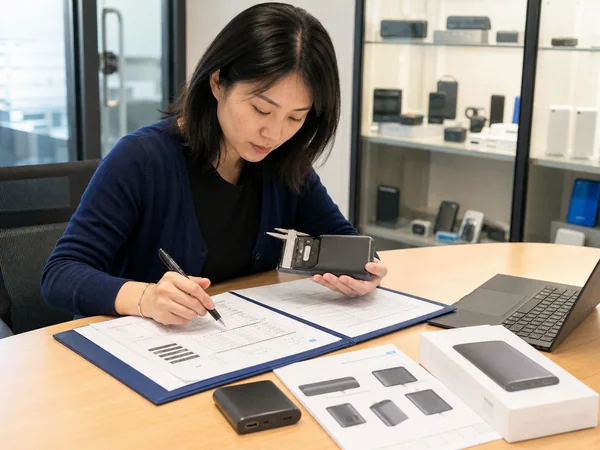
Lisez les noms et les numéros de modèle, pas seulement le résultat des essais. Si le demandeur, l’usine, le modèle ou les composants critiques diffèrent de l’unité produite, demandez au fournisseur d’expliquer la correspondance par écrit.
6. La conformité évolue lorsque le produit change
Les acheteurs sous marque propre supposent souvent qu’un changement de logo laisse toutes les approbations intactes. Un simple changement de logo peut être facile à traiter, mais les allégations sur l’emballage, les noms de modèle et les coordonnées de la partie responsable doivent tout de même être examinés. Les modifications matérielles comportent davantage de risques.
Une nouvelle évaluation peut être nécessaire en cas de modification des éléments suivants :
- Fabricant des cellules, composition chimique, capacité ou disposition des cellules
- Circuit intégré de protection, BMS, implantation de la PCBA ou protocole de recharge
- Bobine de recharge sans fil, blindage, assemblage des aimants ou micrologiciel
- Configuration USB-C, USB-A, Lightning ou du câble intégré
- Résine du boîtier, classement de résistance à la flamme, épaisseur ou construction mécanique
- Valeurs nominales d’entrée, de sortie et de puissance, ou comportement en recharge simultanée

Mettez en place le contrôle des modifications avant la production en série. Le contrat d’achat doit exiger une approbation écrite avant que l’usine ne remplace un composant critique.
7. Liste des documents à vérifier par l’importateur
Utilisez la liste suivante avant d’approuver la mise en production d’une batterie externe :
- Consignez la référence exacte, notamment la capacité, l’énergie nominale en wattheures, la cellule, la PCBA, les ports, le câble, les fonctions sans fil, le boîtier et la puissance nominale.
- Énumérez tous les marchés visés. La conformité européenne ne couvre pas automatiquement les États-Unis, le Royaume-Uni, le Canada, le Japon ou le Moyen-Orient.
- Obtenez le rapport UN 38.3 et son résumé d’essais, puis vérifiez qu’ils correspondent au type de batterie produit.
- Établissez une matrice par marché couvrant les règles relatives aux batteries, à la CEM, aux substances, aux radiofréquences, à la sécurité, à l’étiquetage et à la responsabilité des producteurs.
- Vérifiez les numéros de rapport auprès du laboratoire ou dans la base de données de certification. Repérez les noms de modèle modifiés et les annexes manquantes.
- Examinez les valeurs nominales, les wattheures, les avertissements, les symboles de recyclage, les coordonnées de la partie responsable et les langues requises sur l’étiquette et dans la notice.
- Conservez un échantillon de conformité signé correspondant à la configuration testée.
- Reliez la nomenclature approuvée au bon de commande et à la liste de contrôle d’inspection.
Signaux d’alerte fréquents dans le dossier de conformité d’un fournisseur
- Le fournisseur n’envoie que les pages de couverture des certificats et refuse de fournir les détails des rapports.
- Le rapport mentionne une autre capacité, un autre boîtier, une autre fonction sans fil ou un autre numéro de modèle.
- Le document concerne la cellule, mais le fournisseur le présente comme un rapport portant sur la batterie externe complète.
- Le dossier UN 38.3 ne comporte ni résumé d’essais ni identifiant de rapport unique.
- La déclaration CE de conformité cite des textes obsolètes ou sans rapport avec le produit.
- La documentation FCC d’un modèle filaire est réutilisée pour une version à recharge sans fil.
- L’échantillon de production contient une cellule ou une carte de protection différente de celle de l’échantillon testé.
- Le fournisseur promet qu’un seul rapport couvre toutes les variantes OEM, sans évaluation technique.
Combien de temps prennent les essais de conformité d’une batterie externe ?
Il n’existe pas de délai universel fiable. Un modèle standard avec une cellule éprouvée, une PCBA stable et des rapports existants peut avancer rapidement si seules une vérification documentaire et une adaptation de l’étiquette sont nécessaires. Une nouvelle conception ODM prend plus de temps : le laboratoire a besoin d’échantillons finaux, d’un micrologiciel figé, de composants équivalents à ceux de production et de données techniques complètes.
Planifiez les essais une fois la conception stabilisée. Une substitution tardive de cellule ou une modification du circuit sans fil peut rendre le rapport initial inutilisable.
FAQ : quelles certifications sont nécessaires pour les batteries externes ?
1. Le marquage CE suffit-il pour importer une batterie externe en Europe ?
Non. Le marquage CE fait partie du processus de conformité ; il ne remplace pas le dossier technique qui le justifie. L’importateur doit aussi satisfaire aux obligations applicables concernant le règlement sur les batteries, la CEM, RoHS, l’étiquetage, les instructions et la responsabilité des producteurs.
2. Toutes les batteries externes doivent-elles satisfaire à UN 38.3 ?
Un type de batterie externe lithium-ion destiné au transport commercial doit respecter les exigences UN 38.3 applicables. La batterie assemblée doit être couverte ; un rapport portant uniquement sur la cellule peut ne pas suffire.
3. Une MSDS est-elle la même chose qu’un rapport UN 38.3 ?
Non. Une FDS, également appelée SDS ou MSDS, contient des informations sur les substances chimiques et la manipulation. Les documents UN 38.3 indiquent si le type de batterie au lithium a réussi les essais de transport spécifiés.
4. Une batterie externe filaire nécessite-t-elle une certification FCC ?
Elle peut tout de même relever des règles FCC en tant qu’appareil numérique ou émetteur non intentionnel. La procédure d’autorisation dépend des circuits. Le transfert d’énergie sans fil ajoute des exigences relevant des parties 15 et/ou 18 ainsi qu’une évaluation de l’exposition aux radiofréquences.
5. UL 2056 est-elle obligatoire aux États-Unis ?
Ce n’est pas une exigence fédérale générale pour toutes les batteries externes. Elle peut être imposée par un distributeur, une place de marché, le cahier des charges d’un acheteur, un assureur ou une autorité locale. Considérez-la comme une question de canal de vente et de gestion des risques, pas comme un remplacement de la conformité FCC ou transport.
6. Un seul certificat peut-il couvrir plusieurs capacités ?
Seulement si le rapport ou le système de certification identifie clairement la famille de modèles couverte et si les différences techniques ont été évaluées. Ne supposez pas que les versions de 5 000, 10 000 et 20 000 mAh bénéficient de la même couverture.
Planifiez la conformité avant de demander un devis
Posez une question précise au fournisseur : « Quels rapports couvrent ce modèle exact, sa capacité, sa cellule, sa PCBA et le marché visé ? » La réponse est bien plus utile qu’une promesse générale de disponibilité CE et FCC. Elle révèle aussi les lacunes documentaires avant qu’elles ne provoquent des retards en douane, des refus de plateformes de vente ou des rappels.
Lors d’une demande de devis de batterie externe OEM ou ODM auprès de YULIDA, précisez le pays visé, le canal de vente, la capacité, les sorties filaires et sans fil, le projet d’emballage et le programme de sécurité requis. L’équipe pourra alors associer la demande à un modèle de production, identifier les documents déjà disponibles et les essais restant à confirmer.
Sources officielles et vérification
Ces sources primaires étayent les informations de cet article concernant les normes, la compatibilité, la sécurité ou le transport. Vérifiez les exigences en vigueur pour le modèle exact et le marché de destination.
- Association du transport aérien international — Exigences de transport des batteries au lithium et recommandations du secteur.
- Commission fédérale des communications des États-Unis — Informations sur l’autorisation des équipements radiofréquences.
- UL Solutions — Normes de sécurité des batteries et informations techniques sur la sécurité.
- Commission électrotechnique internationale — Normes électrotechniques internationales et leurs domaines d’application.
