






Wireless Power Bank Market 2026: Android Qi2 and OEM Product Planning
For a brand entering the wireless power bank market in 2026, a useful starting question is: which phones do your customers carry? The answer helps determine whether to develop a compact 15W pack, a higher-power 25W model, or a wireless pack with USB-C for mixed-device use. Android Qi2 support has broadened the options, but phone models and cases still need to be checked individually.
This guide looks at portable battery packs with wireless output, including magnetic models. Mains-powered charging pads and wired-only power banks fall outside its scope. It uses official product and standards information to help OEM buyers plan a range, assess demand, and write a sourcing brief. It does not offer an independently measured market-size forecast. Sources were checked on October 13, 2026.
What is changing in the wireless power bank market?
Qi2 buyers now have more certified products to consider and a choice between 15W and 25W tiers. On Android, the details vary by phone. Those differences matter when choosing a product and writing its compatibility claims.
More Qi2 products, but no power-bank sales figure
In its January 2026 announcement, the Wireless Power Consortium (WPC) reported more than 1,200 new Qi2-certified products during 2025. The count includes transmitters and receivers across the ecosystem. It shows that certified product choice is expanding, but tells us neither how many wireless power banks were sold nor their revenue, consumer demand, or market share.
For a buying decision, start closer to your own customers. Check the phones and cases they use, then test what they are willing to pay for portable wireless charging. A growing certification list cannot answer those questions for your sales channel.
15W and 25W can serve different buyers
WPC launched Qi2 25W on July 23, 2025. Its official launch announcement sets out the higher maximum alongside the original 15W Qi2 level. Buyers planning a 2026 range therefore have two power tiers to assess against their target phones, product size, and price.
Samsung’s current Galaxy S26 accessory guidance, for example, includes a Qi2 15W portable battery pack alongside a Qi2 25W magnetic charger. Both tiers appear in the range; the listing does not reveal their relative sales.
A 25W rating may help distinguish a premium model, provided customers have phones that can use it. Ask what happens after the initial peak, too. The rating alone does not show whether a pack charges faster throughout a session or delivers more usable energy from its battery.
Check Android support model by model
Google’s current Pixelsnap charging guidance lists Pixel 11 models at up to 25W with the Pixelsnap Charger. With that charger, Pixel 10, Pixel 10 Pro, and Pixel 10 Pro Fold are listed at up to 15W, while Pixel 10 Pro XL is listed at up to 25W. These ratings apply to Google’s reference setup. They are not guaranteed results for an unrelated OEM power bank.
Samsung’s Colombian Galaxy S26 charging guidance also separates the models: approximately 25W for S26 Ultra, 20W for S26+, and 15W for S26 and S26 FE with its specified EP-P2900 setup. Its magnet wireless charger specifications identify a Qi2-ready case requirement for Galaxy devices.
A supplier’s “Android compatible” description needs more detail before it belongs in a purchase specification. List phones with integrated magnetic support separately from approved phone-and-case combinations, and test every combination you plan to claim. Our Android magnetic power bank guide explains how to narrow that device list.
Four product segments to consider for an OEM range
The table below groups products by their intended use. It is a planning aid, not a ranking by market share. A pack may suit several uses, but deciding who it is primarily for makes the specification easier to resolve.
| Product segment | Who it may suit | What to check |
|---|---|---|
| Conventional Qi wireless pack | Price-conscious buyers with a defined list of compatible phones | Does charging remain reliable with the intended alignment and case? |
| Magnetic Qi2 15W pack | Everyday top-up users whose phones, budget, and size needs fit this tier | Is the exact product certified, and is the phone-and-case combination supported? |
| Qi2 25W pack | Buyers willing to pay more for higher-power charging on supported phones | What power does a sample built to the intended production specification sustain, and how hot does it get? |
| Wireless plus USB-C hybrid pack | Mixed-device users who also want a cable option | Which wired profiles and shared-output limits apply when ports are used together? |
Check the charging standard as well as the magnets. WPC’s magnetic charging explainer distinguishes certified Qi2 products from uncertified magnetic chargers. A ring added to a case can help a pack attach, but cannot give a phone wireless-charging hardware it lacks.
If the initial order will be small, compare two distinct concepts before adding cosmetic variants. A compact everyday pack and a higher-capacity premium pack, for example, give you different customer needs to test. Use samples and channel feedback to decide whether either concept deserves an order.
Plan capacity, output, and case fit together
Balance usable energy with size and weight
A 5,000mAh design can focus on compact carry and short top-ups. A 10,000mAh design can target longer use, with a different allowance for weight and thickness. The capacity choice alone does not fix the dimensions or the number of phone charges.
Ask for cell capacity, nominal voltage, watt-hours, measured delivered energy, and the test conditions. Conversion losses, wireless transfer losses, and the phone’s own power use all affect the result. Before printing “two full charges,” agree on the phone and test method that support the claim.
Specify wireless and USB-C performance separately
Give wireless output, wired output, and power bank recharge input their own fields in the request for quotation (RFQ). A high USB-C wattage on the box says nothing by itself about wireless output. For simultaneous charging, ask how power is shared and check temperatures with the intended devices connected.
For a 25W design, agree on starting battery level, ambient conditions, firmware, case, test duration, and measurement method. Review the charging curve as well as the peak. The Qi2 25W buyer checklist und wireless output verification guide cover the checks needed to compare a claimed rating with measured results.
Test the phone and case together
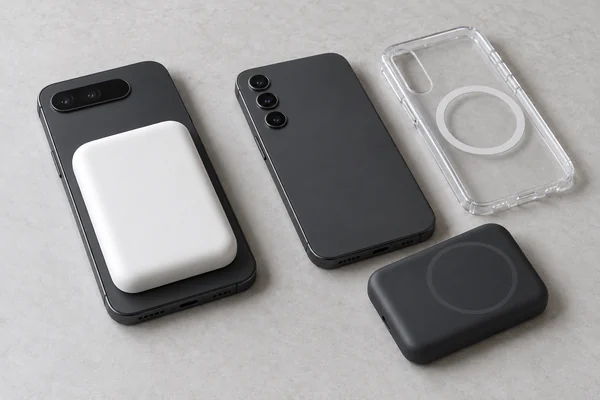
Inspect camera clearance, coil alignment, magnetic retention, grip, and how the pack sits against the approved case. A design that fits one phone generation may obstruct another camera layout or sit poorly on a different case. Name the tested phones and case conditions in the compatibility list, including any power limits.
Match the product to the region and sales channel
A global Qi2 trend gives little guidance on how much stock to buy for a particular country. Build that estimate from retailer feedback, actual sell-through, customer device mix, returns, and price tests in the channel you plan to use.
- Brand webstores and electronics retailers: give buyers a clear compatibility list, performance evidence, useful product comparisons, and an after-sales process.
- Online marketplaces: show supported phones, required cases, wireless output, and wired output clearly in listing images and specifications. Track compatibility-related returns separately from hardware failures.
- Promotional and corporate-gift channels: find out which devices recipients use before making wireless charging the main feature. For a mixed group, a well-specified USB-C fallback and simple instructions may be important.
- Travel-oriented channels: review weight, energy labeling, packaging, and current carrier requirements before making travel-use claims. A capacity number alone cannot establish acceptance on every route or carrier.
The destination also affects documentation, labeling, language, and distribution responsibilities. Check the exact configuration and sales destination with qualified compliance support. Qi certification covers its own standard and scope; separate evidence is still needed for battery transport and market access.
Build a demand forecast before committing to inventory
Start with the customer base you can reach in a specific channel. Estimate how many use supported phone-and-case combinations, then apply a conservative purchase rate over a defined period. Run low, base, and high scenarios for price, conversion, returns, and replenishment time.
When using a third-party market report, lesen Sie die category definition before quoting its headline number. Does it include charging pads or wired power banks? Does it count OEM shipments or retail sales? Keep revenue and units separate, and compare the forecast periods. This guide leaves out global revenue and CAGR estimates because those figures need a consistently defined dataset.
A pilot launch gives you a way to replace assumptions with sales evidence. Review sell-through by phone audience, pre-purchase questions, return reasons, and repeat retailer orders. If most demand comes from one supported device group, revise the next production brief before buying more stock.
Turn the market analysis into an OEM brief
A manufacturer needs enough detail to quote the product you intend to sell. Include:
- Target countries, sales channel, intended use, and retail price range.
- Named phones and case conditions, with the proposed wireless output claim for each group.
- Capacity, watt-hours, size and weight targets, USB-C profiles, recharge input, and simultaneous-use requirements.
- The exact model’s certification scope, checked against the WPC product database, applicable compliance and transport documents, and packaging claims that need evidence.
- Sample acceptance tests, traceability, warranty handling, production change control, and criteria for reviewing the pilot order.
Keep pricing assumptions and technical acceptance criteria in the same brief. If a component is changed to meet the target cost, you need to know whether the compatibility claim still holds. Our Leitfaden für Powerbank-Angebotsanfragen provides a specification structure, and the quality-control plan guide covers production checkpoints.
When discussing a project with YULIDA, use the brief to ask which exact model is proposed, what can be customized, and what certification evidence is available. Confirm MOQ and lead time for that configuration before committing to a bulk order or making product claims. The manufacturer evaluation checklist can help you compare the answers.
Häufig gestellte Fragen
1. What is the wireless power bank market in 2026?
It covers portable battery packs that charge compatible devices wirelessly. For OEM planning, useful groups include conventional Qi packs, certified magnetic Qi2 packs, and higher-power Qi2 25W packs. When comparing supplier offers, market reports, or sales forecasts, check that desktop charging pads and wired-only power banks are counted separately.
2. How large is the wireless power bank market?
This guide does not give a global revenue or CAGR estimate. A reliable figure needs a consistent product definition, geography, base year, and research method. WPC certification counts cover multiple product types and cannot measure power-bank sales. For an order decision, forecast from your compatible customer base, channel sell-through, price, and inventory assumptions.
3. Does Android Qi2 support mean every Android phone can use a magnetic power bank?
No. Check the exact phone, its wireless-charging support, the power bank, and any required magnetic case. Describe phones with integrated magnetic Qi2 support separately from Qi2 Ready phone-and-case combinations. A stick-on ring may help a pack attach, but cannot add a missing wireless receiver or establish Qi2 certification.
4. Will a Qi2 25W power bank charge every compatible phone at 25W?
No. The 25W rating is a maximum under supported conditions. Actual power depends on the receiving phone, charging profile, firmware, alignment, case, temperature, and battery state. Before printing a speed claim, approve sustained charging results for the specified phone-and-case combinations. Magnetic attachment by itself does not verify charging speed.
5. Should an OEM buyer choose 5,000mAh or 10,000mAh?
Start with how the customer will use the pack. A 5,000mAh design can suit compact everyday top-ups; a 10,000mAh design can target longer use, with more weight and thickness to consider. Compare watt-hours, measured delivered energy, dimensions, thermal behavior, and cost. Validate the finished design before promising a number of full phone charges.
6. Is 15W still a reasonable product choice in 2026?
Yes, if it fits the target phones, price, size, and customer expectations. A validated 15W pack can suit everyday top-ups, especially for phones that do not accept higher wireless input. Consider a 25W model when enough of your customers can use the extra capability and sample tests show acceptable sustained charging performance.
7. Which documents should buyers request before a bulk order?
Ask for the exact model specification, applicable Qi certification record, phone-and-case compatibility matrix, battery identity and transport documents, market-specific compliance evidence, and sample test reports. Agree on quality-control limits, traceability, warranty handling, and change control. Match the documents to the proposed production configuration. A certificate for another model or a supplier’s component does not automatically cover the finished pack.
8. How should brands turn a market trend into an OEM product brief?
Set out the sales country, channel, target phones, intended use, and retail price range. Then specify capacity, size, wireless and USB-C performance, supported cases, packaging claims, and acceptance tests. Validate samples and a limited launch before increasing inventory. Ask the manufacturer for the exact configurable model, certification scope, MOQ, lead time, and any evidence still needed.
Offizielle Quellen und Nachweise
Diese Primärquellen stützen die Aussagen dieses Artikels zu Normen, Kompatibilität, Sicherheit und Transport. Prüfen Sie die aktuellen Anforderungen für das genaue Produktmodell und den jeweiligen Zielmarkt.
- Wireless Power Consortium — Qi- und Qi2-Standards, Zertifizierung und Informationen zum kabellosen Laden.
- Wireless Power Consortium — Qi- und Qi2-Standards, Zertifizierung und Informationen zum kabellosen Laden.
- Samsung Support : Voraussetzungen und Anwendungshinweise für kabelloses Laden.
- Google Pixel Help : Voraussetzungen und Anwendungshinweise für kabelloses Laden.
- Samsung Support : Voraussetzungen und Anwendungshinweise für kabelloses Laden.
- Samsung Support : Voraussetzungen und Anwendungshinweise für kabelloses Laden.
