







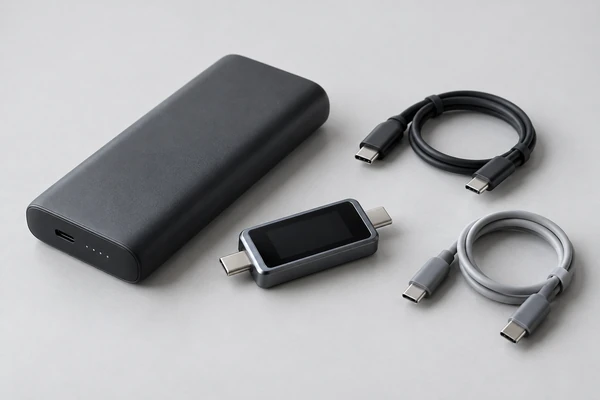
USB-C PD testers with an internal battery: what OEM buyers should check
A PD tester with an internal battery is useful when an OEM buyer needs the instrument to remain operational independently of the power bank being inspected. Before buying one or relying on a supplier’s results, verify what the battery powers, how long it runs and what happens to the record when the power bank shuts down. Portable operation, offline logging and a short backup supply are different features.
The purchasing question is specific: will this instrument preserve the evidence needed to review a power-bank sample? A battery specification alone says little about protocol analysis, sustained output testing or measurement accuracy. This guide focuses on checking the instrument and its records before using them to review OEM samples.
What does “internal battery” actually mean?
Ask the instrument supplier to identify the operating-power arrangement in writing. Product listings often group several convenient features under “portable” or “standalone.” Those descriptions leave important questions unanswered.
| Power arrangement | What to establish | Anzufordernde Nachweise |
|---|---|---|
| Powered by the device under test | Which functions stop when the power bank removes its output? | Manual section covering startup, power loss and saved readings. |
| Auxiliary USB power | Which port powers the instrument, and which connections are permitted? | Manufacturer’s connection instructions and a documented test arrangement. |
| Rechargeable internal battery | Does it power the display, measurement circuit and logging throughout the required session? | Battery specification, runtime conditions and low-battery behavior. |
| Supercapacitor or brief backup | Is the hold-up time sufficient to save or lesen Sie die final result? | Specified backup duration and an explanation of what is stored automatically. |
A useful example is the POWER-Z KM003C. ChargerLAB’s introduction describes a supercapacitor that supports roughly five to ten seconds of operation after disconnection. That is a short backup interval, not evidence of a rechargeable battery with an extended runtime. The same source describes a built-in load used for protocol-detection functions; its presence does not establish a continuous high-power load rating.
These details illustrate how to read an instrument specification. They are not a recommendation to buy that model or a statement about equipment used by YULIDA.
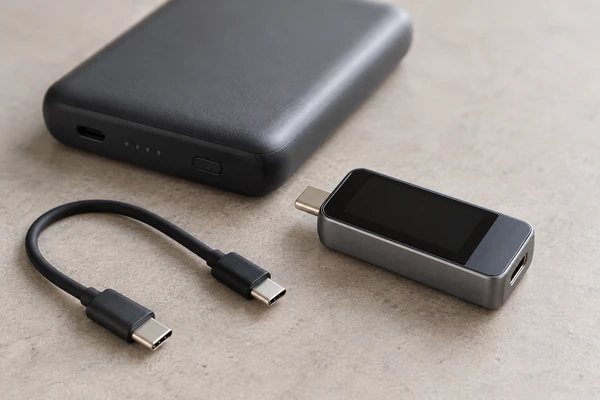
Will the record survive the power bank switching off?
A power bank reaching its cutoff can remove the tester’s operating supply. For procurement work, the final energy total and the reason a recording ended may matter more than keeping the display illuminated.
Separate recording from power independence
POWER-Z’s offline-recording guide shows a KM003C recording with a power bank and a separate P240 load. The documented workflow later transfers the data to computer software. It demonstrates recording without a computer during the session; it does not establish that the tester is internally battery-powered or that every interruption is recorded without a gap.
Ask for a demonstration using the proposed firmware and normal operating mode. The supplier should explain whether readings are saved continuously, at a manual stop or through another documented action. Check the recovered file after a permitted source interruption, not just the screen before it.
Define the record you need
- Instrument model, firmware and the power arrangement used during recording.
- Elapsed time, voltage and current records at a sampling interval suitable for the question being investigated.
- Accumulated energy and an explanation of the measurement location.
- A clear indication of cutoff, interruption or a manually ended session.
- A recoverable original file with its units and time information intact.
Agree which fields are required before comparing samples. A screenshot of the last visible wattage cannot explain an entire discharge. If capacity approval is the objective, use the conditions and measurement boundaries in the power-bank capacity testing guide.
Check which functions remain available on battery power
Independent operating power can keep an instrument running, but each measurement function still has its own requirements. A meter reads electrical quantities. A PD trigger requests a supported profile. A protocol analyser may capture the negotiation. An electronic load draws controlled current or power. One housing can combine functions; verify them individually.
Keysight describes electronic loads as instruments that sink current and absorb power. That physical task requires an appropriate operating range and thermal design. A tester’s internal battery does not, by itself, provide this capability.
For example, a 240W measurement-path rating should not be treated as a promise that the instrument can dissipate 240W continuously. PassMark’s USB PD Tester Pro FAQ explicitly ties continuous 240W operation to a cool environment and good airflow. Read the offered instrument’s limits for the intended configuration, including cooling and any duty-cycle restrictions.
Keep protocol discovery, a successful power request and sustained output under load as separate evidence. The USB-C PD power-bank specification guide explains how those requirements belong in the product specification. A full fast-charging validation plan should remain the reference for approving the power bank.
A purchasing checklist for the tester and its software
Use this matrix when buying inspection equipment or reviewing a factory’s sample report. A supplier should be able to answer with the exact model, documentation and a relevant demonstration. “Supports PD” is too broad for an equipment decision.
| Prüfung | Question for the instrument supplier | What the answer helps you decide |
|---|---|---|
| Power source | Which circuits use the internal battery, the device under test or auxiliary power? | Whether the required function remains available during an interruption. |
| Battery runtime | Under what display, logging and connection conditions was runtime specified? | Whether the instrument can complete the intended inspection session. |
| Data retention | What survives low battery, source cutoff and a restart? | Whether the final record can be reviewed without repeating the test. |
| Protocol capability | Does the device identify profiles, request them, capture messages or perform defined test sequences? | Which questions it can answer about the power-bank interface. |
| Load capability | What are the continuous voltage, current and dissipation limits under the stated cooling conditions? | Whether a separate load is needed for the planned operating points. |
| Measurement quality | What accuracy specification and calibration information apply to the range being used? | Whether differences between samples are meaningful; display resolution alone is insufficient. |
| Export and software | Can the original record be exported, and what software, operating system or licence is needed? | Whether buyers and suppliers can exchange and inspect the same evidence. |
Keep the measurement arrangement in the report
Die AVHzY CT-3 manual explains that the instrument’s own consumption and resistance between its measurement point and ports affect the relationship between displayed readings and actual input or output quantities. Its guidance is model-specific, but the procurement lesson is general: record where the measurement is taken and how the tester is powered.
Independent power does not automatically remove cable or connector losses. Follow the manufacturer’s connection instructions, including restrictions on auxiliary supplies. If a configuration is unclear, have the instrument supplier resolve it before using the results to accept or reject a power-bank batch.
Use the tester record within an OEM sample-approval process
Before comparing a supplier’s report with your own measurements, agree on the instrument configuration and the power-bank sample revision. Include cable identification, load settings, ambient conditions and the recorded start and end conditions. A difference between two reports may come from the setup; investigate it before attributing it to the product.
Ask for the original exported file alongside the summary. Keep instrument firmware and calibration information with the record so the method can be repeated. For incoming inspection, a short documented check may answer the immediate question. Engineering validation and safety evaluation require their own equipment and procedures.
A buyer’s PD scan also does not establish USB-IF certification. USB-IF’s USB Charger programme describes compliance testing, listing and trademark requirements. Review applicable certification and destination-market compliance evidence separately from the tester readings.
For a YULIDA OEM/ODM power-bank enquiry, send the target USB-C profiles, intended devices, destination markets and sample-acceptance requirements. Request the proposed model’s specification and supporting test records, including how those records were produced. Confirm the available configuration and evidence before committing to production.
Häufig gestellte Fragen
1. Do I need a PD tester with an internal battery to inspect power banks?
Only if independent operation solves a specific inspection need. Check whether you need to keep the display on after shutdown, continue logging through an interruption or work without a nearby power source. A documented auxiliary-power arrangement or reliable stored records may meet the same need. Verify the exact tester model and firmware.
2. Does offline logging mean the tester has a built-in battery?
No. Offline logging describes recording without a connected computer. The tester may still draw its operating power from the power bank or an auxiliary supply, and later analysis may require computer software. Ask separately about operating power, memory, shutdown behavior and export requirements.
3. Is the POWER-Z KM003C backup a rechargeable battery?
ChargerLAB describes the KM003C backup as a supercapacitor that provides roughly five to ten seconds of operation after disconnection. That description should not be converted into a rechargeable-battery claim or an hours-long runtime promise. Confirm the specification of the version offered by the instrument supplier.
4. Can a battery-powered USB-C tester replace an electronic load?
An internal battery alone does not provide controlled load testing. Some testers include load functions, but their continuous dissipation, voltage and current limits must be specified separately. A small load used for protocol detection does not establish that the instrument can sustain the power-bank output you want to evaluate.
5. Will an internal battery make the energy measurement exact?
No. Accuracy still depends on the instrument specification, calibration, measurement boundary and connections. Independent operating power can change how the tester consumes energy from the device under test, but it does not automatically remove cable losses or resolve every measurement error. Record the arrangement used.
6. What should happen to a test record when the power bank shuts down?
The required behavior should be agreed before testing. Ask whether accumulated energy and elapsed time are stored automatically, whether the final record can be recovered after restart and whether export includes the interruption. A screen that stays on briefly is not proof that the complete record has been saved.
7. Does a passing PD tester result prove USB-IF certification?
No. A buyer's protocol scan or load-test record is evidence for that check under its stated conditions. USB-IF certification involves applicable compliance and interoperability requirements. Verify certification evidence separately, and keep product safety and destination-market compliance reviews in the power-bank approval process.
8. What tester information should I request with an OEM power bank sample report?
Request the instrument model and firmware, operating-power arrangement, measurement location, load equipment and settings, cable details and calibration information. Ask for the original data file, test conditions and shutdown notes. Use the same agreed setup when comparing the supplier's results with your own sample checks.
Offizielle Quellen und Nachweise
Diese Primärquellen stützen die Aussagen dieses Artikels zu Normen, Kompatibilität, Sicherheit und Transport. Prüfen Sie die aktuellen Anforderungen für das genaue Produktmodell und den jeweiligen Zielmarkt.
- USB Implementers Forum — Spezifikationen und Leitlinien für USB Type-C und USB Power Delivery.
