






Quelles certifications sont nécessaires pour les batteries externes aux États-Unis et dans l’UE ? Comprendre CE, FCC, RoHS et UN 38.3 (2026)
En bref : il n’existe pas de certificat universel pour les batteries externes. Pour une commercialisation dans l’UE en 2026, le dossier de conformité nécessite généralement des démarches au titre du règlement européen sur les batteries, le marquage CE selon les textes applicables au modèle fini, des justificatifs CEM et RoHS, des relevés de sécurité et de traçabilité, ainsi que les enregistrements pertinents des producteurs d’équipements électriques et électroniques et de batteries. Une commercialisation aux États-Unis exige la procédure d’autorisation FCC adaptée à l’électronique du produit. Les modèles à recharge sans fil fonctionnant au-dessus de 9 kHz relèvent des orientations des parties 15 et/ou 18 de la FCC. Tout modèle de batterie au lithium présenté au transport nécessite également des essais UN 38.3 et un résumé d’essais disponible.
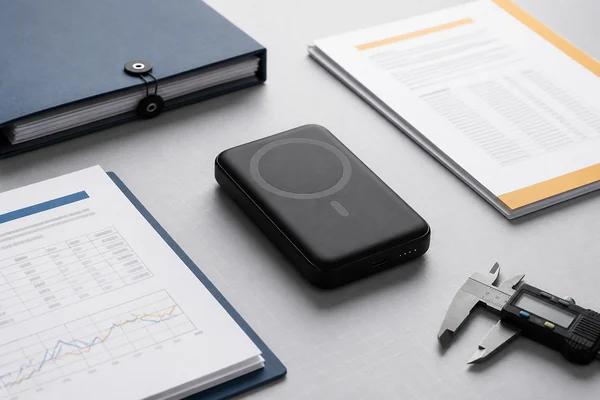
Partez du matériel. Un modèle USB filaire de base, un modèle magnétique sans fil, une batterie externe avec Bluetooth et un modèle à prise secteur intégrée ne partagent pas le même plan d’essais. Même deux produits annonçant 10 000 mAh peuvent nécessiter des rapports différents s’ils utilisent d’autres cellules, contrôleurs de recharge, modules sans fil, boîtiers ou micrologiciels.
| Exigence | Marché de l’UE | Marché américain | Ce que cela démontre |
|---|---|---|---|
| Marquage CE | Requis lorsque la législation européenne applicable le prévoit, notamment le règlement européen sur les batteries | Ce n’est pas une exigence américaine | Le fabricant déclare la conformité aux règles européennes applicables |
| Autorisation FCC | Ce n’est pas une exigence européenne | Requise lorsque le produit relève des règles FCC d’autorisation des équipements | Conformité des émissions radiofréquences et, le cas échéant, des émissions radio intentionnelles ou du transfert d’énergie sans fil |
| RoHS | Requise pour les équipements électriques et électroniques relevant de son champ d’application | Il n’existe pas de règle fédérale unique équivalente à RoHS pour toutes les batteries externes | Les substances soumises à restriction restent sous les limites applicables |
| UN38.3 | Requis pour le transport du type de pile ou de batterie au lithium | Requis pour le transport du type de pile ou de batterie au lithium | Le type de batterie a réussi la séquence d’essais de transport de l’ONU |
| UL 2056 | Ce n’est pas une exigence légale générale dans l’UE | Ce n’est pas une exigence fédérale universelle de vente, mais les distributeurs, acheteurs ou assureurs la demandent souvent | Essais de sécurité du produit batterie externe |
| DEEE et REP des batteries | Les obligations d’enregistrement et de déclaration dépendent du pays et du rôle du vendeur | Les obligations de recyclage varient selon l’État et le canal de vente | Collecte en fin de vie et responsabilité des producteurs |
Marquage CE des batteries externes vendues dans l’UE

Le marquage CE n’est pas un certificat de laboratoire. Il constitue la déclaration légale du fabricant selon laquelle le produit respecte les règles européennes qui lui sont applicables. Le fabricant identifie ces règles pour le modèle exact, réalise l’évaluation de conformité, prépare le dossier technique, signe la déclaration UE de conformité et appose le marquage CE.
Le Règlement européen sur les batteries (UE) 2023/1542 couvre les batteries mises sur le marché de l’UE. Il exige une documentation technique, une évaluation de conformité, une déclaration UE de conformité, le marquage CE, une identification et des informations de sécurité. Certaines obligations d’étiquetage, de devoir de diligence et de durabilité entrent en application par étapes ; l’importateur doit donc vérifier les dates applicables au moment de la mise sur le marché du produit.
L’électronique d’une batterie externe finie nécessite souvent une évaluation au titre de la Directive CEM 2014/30/UE. Les essais CEM vérifient deux points : si le produit génère des perturbations électromagnétiques inacceptables et s’il continue de fonctionner dans l’environnement électromagnétique pour lequel il a été conçu.
Le Bluetooth, le Wi-Fi, le NFC, la connectivité cellulaire et d’autres fonctions de radiocommunication peuvent faire entrer la directive sur les équipements radioélectriques dans le champ des exigences concernées. Ne classez pas automatiquement la recharge sans fil comme une fonction relevant de la directive RED. Le laboratoire doit examiner la fréquence de fonctionnement, les éventuelles communications de données et la conception réelle du circuit.
La même prudence s’applique à la directive basse tension. Une batterie USB basse tension ordinaire se situe généralement hors de sa plage de tension ; cette directive ne doit donc pas figurer par défaut sur toutes les déclarations. Un modèle à prise secteur intégrée, à entrée CA ou fourni avec un adaptateur secteur nécessite un examen distinct des parties alimentées par le secteur et de leurs exigences de sécurité.
Exigences FCC pour les batteries externes vendues aux États-Unis
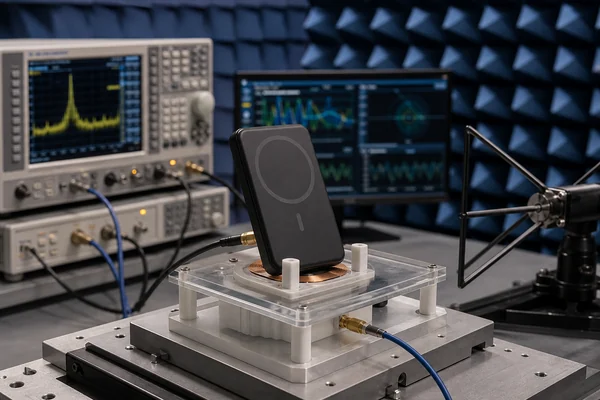
La conformité FCC concerne les émissions radiofréquences. Elle ne renseigne ni sur la sécurité de la batterie, ni sur la capacité annoncée, ni sur l’autorisation d’expédier le produit par avion.
Un produit filaire peut être considéré comme un émetteur non intentionnel et suit souvent la procédure de déclaration de conformité du fournisseur (SDoC). Un produit qui émet intentionnellement des signaux radio nécessite généralement une certification FCC. Dans les deux cas, la partie responsable aux États-Unis doit disposer des relevés de la configuration testée et veiller à ce que la production y reste conforme.
Une bobine de recharge sans fil modifie le travail à effectuer. Le document d’orientation FCC KDB 680106 indique que les dispositifs de transfert d’énergie sans fil fonctionnant au-dessus de 9 kHz doivent être autorisés au titre de la partie 15 et/ou de la partie 18. Si le système de recharge échange aussi des données, ses modes de fonctionnement peuvent nécessiter des autorisations distinctes. Les appareils relevant des parties 15 et 18 doivent également respecter les limites applicables d’exposition humaine aux radiofréquences.
Lorsqu’un fournisseur envoie un fichier intitulé « FCC Certificate », ne vous arrêtez pas à son nom. Recherchez le modèle testé, les détails du PCB ou du module et la procédure d’autorisation. Avant d’approuver une batterie externe magnétique, demandez le rapport final, la SDoC ou l’autorisation FCC selon le cas, le fichier graphique de l’étiquette, les mentions requises dans la notice et le nom de la partie responsable aux États-Unis.
Conformité RoHS pour l’UE
Le texte de la directive RoHS 2011/65/UE limite dix substances dans les équipements électriques et électroniques : plomb, mercure, cadmium, chrome hexavalent, PBB, PBDE, DEHP, BBP, DBP et DIBP. Sauf exclusion ou exemption applicable, une batterie externe vendue dans l’UE doit s’y conformer.
Un rapport RoHS portant sur un composant ne couvre pas le produit fini. Les justificatifs utiles sont liés à une nomenclature maîtrisée et tiennent compte du PCB, des soudures, des câbles, des connecteurs, du boîtier, des revêtements, des encres et des autres matériaux homogènes concernés. Les déclarations des fournisseurs et les essais fondés sur les risques peuvent étayer le dossier technique, mais seulement s’ils correspondent aux pièces utilisées en production.
Essais UN 38.3 pour le transport des batteries au lithium
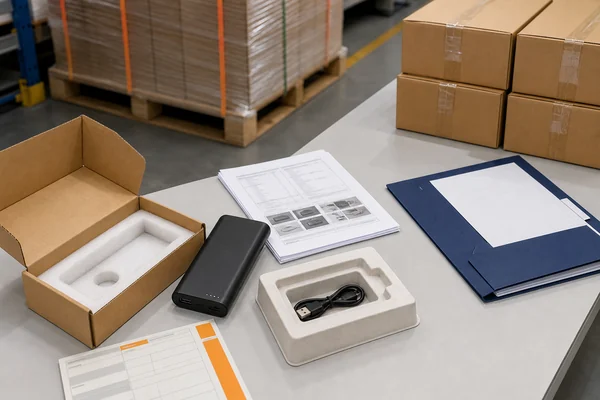
UN 38.3 répond à une question précise : ce type de pile ou de batterie au lithium a-t-il réussi la séquence d’essais de transport de l’ONU ? Avant d’être présenté au transport, il doit réussir les essais applicables de la section 38.3 du Manuel d’épreuves et de critères des Nations unies. Ces essais portent sur la simulation d’altitude, les variations de température, les vibrations, les chocs, les courts-circuits externes, l’impact ou l’écrasement, la surcharge et la décharge forcée. Réussir UN 38.3 ne constitue pas une approbation générale du produit pour un usage grand public.
Le fabricant et les distributeurs en aval doivent mettre à disposition un résumé d’essais UN 38.3. Ce document identifie le fabricant de la batterie ou du produit, le laboratoire, le numéro et la date du rapport, puis décrit le type de batterie, sa masse, son énergie nominale en wattheures et ses numéros de modèle. Il consigne aussi les essais réalisés et leurs résultats. Un rapport de laboratoire complet peut étayer le dossier, mais ne remplace le résumé que s’il en contient tous les éléments requis.
La capacité seule prouve peu de choses. Un modèle de 10 000 mAh à cellules en poche et un modèle de 10 000 mAh à cellules cylindriques ne constituent pas le même type de batterie. Une modification de cellule, de configuration de la batterie assemblée, de circuit de protection ou d’une autre pièce liée à la sécurité peut entraîner une évaluation comme nouveau type. Le rapport doit correspondre à la batterie qui sera réellement expédiée.
Le transport aérien ajoute des règles d’emballage et d’état de charge. Les recommandations 2026 de l’IATA sur les batteries au lithium précisent que les batteries lithium-ion seules expédiées sous UN 3480 selon l’instruction d’emballage 965 sont interdites comme fret sur les avions de passagers et doivent être expédiées avec un état de charge ne dépassant pas 30 %, sauf application des approbations requises. Un carton de batteries externes est normalement traité comme un envoi de batteries, même si des câbles USB ou des emballages de vente sont inclus.
Sécurité du produit : UL 2056, IEC 62133-2 et CPSC
Les États-Unis n’ont pas d’équivalent au marquage CE, et l’autorisation FCC ne remplace pas les essais de sécurité des batteries. UL 2056 est la norme de sécurité dédiée aux batteries externes contenant des batteries et fournissant une alimentation CC basse tension aux appareils portables. Son champ couvre les essais électriques et mécaniques, le comportement en surcharge, le marquage de capacité, le risque d’incendie et d’autres dangers prévisibles.
La loi fédérale ne fait pas du marquage UL une condition générale pour toute vente de batterie externe grand public. Les distributeurs, les acheteurs professionnels et les assureurs exigent néanmoins souvent une certification de sécurité par un tiers. IEC 62133-2 est également utilisée pour la sécurité des piles et batteries au lithium rechargeables. Ni cette norme ni UL 2056 ne remplace UN 38.3.
Un rapport de laboratoire sans anomalie décrit uniquement l’échantillon testé. La Commission américaine de sécurité des produits de consommation a rappelé des batteries externes à la suite de signalements de surchauffes, d’incendies et de brûlures. C’est pourquoi les fournisseurs de cellules, les réglages du BMS, le micrologiciel, les soudures, l’isolation et les relevés d’essais de vieillissement doivent rester maîtrisés après la certification.
Sécurité des produits, traçabilité et responsabilité des producteurs dans l’UE
Le règlement relatif à la sécurité générale des produits s’applique depuis le 13 décembre 2024. Il couvre les risques que les textes européens sectoriels ne traitent pas entièrement. Il fixe également des règles de traçabilité, de rappel, d’offres en ligne et de présence d’un opérateur économique responsable établi dans l’UE. Lorsque le fabricant est situé hors de l’UE, une offre en ligne doit indiquer l’identité du produit, les informations du fabricant et les coordonnées de la personne responsable dans l’UE.
Le marquage CE n’est qu’un volet de l’accès au marché européen. Une entreprise vendant des batteries externes peut également être soumise aux obligations suivantes : enregistrement et déclaration DEEE, enregistrement comme producteur de batteries, financement du recyclage et étiquetage du produit. Ces obligations sont gérées pays par pays et varient selon le rôle du vendeur : fabricant, importateur, distributeur ou vendeur à distance.
Comment les caractéristiques du produit modifient le plan d’essais
| Conception du produit | Questions de conformité supplémentaires |
|---|---|
| Batterie externe USB filaire de base | Émissions CEM ou FCC, sécurité de la batterie, capacité nominale, protection des ports, RoHS et UN 38.3 |
| Recharge magnétique sans fil | Autorisation du transfert d’énergie sans fil (WPT), exposition RF, température de la bobine, détection d’objets étrangers, alignement, allégations de puissance et maîtrise des mentions Qi ou Qi2 |
| Connexion Bluetooth, NFC ou à une application | Certification des émissions radio intentionnelles, intégration du module radio, configuration de l’antenne, obligations logicielles et de cybersécurité lorsqu’elles s’appliquent |
| Prise secteur intégrée | Sécurité électrique sur secteur, isolation, lignes de fuite et distances dans l’air, normes des prises, valeurs nominales d’entrée CA et approbations de sécurité propres au marché |
| Recharge solaire | Sécurité de l’entrée photovoltaïque, allégations d’usage extérieur, exposition à la chaleur, inflammabilité et preuves réalistes des performances de recharge |
| Plusieurs capacités ou fournisseurs de cellules | Vérifier si la famille testée couvre chaque configuration et si un changement de cellule ou de construction nécessite un examen ou de nouveaux essais |
Un anneau magnétique ne prouve ni une certification Qi2 ni une autorisation Made for MagSafe d’Apple. Avant d’apposer ces noms ou logos sur une boîte, demandez l’enregistrement du Wireless Power Consortium ou l’autorisation d’Apple pour le modèle exact.
Documents de conformité à demander avant de passer commande
- Les spécifications du modèle final, la révision de la nomenclature, la version du circuit, la version du micrologiciel et les photographies approuvées du produit.
- Le résumé d’essais UN 38.3 et le rapport correspondant à la configuration exacte des cellules et de la batterie.
- Les rapports CEM, radio ou de transfert d’énergie sans fil applicables, ainsi que la SDoC ou l’autorisation FCC lorsque celles-ci sont requises.
- La déclaration UE de conformité indiquant les textes législatifs qui s’appliquent réellement au modèle final.
- Des justificatifs RoHS liés à la nomenclature de production, et non à un boîtier ou à un PCB sans rapport avec le produit.
- Les rapports de sécurité des batteries et du produit fini, par exemple selon UL 2056 ou IEC 62133-2, lorsqu’ils sont exigés par l’acheteur ou le canal de vente.
- L’étiquette signalétique finale, les marquages de l’emballage, le manuel d’utilisation, les avertissements de sécurité et l’identification du modèle.
- Les coordonnées du fabricant, de l’importateur ou de la personne responsable dans l’UE, ainsi que les enregistrements DEEE et batteries pertinents.
- Les relevés de traçabilité de production concernant le lot de cellules, la révision du PCBA, la date d’assemblage et l’inspection finale.
- Un accord écrit de gestion des modifications interdisant le remplacement des cellules, des contrôleurs ou des composants de sécurité sans approbation.
Pour un projet YULIDA, l’examen documentaire commence par le modèle final, sa configuration et le marché de destination. La page des services OEM/ODM de batteries externes explique quels changements relèvent du marquage standard, d’une personnalisation légère ou d’un développement plus poussé. La page de l’usine de batteries externes décrit les contrôles de production et d’inspection mis en œuvre pour ces modèles.
Comment vérifier qu’un rapport correspond à votre produit
Commencez par lire le numéro de modèle. S’il ne correspond pas au produit, à l’étiquette, au devis et à l’emballage, arrêtez-vous là. S’il correspond, comparez le fabricant et le modèle de cellule, l’énergie nominale en wattheures, la version du PCB, le module sans fil, les ports et le boîtier aux informations du rapport. Pour un rapport couvrant une famille de modèles, demandez la définition de cette famille et la justification technique expliquant pourquoi le modèle testé dans le cas le plus défavorable couvre les autres versions.
Vérifiez ensuite le laboratoire, la portée de son accréditation, la date du rapport et le moyen d’en vérifier l’authenticité. L’ancienneté ne suffit pas à invalider un rapport, mais le fabricant doit démontrer que la conception et les règles applicables n’ont pas changé. Une capture d’écran recadrée d’un certificat, sans identifiant de rapport ni détails sur le modèle, ne constitue pas un dossier de conformité.
Erreurs courantes de certification lors de l’approvisionnement en batteries externes
- Considérer le marquage CE comme un simple certificat de laboratoire plutôt que comme une démarche de conformité du fabricant.
- Utiliser un rapport FCC concernant un autre PCB, une autre bobine de recharge sans fil ou une autre famille de modèles.
- Présenter UN 38.3 comme une preuve de sécurité du produit de consommation.
- Changer de fournisseur de cellules au lithium après les essais sans examen de conformité documenté.
- Citer la directive basse tension ou la directive sur les équipements radioélectriques dans toutes les déclarations UE sans vérifier la conception.
- Négliger les obligations liées à la personne responsable dans l’UE, aux DEEE, à la REP des batteries et aux fiches de vente en ligne.
- Imprimer les logos Qi2, MagSafe, UL ou FCC avant de vérifier le droit de les utiliser.
Questions fréquentes
Toutes les batteries externes doivent-elles satisfaire aux exigences CE, FCC, RoHS et UN 38.3 ?
Non. Le marquage CE et RoHS sont des exigences de l’UE. Les règles FCC s’appliquent aux produits commercialisés aux États-Unis lorsque leurs fonctions électroniques ou radio relèvent des règles FCC d’autorisation des équipements. UN 38.3 s’applique au transport des batteries au lithium. La combinaison exacte dépend du marché de destination et du matériel final.
Le marquage CE est-il un certificat délivré par un laboratoire d’essais ?
Généralement non. Le marquage CE constitue la déclaration du fabricant selon laquelle le produit respecte toutes les exigences européennes applicables. Des rapports de laboratoire et des certificats tiers peuvent étayer cette déclaration, mais le fabricant reste responsable de l’évaluation de conformité, du dossier technique et de la déclaration UE de conformité.
Toutes les batteries externes doivent-elles avoir un identifiant FCC ID ?
Non. Certains appareils émettant involontairement des radiofréquences suivent la procédure de déclaration de conformité du fournisseur (SDoC) et ne reçoivent pas d’identifiant FCC ID. Les émetteurs radio intentionnels nécessitent généralement une certification et un identifiant FCC ID. Les modèles à transfert d’énergie sans fil nécessitent une évaluation propre à leur conception selon la partie 15 et/ou la partie 18.
UN 38.3 est-il équivalent à IEC 62133-2 ou à UL 2056 ?
Non. UN 38.3 traite des conditions de transport. IEC 62133-2 porte sur les exigences de sécurité des cellules et batteries portables étanches au lithium rechargeables, tandis qu’UL 2056 concerne la sécurité des batteries externes finies. Aucun de ces référentiels ne remplace les autres.
Un même rapport d’essais peut-il couvrir des modèles de 5 000 mAh et de 10 000 mAh ?
Uniquement lorsque le rapport ou une évaluation technique acceptée définit clairement la famille de modèles et explique pourquoi la configuration testée couvre les autres modèles. Des nombres de cellules, des énergies nominales, des boîtiers, des comportements thermiques ou des réglages de protection différents peuvent nécessiter des essais distincts.
Une batterie externe magnétique peut-elle automatiquement être présentée comme Qi2 ou MagSafe ?
Non. Un anneau magnétique assure uniquement la fixation et l’alignement. Qi2 et Made for MagSafe sont des mentions soumises à une certification ou à une autorisation. Demandez le justificatif de certification correspondant au modèle exact avant d’utiliser l’un de ces noms ou logos dans des supports commerciaux.
Qui est responsable lorsque l’usine fabrique le produit sous la marque d’un acheteur ?
Les responsabilités sont réparties dans la chaîne d’approvisionnement selon les règles de chaque marché. Le fabricant légal, le propriétaire de la marque, l’importateur, la personne responsable dans l’UE, la partie responsable aux États-Unis et le distributeur peuvent chacun avoir des obligations distinctes. L’accord commercial doit identifier ces rôles et préciser qui gère les rapports, les déclarations, les étiquettes, les enregistrements, les rappels et les modifications de conception.
Établir le plan de conformité autour du modèle final
Définissez le périmètre de conformité avant de figer l’outillage et l’emballage. Les changements tardifs coûtent cher, surtout lorsqu’ils touchent la cellule, le PCB, la fonction radio ou les allégations imprimées. Confirmez d’abord le pays de destination, le canal de vente, la capacité, la cellule, les fonctions de recharge et les rôles juridiques. Demandez ensuite au laboratoire et au fabricant de préparer un plan d’essais pour ce modèle.
Une demande de devis utile précise le marché visé, le type de produit, la capacité, les fonctions de recharge, la quantité prévue et toute norme propre au distributeur. Grâce à ces informations, YULIDA peut vérifier quels documents correspondent au modèle de base et si les modifications demandées nécessitent des essais supplémentaires. Demandez à YULIDA d’examiner le périmètre de conformité de votre modèle.
Cet article présente un aperçu pratique de l’approvisionnement et ne constitue pas un avis juridique. Les réglementations, les normes et les politiques des distributeurs peuvent évoluer. Confirmez le périmètre final avec un laboratoire accrédité et l’opérateur économique responsable avant de mettre un produit sur le marché.
Sources officielles et vérification
Ces sources primaires étayent les informations de cet article concernant les normes, la compatibilité, la sécurité ou le transport. Vérifiez les exigences en vigueur pour le modèle exact et le marché de destination.
- Commission fédérale des communications des États-Unis — Informations sur l’autorisation des équipements radiofréquences.
- Association du transport aérien international — Exigences de transport des batteries au lithium et recommandations du secteur.
