







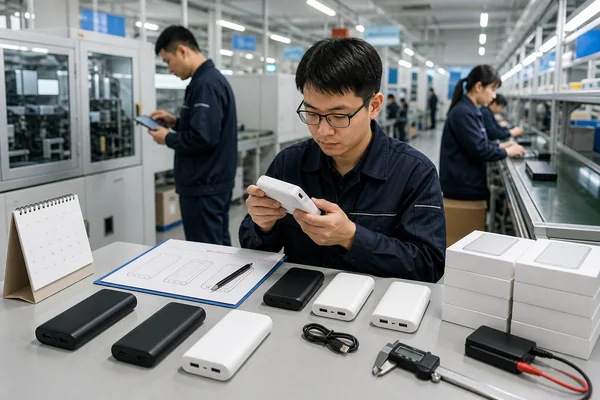
Combien de temps faut-il pour fabriquer une batterie externe personnalisée en Chine ? Calendrier OEM/ODM, de la demande de devis à l’expédition (2026)
En bref : comptez environ 4 à 7 semaines avant expédition pour un modèle de batterie externe existant avec un logo et un emballage standard. Une couleur, un câble, un emballage sur mesure ou des modifications électriques portent généralement cette fourchette à 6 à 10 semaines. Un nouvel outillage, une nouvelle électronique ou des essais de conformité propres au modèle peuvent allonger le délai à 12 à 20 semaines, voire davantage.
Il s’agit de fourchettes de planification, pas d’un engagement de livraison. L’envoi de la première demande ne déclenche pas le délai de production. L’usine peut planifier le travail une fois les spécifications, les fichiers graphiques, les conditions commerciales et le processus d’approbation suffisamment définis. Le temps de transport est distinct.
Le tableau ci-dessous propose aux importateurs et aux acheteurs de produits sous marque propre un calendrier de travail pour un projet OEM de batterie externe. Il précise également les décisions qui incombent à l’acheteur, car des approbations lentes peuvent prendre plus de temps que l’assemblage.
Calendrier pratique de fabrication d’une batterie externe personnalisée
| Étape du projet | Fourchette de délai indicative | Points à confirmer |
|---|---|---|
| Demande de devis et examen des besoins | 1 à 3 jours ouvrés | Modèle, capacité, ports, protocoles, quantité, marché visé et niveau de personnalisation |
| Étude de faisabilité et devis | 2 à 5 jours ouvrés | Configuration, quantité minimale de commande, paliers de prix, type d’échantillon, outillage et périmètre de conformité |
| Préparation des échantillons | 5 à 30 jours ouvrés | Matériel, logo, couleur, emballage, micrologiciel et critères d’approbation |
| Examen des documents de conformité ou nouveaux essais | De 2 jours ouvrés à 8 semaines ou plus | Modèle exact, cellule, PCB, marché, périmètre des essais du laboratoire et validité des rapports |
| Achat des matériaux et préparation de la production | 7 à 20 jours ouvrés | Nomenclature et fichiers graphiques approuvés, prévisions, acompte et créneau de production |
| Production en série | 15 à 30 jours ouvrés | Quantité, capacité des lignes, disponibilité des composants et gestion des modifications |
| Inspection finale et autorisation d’expédition | 2 à 5 jours ouvrés | Résultat de l’inspection, liste de colisage, étiquettes, documents de transport et règlement du solde |
| Transport international | Variable selon l’itinéraire et le mode de transport | Acceptation des marchandises dangereuses, réservation, destination et modalités douanières |
Certaines étapes peuvent se dérouler en parallèle. Les fichiers graphiques de l’emballage peuvent, par exemple, être préparés pendant la fabrication de l’échantillon. D’autres étapes ne le permettent pas. L’usine ne devrait pas acheter toute la quantité d’emballages avant l’approbation des fichiers par l’acheteur, ni commencer la production en série tant que les spécifications électriques évoluent encore.
Combien de temps prend chaque type de personnalisation ?
Logo et emballage standard sur un modèle existant
C’est généralement la voie la plus rapide. La batterie, le PCBA, le boîtier et le micrologiciel existent déjà. L’usine doit surtout confirmer le procédé de marquage du logo, les fichiers graphiques, la couleur, l’emballage et la quantité commandée.
Un calendrier réaliste prévoit environ 4 à 7 semaines avant expédition après validation de l’échantillon, des fichiers graphiques et de l’acompte. La commande peut néanmoins être retardée si la cellule choisie ou la couleur du boîtier n’est pas en stock, ou si l’acheteur demande une structure d’emballage nécessitant un nouveau tracé de découpe.
Couleur, câble, écran ou emballage de vente personnalisés
Des modifications qui semblent mineures sur un dessin peuvent concerner plusieurs fournisseurs. Une couleur de boîtier personnalisée nécessite une mise au point de la teinte et l’approbation d’un échantillon. Un autre câble intégré peut modifier le connecteur, la longueur, le renfort moulé anti-traction ou le profil de recharge. Un changement d’affichage peut concerner à la fois l’écran et le micrologiciel.
Prévoyez environ 6 à 10 semaines avant expédition. Demandez au fabricant quels éléments sont standard et lesquels doivent être achetés ou développés spécialement pour la commande.
Nouveau boîtier, outillage ou circuit électronique
Un nouveau boîtier constitue un projet de développement, pas une commande d’impression. La conception industrielle, l’étude mécanique, le prototypage, l’outillage, les essais d’injection, les contrôles d’ajustement et les essais de fiabilité précèdent tous la production en série. Des modifications électroniques peuvent nécessiter une révision du PCB, du travail sur le micrologiciel et une nouvelle série d’essais de sécurité ou de compatibilité.
Prévoyez au moins une fourchette de 12 à 20 semaines, et davantage si la conception présente encore des problèmes thermiques, de recharge ou mécaniques. L’acheteur doit définir la propriété de l’outillage, la procédure d’approbation des révisions et la marche à suivre si le premier essai ne respecte pas les spécifications signées.
Étape 1 : envoyer une demande que l’usine peut chiffrer
« Merci de chiffrer une batterie externe de 10 000 mAh » ne suffit pas. Deux produits portant cette indication peuvent utiliser des cellules, des puissances de sortie, des protocoles, des ports, des circuits de protection et des emballages différents. Les devis ne seront pas comparables.
Envoyez les mêmes exigences écrites à chaque fournisseur présélectionné. Précisez :
- La capacité visée en mAh et l’énergie nominale en Wh.
- Les puissances d’entrée et de sortie USB-C requises, la sortie USB-A et les protocoles de recharge.
- La puissance de recharge sans fil et les exigences d’alignement magnétique, le cas échéant.
- Les besoins en câble intégré, prise secteur, écran, lampe torche ou autres fonctions.
- Les marchés visés et les documents de conformité exigés par ces marchés ou canaux de vente.
- Le procédé de marquage du logo, la couleur, les étiquettes, la notice, les accessoires et l’emballage de vente.
- Les quantités de 500, 1 000 et 2 000 pièces, avec la répartition par couleur ou emballage.
- Le nombre d’échantillons, le plan d’inspection, la destination de livraison et l’Incoterm demandé.
Pour comprendre la répartition des coûts, consultez notre guide sur les prix, quantités minimales et outillages des batteries externes personnalisées. Il explique pourquoi un devis doit préciser la configuration du produit, en plus du prix unitaire.
Étape 2 : terminer l’étude de faisabilité avant d’approuver le prix
Un prix n’a guère de valeur si le matériel proposé ne peut pas répondre aux besoins. Demandez au fabricant de confirmer la configuration des cellules, le PCBA, la répartition de la puissance totale en sortie, le comportement en recharge simultanée, les limites du boîtier et les documents d’essais disponibles.
Soyez attentif aux formulations telles que « jusqu’à 22,5 W » ou « compatible PD ». Demandez quel port fournit cette puissance, avec quel profil de tension, et ce qui se passe lorsque deux sorties sont utilisées ensemble. Une incompatibilité de spécifications découverte après l’impression de l’emballage coûte cher et prend du temps à corriger.
Avant de choisir un fournisseur, examinez les justificatifs indiqués dans notre liste de contrôle pour l’audit d’une usine de batteries externes. La capacité de production, la maîtrise des composants et les relevés de modifications techniques influencent directement la fiabilité des livraisons.
Étape 3 : choisir le type d’échantillon adapté
Chaque étape d’échantillonnage répond à une question différente. Un échantillon en stock permet de vérifier le modèle de base, tandis qu’un échantillon marqué permet de contrôler le logo et la présentation. L’échantillon de présérie doit représenter la configuration approuvée pour la production.
| Type d’échantillon | Utilisation | Délai indicatif |
|---|---|---|
| Échantillon en stock | Premier examen des dimensions, des fonctions et de la finition | 2 à 5 jours ouvrés, hors livraison |
| Échantillon avec logo ou couleur personnalisée | Approbation du marquage, de la couleur et de l’état de surface | 5 à 15 jours ouvrés, hors livraison |
| Échantillon de développement | Matériel, micrologiciel, câble ou boîtier modifié | 10 à 30 jours ouvrés, voire davantage |
| Échantillon de présérie | Configuration finale, emballage et niveau de qualité de fabrication | 3 à 10 jours ouvrés après disponibilité des matériaux |
Signez et datez l’échantillon de présérie approuvé. Consignez le modèle, la cellule, la révision du PCBA, le micrologiciel, la couleur, le logo, l’emballage et les accessoires. Cet échantillon devient la référence pour l’inspection de la production. Si un composant change ensuite, exigez une notification écrite et une approbation.
Étape 4 : confirmer la conformité avant de figer le calendrier
Les rapports existants ne font gagner du temps que s’ils couvrent le produit commandé. Vérifiez la correspondance entre les documents et le numéro de modèle, la cellule, la conception électrique, la fonction sans fil et le marché visé. Un rapport portant sur un produit d’apparence similaire ne couvre pas automatiquement une nouvelle configuration.
Si de nouveaux essais sont nécessaires, obtenez un devis et un plan d’essais du laboratoire avant de promettre une date de lancement. Les essais, l’examen du rapport et les corrections peuvent prendre plusieurs semaines. Un échec aux essais ou une modification matérielle peut obliger à reprendre une partie du processus.
Les batteries externes expédiées comme fret sont des produits à batterie au lithium. Les modalités exactes de transport et la documentation doivent être vérifiées avec le transporteur ou le transitaire. Les recommandations 2026 du guide de l’IATA sur les batteries expliquent les informations attendues dans le résumé d’essais UN 38.3 pour les batteries au lithium. Notre guide de conformité des batteries externes donne aux acheteurs un point de départ plus large pour les projets destinés à l’UE et aux États-Unis.
Étape 5 : acheter les matériaux et approuver le plan de production
Le délai d’approvisionnement en matériaux est souvent le véritable goulot d’étranglement. Les cellules, les PCBA et les boîtiers standard peuvent être disponibles rapidement, tandis qu’un écran, un câble, un carton ou une couleur sur mesure peuvent prendre davantage de temps. Une commande de 2 000 pièces ne prend pas toujours deux fois plus de temps qu’une commande de 1 000 pièces : le composant le plus contraignant et le créneau de production disponible comptent davantage.
Avant de lancer les achats, confirmez la nomenclature approuvée, les fichiers d’emballage, la quantité par variante, l’acompte, la date d’achèvement demandée et les règles de substitution. Demandez un calendrier de production avec des jalons, plutôt qu’une seule date finale.
Étape 6 : maîtriser la première série de production
Un processus de production type comprend l’inspection à réception, le tri ou l’appairage des cellules, les contrôles des PCBA, l’assemblage, les essais fonctionnels, le vieillissement, l’inspection visuelle et l’emballage. L’ordre exact dépend du modèle.
Pour un produit nouveau ou modifié, demandez un contrôle du premier article ou du lot pilote avant d’assembler toute la commande. Il est plus facile de corriger l’ajustement d’un câble, la position d’une étiquette ou un réglage du micrologiciel après un petit lot qu’après la fabrication de 2 000 unités finies.
Définissez à l’avance des limites d’acceptation mesurables. Notre liste de contrôle qualité des batteries externes en 15 points couvre l’énergie nominale, l’énergie utilisable en sortie, les profils de recharge, les protections, la température, la construction, les étiquettes et les documents. Le processus de contrôle qualité de l’usine doit correspondre aux spécifications et au plan d’inspection de l’acheteur.
Étape 7 : inspecter, autoriser l’expédition et réserver le transport
L’inspection finale doit avoir lieu une fois la commande terminée et emballée, mais avant l’autorisation d’expédition. Vérifiez la quantité, la qualité de fabrication, les fonctions, l’emballage, les marquages, les accessoires et la taille d’échantillon convenue. Conservez le rapport d’inspection et tout relevé d’actions correctives dans le dossier de commande.
Le temps de transport ne commence qu’après l’acceptation du fret et la réservation. Les envois de batteries au lithium peuvent être soumis à des contraintes de transporteur, d’itinéraire, d’emballage et de documentation qui ne concernent pas les marchandises ordinaires. Demandez au transitaire un calendrier propre à l’itinéraire. Évitez de bâtir un plan de lancement sur une estimation générique du type « une semaine par avion » ou « un mois par mer ».
Qu’est-ce qui retarde le plus souvent une commande OEM de batteries externes ?
- Des spécifications incomplètes. L’acheteur et l’usine chiffrent des produits différents sans s’en rendre compte.
- Des révisions tardives des fichiers graphiques. Des changements d’étiquettes, de notices ou d’emballages peuvent bloquer l’achat des matériaux.
- Un périmètre de conformité mal défini. Les essais ne sont abordés qu’une fois le produit et la date de lancement fixés.
- Des changements de composants. Une cellule, un PCBA, un câble ou un boîtier est remplacé sans examen encadré.
- Une approbation lente des échantillons. L’échantillon attend des commentaires alors que la date de livraison demandée reste inchangée.
- Les capacités en haute saison. Les créneaux de production, la disponibilité des fournisseurs d’emballages et les capacités de transport se réduisent pendant les périodes chargées et les congés.
- Un échec à l’inspection. Des reprises et une nouvelle inspection sont nécessaires avant l’autorisation d’expédition.
Comment les acheteurs peuvent-ils réduire les délais sans accroître les risques ?
- Utilisez une plateforme existante lorsque la date de lancement compte davantage qu’un boîtier unique.
- Figez les spécifications du produit avant d’approuver le prix et les fichiers graphiques.
- Envoyez les fichiers modifiables du logo, des étiquettes et de l’emballage dès le début du projet.
- Définissez les marchés visés en amont pour permettre l’examen des rapports et des étiquettes appropriés.
- Approuvez ou refusez les échantillons à l’aide d’une seule liste de commentaires consolidée.
- Réservez la capacité de production sur la base de prévisions réalistes.
- Réservez l’inspection et discutez de l’itinéraire de transport avant la fin de la production.
Sauter l’approbation des échantillons ou réduire les essais peut raccourcir le calendrier sur le papier, mais les problèmes non résolus se retrouvent alors dans la production en série. Accélérez le processus d’approbation en prenant les décisions plus tôt, pas en supprimant les contrôles.
Questions à poser avant d’accepter la date de livraison
- Le délai annoncé commence-t-il à la commande, au versement de l’acompte, à l’approbation des fichiers graphiques ou à celle de l’échantillon ?
- Quels composants ont les délais d’achat les plus longs ?
- Le calendrier est-il établi selon la capacité de production actuelle ?
- L’examen de conformité et les essais sont-ils inclus ?
- À quelle date l’échantillon de présérie doit-il être prêt ?
- Quand l’inspection finale peut-elle avoir lieu ?
- Le transport international est-il inclus ou fait-il l’objet d’un devis distinct ?
Fourchettes de planification pour des commandes de 500, 1 000 et 2 000 pièces
YULIDA étudie couramment des projets OEM par paliers de 500, 1 000 et 2 000 pièces. Le tableau ci-dessous est un exemple de planification pour un modèle existant, après approbation de l’échantillon final et des fichiers graphiques. Il ne constitue ni un devis ni un calendrier garanti.
| Quantité commandée | Type de projet courant | Fourchette de délai avant expédition |
|---|---|---|
| 500 pièces | Logo et emballage standard sur un modèle existant | Environ 4 à 6 semaines |
| 1 000 pièces | Personnalisation du logo, de la couleur ou de l’emballage | Environ 5 à 8 semaines |
| 2 000 pièces | Plusieurs variantes ou personnalisation plus poussée | Environ 6 à 10 semaines |
Une même commande de 2 000 pièces peut être plus rapide avec des matériaux standard, ou plus lente si elle comprend plusieurs couleurs, versions de prise ou langues d’emballage. Demandez un calendrier propre au projet.
Obtenir un calendrier de production adapté à votre projet de batterie externe
Lorsque vous contactez YULIDA, indiquez le type de produit, la capacité, les exigences de recharge, le marché visé, les détails de personnalisation, la quantité commandée et la destination. Ces informations permettent à l’usine de décomposer le calendrier en échantillonnage, préparation des matériaux, production, inspection et planification de l’expédition.
Consultez nos services de fabrication OEM/ODM de batteries externes ou demandez un devis pour 500, 1 000 ou 2 000 pièces.
Questions fréquentes
1. Combien de temps faut-il pour fabriquer une batterie externe personnalisée en Chine ?
Un modèle de batterie externe existant avec un logo personnalisé et un emballage standard nécessite généralement environ 4 à 7 semaines avant expédition. Des couleurs, des câbles, un emballage personnalisés ou des modifications électriques peuvent demander 6 à 10 semaines. Un nouvel outillage ou une nouvelle électronique peuvent allonger le calendrier à 12 à 20 semaines, voire davantage.
2. Quand commence le délai de production d’une batterie externe ?
En pratique, le délai commence après validation des spécifications du produit, des fichiers graphiques, de l’échantillon, des conditions commerciales et de l’acompte. Le temps passé à compléter une demande de devis incomplète ne devrait pas être compté comme du temps de production.
3. Combien de temps prend un échantillon de batterie externe personnalisée ?
Un échantillon en stock prend normalement 2 à 5 jours ouvrés. Un échantillon avec logo ou couleur personnalisée peut demander 5 à 15 jours ouvrés, tandis qu’un échantillon de développement impliquant des modifications du matériel, du micrologiciel ou du boîtier peut nécessiter 10 à 30 jours ouvrés, voire davantage.
4. La quantité commandée influe-t-elle sur le temps de production ?
Oui, mais le temps de production n’augmente pas proportionnellement à la quantité. La disponibilité des composants, la personnalisation, le nombre de variantes du produit et la capacité de production disponible de l’usine ont souvent plus d’influence que la différence entre 500, 1 000 et 2 000 pièces.
5. Les essais de certification peuvent-ils retarder une commande de batteries externes ?
Oui. Les rapports existants ne font gagner du temps que s’ils couvrent la configuration exacte du produit et le marché visé. Si de nouveaux essais sont nécessaires, les disponibilités du laboratoire, les essais, la préparation des rapports et les corrections peuvent ajouter plusieurs semaines.
6. Qu’est-ce qui retarde le plus souvent une commande OEM de batteries externes ?
Les causes courantes sont des spécifications incomplètes, des révisions tardives des fichiers graphiques, une approbation lente des échantillons, des composants indisponibles, des exigences de conformité mal définies, des contraintes de capacité de production et des échecs aux inspections finales.
7. Le transport international est-il inclus dans le délai de fabrication ?
Non. Le délai de fabrication se termine normalement lorsque la commande finie réussit l’inspection et reçoit l’autorisation d’expédition. La réservation du fret, l’acceptation des batteries au lithium, les formalités douanières et le transport international doivent être calculés séparément.
Sources officielles et vérification
Ces sources primaires étayent les informations de cet article concernant les normes, la compatibilité, la sécurité ou le transport. Vérifiez les exigences en vigueur pour le modèle exact et le marché de destination.
- Association du transport aérien international — Exigences de transport des batteries au lithium et recommandations du secteur.
