





What Is a TFT Power Bank? B2B Sourcing Guide
Two quotes sit in your inbox. Same 10,000 mAh capacity, same lithium polymer cells, same 22.5W output. Supplier A offers the standard build with four LED dots at $6.80 per unit. Supplier B offers a TFT power bank with a color display showing exact percentage and real-time wattage at $9.10. Across a 5,000-unit order, that gap is $11,500. Choose wrong and you either leave margin on the table or stock a line that looks dated by next spring.
This guide covers what a TFT power bank is, what it costs, which specs to verify, and why fewer than five factories worldwide can mass-produce one. It also explains China’s mandatory national standard GB 47372-2026, published on March 31, 2026 and effective April 1, 2027. The standard requires safety monitoring, storage of abnormal-event data, and a way for users to read specified information; it does not require a built-in display. A TFT panel is a product-design choice, not a shortcut to compliance.
What Is a TFT Power Bank?
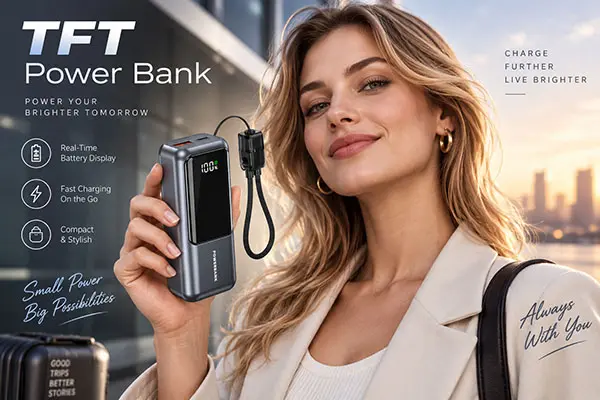
A TFT power bank is a portable charger with a thin-film-transistor color display that shows exact battery percentage, per-port output, and charging direction in real time, replacing the LED dots on standard models. China’s GB 47372 standard takes effect on April 1, 2027. It requires users to be able to read specified safety information, but permits a built-in screen or wired or wireless access through a phone or computer; a visible percentage display is not mandatory.
TFT is the same display family used in car dashboards and entry-level smartphones. Each pixel sits behind its own transistor, so a small panel renders crisp color graphics on very little power. Retail listings call the category smart display power bank or power bank with TFT screen. On the unit, the panel shows:
- Battery level as a number: 87%, not four glowing dots
- Input and output wattage in real time
- Which ports are active and at what speed
- Temperature and fault warnings on better units
For B2B buyers, the $1.50 to $3.00 unit-cost premium can make sense for three commercial reasons. A visible percentage display can make the product feel more premium at the same cell capacity. Support volume may fall because the device itself answers the question, “is it actually charging?” A configurable interface can also distinguish an OEM or ODM product on the shelf. These are product benefits, not proof of GB 47372 compliance; verify the standard’s safety and information-access requirements separately.
The commercial weight is measurable. The global market for TFT screen power banks stood at $542.8 million in 2025, and PW Consulting’s TFT Screen Power Bank Market report forecasts $1.4 billion by 2032, a compound annual growth rate of roughly 14.5%.
How a TFT Power Bank Works ?
A TFT power bank works by connecting three components that a standard model runs in simplified form or skips entirely: a fuel gauge chip, a microcontroller, and a display driver that renders data on the color screen.
The fuel gauge IC. This chip samples cell voltage, current, and temperature several times per second and computes true state of charge. Named parts from TI or ADI hold accuracy within 1-3%. Cheap builds estimate charge from voltage alone, which can drift by 8% or more. That is why LED dots on budget units jump from two to four with no warning: the data behind them is a guess.
The MCU. The microcontroller reads the fuel gauge, negotiates fast-charge protocols such as USB PD 3.0 and QC 3.0, routes power between ports, and decides what the screen shows. It also manages the sleep states that protect standby time.
The display driver and panel. The driver IC converts MCU instructions into pixel data, and the panel renders the interface: percentage readout, input and output arrows, wattage figures, and on some models a boot logo in your brand colors.
The panel is the visible part, but firmware decides quality. Two factories can source the identical screen and ship products that feel completely different, because UI logic, refresh behavior, and gauge calibration all live in code. When you audit a TFT power bank supplier, ask who writes the display firmware. A factory limited to a reference design cannot put your logo on the boot screen without outsourcing.
TFT vs LED vs Segment Display: What B2B Buyers Should Choose
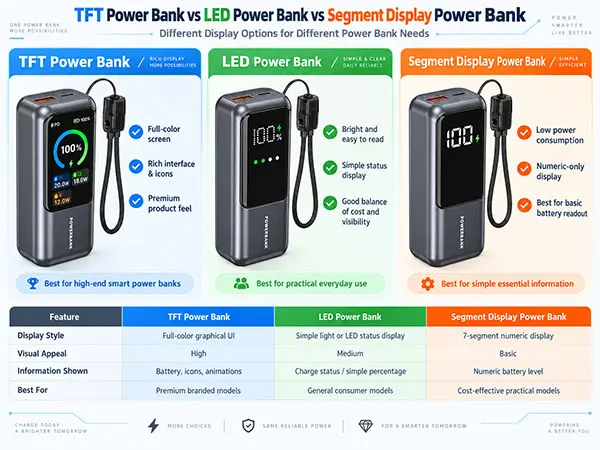
For premium and mid-range retail lines, a TFT power bank can offer clearer readouts and stronger shelf appeal. LED indicators still suit high-volume promotions, while segment LCDs cover the mid-range. Display type alone neither qualifies nor disqualifies a product under GB 47372; check how the required safety information can be read.
| Display Type | Information Shown | Unit Cost Impact | Idéal pour |
|---|---|---|---|
| TFT color display | Exact percentage, per-port wattage, charging direction, custom branding | +$1.50 to $3.00 | Premium retail lines, brand programs, gifting |
| Segment LCD | Numeric percentage only | +$0.30 to $0.80 | Mid-range lines with tight BOM targets |
| LED dot indicators | 4 or 5 dots at 25% steps | Included in baseline | High-volume promotions and giveaways |
Three notes for reading that table. A segment LCD can show a percentage number, but GB 47372 does not prescribe a percentage display or any particular display technology. For compliance, verify safety monitoring, storage of abnormal-event data, and access to the required information. The TFT premium also buys more than the panel: an accurate fuel gauge matters because a color screen reading “62%” while the true level is 70% is worse than no screen at all. Many brands stock both: a TFT power bank at the top of the line and LED versions for volume channels.
Why the Market Is Moving to Screens Now ?
Five factors shape the decision to add a TFT display: China’s new safety standard raises the importance of readable safety data without mandating a screen; high-wattage charging, retail competition, smartphone-shaped user expectations, and cheaper fuel gauge chips also influence product design.
GB 47372 requires access to safety data, not a TFT display
China’s mandatory national standard for power banks, GB 47372-2026, was published on March 31, 2026 and takes effect on April 1, 2027. Clause 6.8 requires monitoring battery voltage and temperature, storing specified abnormal-event information, and letting users read that information and battery identification details. A built-in screen is one permitted readout method; wired or wireless access through a phone or computer is another. The standard does not mandate a TFT screen or a percentage display, and a screen alone does not establish compliance. Supplier estimates of the cost of safety upgrades should be assessed against the actual design and tests required, rather than treated as a mandatory display surcharge.
Why does this matter if you sell outside China? China produces roughly nine in ten of the world’s power banks. GB 47372 directly governs products sold in China, while shared components and factory processes may also influence export models. The rule does not by itself imply a display-panel shortage or the disappearance of LED-only models. Check the rules in each destination market and ask suppliers for evidence of compliance and production capacity rather than assuming every 2027 design needs a TFT panel.
High-wattage charging needs real-time feedback
Current platforms push 65W to 140W across two or three ports. When a laptop and a phone charge at the same time, the split matters, and a screen showing 45W in and 20W out answers questions a dot matrix cannot. Reviewers now verify displayed wattage against meter readings, so accuracy is a spec you can defend.
Retail shelf competition rewards screens
Private-label power banks crowd the same listings. At equal capacity, a color display with a custom boot logo is one of the few differences a shopper can see in two seconds. The effect compounds at the magnetic-wireless overlap, currently the fastest-growing section of the market, and our roundup of Fabricants de batteries externes magnétiques sans fil shows which factories already work at that intersection.
Users expect exact numbers everywhere
Consumers now read every charge on their phone as a number. Four dots on a $20 power bank reads like a cost cut, and product teams running LED indicators on premium SKUs get that feedback in the reviews.
Fuel gauge chips got cheap
Accurate state-of-charge measurement used to carry a premium price. Fuel gauge IC costs have fallen far enough that a gauge holding 1-3% accuracy is viable on mid-range BOMs, which makes an honest display possible at volume price points. The screen is only as truthful as the gauge behind it, and the gauge no longer breaks the budget.
Sourcing Checklist: Specs That Matter on a TFT Power Bank
Before you approve a TFT power bank for production, verify these eight specifications with your supplier in writing.
| Spécification | What Good Looks Like | Pourquoi c’est important |
|---|---|---|
| Display size and resolution | 1.14 to 2.0 inch, 240 x 280 or higher | Panels below 240 px look grainy under retail lighting |
| Display content set | Percentage, wattage in and out, port status, temperature alert | A screen showing percentage alone wastes the panel |
| Fuel gauge accuracy | 1-3% with a named IC such as TI, ADI, or CellWise | Voltage-based estimation drifts up to 8% |
| MCU and protocol support | USB PD 3.0, QC 3.0 or 4, PPS | Determines real charging speed and the firmware upgrade path |
| Refresh rate | 1-2 seconds for wattage values | A 5-second refresh makes the display feel broken |
| Display power draw | Under 5 mW at idle | High draw erodes standby time; target six months or more |
| Sunlight readability | 400 nits or higher, transflective or high-brightness panel | Outdoor readability drives perceived build quality |
| Lamination and protection | Full lamination or a hardened cover lens | Prevents dust ingress and improves drop survival |
Three verification moves separate serious suppliers from traders. Ask for the fuel gauge IC part number in the quotation rather than a generic “accurate gauge” claim. Request a screen-on versus screen-off standby comparison report. Check the unit under bright light, at least 10,000 lux, because a panel that washes out in sunlight washes out on the sales floor.
One spec sits outside the display but drives the whole quote: the battery cell, the largest single cost item and the main determinant of real capacity. Our guide to Cellules de batterie pour une batterie externe breaks down the grades you will be offered.
Why Fewer Than 5 Factories Can Mass-Produce TFT Power Banks?
Fewer than five factories worldwide can mass-produce a TFT power bank at export quality, based on our audits of display-capable production lines across the 2025-2026 sourcing cycle. Volume production requires four capabilities most assembly plants have never built, and the gaps cannot be closed with money inside one product cycle.
A responsive panel supply chain. Display modules come from a different supplier ecosystem than cells and PCBs. A factory needs standing relationships with panel makers to secure custom panels, priority capacity, and engineering support when yields dip. Panel lead times of four to eight weeks set the pace of the whole order, and factories without panel pull get queued behind phone makers.
Embedded firmware development. The display needs UI code, boot logo management, fuel gauge calibration, and protocol handling, all maintained in-house. Most power bank factories assemble reference designs they cannot modify. If your supplier cannot change a font size or add a temperature warning without emailing a chip vendor, it cannot support a TFT power bank program.
Structural stacking and thinning. Fitting the panel, backlight, and flex connector into a housing that still passes drop tests is real mechanical engineering. Light leakage, connector fatigue, and thickness creep past 16 mm kill designs late, after tooling money is spent.
Yield ramp discipline. Early production runs of a new model see elevated defect rates: dead pixels, connector faults, backlight bleed. Holding a 98%+ yield across a 10,000-unit order takes process control that only comes from having done it before. A workshop can build 100 good samples; that is not mass production.
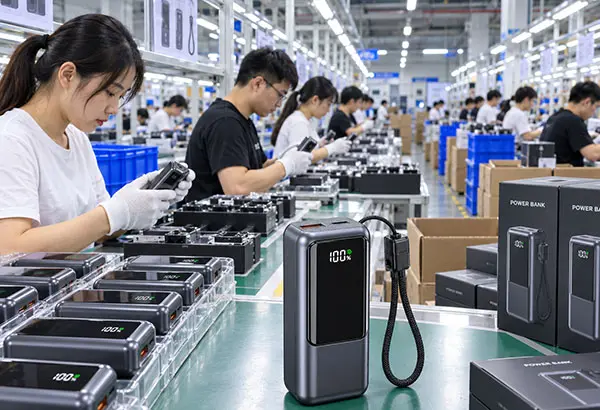
Shenzhen Yulida Technology Co., Ltd is one of the factories that has cleared these gates. YULIDA Power runs TFT power bank mass production with in-house firmware development, and every batch passes a 28-point inspection plus 72 hours of aging before release. Sample quality tells you little here; production-line evidence is what matters before committing tooling money.
MOQ, Pricing, and Lead Times
At factories with genuine mass-production capability, MOQ for a TFT power bank starts at 500 pcs for standard models, as of Q3 2026 quotes. Custom branding and UI work may carry higher minimums; fully custom housings with new tooling start around 3,000 to 5,000 pcs.
Unit pricing breaks into three layers. The TFT module adds $1.50 to $3.00 per unit at common sizes from 1.14 to 2.0 inches, before volume discounts; resolution, brightness, and lamination push toward the top of that range. The cell remains the largest cost item and moves a quote more than the display does, so cell grade deserves as much negotiation attention as the screen. Everything else follows standard power bank economics, and our custom power bank cost guide for 2026 breaks down how factories build a quote, tooling and packaging included.
Tooling and timelines follow from your choices. An existing platform with your logo keeps tooling cost near zero and samples inside 7 to 15 days. A new housing runs $6,000 to $18,000 in tooling and adds 30 to 40 days. Mass production runs 25 to 35 days after deposit and firmware sign-off. First orders with custom UI need another 10 to 15 days for approval cycles on top of that.
One note on where prices may be heading: estimates collected across our supplier network in 2026 suggest that some GB 47372 safety upgrades could raise production costs by 20-30%, depending on the design and changes needed. This is a commercial estimate, not a cost increase mandated by the standard or a required display surcharge. Reconfirm pricing and the necessary tests with the factory before placing an order.
Certifications and Compliance
An export-ready TFT power bank needs CE, FCC, RoHS, and UN38.3 at minimum. China domestic sales additionally require 3C certification, and GB 47372-2026, enforced from April 2027, will tighten what that mark covers.
The core set, briefly:
- CE for the EU, covering electromagnetic compatibility and electrical safety
- FCC for the United States
- RoHS, restricting hazardous substances
- UN38.3 plus MSDS, mandatory for shipping lithium products by air
- 3C for China domestic sales, the certification channel through which GB 47372 is enforced
PSE for Japan, KC for Korea, and UKCA for the UK apply as your distribution requires. For the product-side basics, see our guide on what certifications power banks need; for the documents each customs broker expects in each destination market, our market-by-market compliance breakdown covers the EU, US, UK, Japan, India and China.
Factory-level credentials matter as much as product marks. BSCI audit reports are what European retail buyers ask for first, and ISO 9001 certifies the quality management system behind any mass production claim. YULIDA holds both. A factory claiming TFT power bank mass production but unable to produce an ISO 9001 certificate and a recent BSCI report on request is a reseller.
Contrôle qualité: What to Test Before Shipment
Every TFT power bank batch should clear a 28-point inspection and a 72-hour aging test before it leaves the factory. That is the baseline YULIDA runs on its own production, and a reasonable bar to write into any purchase agreement.
What the 28 points cover, grouped:
- Electrical: real capacity versus rated, output voltage regulation under load, and protocol handshake on every port
- Affichage : dead pixel scan, brightness uniformity, backlight bleed, refresh stability across the operating temperature range, connector seating after vibration
- Mechanical: port insertion cycles, drop tests from 1.0 to 1.2 meters, shell and lens integrity
- Safety: overcharge, over-discharge, short circuit, and temperature rise at full load
The 72-hour aging test exists because failures cluster early: cell defects and solder joint faults overwhelmingly surface in the first 48 to 72 hours of powered operation. Aging pulls those failures back to the factory floor, where a defect costs a rework slot instead of a warranty claim.
For a checklist you can run yourself on incoming goods, our 15-point power bank quality test guide includes the pass and fail thresholds used in production audits.
Questions fréquentes
Six questions buyers ask most about TFT power bank sourcing, answered directly.
1. Does the TFT screen drain the power bank’s battery?
No, not in any way that matters. On a TFT power bank, the display draws a few milliwatts and sleeps after a short idle period, so screen consumption stays under 1% of total capacity across a typical discharge cycle. In standby, the unit drops into a micro-power mode with the panel off entirely. If standby time is a headline spec for your market, ask for a screen-on versus screen-off self-discharge comparison before sign-off.
2. How much does a TFT display add to unit cost?
Between $1.50 and $3.00 per unit at common sizes from 1.14 to 2.0 inches, before volume discounts. Resolution, lamination, and brightness push the number toward the top of the range. For context, the battery cell still moves a quote more than the display does, so negotiating cell grade usually frees more budget than trimming panel specs on the same order.
3. Does China’s new standard apply to exported power banks?
GB 47372 applies to power banks sold in China; it does not automatically set display requirements for exports. Under clause 6.8, users must be able to read specified stored safety information and battery identification details, either on a built-in screen or through a wired or wireless connection to a phone or computer. An LED-only model is not automatically noncompliant, but its information-access method and other safety provisions must be checked. Exporters should also verify the requirements of each destination market.
4. What is the MOQ for TFT power banks?
MOQ starts at 500 pcs for standard TFT models at factories with mass production capability, YULIDA included. Custom branding and UI work may carry higher minimums, and fully custom housings start around 3,000 to 5,000 pcs. If a quote promises lower minimums on a custom display program, check whether the factory actually builds the product or is trading someone else’s capacity.
5. How is sourcing a TFT power bank different from a standard model?
The process adds two approval steps: display sample sign-off and firmware or UI approval. Expect samples in 7 to 15 days instead of 3 to 5, and budget an extra 10 to 15 days on first orders for the approval loops. Cell selection, certifications, and QC otherwise follow the standard power bank workflow you already run. Our guide to the sample workflow before mass production covers each sign-off gate in detail. Plan the calendar around the approvals, not the assembly.
6. Are TFT screens durable enough for daily use and drops?
Yes, when the design protects them. Production-grade TFT power banks recess the panel behind a hardened PMMA or tempered glass lens, mount it on shock-damping structure, and pass drop tests from 1.0 to 1.2 meters onto a hard surface. Field failures trace mostly to designs that skip those three elements, so ask for the drop test report alongside the aging test report before approving tooling.
Where to Source TFT Power Banks
Here is the shortlist of what to verify before committing budget to a smart display power bank program.
Verify mass production, not samples. Ask for yield data on recent batches, the headcount of the firmware team, and photos of the production line running display modules. Put the QC baseline in writing: 28-point inspection, 72-hour aging, and defined AQL levels in the purchase agreement.
On capability, Shenzhen Yulida Technology Co., Ltd is one of the few factories worldwide producing TFT power banks at export scale, with BSCI and ISO 9001 credentials, in-house firmware development, and an MOQ starting at 500 pcs. You can review the current TFT display power bank range for standard platforms, or see how the OEM/ODM program handles custom UI and boot logos.
Next step: send an RFQ with three numbers in it, target capacity, display size, and budget per unit. Ask for a functional sample and the aging test report in the same thread. A factory that answers both in one reply is one you can build a program on.
