




Qi2 25W Power Banks: Compatibilité, Certification and OEM Buyer Checklist
A Qi2 25W power bank can deliver up to 25W wirelessly to a compatible phone, but the phone model and charging conditions determine the actual result. For an OEM buyer, a useful comparison starts with three questions: which phones will customers use, which exact product is certified, and what does the sample deliver under repeatable conditions?
A quotation headed “25W magnetic power bank” leaves those questions open. Before approving a private-label order, connect every proposed packaging claim to a model-specific specification or test result. This guide explains what to request and how to turn the answers into sample acceptance criteria.
Manufacturer compatibility sources checked: 6 October 2026. The phone examples below are a selected comparison, not a complete compatibility list.
What is the difference between Qi2, Qi2.2 and Qi2 25W?
Le Wireless Power Consortium (WPC) identifies the original Qi2 generation with 15W charging. Qi specification v2.2.1, launched in July 2025, is branded Qi2 25W. Suppliers may use “Qi2.2” in quotations; ask them to identify the certified model and its supported wireless power.
The increase from 15W to 25W is about 67% in maximum power. That calculation does not establish a 67% reduction in charging time. A useful retail claim needs evidence from the intended phone, charging mode and test conditions.
Keep specification version, certification identity and advertised output in separate fields on your sourcing sheet. This makes it easier to spot a quote that uses a newer standard name while leaving the actual wireless rating unclear.
Which phones support 25W wireless charging?
The following figures are phone manufacturers’ published maximums. They are not results from a YULIDA power bank test. Validate each phone-and-power-bank combination before using it in your own compatibility claim.
| Téléphone | Manufacturer-listed Qi2 maximum | Primary source |
|---|---|---|
| iPhone 17 | Up to 25W | Apple specifications |
| iPhone Air | Up to 20W | Apple specifications |
| Pixel 10 Pro XL | Up to 25W | Google specifications |
| Pixel 10, Pixel 10 Pro, Pixel 10 Pro Fold | Up to 15W | Google specifications |
For every target phone, record the model, software version, case, charging mode and measured result. Use separate entries for different cases when they are part of your intended customer setup. Magnetic attachment alone does not demonstrate a phone’s electrical charging capability. Our compatibilité des batteries externes sans fil guide covers broader selection questions.
Why a 25W rating does not settle real-world performance
Temperature belongs in the comparison. Apple’s temperature guidance explains that wireless charging can slow or stop when an iPhone gets too warm. A brief peak-power reading therefore cannot answer how much charging a customer receives over a longer session.
Ask the supplier to distinguish these four ratings:
- Sortie sans fil : the supported wireless modes and the conditions attached to the maximum.
- USB-C output: the available wired charging profiles.
- Recharging input: the adapter and cable requirements for refilling the power bank.
- Shared output: the allocation when wireless and wired charging operate together, if supported.
Test battery-powered operation separately from any supported pass-through mode. Record the power bank’s starting charge as well as the phone’s. This avoids comparing a standalone sample with another sample using external input without acknowledging the difference.
How to verify certification for an OEM or private-label model
Request the Qi Certificate of Registration and inspect its linked WPC entry. WPC’s verification guidance says the database record must match the product’s appearance, brand, product name and type number. A logo or a supplier’s “Qi compatible” wording is insufficient evidence by itself.
Keep the certificate, database reference, sample photographs and proposed retail model name together. If the quotation identifies a different product from the certificate, ask for written clarification before approving artwork.
For rebranding, WPC describes a substantially similar product certification route for eligible identical variants. Each registered variant receives its own Qi-ID. Changes to the housing shape, connector or charging-surface material can require retesting. Confirm the route for your actual design with the supplier or authorized laboratory.
Qi certification also does not replace applicable product regulations or transport documentation. Use the Guide des certifications et de la conformité to organize the documents needed for the proposed model and destination market.
Turn sample testing into written acceptance criteria
Agree the test method and pass/fail criteria before comparing samples. The following is a buyer’s planning framework, not a substitute for certification or a universal Qi test specification.
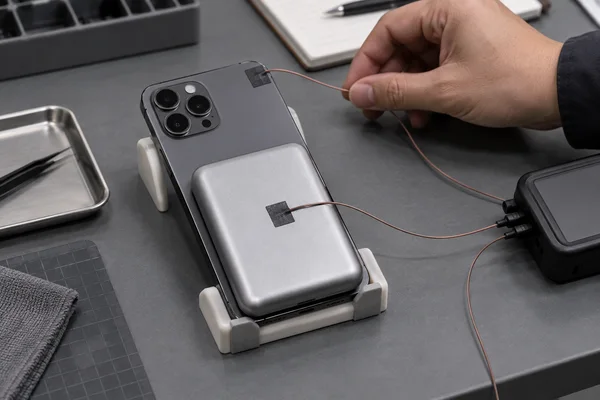
- Freeze the test setup. Identify the sample, phone, software, case, room conditions, starting charge levels and starting temperatures. Use the same setup for competing samples and allow devices to return to the agreed starting temperature between runs.
- Choose a meaningful charging window. For example, compare the phone’s charge gained during a defined 30-minute session, then evaluate a longer session separately. State the starting percentage and screen-use condition. These are example comparison methods, not promised charging results.
- Define what “power” means. State the measurement point, equipment and sampling method. Input power, wireless transfer and battery charging are different measurement boundaries. A phone animation cannot establish watts. See how to verify Qi2 wireless output when preparing the measurement request.
- Record behavior over time. Request the power trace where measurable, temperature measurement locations, charging interruptions and final charge level. Repeat runs using an agreed sample count and report variation rather than selecting only the best result.
- Check everyday fit. Inspect attachment and removal with the intended cases, camera clearance, button access and handheld comfort. Record the exact combination tested so an acceptable bare-phone result is not treated as approval for every case.
- Set the release decision. Write measurable limits into the approval sheet with the supplier or qualified laboratory. Mark missing evidence as unresolved. Approve claims only after the relevant checks pass.
For example, if a sample charges successfully but its certificate identifies another model, keep certification approval open. If the certification matches but the claimed charging result cannot be reproduced, keep that performance claim open. Separating those decisions prevents one successful check from masking another unfinished requirement.
Compare quotations and control the production version
Ask every shortlisted supplier to quote against the same brief: target phones, intended cases, capacity, dimensions, weight, charging modes, branding, destination markets and required evidence. Request separate confirmation of minimum order quantity, sample costs, tooling, packaging, lead time and the process for handling failed inspection results.
A 25W model deserves consideration when the target phones can use it and testing demonstrates a useful benefit. For customers whose phones accept lower wireless power, compare size, usable charging performance and total sourcing cost before paying for the higher rating. Keep any claimed number of phone recharges tied to a defined test instead of estimating it from the headline battery capacity alone.
Record the approved hardware and firmware revisions. Agree how changes to the cell, coil, controller or enclosure will be reviewed against the approved sample and certification scope. Keep the specification, reports, sample approval and unresolved questions in one purchasing file. The processus de contrôle qualité can help structure production checks.
For a YULIDA OEM/ODM inquiry, include that brief and request model-specific evidence. It gives both sides a concrete basis for selecting samples and approving the eventual product claims.
FAQ
1. Does every magnetic power bank support Qi2 25W?
No. Magnetic attachment alone establishes neither certification nor output. Match the exact product to its WPC record and confirm its wireless rating before comparing it as a Qi2 25W candidate.
2. Are Qi2.2 and Qi2 25W the same term?
WPC brands Qi specification v2.2.1 as Qi2 25W. Suppliers may shorten the version to “Qi2.2.” Request the exact certified model and supported power so terminology does not substitute for product evidence.
3. Will a Qi2 25W power bank charge iPhone Air at 25W?
No. Apple lists a 20W Qi2 maximum for iPhone Air. Use that model-specific limit in compatibility copy, and validate actual performance with the chosen power bank.
4. Do all Pixel 10 models support 25W wireless charging?
No. Google lists up to 25W for Pixel 10 Pro XL and up to 15W for Pixel 10, Pixel 10 Pro and Pixel 10 Pro Fold. Test and describe the individual model.
5. Does 25W mean the phone will finish charging 67% faster?
No. The approximately 67% figure compares maximum power ratings of 25W and 15W. To claim a charging-time improvement, compare measured sessions with the same phone, starting charge and test conditions.
6. Can an OEM buyer put a new brand on a certified model?
WPC provides a registration route for eligible rebranded identical products. Confirm the variant’s registration and Qi-ID before approving packaging. Design changes may require a different assessment or retesting.
7. Can wireless and Recharge USB-C run at full power together?
Check the selected model’s shared-output specification. Ask for simultaneous-operation test results and any restrictions. Separate maximum ratings for each port or mode do not establish the combined result.
8. Should an OEM buyer choose 15W or 25W?
Start with the target phones, then compare tested charging performance, size, weight and cost. Choose the model that meets the written acceptance criteria and supports claims you can document.
Sources officielles et vérification
Ces sources primaires étayent les informations de cet article sur les normes, la compatibilité, la sécurité ou le transport. Vérifiez les exigences actuelles pour le modèle précis et le marché de destination.
- Wireless Power Consortium — Normes Qi et Qi2, certification et informations sur la recharge sans fil.
- Assistance Apple — Fonctions de recharge des appareils et conseils de compatibilité.
- Assistance Apple — Fonctions de recharge des appareils et conseils de compatibilité.
- Assistance Google Pixel — Fonctions de recharge des appareils et conseils de compatibilité.
- Assistance Apple — Fonctions de recharge des appareils et conseils de compatibilité.
- Wireless Power Consortium — Normes Qi et Qi2, certification et informations sur la recharge sans fil.
