





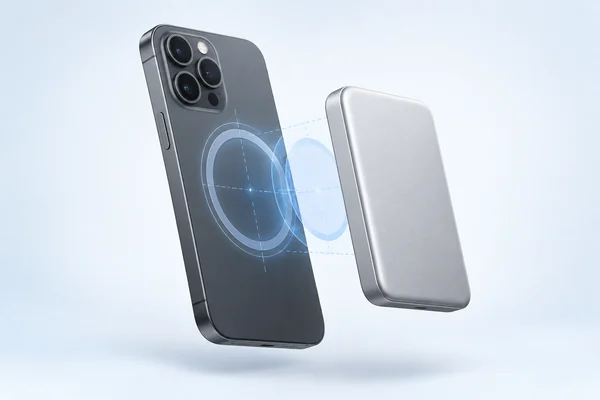
Magnetic power bank alignment: 7 checks before bulk orders
Check magnetic power bank alignment on the exact phones and cases your customers will use before approving a bulk order. Record where the sample sits, how it holds during handling and whether charging continues in that position. Keep those observations with the approved specification so the supplier and inspector can repeat the same checks on production units.
A convincing sample demonstration still leaves several purchasing questions open. Was the phone bare or in a case? Did the sample match the proposed production design? Was charging observed beyond the initial connection? This guide turns those questions into seven checks for OEM and private-label buyers, with an inspection checklist, a troubleshooting table and a supplier brief you can adapt.
The procedures below are suggested purchasing checks. Agree the test conditions, equipment and acceptance limits with the supplier before using them to approve samples or inspect an order.
Magnetic alignment, holding strength and charging: what to approve
Separate the result into three parts. Alignment describes where the power bank settles on the phone. Holding strength describes how the attachment behaves under a defined load or handling method. Charging performance requires its own observation and, for a numerical power claim, a suitable measurement method.
A sample can look well positioned while leaving charging compatibility unresolved. It can also charge on a desk yet move more than you want during handheld use. Put each requirement in the specification so an inspector does not have to decide what the buyer meant by “good magnetic performance.”
| Approval area | Question to resolve | Record to keep |
|---|---|---|
| Alignment and fit | Does it settle in the agreed position without obstructing the phone? | Reference photos with phone, case and sample identified |
| Attachment | Does it meet the agreed handling or force-measurement requirement? | Method, conditions and individual sample results |
| Charging | Does the approved combination meet the specified charging requirements? | Session records and the measurement method for any power claim |
| Claim verification | Do the product identity and documents support the claims you intend to sell? | Model specification, certification references and approved wording |
1. Define the phone-and-case combinations you will sell
Start with a compatibility list that names devices. “For iPhone and Android” is too broad to serve as an inspection instruction. Record the exact phone model, case brand and model, and any accessory required for the proposed configuration.
For an Android range, check each phone’s own wireless-charging specification before planning magnetic accessory claims. An added ring can provide an attachment surface; it cannot add a wireless-charging receiver to a phone that lacks one. YULIDA’s guide to magnetic power banks for Android covers the broader device-selection question. Keep this sample approval focused on the combinations you actually intend to offer.
Include the practical details that could be missed in a demonstration: camera clearance, access to buttons and ports, the direction in which an integrated cable exits, and clearance around a folding hinge where relevant. If a stand is part of the selected design, check the proposed viewing position with the phone fitted.
Ask the supplier to identify combinations that remain untested. That gives the marketing team a usable boundary and helps you choose which additional samples to request.
2. Check alignment and fit through repeated attachment
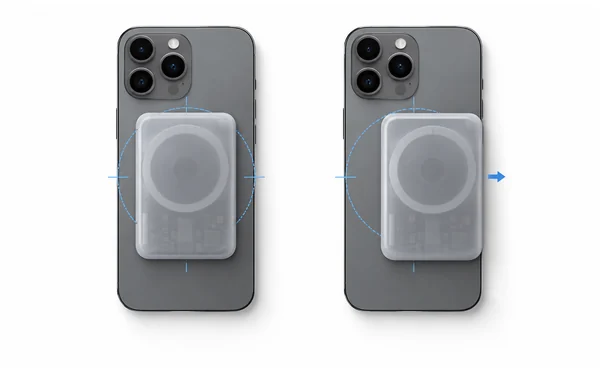
Use an identified sample in the proposed production housing. Photograph the back of the target phone, the power bank and the attached combination. A side view is useful for recording whether a camera surround or case feature prevents the surfaces from sitting as intended.
Then follow a repeatable sequence:
- Place the phone on a stable, protected surface and attach the power bank as the instructions describe.
- Record the position where it settles, using the same camera angle and visible reference points for each sample.
- Remove and reattach it for the agreed number of repetitions. Record any different resting position or need for manual adjustment.
- Repeat with each approved case, keeping the results separate from the bare-phone check.
Choose the repetition count before comparing suppliers. An agreed count makes the observations comparable; this guide does not prescribe a universal number.
If a sample repeatedly settles in different positions, ask the supplier to investigate before approval. Send the photos and identify the phone, case and sample involved. “Sometimes off-centre” is difficult to reproduce without those details.
3. Specify magnetic holding behaviour you can reproduce
A request for stronger magnets needs an observable target. Consider how the customer will use the product: holding the phone, lifting it from a desk, removing the power bank, or adjusting a stand. Decide which actions belong in your sample check and how much movement is acceptable during each one.
Keep the phone supported over a padded surface during handling checks. Avoid improvised drop demonstrations that put the device or battery at unnecessary risk. If impact resistance is part of the purchase specification, arrange an appropriate separate test plan.
For instrumented holding-force measurements, agree the fixture and loading direction. A straight pull away from the phone and movement along its back examine different loading conditions. Record the equipment, attachment surface, pull direction and procedure with the result; a bare number does not explain how a sample was assessed.
Check removal as well. A buyer may want secure attachment during ordinary use and manageable removal by hand. Evaluate both on the intended phone-and-case combination rather than choosing a design solely because it feels hardest to detach.
Retain individual sample results. If one unit behaves differently, an average alone can hide the item that needs investigation.
4. Test the actual cases and accessories
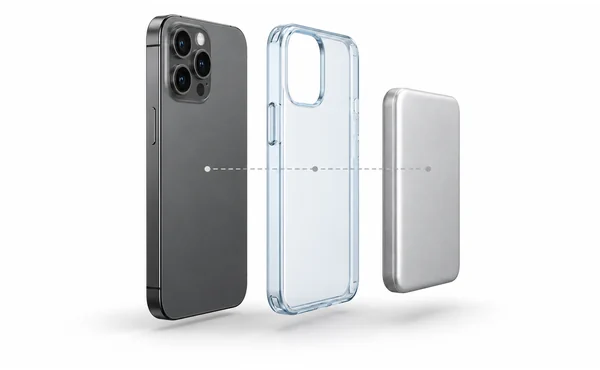
Case compatibility belongs in its own record. A bare-phone result does not establish how the same power bank behaves with your retail bundle. Identify the case construction and any ring or accessory fitted to it, then repeat the alignment, attachment and charging observations on that configuration.
As a product-specific example, Belkin documents support for MagSafe-compatible cases up to 3 mm on its BoostCharge Slim Magnetic Power Bank 5K with Stand Qi2 15W. That condition belongs to the named Belkin product. Use it as an example of precise compatibility wording; the selected YULIDA model needs its own supported conditions.
When a sample works without a case but performs differently with one, preserve both results. Change one part of the configuration at a time so the supplier can investigate the difference. Record whether the symptom is movement, difficulty attaching, charging interruption or some combination of these.
A compatibility list should also match what the customer receives. If the approved result requires a particular case or accessory, make that dependency clear in the product description and packaging instructions.
For example, suppose a sample meets the agreed checks on a bare phone but repeatedly stops charging with the case planned for your bundle. Approving the bare-phone result would leave the retail configuration unresolved. Ask for a corrected sample, evaluate a different case or revise the proposed bundle, then repeat the affected checks.
5. Observe charging under recorded conditions
The charging symbol confirms that the phone has recognised a charging session. To assess the behaviour your specification calls for, continue the observation for an agreed duration and record interruptions, warnings and any repositioning required.
Record the phone model and software version, the starting charge levels of both devices, the case, ambient conditions and the phone activity used during the check. Keep these conditions comparable between samples. If the selected model supports simultaneous wired output or pass-through charging, evaluate the relevant mode separately and label its result.
For Apple’s MagSafe Charger, Apple’s support guidance explains that actual charging power depends on the iPhone model, power adapter and system conditions. It also says software may limit charging above 80% if the battery gets too warm. These conditions describe Apple’s system. For your own sample comparison, record operating conditions before drawing conclusions about the source of a charging difference.
If a supplier quotes a measured wattage, ask where the measurement was taken and what it represents. Agree how a wireless-output claim will be verified for the selected model. A phone’s battery-percentage change over a short session is useful as an observation, but it does not by itself document the claimed output power.
For a thermal concern, record the event and stop using a visibly damaged or abnormal sample. Have the supplier assess it against the applicable product test plan. Do not invent a temperature limit from touch or copy a threshold from an unrelated product.
6. Match certification claims to the exact product
Request the certification reference for the exact product configuration before approving packaging that makes a Qi or Qi2 certification claim. The Wireless Power Consortium’s verification guidance directs buyers to its product database and says the registration record should match the product’s appearance, brand, name and type number.
Check the record against the sample and proposed label. If the project uses a private-label brand or a different model name, ask the supplier to explain the applicable registration route and provide the corresponding evidence. Resolve discrepancies before printing the claim on a carton.
Keep the document review separate from your physical sample observations. A firm magnetic connection cannot establish a certification record, and a certification reference does not replace your agreed fit and handling checks for a particular retail bundle.
7. Keep a golden sample and define production checks
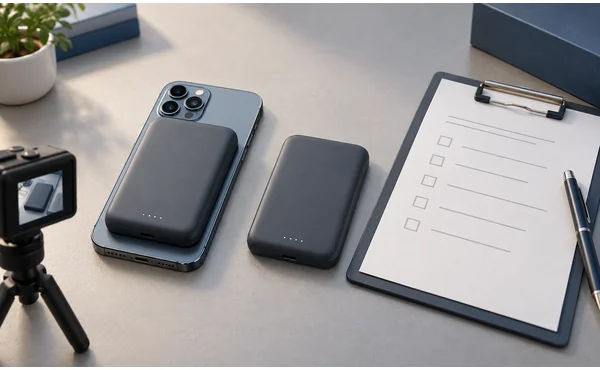
Give the approved sample a reference number and retain the dated approval, configuration details and photos. Ideally, the buyer, supplier and inspector should be able to identify the same approved version without relying on a chat history or an unlabelled sample on someone’s desk.
Le published processus de contrôle qualité includes magnet alignment in assembly control and alignment checks for wireless models within its model-dependent final inspection. For your order, ask which checks apply to the selected model and request the corresponding inspection records.
Agree how production samples will be selected, how defects will be classified and what happens when a result falls outside the approved requirement. YULIDA’s power bank quality-control plan guide provides the wider inspection context; add the magnetic alignment and case-specific requirements to your own order documentation.
Include a change-control rule. Changes to the approved magnetic arrangement, housing or wireless configuration should trigger a review of the requirements they may affect. YULIDA’s published process calls for buyer review of relevant changes affecting performance, certification, appearance or compatibility. Identify the checks to repeat and update the sample reference when a changed version is approved.
When a sample fails: record the symptom before deciding why
A failed observation is a starting point for investigation. The table below helps you send a useful report to the supplier. The checks are suggested follow-ups, not diagnoses or automatic pass/fail rules.
| Observed symptom | Éléments à consigner | Next check to agree | Approval decision |
|---|---|---|---|
| The resting position varies | Photos from repeated attachment on the same phone and case | Compare other identified samples using the same procedure | Hold alignment approval until the variation is explained |
| The power bank moves during handling | Handling action, movement and attachment surfaces | Repeat the agreed handling or force test | Compare results with the written attachment requirement |
| Charging starts and then stops | Timing, charge levels, warnings and any movement | Repeat under matched conditions; investigate with the supplier | Keep charging approval open until the cause is addressed |
| A problem appears only with a case | Exact case and accessory configuration | Compare against the recorded bare-phone result | Revise the supported combination or request a corrected sample |
| The sample differs from its documents | Model labels, photos and the document reference | Request a matching specification or registration record | Hold the affected product claim until identity is resolved |
What to put in your magnetic power bank supplier brief
Send the compatibility list with the enquiry so suppliers quote against the same intended use. Include the preferred housing format and any stand, cable or display requirement, but leave unsupported performance claims out of the brief.
Ask the supplier to return:
- The proposed model and configuration, with sample identifiers and an explanation of any differences from production.
- The supported phone-and-case combinations and configurations that still need evaluation.
- A proposed alignment and attachment check, plus the method for verifying charging claims.
- The product documents needed for the intended label and sales market.
- The production inspection records and change-review process available for the order.
For the sample-approval record, you can adapt this instruction: approve the identified configuration only for the listed phone-and-case combinations; retain the reference photos and agreed test results; refer changes affecting those requirements back to the buyer before accepting the changed version.
This gives the supplier a defined review task. It also gives your own team a way to compare quotations when two products look similar but come with different evidence or compatibility commitments.
Questions fréquentes
1. How do you test magnetic power bank alignment?
Attach the identified sample repeatedly to each target phone and case, photograph its resting position and record any manual adjustment or interference. Use an agreed procedure across samples. Observe charging in the approved position and keep that result alongside the mechanical fit record.
2. How strong should the magnets be?
Set the requirement around the intended handling behaviour and removal experience. If a numerical force limit is needed, agree the fixture, loading direction and method with the supplier or test provider. Compare measured results only when those conditions are equivalent.
3. Can a magnetic power bank work with Android phones?
Check the exact phone’s wireless-charging capability and the attachment configuration required by the selected power bank. Test that combination with the intended case. Avoid extending a result from one Android model to an entire brand or range without supporting compatibility evidence.
4. Does a stronger magnetic hold mean faster charging?
A stronger hold does not establish a charging-power result. Assess attachment using the agreed mechanical check, then verify charging under recorded conditions. The phone, charging system and operating conditions all need to be accounted for when evaluating a performance claim.
5. What case thickness should the specification allow?
Use the conditions validated for the selected product and cases. Include case identity and any accessory dependency in the compatibility record. The cited Belkin product’s 3 mm condition is a model-specific example, not a universal limit for magnetic power banks.
6. What proves that the product is Qi2 certified?
Use the applicable WPC registration and database entry, checking that the product identity matches the sample and intended branding. Request clarification for any mismatch. A magnetic attachment demonstration or an unsupported statement on a quotation is insufficient evidence of certification.
7. What should the golden-sample file contain?
Keep the sample identifier, approved specification, phone-and-case list, reference photos, dated test results and approval record together. Include the agreed production checks and changes that require review. An inspector should be able to determine which configuration and criteria apply without guessing.
8. When should alignment and charging checks be repeated?
Repeat the relevant checks when a proposed change affects an approved requirement, or when a production observation calls the original result into question. Identify the changed component or configuration, review the affected evidence and record the approval of any replacement reference sample.
Discuss a YULIDA sample plan before the bulk order
Send YULIDA your target phone-and-case list, intended sales market and the magnetic model you want to evaluate. Ask which sample checks and inspection records can be included for that configuration. Request an OEM/ODM sample discussion with those details so the next step is a specific sample plan and quotation.
Sources officielles et vérification
Ces sources primaires étayent les informations de cet article sur les normes, la compatibilité, la sécurité ou le transport. Vérifiez les exigences actuelles pour le modèle précis et le marché de destination.
- Assistance Apple — Fonctions de recharge des appareils et conseils de compatibilité.
- Wireless Power Consortium — Normes Qi et Qi2, certification et informations sur la recharge sans fil.
