






Power Bank Packaging Tests: Drop, Vibration and Carton Checks for OEM Buyers
Power bank packaging tests should evaluate the finished product in the packaging configuration that will actually be shipped. Before accepting a report, check the product model, packing quantity, packaging revision, test method and acceptance criteria. Review the condition of the power banks inside, not just the appearance of the outer carton.
A report for a different insert or carton quantity leaves a gap in the approval record. So does a test that covers the factory-to-warehouse shipment when the buyer also needs individual parcels delivered to customers.
This guide explains how OEM buyers can specify and review packaging validation. The checklists are purchasing recommendations, not a laboratory procedure or a substitute for lithium-battery transport requirements. Tests involving power banks should be planned and conducted by personnel equipped to manage battery hazards.
What should power bank packaging tests cover?
Define the complete packed configuration before discussing a test. A retail box, a master carton and a pallet load are different test objects.
| Packaging level | What the buyer should identify | What to review after testing |
|---|---|---|
| Retail box and insert | Product position, insert material, accessory compartments and closure | Product retention, surface damage, box condition and accessory movement |
| Inner box or multipack, if used | Unit count, dividers, orientation and cushioning | Separation between units and condition of the retail packs |
| Master shipping carton | Packed quantity, dimensions, gross weight, board specification and sealing method | Carton deformation, opening, internal movement and damage to contents |
| Palletized load, if used | Carton arrangement, pallet, stacking pattern and securing materials | Load movement, support, carton damage and the condition of the packed products |
For each order, record which configuration goes through each part of the journey. If a distributor removes the master carton and sends a retail box in a separate shipping box, that outbound parcel needs its own packaging review.
Keep artwork approval separate from protective-performance approval. The liste de contrôle de l’étiquetage et de l’emballage des batteries externes covers product identification and printed information.
Choose the test around the distribution route
Give the laboratory a short route description: how the goods leave the factory, where they are stored or repacked, and how they reach the customer. Include parcel handling, palletized stages and any retailer-specific requirements.
ISTA distinguishes early-design screening tests in its 1-Series from general transport-simulation tests in its 3-Series. A screening result should not be described as evidence that every intended shipping route has been simulated. Select the procedure for the actual distribution system and package type. ISTA test procedures.
Ask the laboratory to identify the procedure and edition, explain its suitability, and list any additional requirements or deviations. Do not choose a method solely because a supplier already has a report with that name.
The approved test plan must state the drop heights, vibration conditions and compression loads, with a basis for each. Do not copy values from another product’s report without checking that they apply to this shipment.
Freeze the product and packaging specification
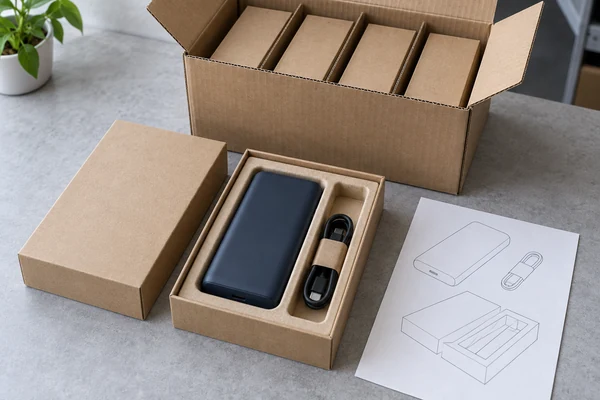
Record the tested configuration in the OEM product specification or an attached packing specification. Include:
- Power bank model, SKU, relevant hardware revision, dimensions and mass.
- Included cables, manuals and other accessories, with their positions in the pack.
- Retail-box and insert drawings, materials and revision numbers.
- Inner-box and master-carton quantities and packing orientation.
- Carton dimensions, board specification, gross weight and closure method.
- Pallet arrangement and securing materials where applicable.
- Test-sample identities, production source and preparation records.
Photograph the packing arrangement before the samples are sealed. The report should show enough detail to distinguish the approved configuration from a similar-looking alternative.
If a preliminary test uses substitute weights instead of finished products, ask what that result can establish. It cannot provide post-test evidence about charging functions or damage to actual power banks.
How to review drop, vibration and compression tests
Ask for the results of the completed test sequence, including which samples underwent each stage.
Drop testing
ASTM D5276 describes free-fall testing of loaded containers. That test object differs from an unpackaged power bank subjected to a product-level mechanical test. Check which one the report actually covers. ASTM D5276.
For a packaging report, request the packed mass, conditioning, drop orientations, heights, sequence and recorded damage. The laboratory should identify the equipment and method used.
A short video of a carton being dropped may show one event, but it does not establish that the approved sequence was completed or that the contents met the acceptance criteria. Ask for sample-linked results and post-test inspection records.
Vibration testing
ASTM D4728 addresses random vibration of filled shipping units. Its public guidance calls for representative field data and warns that random and sinusoidal vibration are not directly equivalent. A report that says only “vibration passed” is too vague to review. ASTM D4728.
Confirm the vibration method, profile, duration, package orientation and any applied top load. Ask which observations were recorded and whether the test followed the selected procedure without interruption or modification.
For power banks, specify a post-test review of product movement, insert damage, accessory retention and abrasion. These are proposed inspection items; the approved plan should define the actual limits.
Compression and stacking checks
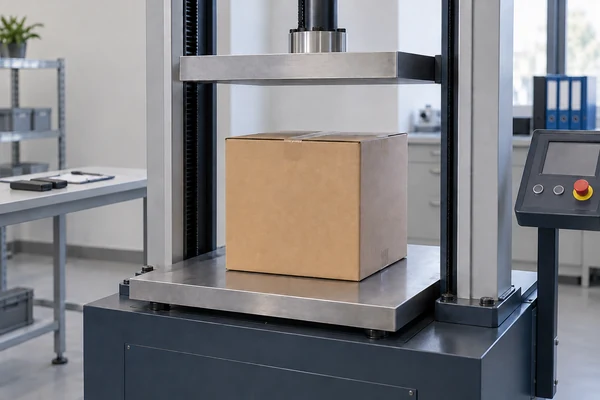
ASTM D642 covers compressive resistance of shipping containers, components and unit loads. Its public scope allows testing with or without contents and points to a separate method for constant-load testing. Identify what was measured before interpreting the result as evidence for warehouse stacking. ASTM D642.
Ask whether the specimen was empty or filled, how it was conditioned, how the load was applied, and what endpoint was used. If the plan represents a stacking exposure, request the load and duration basis.
Do not turn a peak compression-force result into an unsupported claim about how many cartons can be stored for months. Have the packaging specialist assess the intended stacking arrangement and environment. Product storage limits also remain relevant; see the power bank storage and shelf-life guide.
Agree on pass and fail criteria before testing
Write separate criteria for the outer packaging, retail presentation and product condition. Otherwise, the buyer and supplier may disagree about whether a damaged gift box is acceptable even when the device still works.
The following table is a starting point for the purchase specification, not a universal standard.
| Review area | What to define in advance |
|---|---|
| Shipping carton | Permitted deformation, closure integrity, legible identification and containment of contents |
| Retail presentation | Acceptable scuffing, denting, print damage and seal condition for the intended sales channel |
| Product retention | Permitted movement and how displaced products, inserts or accessories will be evaluated |
| Power bank condition | Housing, display, ports and built-in cable inspection, plus the action for any suspected battery damage |
| Functional performance | Named post-test checks, conditions and limits from the approved product specification |
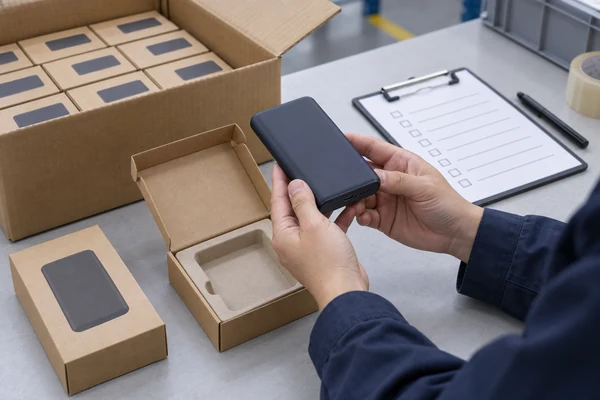
Set the post-test examination order with the laboratory. Suspected battery damage needs a safety assessment before any decision to energize or recharge a unit. Do not charge a visibly damaged or swollen power bank merely to see whether it still works.
A successful startup is only one observation. The agreed assessment may also cover port operation, charging behavior, display function or other model-specific requirements. No single quick check establishes the absence of hidden damage.
What should a useful packaging test report contain?
Request evidence that connects each conclusion to a particular sample and packing revision:
- Report number, laboratory, test dates and responsible reviewer.
- Product identities and the complete tested packaging configuration.
- Sample count, selection basis and preparation details.
- Procedure, edition, test sequence and recorded conditions.
- Equipment identification and relevant calibration records.
- Before-and-after photographs and observations linked to sample IDs.
- Results against each packaging and product acceptance criterion.
- Deviations, failures, retest history and the scope of the final conclusion.
Ask how the samples moved through the sequence. If different specimens were used for different tests, the report should explain whether that follows the selected procedure and what combined exposure was evaluated.
ISTA’s guidance requires the specified sequence for certification testing and does not permit opening a package for internal inspection during that sequence. Agree on inspection points before testing; an undocumented opening and repacking can change what the report represents. ISTA guidance on selecting and using tests.
Keep failed results with the corrective-action record. A later passing report should identify what changed and link back to the failed test.
Example: changing from 40 to 50 units per carton
Consider a hypothetical order of 1,000 power banks. At 40 units per carton, the order needs 25 cartons. Increasing the quantity to 50 reduces that number to 20.
The revised carton contains 25% more products. Even if the outer dimensions stay unchanged, the previous 40-unit report does not establish the performance of the 50-unit arrangement. The gross weight, internal support and product positions need review.
Ask the supplier for the revised packing drawing and actual packed weight. Record the change and obtain the required validation before approving it for shipment. A lower carton count is a commercial benefit to evaluate, not evidence that the new pack is suitable.
ISTA’s retesting guidance calls for repeat testing when the product, packaging or process changes, and when there is doubt about the effect on performance. ISTA retesting guidance.
Apply the same change-review process to insert substitutions, carton-board changes, different sealing methods and altered pallet arrangements. Link approval to the first affected order or lot through the power bank BOM and change-control record.
Check production packing and transport compliance separately
Packaging validation establishes evidence for a defined design. Before shipment, the buyer still needs to confirm that production uses that design.
Include packing checks in the agreed inspection plan: correct revision, unit count, product orientation, accessory positions, carton specification, sealing and shipment identification. Compare selected packed cartons with the approved record. The liste de contrôle des essais qualité des batteries externes covers the wider product review.
Transport compliance needs a separate review. IATA’s battery guidance distinguishes cell and battery test evidence under UN 38.3 from consignment packing and other air-transport requirements. A commercial packaging-test pass does not replace those requirements or establish carrier acceptance. IATA Battery Guidance Document.
Have the responsible dangerous-goods specialist confirm the requirements for the actual product and shipment. Keep that review with the shipping file described in the guide to shipping power banks from China.
A packaging-test brief to send your supplier
Complete these fields before requesting a quotation for testing:
Buyer, purchase order and product SKU: [details]
Product and packaging revisions: [controlled references]
Distribution route and repacking stages: [factory to final destination]
Test configuration: [retail pack, master carton or pallet; contents, quantity, dimensions and mass]
Proposed procedure and edition: [laboratory recommendation and reason]
Sample plan and preparation: [quantity, selection basis, conditioning and laboratory-approved battery condition]
Acceptance criteria: [packaging, appearance, product condition and specified functional checks]
Required report: [sample-linked results, photographs, deviations and failure records]
Change and retest process: [responsible reviewers and approval steps]
Commercial scope: [testing cost, timing, sample disposition and retest charges]
Shipment release: [authorized approver and separate transport-compliance review]
Ask the supplier to identify missing inputs before booking the test. A quoted test name without a defined specimen and acceptance criteria is an incomplete brief.
Questions fréquentes
1. Is there one required drop height for all power bank packaging?
No single value applies to every packaging-validation project. Use the selected procedure and applicable shipment requirements for the exact packed configuration. Record the height, orientations and sequence rather than accepting an unexplained “drop test passed” statement.
2. Can a retail-box test cover the master carton?
Do not assume so. They are different packed configurations. Ask which shipping stages and packaging levels the report covers, including any repacking before delivery to the customer.
3. Does an intact outer carton mean the power banks passed?
No. Review the contents against the agreed product criteria. Packaging appearance, retail presentation and functional results should be recorded separately, with suspected damage referred for a safety assessment.
4. Can foam be replaced with a paper insert after approval?
Treat it as a packaging change. Identify the new material and geometry, update the packing specification, and complete the required review and testing before production use. Similar appearance does not establish equivalent protective performance.
5. Is packaging validation the same as inspecting every shipment?
No. Validation evaluates a defined packaged-product design under an agreed test plan. Shipment inspection checks whether a production lot follows the approved requirements. The contract and applicable requirements should define both activities and any periodic retesting.
6. Can one report cover several power bank models?
Only where the proposed coverage has a documented technical basis and is permitted by the applicable procedure or approval program. Compare product geometry, mass, packaging fit and other relevant differences. Do not extend the report solely because the models have the same advertised battery capacity.
Discuss packaging requirements with YULIDA
When requesting an OEM quotation, send the product model, destination, sales channel and proposed carton quantity with the packaging artwork. Describe any repacking or individual-parcel delivery after the bulk shipment arrives.
Ask YULIDA to confirm the proposed packing specification and which model-specific records are available. Agree on any laboratory work, acceptance criteria and change-approval responsibilities before the packing configuration is released for production. Contacter YULIDA about your OEM power bank project.
Sources officielles et vérification
Ces sources primaires étayent les informations de cet article sur les normes, la compatibilité, la sécurité ou le transport. Vérifiez les exigences actuelles pour le modèle précis et le marché de destination.
- Association du transport aérien international — Exigences de transport des batteries au lithium et recommandations du secteur.
