








Comment inspecter les batteries externes avant expédition : échantillonnage AQL, classification des défauts et liste de contrôle qualité
Une inspection de batteries externes avant expédition compare un lot de produits finis au bon de commande, aux spécifications approuvées, à l’échantillon de référence et aux exigences d’emballage. Avant son lancement, l’acheteur doit définir le lot et le plan d’échantillonnage, les classes de défauts, les nombres d’acceptation, les méthodes d’essai et l’autorité de libération. Le rapport doit conduire à une décision claire : libérer, bloquer, reprendre ou réinspecter le lot.
L’inspection avant expédition (PSI) fournit des éléments sur le lot terminé et prêt à quitter l’usine. L’échantillonnage ne peut pas prouver que chaque unité est exempte de défauts, et l’inspection ne remplace ni la validation du produit, ni la certification de sécurité, ni les contrôles du transport des batteries au lithium. Elle répond à une question plus précise : ce lot respecte-t-il les règles d’acceptation convenues avec l’acheteur ?
Qu’est-ce qu’une inspection de batteries externes avant expédition ?
Une inspection avant expédition, souvent abrégée PSI, est un contrôle des produits finis avant que l’acheteur autorise leur expédition. Un inspecteur vérifie la quantité disponible, prélève des échantillons dans le lot, examine la qualité de fabrication et l’emballage, réalise les essais fonctionnels convenus, consigne les défauts et présente ses constatations.
L’inspecteur peut travailler pour l’acheteur, l’usine ou une société d’inspection indépendante. L’indépendance peut réduire les conflits d’intérêts, mais un périmètre écrit clair compte davantage que le nom de l’entreprise sur le rapport. Aucun inspecteur ne peut prendre une décision fiable à partir d’une instruction aussi vague que « vérifier la qualité ».
Distinguer validation, approbation des échantillons et inspection avant expédition
Plusieurs activités qualité interviennent pendant un projet OEM. Elles répondent à des questions différentes et ne doivent pas être considérées comme interchangeables.
| Activité | Question principale | Moment habituel |
|---|---|---|
| Validation du produit | La conception satisfait-elle aux exigences de performance, de sécurité et de fiabilité ? | Pendant le développement et avant la production en série |
| Approbation de l’échantillon de présérie | Cet échantillon physique et sa configuration documentée sont-ils approuvés comme référence de production ? | Avant d’autoriser l’engagement des matériaux et la production en série |
| Inspection avant expédition | Le lot de produits finis respecte-t-il les exigences approuvées selon le plan d’échantillonnage convenu ? | Après la production, au stade de préparation de l’emballage convenu |
| Examen des documents de transport | La conception de la batterie, le résumé d’essais, les marquages, l’emballage et les modalités d’expédition conviennent-ils à l’itinéraire prévu ? | Avant l’acceptation de l’envoi par la chaîne logistique |
Approuvez une référence maîtrisée avant la production. La guide de contrôle pour l’approbation des échantillons de batteries externes explique comment consigner le modèle, la cellule, le PCBA, le micrologiciel ainsi que les révisions des fichiers graphiques et de l’emballage. Sans cette référence, un inspecteur peut constater des différences sans pouvoir déterminer quelle version l’acheteur a approuvée.
Préparer le dossier d’inspection avant de réserver un inspecteur
Transmettez à la société d’inspection les mêmes documents maîtrisés que ceux utilisés par l’usine. Le dossier d’inspection doit contenir :
- Bon de commande, numéro de modèle, quantités et marchés de destination
- Spécifications produit approuvées avec date de révision
- Échantillon de référence, fiche d’échantillon signée ou photographies de référence détaillées
- Nomenclature approuvée ou liste des composants maîtrisés
- Logo, étiquette signalétique, code-barres, notice et fichiers graphiques de l’emballage
- Spécifications des cartons, méthode d’emballage et liste des accessoires
- Documents de conformité et de transport requis
- Norme d’échantillonnage, niveau de contrôle et valeurs AQL
- Définitions des défauts critiques, majeurs et mineurs approuvées par l’acheteur
- Méthodes d’essai, équipements, conditions et limites d’acceptation
- Actions correctives encore ouvertes après l’approbation des échantillons ou une production antérieure
Lorsqu’une exigence est difficile à décrire, utilisez un dessin ou une photographie assortis d’une limite acceptable. « Aucune rayure » prête à discussion. Une distance d’observation, des conditions d’éclairage et une taille maximale de marque définies donnent aux deux parties une règle utilisable.
Choisir le moment de l’inspection et le stade de préparation requis
Définissez ce stade dans le bon de commande ou le cahier des charges d’inspection. La production et l’emballage doivent être suffisamment avancés pour que les échantillons sélectionnés représentent l’envoi. En parallèle, les cartons et les palettes doivent rester accessibles pour une sélection aléatoire.
Il n’existe pas de pourcentage universel de produits emballés convenant à toutes les commandes. Une règle de préparation courante chez un prestataire d’inspection peut être inadaptée à un envoi contenant plusieurs SKU ou à un projet nécessitant des contrôles par carton. Demandez à l’usine de communiquer, avant l’arrivée de l’inspecteur, les quantités terminées, emballées et non terminées, ainsi que les produits stockés dans une autre zone.
Définir le lot d’inspection avant de prélever les échantillons
Le lot est la population dans laquelle les échantillons sont prélevés et à laquelle s’applique la décision d’inspection. Consignez le SKU, le modèle, la couleur, la capacité, les révisions du matériel et du micrologiciel, les dates de production, le lot de cellules, la plage de numéros de cartons et la quantité totale.
Ne regroupez pas sans le signaler des produits présentant des différences importantes. Deux capacités dans un même boîtier, des fournisseurs de cellules différents, des séries de production distinctes ou des étiquettes de destination différentes peuvent nécessiter des lots séparés ou des consignes d’échantillonnage stratifié. Si l’envoi est réparti entre plusieurs entrepôts, consignez chaque emplacement et décidez de la répartition des prélèvements.
Prélever les échantillons au hasard dans l’ensemble de l’envoi
C’est l’inspecteur, et non l’usine, qui doit sélectionner les unités. Les échantillons doivent provenir de différents cartons, positions sur les palettes et zones de stockage accessibles. Des échantillons préparés par l’usine peuvent masquer les variations entre lignes d’assemblage, équipes ou lots de cellules.
Consignez le numéro de chaque carton sélectionné et l’identification de chaque échantillon. Séparez les échantillons destinés aux essais destructifs, de longue durée ou en laboratoire de ceux utilisés pour les contrôles courants d’apparence et de fonctionnement. Si une unité défaillante est remplacée par une unité de réserve non consignée, le décompte des défauts et le rapport perdent leur sens.
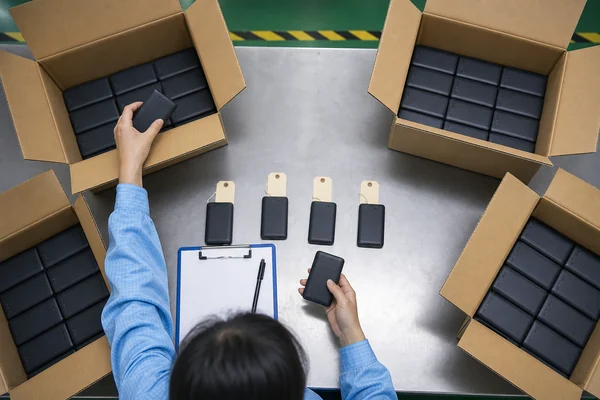
Comment fonctionne l’échantillonnage AQL
ISO 2859-1:2026 définit des procédures d’échantillonnage indexées sur le niveau de qualité acceptable, ou AQL, pour le contrôle lot par lot par attributs. Dans un plan d’échantillonnage simple, la taille du lot et le niveau de contrôle choisi déterminent une lettre-code et une taille d’échantillon. La valeur AQL retenue donne ensuite un nombre d’acceptation et un nombre de rejet.
L’édition ISO en vigueur comprend des procédures de contrôle normal, renforcé, réduit et à lots sautés, avec des règles de passage de l’une à l’autre. Un acheteur ne doit pas recopier une taille d’échantillon d’un tableau en ligne et l’appliquer à toutes les commandes. Le plan, le régime de contrôle et les règles de changement doivent être choisis et documentés.
L’AQL ne garantit pas que l’envoi contient au maximum un pourcentage donné d’unités défectueuses. L’ASQ définit l’échantillonnage pour acceptation comme le contrôle d’un échantillon prélevé dans un lot pour décider d’accepter ou non ce lot. L’échantillonnage maîtrise le risque de décision ; il ne révèle pas le taux exact de défauts de l’ensemble de l’envoi.
Utilisez un exemplaire sous licence de la norme en vigueur ou la procédure maîtrisée d’un prestataire d’inspection pour obtenir les tableaux. L’acheteur doit approuver le niveau de contrôle, les valeurs AQL, les classes de défauts et les règles d’acceptation avant la fin de la production.
Ne pas appliquer un AQL universel à toutes les commandes de batteries externes
Le plan approprié dépend du risque pour l’acheteur, de l’historique des commandes, de la maturité du produit, de la destination, du canal de vente et du coût d’une défaillance. Une commande promotionnelle, un lancement en magasin et une batterie externe fournie avec un autre appareil peuvent justifier des règles d’inspection différentes.
Les défauts critiques nécessitent souvent un traitement plus strict que les défauts esthétiques, et un acheteur peut imposer par contrat un nombre d’acceptation nul pour une condition critique définie. Cette règle doit figurer dans le cahier des charges d’inspection. Elle ne doit pas être déduite d’une liste générique après la découverte d’un défaut.
Définir par écrit les défauts critiques, majeurs et mineurs
La classification des défauts détermine la façon de compter les constatations ; il faut donc convenir d’exemples avant l’inspection. Le tableau suivant est un point de départ, pas une définition juridique universelle.
| Classe de défaut | Signification pratique | Exemples possibles pour les batteries externes |
|---|---|---|
| Critique | Condition pouvant créer un risque de sécurité, juridique ou de transport grave, ou enfreignant une exigence de tolérance zéro définie par l’acheteur | Batterie gonflée, surchauffe anormale, conducteur exposé, signe de fuite, non-concordance grave de l’identification de la batterie ou marquage interdit |
| Majeur | Défaillance susceptible de rendre le produit inutilisable, sensiblement différent des spécifications approuvées ou inacceptable pour le client visé | Modèle ou étiquette de capacité incorrects, sortie non fonctionnelle, profil de charge rapide requis absent, câble intégré défaillant, accessoire manquant, code-barres de vente incorrect ou écart d’assemblage important |
| Mineur | Écart de fabrication ou d’apparence n’affectant pas sensiblement le fonctionnement normal | Petite marque de surface dépassant la limite d’apparence convenue, léger décalage d’impression ou faible variation de couleur sur un produit utilisable |
Une même observation peut changer de classe selon son emplacement, sa gravité et le marché visé. Une rayure sur une surface cachée n’équivaut pas à une détérioration traversant le marquage de la marque. Le rapport doit inclure des photographies et des mesures, pas seulement une désignation de défaut.
Suivre une séquence d’inspection fixe
Une séquence constante réduit les contrôles oubliés et évite de mélanger les unités après les essais.
- Confirmer l’usine, le bon de commande, l’identité du lot, les quantités et le stade de préparation.
- Sélectionner les cartons et les unités selon les consignes d’échantillonnage approuvées.
- Vérifier les cartons d’expédition, l’emballage de vente, les fichiers graphiques, les étiquettes, les codes-barres, les accessoires et les notices.
- Inspecter l’apparence, l’assemblage, les dimensions, le poids et la qualité de fabrication.
- Tester l’entrée de charge, les sorties filaires, les câbles intégrés, les indicateurs, les boutons et les fonctions sans fil applicables au modèle.
- Effectuer les mesures convenues sur le sous-échantillon défini, dans des conditions consignées.
- Examiner la traçabilité, les relevés de production et les documents requis.
- Compter les défauts par classe, photographier les constatations et établir un rapport avec les résultats bruts.
Utilisez le guide des essais de qualité des batteries externes détaillé pour définir les méthodes d’essais électriques et de capacité. Une liste de contrôle PSI doit renvoyer à ces méthodes plutôt que de les réduire à une case non vérifiée.
Vérifier l’emballage, les étiquettes et l’identité de l’envoi
Les erreurs d’emballage peuvent bloquer le dédouanement ou entraîner un réétiquetage coûteux même si la batterie externe fonctionne. Comparez la boîte de vente, l’étiquette signalétique, la notice, le carton d’expédition et les marquages d’expédition aux fichiers graphiques approuvés. Scannez les codes-barres plutôt que de les juger à leur apparence.

- Exactitude du modèle, de la capacité, de l’énergie en wattheures et des indications d’entrée et de sortie
- Marque, logo, couleur et révision des fichiers graphiques
- Langue de destination et informations requises sur l’importateur
- Contenu et emplacement du code-barres, et résultat du scan
- Accessoires, type de câble, notice et documents de garantie
- Unités par carton, dimensions des cartons, poids brut et marquages
- Protection contre les mouvements, l’abrasion et les dommages aux connecteurs
Ne demandez pas à un inspecteur d’approuver des éléments graphiques réglementaires sans lui fournir la référence approuvée et les exigences de destination. L’inspecteur peut comparer les versions et signaler les écarts ; la responsabilité juridique reste celle des parties qui mettent le produit sur le marché.
Vérifier la qualité de fabrication et le fonctionnement de base
Inspectez l’ajustement du boîtier, les jonctions, les ports, les connecteurs, les câbles, les boutons, les fenêtres d’affichage, l’impression et la finition de surface. Mesurez les dimensions et le poids convenus avec des équipements étalonnés. Les contrôles fonctionnels doivent couvrir chaque interface des spécifications, notamment le fonctionnement en entrée, en sortie ou bidirectionnel d’un port USB-C.
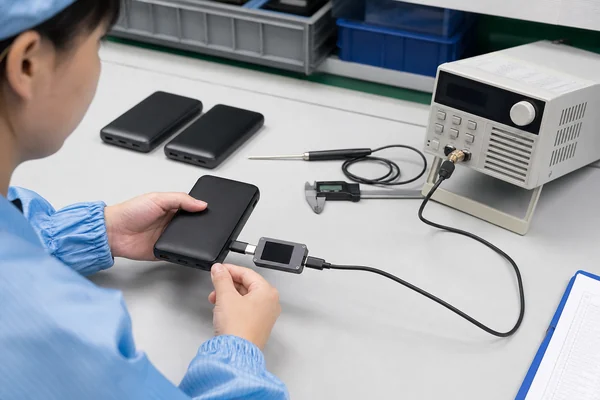
Pour la sortie filaire, consignez la charge d’essai, la tension, le courant et le profil de charge. Pour les modèles à plusieurs sorties, vérifiez les combinaisons indiquées dans le tableau des ports. Pour un modèle magnétique sans fil, consignez l’alignement, l’indication de charge, l’appareil ou le récepteur d’essai, les conditions d’utilisation avec une coque et les observations de température. Ne transformez pas une allégation commerciale non vérifiée en critère de réussite de l’inspection.
Utiliser un sous-échantillon défini plus petit pour les essais de performance mesurée
Certains essais durent plus longtemps que la visite d’inspection ou mobilisent une grande partie des échantillons disponibles. L’énergie utilisable, le temps de recharge complète, le rendement de conversion et le comportement thermique nécessitent des conditions initiales, des équipements et des profils d’essai définis. Précisez combien d’unités seront testées et si le travail sera réalisé à l’usine, dans une société d’inspection ou en laboratoire.
La capacité nominale en mAh décrit la batterie interne à sa tension nominale. Elle ne doit pas être comparée directement aux mAh en sortie mesurés à une autre tension. Consignez l’énergie en wattheures, la tension de sortie, la charge, le seuil de coupure, les conditions ambiantes et la configuration des câbles pour qu’une autre personne puisse reproduire le résultat.
Identifier les contrôles qui sortent du cadre d’une PSI courante
| Contrôle | Méthode de maîtrise habituelle | Motif |
|---|---|---|
| Nombre de cartons et identité de l’envoi | Vérification des quantités ou contrôle par carton | L’envoi doit correspondre à la commande et à la liste de colisage |
| Apparence et fonctionnement de base | Échantillon AQL | Il s’agit de contrôles de conformité par attributs sur des unités finies |
| Énergie utilisable ou temps de recharge | Sous-échantillon défini pour les essais de performance | Les essais nécessitent du temps, des conditions définies et des données mesurées |
| Durée de vie en cycles, essais en conditions abusives et programme complet de fiabilité | Validation en développement ou en laboratoire | Ces essais ne peuvent pas être réalisés dans le cadre d’une courte visite avant expédition |
| Certification de sécurité du produit applicable | Laboratoire accrédité et procédure de conformité propre au marché | Une inspection visuelle n’est pas une évaluation de certification |
| Justificatifs d’essais UN 38.3 et acceptation au transport | Examen documentaire complété par les exigences du prestataire logistique | Les règles de transport s’appliquent à la conception de la batterie et à l’envoi prévu, pas seulement aux unités échantillonnées |
IEC 62133-2:2017+A1:2021 précise les exigences de sécurité et les essais des cellules et batteries secondaires portables étanches au lithium qui relèvent de son domaine d’application. Le Manuel d’épreuves et de critères de l’ONU comprend, dans sa sous-section 38.3, des dispositions relatives aux cellules et batteries au lithium. Ces documents définissent des travaux qui ne peuvent pas être reproduits par un contrôle fonctionnel rapide pendant une PSI.
Examiner la traçabilité et les documents de transport des batteries
Vérifiez la concordance du modèle fini avec la cellule approuvée, la configuration de la batterie et les rapports concernés. Consignez le fabricant et le modèle de cellule, le lot de production, le lot de produits finis ainsi que les révisions du micrologiciel ou du matériel, le cas échéant. Un rapport portant sur une autre conception de batterie ne doit pas être accepté au seul motif que la marque semble similaire.
Le Manuel d’épreuves et de critères de l’ONU, révision 8 et amendement 1 contient les modifications actuellement publiées de la sous-section 38.3. Les expéditions aériennes doivent aussi respecter les règles applicables au transporteur, à l’itinéraire et aux marchandises dangereuses. Le Guide IATA 2026 sur les batteries repose sur les Instructions techniques de l’OACI 2025-2026 et la 67e édition de la Réglementation de l’IATA pour le transport des marchandises dangereuses.
Un rapport PSI doit confirmer que les documents spécifiés étaient disponibles et cohérents avec le modèle inspecté. Il ne doit pas déclarer qu’un envoi est légalement autorisé pour tous les itinéraires. L’acceptation finale dépend de la classification réelle, de l’état de charge lorsqu’il est réglementé, de l’emballage, des marquages, des déclarations, du transporteur et de l’itinéraire.
Exiger un rapport d’inspection étayé par des preuves
Un acheteur absent de l’usine doit malgré tout pouvoir comprendre ce qui a été inspecté et comment le résultat a été obtenu. Exigez au minimum :
- Fournisseur, adresse de l’usine, date d’inspection et inspecteur
- Bon de commande, SKU, modèle, taille du lot et stade de préparation de l’emballage
- Norme d’échantillonnage, niveau de contrôle, valeurs AQL et taille de l’échantillon
- Méthode de sélection des cartons et des unités
- Nombre de défauts par classe, avec nombres d’acceptation et de rejet
- Mesures brutes, détails des équipements et conditions d’essai
- Photographies des échantillons, de l’emballage, des étiquettes et de chaque défaut
- Noms des documents, numéros des rapports et révisions examinées
- Éléments non terminés, inaccessibles ou non testés
- Résultat global et personne autorisée à libérer l’envoi
Les photographies doivent montrer le contexte et les détails. Un gros plan d’un port endommagé sans identifiant d’échantillon n’est pas traçable. L’affichage d’un appareil de mesure sans le produit connecté ni les réglages d’essai constitue une preuve insuffisante.
Décider de libérer, bloquer, reprendre ou réinspecter le lot
Un résultat « conforme » de la société d’inspection est un élément de la décision d’expédition. L’acheteur doit encore examiner les points ouverts, les écarts aux spécifications et l’état des documents. Un lot échantillonné peut respecter la règle numérique de défauts tout en comportant une modification des spécifications refusée par l’acheteur.
Si le lot échoue à l’inspection, bloquez-le. Demandez à l’usine d’isoler les produits concernés, d’identifier la cause, de définir le périmètre des reprises et de fournir des preuves. Après reprise, la réinspection doit suivre un plan convenu, et non porter sur quelques unités de remplacement choisies à la main. Consignez si le lot initial a été entièrement trié, partiellement repris ou refabriqué.
Cahier des charges d’inspection des batteries externes prêt à copier
Remplissez ce document avant de réserver l’inspection. Remplacez chaque élément entre crochets par une exigence maîtrisée.
Acheteur et bon de commande :
Usine et adresse d’inspection :
Modèle de produit et SKU :
Révisions du matériel, du micrologiciel et des fichiers graphiques :
Définition du lot et quantité :
Stade de préparation de l’emballage requis :
Spécifications approuvées et échantillon de référence :
Norme d’échantillonnage et édition :
Niveau et régime de contrôle :
AQL pour les défauts critiques, majeurs et mineurs :
Définitions des défauts approuvées par l’acheteur :
Répartition des échantillons par SKU ou lot de production :
Contrôles de l’emballage et des fichiers graphiques :
Essais fonctionnels et limites d’acceptation :
Sous-échantillon de performance et conditions d’essai :
Relevés de traçabilité à examiner :
Documents de conformité et de transport à examiner :
Photographies et données brutes requises dans le rapport :
Personne autorisée à libérer l’envoi :
Action en cas d’échec du lot :
Pour un nouveau projet, transmettez les mêmes exigences d’acceptation avec la demande de devis de batteries externes. Le fabricant aura ainsi le temps de chiffrer les essais, de prévoir les relevés de production et d’identifier les exigences nécessitant l’appui d’un laboratoire.
Questions fréquentes des acheteurs
Que vérifie-t-on lors d’une inspection de batteries externes avant expédition ?
Le périmètre comprend normalement la quantité expédiée, l’identité du produit, l’emballage, les étiquettes, la qualité de fabrication, les dimensions et les essais fonctionnels convenus. Les mesures de performance, l’examen documentaire et la traçabilité peuvent être ajoutés si les méthodes et les tailles d’échantillon sont définies à l’avance.
Que signifie AQL dans une inspection d’usine ?
L’AQL est un indice utilisé dans un système d’échantillonnage pour acceptation. Avec la taille du lot, le niveau et le régime de contrôle, il aide à déterminer la taille de l’échantillon et les critères d’acceptation ou de rejet. Il ne mesure pas le pourcentage exact de défauts dans l’envoi.
Quel AQL un acheteur de batteries externes doit-il choisir ?
Il n’existe pas de valeur unique convenant à tous les acheteurs ou modèles. Choisissez les valeurs et les règles relatives aux défauts critiques selon le risque produit, la destination, le canal de vente, la maturité du projet et l’historique du fournisseur. Inscrivez cette décision dans les spécifications d’achat avant l’inspection.
Un inspecteur peut-il vérifier la capacité réelle d’une batterie externe ?
Un inspecteur peut mesurer l’énergie utilisable en sortie sur un sous-échantillon défini si les équipements, la charge initiale, le profil de tension, la charge d’essai, le seuil de coupure et la limite d’acceptation sont spécifiés. Un contrôle fonctionnel court ne peut pas, à lui seul, établir la capacité nominale, le rendement de conversion et les performances à long terme de la cellule.
Que se passe-t-il si le lot échoue à l’inspection ?
Bloquez l’expédition, examinez les défauts et exigez un plan écrit d’isolement des produits concernés et d’actions correctives. Après reprise ou tri, réinspectez le lot selon un plan convenu. Ne le libérez pas au seul motif que quelques échantillons de remplacement sont conformes.
La PSI remplace-t-elle la certification ou les essais UN 38.3 ?
Non. La PSI vérifie la conformité d’un lot de produits finis selon un plan d’échantillonnage. Les normes de sécurité produit, la conformité au marché de destination et les essais de transport des batteries au lithium nécessitent leurs propres procédures et justificatifs. L’inspecteur peut vérifier si les documents spécifiés correspondent au produit, mais une inspection visuelle ne peut pas remplacer une démonstration de conformité en laboratoire.
Références officielles utilisées pour ce guide
- ISO 2859-1:2026, procédures d’échantillonnage indexées sur l’AQL pour le contrôle lot par lot
- Glossaire qualité de l’ASQ, définitions de l’échantillonnage pour acceptation et de l’AQL
- IEC 62133-2:2017+A1:2021, exigences de sécurité des cellules et batteries secondaires portables étanches au lithium
- CEE-ONU, Manuel d’épreuves et de critères de l’ONU, révision 8 et amendement 1
- Guide IATA 2026 sur les batteries
Planifier l’inspection tant que la commande reste maîtrisable
La planification d’une PSI commence avant l’arrivée de l’inspecteur à l’usine. Définissez la configuration approuvée, le lot, les règles d’échantillonnage, les classes de défauts et les méthodes d’essai pendant que l’usine peut encore préparer les relevés et clarifier les exigences. Si ces décisions attendent que les produits soient emballés, le rapport risque de simplement constater un désaccord qui aurait pu être résolu plus tôt.
Pour une commande YULIDA, transmettez le modèle, la quantité, le marché de destination et les contrôles requis via la page de contact. L’usine peut préparer les spécifications du modèle, les relevés de production, les échantillons de référence et les informations d’emballage correspondants. L’acheteur ou la société d’inspection qu’il mandate doit approuver les règles définitives d’échantillonnage et de libération.
Sources officielles et vérification
Ces sources primaires étayent les informations de cet article concernant les normes, la compatibilité, la sécurité ou le transport. Vérifiez les exigences en vigueur pour le modèle exact et le marché de destination.
- Commission électrotechnique internationale — Normes électrotechniques internationales et leurs domaines d’application.
- Association du transport aérien international — Exigences de transport des batteries au lithium et recommandations du secteur.
