







YULIDA checks power banks at three points: when materials arrive, during assembly, and before shipment. The published process includes functional testing, protection checks and a model-specific 28-point final inspection. A 72-hour battery-cell-lot aging procedure applies where specified in the approved quality plan. Sampling, test conditions, acceptance criteria and available records are confirmed for the selected model and target market.
Why Power Bank Quality Control Requires More Than a Capacity Test
A power bank combines lithium cells and a battery-management system with charging electronics, connectors, firmware, mechanical parts, and packaging. A unit may show the expected capacity but still fail because of unstable protocol negotiation, excessive temperature, weak welding, poor cell matching, wireless misalignment, connector wear, or faulty protection logic.
Quality checks continue from incoming components to finished-batch release. Limits come from the approved specification, applicable standards, and the buyer-approved sample.
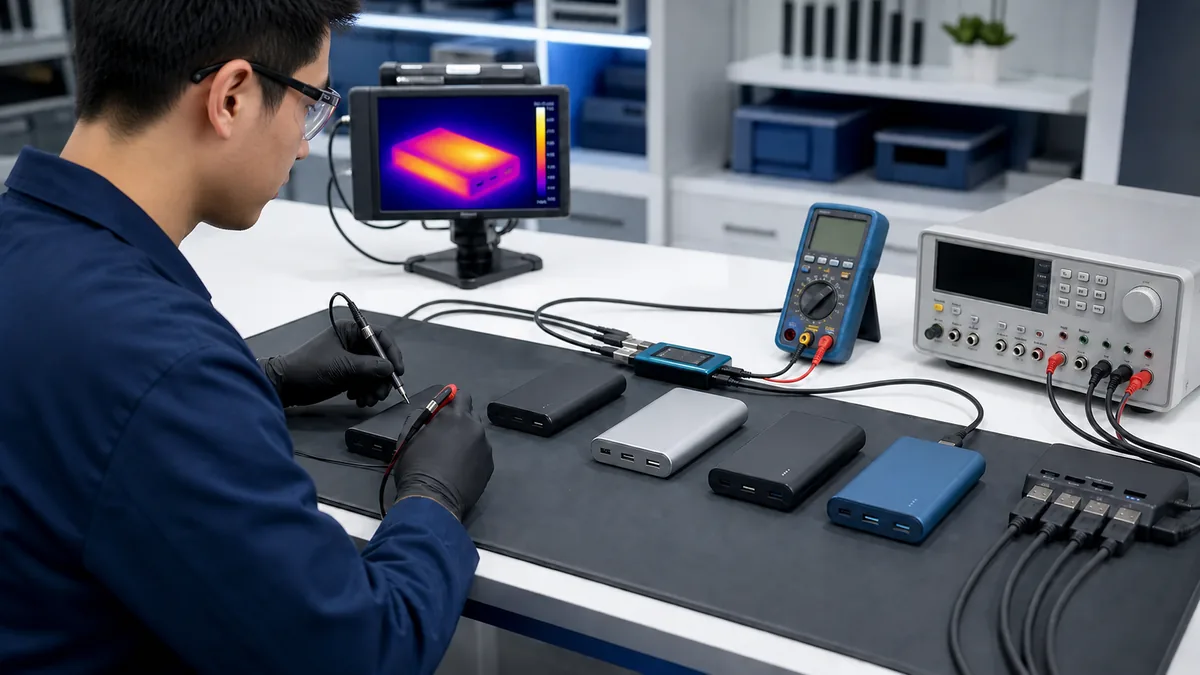
Power Bank Inspection and Testing Stages
| Stage | Typical Checks | Purpose |
|---|---|---|
| Incoming battery cells | Supplier and lot verification, appearance, voltage, internal resistance, capacity sampling, and date-code review | Reduce variation and identify damaged or inconsistent cells before assembly |
| PCBA and electronic parts | Board version, component placement, solder quality, firmware version, charging IC, ports, and display module | Confirm the electronics match the approved bill of materials |
| Cell matching and welding | Cell grouping, polarity, tab placement, weld consistency, insulation, and connection integrity | Check weld integrity, insulation, and current paths |
| Assembly control | Cable routing, connector fit, magnet alignment, housing closure, button response, labeling, and workmanship | Prevent mechanical and cosmetic defects |
| Electrical function | Input/output voltage and current, USB-C PD or supported protocols, simultaneous output, display accuracy, and wireless charging | Confirm charging functions against the approved specification |
| Protection and thermal behavior | Overcharge, over-discharge, over-current, short-circuit, temperature response, and automatic shutoff according to the model plan | Confirm protection responses against the model test plan |
| Aging and final inspection | Cell burn-in, charge/discharge observation, finished-unit inspection, appearance, accessories, and packaging | Record early failures and separate nonconforming units before release |
What Is Included in the 28-Point Final Inspection?
The checklist varies by model. It covers identification, housing condition, buttons and indicators, ports and cables, charging functions, battery display, accessories, and packaging. Wireless models also receive alignment checks.
Critical requirements must match the signed specification and approved sample. A changed battery cell, PCBA version, wireless module, housing material, connector, or firmware should trigger formal review rather than being treated as a routine substitution.
Battery-Cell Burn-In and Aging Tests

For applicable production plans, battery-cell lots undergo a defined 72-hour aging procedure intended to identify early abnormalities before assembly or shipment. The approved quality plan defines sampling, test conditions, acceptance criteria and the observations to record. Confirm the applicable aging procedure and available batch records for the selected model rather than assuming every cell or finished unit receives the same test.
The test duration alone does not guarantee quality. Buyers should also ask how batches are identified, what constitutes a failure, how rejected units are segregated, whether replacement components are retested, and how aging records connect to finished production lots.
Quality Evidence Available to B2B Buyers
- Approved product specification and golden sample
- Bill of materials or controlled component list when agreed
- Incoming, in-process, aging, and final-inspection records
- Batch and date-code identification
- Model-specific CE, FCC, RoHS, UN38.3, and China 3C documentation where applicable
- MSDS and lithium-battery shipping documentation
- Pre-shipment inspection report when requested
- Corrective-action report for confirmed production or field issues
Certification Verification Before Ordering
Certification claims should be checked against the exact product being purchased. Buyers should verify the model number, battery rating, wireless function, PCBA and charging configuration, applicant or manufacturer name, laboratory, test standard, issue date, and report number. A report for a visually similar model may not cover a changed battery pack or electronics design.
UN38.3 relates to lithium-battery transport testing; CE, FCC, RoHS, and China 3C address different regulatory requirements. None of these documents replaces factory quality control, and factory inspection does not replace target-market compliance review.
Managing Defects and Production Changes
Failed components and finished units are labeled and separated from approved stock. Reworked units must be tested again. When a defect recurs, the corrective-action record should identify the affected lots, root cause, containment, and verification result.
For OEM/ODM orders, material and design changes should be controlled in writing. A change to the battery cell, PCBA, firmware, connector, housing, or packaging requires buyer review if it affects performance, certification, appearance, or compatibility.
Frequently Asked Questions About Power Bank Quality
Does every power bank receive the same tests?
Core functional and appearance checks apply across products, but the complete test plan depends on the model. Wireless, magnetic, solar, AC plug, TFT display, multi-port, and high-power PD products require additional model-specific checks.
What does a 72-hour burn-in test show?
Where specified in the approved quality plan, a 72-hour battery-cell-lot aging procedure helps identify early abnormalities. The duration alone does not establish test coverage or product quality. Buyers should confirm the sampling, test conditions, acceptance criteria and available batch records for the selected model.
How can an importer verify advertised battery capacity?
Capacity should be tested with documented equipment and conditions. Buyers should distinguish nominal cell capacity from usable output energy after voltage conversion and efficiency losses.
Can a third party inspect the order before shipment?
Yes. Buyers can arrange an independent pre-shipment inspection and should define sampling level, critical, major and minor defects, test methods, and acceptance criteria before production.
How does quality control connect to OEM/ODM development?
The approved specification, golden sample, bill of materials, firmware version, certification scope, and inspection criteria become the reference for production. Review the full OEM/ODM process and the YULIDA power bank factory capabilities.
Request Quality and Compliance Documents
Send the model number, target market, order quantity, and required certifications. YULIDA will confirm which documents are available and agree on inspection requirements before quotation.