





YULIDA manufactures power banks in Shenzhen, China for brand owners, importers, distributors, retailers, and promotional product companies. Standard logo and packaging orders usually start at 500 units. Light customization starts at 1,000 units, while projects involving custom PCBA, firmware, or tooling typically start at 2,000 units.
What Does the YULIDA Power Bank Factory Manufacture?
YULIDA manufactures portable charging products for international B2B orders. Current product categories include magnetic wireless models, TFT display power banks, built-in-cable and AC plug models, outdoor solar and hand-crank units, metal power banks, and multi-function chargers. Buyers can select an existing production model with custom branding and packaging. Projects can also customize the color, cable, connector, surface finish, PCBA, tooling, or smart-display firmware, depending on the order quantity and engineering review.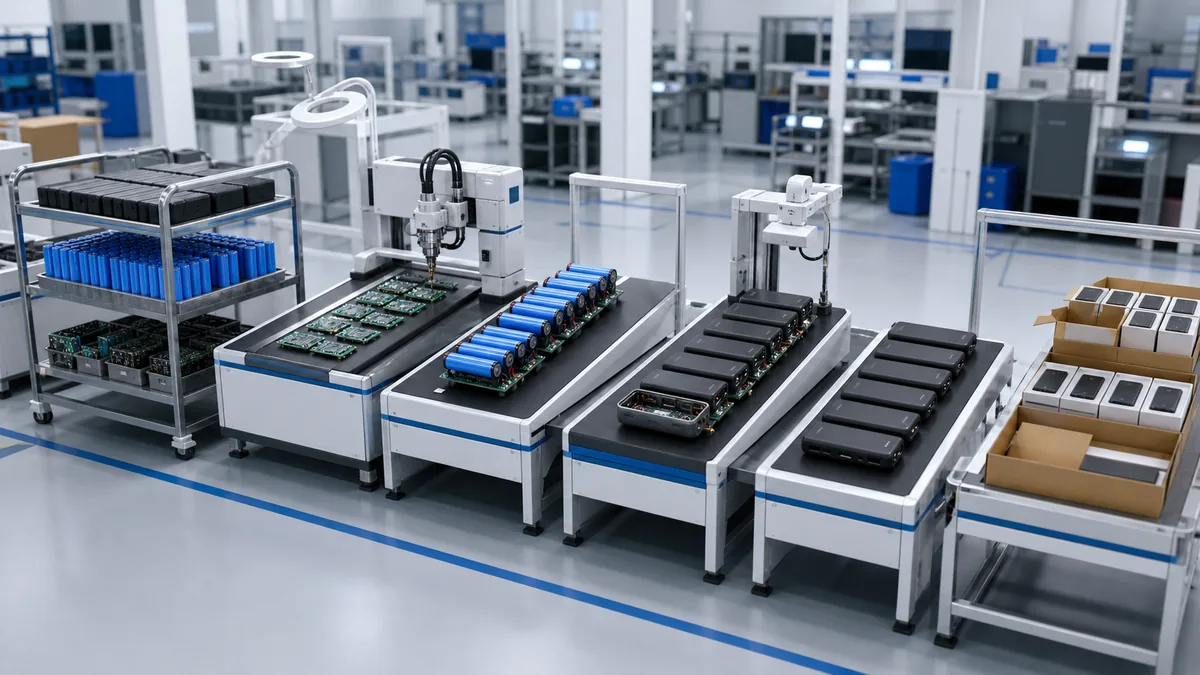
Select a magnetic model for production review
Use the published specifications below to shortlist a sample from the magnetic wireless power bank category. These are model-page specifications, not independent certification or performance verification.
| Model | Published capacity | Published wireless output | Confirm for your order |
|---|---|---|---|
| AJ01 | 10,000mAh; 38.5Wh at 3.85V | iOS 7.5W; Android EPP up to 15W | Exact phone/case, charging mode and sample test conditions |
| AJ05 | 5,000mAh or 10,000mAh; request Wh for each version | 5W / 7.5W / 10W / 15W | Selected capacity, dimensions, label and supported device profile |
| AJ06 | 5,000mAh or 10,000mAh; request Wh for each version | 5W / 7.5W / 10W / 15W | Selected capacity, ports, charging modes and sample approval |
Rated output depends on the device, protocol and test conditions. Confirm wired profiles, compatibility, customization, MOQ and current model-specific documents in the written specification. Request the selected model, sample and OEM quotation.
Factory Capabilities at a Glance
Choose an existing-model OEM program for a faster launch, or extend the project into deeper engineering and product development when the market requires greater differentiation.| Capability | What YULIDA Supports | Buyer Benefit |
|---|---|---|
| Existing-model OEM | Logo printing, custom user manuals, retail packaging, and stock color selection | Uses an existing production model; no new tooling is required |
| Light customization | Pantone colors, cable type and length, connector selection, surface finish, and packaging design | Changes appearance and connectors without developing a new mold |
| Deep ODM | Custom PCBA, firmware, industrial design, structural engineering, and proprietary molds | Supports deeper product differentiation after engineering review and sampling |
| Compliance support | CE, FCC, RoHS, UN38.3, and China 3C documentation according to the selected model | Helps align documentation with the selected model and target market |
| Quality assurance | Incoming checks, in-process controls, functional validation, final 28-point inspection, and aging tests | Creates inspection records for each production batch |
Engineering Review Before Production
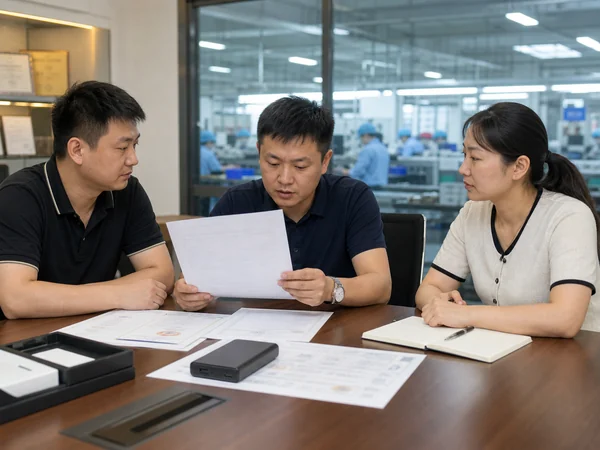
Before sampling or mass production, the YULIDA team reviews the product specification, housing, PCBA, battery cell, charging protocol, materials, packaging, and compliance requirements. This review helps align technical details, tooling needs, target cost, lead time, and inspection criteria with the buyer before production planning begins.How Power Banks Move Through the Factory
- Requirement reviewTarget market, capacity, charging protocol, ports, wireless requirements, quantity, branding, packaging, and compliance needs are confirmed.
- Sample and specificationAn existing model or prototype is evaluated. Electrical parameters, materials, artwork, and acceptance criteria are documented.
- Engineering and sourcingPCBA, battery cells, housing, cables, display modules, magnets, and packaging materials are prepared against the approved specification.
- Assembly and in-process controlCell matching, soldering, PCBA installation, housing assembly, firmware loading, and cosmetic checks are completed at defined workstations.
- Functional and safety testingInput/output, protocol negotiation, capacity, display, wireless charging, temperature behavior, and protection functions are checked.
- Aging, final inspection, and shipmentWhere specified in the approved quality plan, battery-cell lots undergo a 72-hour aging procedure. Confirm the sampling, conditions and acceptance criteria for the selected model. Finished-unit inspection and batch records follow that plan before approved goods are packed with the required documents.
OEM and ODM Order Levels
| Program | Typical Starting MOQ | Typical Lead Time | Ideal For |
|---|---|---|---|
| Standard OEM | 500 units | 15–20 days | Logo and packaging on an existing production model |
| Light Customization | 1,000 units | 20–25 days | Custom color, cable, connector, finish, and packaging |
| Deep ODM | 2,000 units | 30–45 days | Custom PCBA, firmware, industrial design, and proprietary mold |
Final MOQ and lead time depend on the model, battery-cell availability, certification scope, packaging, tooling, and engineering complexity. Buyers should request a written specification and production schedule before placing a large order.
Certifications and Market-Entry Documentation
YULIDA lists CE, FCC, RoHS, UN38.3, and China 3C documentation for selected products, together with BSCI and ISO 9001 factory credentials. Coverage is model-specific. Buyers should verify the report number, tested model, named applicant or manufacturer, laboratory, standard, and validity date before ordering. For lithium-battery shipments, importers commonly request the UN38.3 test report, MSDS, commercial invoice, packing list, and model-specific conformity documents. YULIDA can align the document package with the target market and confirmed shipping method.How B2B Buyers Can Audit a Power Bank Factory
- Confirm the legal company name, production address, and whether assembly and quality control take place at the stated facility.
- Request a live or recorded factory tour showing cell handling, soldering, assembly, aging, testing, and finished-goods areas.
- Match certification reports to the exact battery capacity, PCBA, wireless module, housing, and model being purchased.
- Approve a signed specification sheet and golden sample before mass production.
- Define the inspection level, acceptance criteria, defect classification, warranty handling, and change-control rules in writing.
- Use a pre-shipment inspection for the first order or any materially changed product.