





Power Bank Compliance by Country: EU, US, UK, Japan, India and China Requirements for OEM Buyers
There is no worldwide power bank certificate. Start with UN 38.3 transport evidence for the exact lithium battery type, then build a separate compliance file for every sales market. An EU launch may involve the EU Batteries Regulation, CE marking, EMC, RoHS and producer registration. A US model needs the correct FCC route for its circuitry and wireless functions, while UL 2056 may be requested by the buyer or sales channel. Japan uses PSE requirements for mobile batteries, India lists power banks under the BIS Compulsory Registration Scheme, and China requires CCC for power banks within its domestic compulsory-certification scope.
The model matters as much as the country. A wired 10,000mAh power bank, a Qi2 magnetic model, a Bluetooth-enabled model and a unit with a built-in AC plug do not share one compliance plan. Fix the battery cell, PCBA, rated power, ports, cables, wireless functions, firmware and enclosure before relying on any report.
Last reviewed: September 3, 2026. This guide explains common compliance routes for OEM buyers; it is not legal advice. Rules, implementation dates and retailer policies change. Confirm the final product, responsible economic operator, sales channel and shipment route with a qualified laboratory or compliance adviser before launch.
Power bank requirements by market at a glance
| Destination | Main starting points | Who normally holds responsibility | Common buyer mistake |
|---|---|---|---|
| European Union | EU Batteries Regulation, CE conformity file, EMC, RoHS, applicable radio rules, WEEE and battery producer responsibility | Manufacturer, EU importer and other economic operators according to their legal roles | Requesting a generic “CE certificate” without checking the Declaration of Conformity or technical file |
| United States | FCC equipment authorization where applicable, consumer-product safety assessment, retailer requirements and lithium-battery transport rules | US responsible party, importer, manufacturer, distributor or retailer depending on the rule | Treating FCC as proof of battery safety or assuming UL 2056 is a universal federal sales certificate |
| Great Britain | Applicable UK product rules, accepted CE or UKCA route, EMC and RoHS review, battery and WEEE producer duties | Manufacturer, UK importer or authorised representative according to the applicable legislation | Using one “UK” file without separating Great Britain from Northern Ireland |
| Japan | Electrical Appliances and Materials Safety Act and PSE requirements for mobile batteries | Japanese manufacturer or importer placing the product on the market | Printing a PSE mark before the responsible business has completed its conformity duties |
| India | BIS Compulsory Registration Scheme for power banks for portable applications under the listed Indian standard | Registered manufacturer and authorised Indian representative where applicable | Assuming a registration for one brand, factory or model automatically covers another |
| China | CCC certification for power banks in the applicable domestic scope, current implementation rules and GB standards | Certified applicant, manufacturer and production site within the scheme | Using an export-market report as a substitute for a valid CCC certificate |
Use this table to open the review. The purchase-order checklist comes after the product is classified. Capacity, watt-hours, wireless charging, an AC input, built-in cables, solar charging, radio communication and bundled adapters can change the applicable rules. Marketplace policies and dangerous-goods carriers may add requirements that do not appear in national product legislation.

Certificate, report, declaration and registration are different documents
Suppliers often place every compliance document in a folder named “certificates.” That label hides important differences. Ask what each document proves and who issued or signed it.
| Document | What it normally shows | What it does not prove by itself |
|---|---|---|
| Test report | Identified samples were tested against stated methods and conditions | That every production unit matches the sample or that the product may be sold in every country |
| Certification or listing | A certification body evaluated a defined product under a particular scheme | Coverage of unlisted brands, factories, models, capacities or later design changes |
| Declaration of Conformity | The manufacturer declares that an identified product meets listed legislation and standards | That an EU authority issued a general approval certificate |
| UN 38.3 test summary | The lithium cell or battery type passed the applicable UN transport test sequence and provides the required summary information | Electrical safety, EMC, restricted-substance or market-registration compliance |
| Product registration | A product, manufacturer or responsible party is recorded under a national scheme | Coverage outside the scheme, market or registered scope |
| SDS or MSDS | Chemical, handling and emergency information supplied for the battery or product | Passing UN 38.3 or approval for air, sea or road transport |
Start with the transport file for the exact battery type
Permission to sell and permission to ship answer different questions. The transport file usually comes first because samples and production units must leave the factory. UN 38.3 appears in subsection 38.3 of the United Nations Manual of Tests and Criteria. The test sequence covers transport conditions such as altitude, temperature cycling, vibration, shock, external short circuit, impact or crush, overcharge and forced discharge as applicable to the cell or battery type.
The test summary required by subsection 38.3.5 should identify the manufacturer, laboratory, report number and date, battery description, model numbers, mass, watt-hour rating, tests completed, results and authorised signatory. A cell report cannot automatically be presented as evidence for every assembled power bank. The production battery construction must match the tested type and the scope shown in the documents.
IATA’s 2026 lithium-battery guidance treats power banks as UN 3480 lithium-ion batteries for air cargo, not as batteries contained in or packed with equipment. The guidance places power banks under Packing Instruction 965 and states that they are shipped at less than 30% state of charge; the applicable section depends on the watt-hour rating and shipment details. Packaging, quantity, marks, labels, documentation and carrier acceptance still need a shipment-specific review. Use the detailed power bank shipping checklist when planning freight.

Buyer rule: do not approve a battery document by filename. Match the manufacturer, battery model, watt-hours, physical description, report ID and production construction.
Where IEC 62133-2 and UL 2056 fit
IEC 62133-2 specifies safety requirements and tests for portable sealed secondary lithium cells and batteries under intended use and reasonably foreseeable misuse. It is a battery-safety standard, not a universal market-access mark. A national certification program, customer specification or CB Scheme project may use it as part of a broader evaluation.
UL 2056 is a dedicated power-bank safety standard used in North American safety programs. It addresses the complete power bank rather than only the cell. UL 2056 is not a blanket federal sales certificate for every US power bank. Retailers, insurers, corporate buyers and procurement contracts may still require a recognised safety listing. Check the channel before the design is frozen. A late requirement can force component changes and repeat testing.
European Union: build one technical file for all applicable rules
The EU does not issue a general “CE certificate” for a power bank. CE marking is the manufacturer’s statement that the identified product complies with all EU legislation that requires the mark. The manufacturer completes the conformity assessment, prepares the technical documentation, signs the EU Declaration of Conformity and applies the marking. The importer has its own verification and traceability duties.
EU Batteries Regulation
Regulation (EU) 2023/1542 applies to batteries placed on the EU market. A consumer power bank will generally contain a portable battery and requires a product-specific classification. The regulation covers conformity assessment, technical documentation, an EU Declaration of Conformity, CE marking, identification, safety information and phased labelling or sustainability duties. Some dates depend on implementing acts or the battery category, so the label artwork should be checked against the planned placing-on-the-market date rather than copied from an older project.
EMC, RoHS and radio functions
A power bank’s switching electronics can create electromagnetic disturbance and can also be affected by nearby equipment. The applicable EMC assessment should cover the final ports, operating modes, cables and wireless-charging functions. RoHS restricts specified hazardous substances in electrical and electronic equipment, so the evidence should follow the bill of materials and homogeneous materials, not just the battery cell.
A basic inductive charging function and a product that also communicates by Bluetooth, NFC or another radio technology may follow different conformity routes. Ask the laboratory to classify every intentional and unintentional radio-frequency function. Do not add a radio feature after testing and assume the original declaration remains valid.
Importer and producer-responsibility work
Laboratory reports do not complete an EU launch. The responsible economic operator must also address product identification, contact details, language, instructions, traceability and the applicable General Product Safety Regulation duties. Battery and WEEE producer registration, reporting, take-back and recycling obligations are normally handled country by country. An OEM factory cannot register every overseas brand automatically.
- EU Declaration of Conformity for the exact finished model
- Technical reports supporting the legislation and standards listed in the declaration
- Battery Regulation conformity and labelling records
- EMC and RoHS evidence for the final construction
- Radio assessment where the product includes communication functions
- Risk assessment, instructions and safety information in the required languages
- EU economic-operator details and traceability records
- Country-specific WEEE and battery producer registrations
United States: FCC compliance is not battery-safety certification
The FCC regulates radio-frequency energy. A wired power bank may contain digital circuitry subject to rules for unintentional radiators. A wireless charging model needs a separate technical classification. FCC guidance states that wireless power transfer devices operating above 9 kHz require equipment authorization and may fall under Part 15, Part 18 or both. A charging system that also transmits information may require certification under the intentional-radiator rules. Radio-frequency exposure requirements can also apply.
Ask the laboratory which authorization procedure and rule parts apply. Then verify the responsible party, test report, model number, operating modes, label text and FCC ID when certification requires one. “FCC available” is not a useful approval statement.
Product safety follows a different path. UL 2056 or another relevant safety program may be a contractual or sales-channel requirement even when it is not a universal federal mandate. Importers also need a process for incident review and any reporting duties under US consumer-product safety law. State battery-recycling, chemical or labelling rules may add work, and marketplaces can set policies beyond federal rules.
United Kingdom: separate Great Britain from Northern Ireland
Great Britain covers England, Scotland and Wales. Current UK guidance allows CE marking to be used alongside or instead of UKCA for a range of product regulations recognised in Great Britain. The correct route still depends on which regulations cover the particular power bank. EMC, RoHS, radio functions and electrical-safety scope should be reviewed against the final design. A standard low-voltage USB power bank and a model with a built-in mains plug may not have the same assessment.
Northern Ireland follows a different product-market framework and generally retains EU rules for relevant goods. A file prepared only for Great Britain should not be assumed to cover Northern Ireland.
The UK importer or producer may also need battery and WEEE registration, reporting and financing arrangements. Government guidance treats the business that first places batteries on the UK market, including an importer with a UK presence, as the battery producer for these duties. Keep product conformity and producer responsibility as separate lines in the launch plan.
Japan: mobile batteries need the correct PSE route
Japan regulates mobile batteries under the Electrical Appliances and Materials Safety Act. METI states that a lithium-ion storage battery sold as a mobile battery must comply with the applicable technical requirements and display the PSE mark. The Japanese business placing the product on the market must complete the required procedures and maintain supporting records.
A PSE logo printed by the overseas factory is not enough. Before packaging approval, confirm the notifying supplier or importer, applicable category, test basis, rated capacity and energy, model identity, required markings and Japanese warnings. Bundled AC adapters and products with an integral mains plug need their own scope review.
- Name and address of the responsible Japanese business
- Product and battery specifications matching the test evidence
- Applicable technical-standard conformity records
- PSE artwork, rating label and Japanese instructions
- Inspection and record-retention procedure for production shipments
India: confirm BIS registration for the model, brand and factory
India lists “Power Banks for Use in Portable Applications” under its compulsory registration framework. BIS currently publishes the product test-report format against IS 13252 (Part 1):2010. The registration process is tied to the manufacturer, factory, brand and covered models. A report from a recognised laboratory supports the application, but the report alone is not the market registration.
Private-label buyers should settle the brand name and model family before filing. Adding a capacity, changing the brand, moving production to another factory or altering safety-relevant components may require inclusion work or a new application. Foreign manufacturers normally work through an Authorised Indian Representative for the scheme. Check current BIS and Ministry of Electronics and Information Technology instructions before shipment because standard transitions and administrative requirements can change.
China: CCC is compulsory within the applicable domestic scope
China added power banks and certain lithium-ion cells and battery packs to the CCC system. Since August 1, 2024, products within the announced scope may not leave the factory, be sold, imported or used in other business activities without CCC certification and the certification mark. The published scope identifies GB 4943.1 and GB 31241 as applicable standards for power banks under the original implementation arrangement.
The rules are changing again. In May 2026, China’s State Administration for Market Regulation announced that GB 47372-2026, Safety Technical Specification for Power Banks, would be added to the CCC certification basis with revised implementation rules. The announcement provides a transition through March 31, 2027. From April 1, 2027, the new rules must be used, and existing certificates for power banks and their internal lithium-ion cells or battery packs must be converted by that date.
An export buyer should not confuse China CCC with destination-market approval. CCC covers the relevant China compulsory-certification scope; it does not replace EU, US, Japanese or Indian work. Export-only situations and any exemption route need case-specific confirmation rather than an assumption based on the factory address.
Qi and Qi2 certification follow the finished wireless product
Qi certification is an interoperability and performance scheme operated by the Wireless Power Consortium. It is separate from national market legislation. A certified coil, controller or reference design does not make the finished power bank Qi Certified. The final product must complete the applicable WPC process and appear in the official product database with a matching brand, product name, manufacturer part number and certification identity.
WPC also controls use of the Qi name and logo. Verify the database listing before printing packaging or marketplace images. If an OEM project changes the brand, enclosure, magnet layout, coil, shielding, firmware or charging profile, ask whether the certification file and listing must be updated.
Build the compliance matrix before paying for tests
Instead of asking whether the factory has CE and FCC, ask which documents cover the exact SKU, brand, factory and destination. A one-page matrix exposes gaps before tooling and packaging costs are committed.
| Matrix field | What to record | Release condition |
|---|---|---|
| Product identity | Brand, model, SKU, capacity, Wh rating, colour and market version | Matches sample, label, quotation and reports |
| Battery construction | Cell maker and model, series or parallel arrangement, pack protection and lot code | Production BOM matches tested battery type |
| Electrical functions | Input, output, USB protocols, simultaneous charging, wireless power and firmware | Every operating mode appears in the test plan |
| Destination and channel | Country, marketplace, retailer, corporate customer and importer | Legal and channel requirements are both listed |
| Transport | UN 38.3 report and summary, SDS, route, carrier and dangerous-goods instruction | Forwarder accepts the exact shipment |
| Market documents | Reports, declarations, certificates, registrations, listings and responsible-party details | Numbers and status can be verified |
| Label and manual | Ratings, marks, warnings, languages, importer details and recycling information | Approved artwork matches the compliance file |
| Change control | Critical components, firmware, drawings and approval authority | No substitution without written technical review |
The buyer’s power bank product specification should carry the same identifiers used in this matrix. Put the approved documents, model names and change-control rules into the OEM manufacturing agreement, then check the finished label against the power bank label guide.
Which OEM changes need a compliance review?
Even a familiar platform needs review when the buyer creates a new variant. The decision depends on the scheme, but the following changes should always be sent to the laboratory, certification body or responsible compliance owner before production:
- Cell manufacturer, model, chemistry, capacity or pack arrangement
- Protection IC, charging controller, MOSFET, PCB layout or firmware
- Wireless coil, shielding, magnets, communication module or power profile
- USB-C, USB-A, Lightning connector or built-in cable configuration
- Rated input, output, total power or pass-through charging behaviour
- Housing material, wall thickness, flame classification or thermal structure
- Built-in AC plug, solar panel, display or added accessory
- Brand, model number, legal manufacturer, importer or production site
- Label claims, certification logos, manual languages or packaging identity
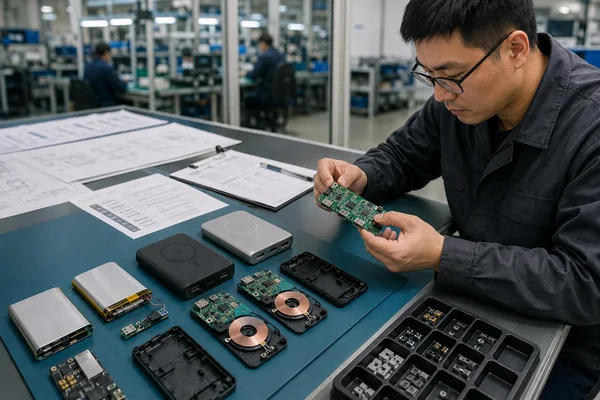
A logo-only project may avoid full electrical retesting, but declarations, registrations, listings and labels can still need revision. Require the scope decision in writing rather than relying on a salesperson’s chat message.
Documents to request from a power bank supplier
- Final specification and bill of materials for the exact SKU
- UN 38.3 test report and test summary for the production battery type
- Current SDS that identifies the same battery or product
- Market-specific test reports, declarations, certificates and registrations
- Certificate database links or verification details where available
- Report photographs, model lists and product-family explanations
- Rating-label, packaging and instruction-manual artwork
- Critical-component list and signed engineering change procedure
- Golden sample or compliance sample matching the tested construction
- Production inspection and traceability records tied to the approved model
Review these files before approving the production sample. The power bank sample approval checklist explains how to lock the configuration, while the pre-shipment inspection guide covers checks before release.
Red flags in a supplier’s compliance package
- The file contains only logos or certificate cover pages
- The model number, capacity, watt-hours or product photograph does not match the quotation
- A cell report is presented as certification for the complete power bank
- The applicant, brand, factory or production address is different and no relationship is explained
- The report predates a major cell, PCBA, wireless or enclosure change
- An FCC file for a wired model is reused for a wireless version
- A CE declaration does not identify the product or applicable EU legislation
- The Qi claim cannot be matched to the WPC certified-product database
- The registration status cannot be found in the issuing authority’s database
- The supplier says that one certificate covers every country and every OEM variant
Frequently asked questions
1. What certifications does a power bank need?
The answer depends on the product and destination. Most commercial shipments need UN 38.3 transport evidence for the lithium battery type. EU, US, UK, Japan, India and China then apply different conformity, registration, marking and producer-responsibility rules. Wireless charging, radio communication and an AC input can add further requirements.
2. Is CE marking enough to sell a power bank in the EU?
No. The CE mark is the visible result of a conformity process. The manufacturer and importer still need the applicable technical documentation, EU Declaration of Conformity, labels, instructions, traceability and evidence under the Batteries Regulation and other relevant EU legislation. WEEE and battery producer registrations are separate.
3. Does every power bank need FCC certification in the United States?
Not every model follows the same FCC authorization procedure. The route depends on the circuitry and radio-frequency functions. FCC guidance says wireless power transfer devices above 9 kHz require equipment authorization under Part 15, Part 18 or both. Ask a qualified laboratory to classify the exact product.
4. Is UN 38.3 the same as IEC 62133-2?
No. UN 38.3 addresses lithium-cell and battery testing for transport classification. IEC 62133-2 addresses safety of portable sealed secondary lithium cells and batteries in intended use and reasonably foreseeable misuse. A project may need both.
5. Is UL 2056 mandatory for all power banks sold in the US?
No blanket federal rule makes UL 2056 certification compulsory for every US power bank. A retailer, marketplace, insurer, corporate buyer or local requirement may still demand a recognised safety listing. Confirm the channel requirements before final design approval.
6. Do mobile power banks sold in Japan need a PSE mark?
Yes, mobile batteries within the Japanese scope must meet the applicable technical requirements under the Electrical Appliances and Materials Safety Act and display the PSE mark. The responsible Japanese business must complete the required procedures; the overseas factory cannot add the mark without that compliance route.
7. Do power banks need BIS registration in India?
Power banks for use in portable applications are listed under India’s compulsory registration framework. BIS publishes the relevant test-report format against IS 13252 (Part 1):2010. Confirm the current registration scope, covered models, brand, factory and authorised Indian representative before import.
8. Can an OEM buyer use the factory’s existing reports under a new brand?
Sometimes, but never assume automatic coverage. The scheme may require a brand addition, new declaration, updated listing, model inclusion or fresh registration. Hardware changes can trigger further testing. Ask the issuing body or responsible compliance owner for a written scope decision before printing labels.
Official reference sources
- UNECE: UN Manual of Tests and Criteria, Revision 8 and amendments
- IATA: lithium-battery transport resources
- EUR-Lex: Regulation (EU) 2023/1542 concerning batteries and waste batteries
- European Union: CE marking guidance
- European Commission: RoHS Directive
- US FCC: wireless power transfer equipment authorization guidance
- US CPSC: battery voluntary standards information
- UK Government: placing manufactured goods on the Great Britain market
- UK Government: waste-battery producer responsibility
- Japan METI: Electrical Appliances and Materials Safety Act and PSE
- Bureau of Indian Standards: compulsory-registration test-report formats
- China SAMR: CCC requirements for lithium-ion batteries and power banks
- China SAMR: 2026 revised CCC requirements and transition for power banks
- IEC: IEC 62133-2 portable lithium battery safety
- Wireless Power Consortium: Qi Certified Product Database
Match the documents to the order before production
Send the supplier the target countries, sales channels, brand, exact power bank specification, planned shipment method and required product claims. Ask for a model-by-model document matrix instead of a folder of unrelated certificates. YULIDA’s compliance resource page explains the main document types, and the OEM/ODM service overview covers specification, sampling and production support. For a project-specific review, contact YULIDA with the SKU and destination list.
Official sources and verification
These primary sources support standards, compatibility, safety, or transport statements discussed in this article. Confirm the current requirement for the exact product model and destination market.
- International Air Transport Association — Lithium-battery transport requirements and industry guidance.
- U.S. Federal Communications Commission — Radio-frequency equipment authorization information.
- International Electrotechnical Commission — International electrotechnical standards and standard scopes.
- Wireless Power Consortium — Qi and Qi2 standards, certification, and wireless-charging information.
