







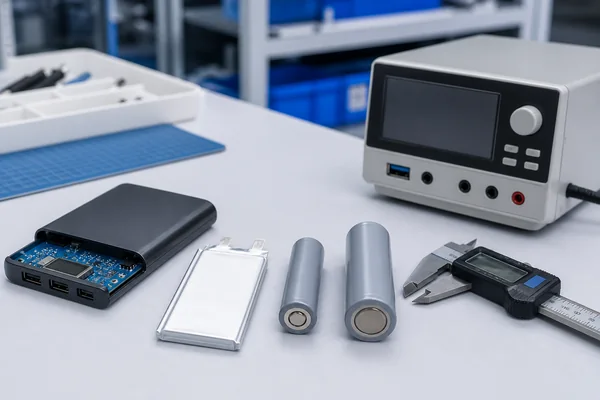
How to Choose Battery Cells for a Power Bank OEM Project: Capacity, Cycle Life and Traceability
Choose a power bank cell by its exact manufacturer and model, electrical limits, documented test conditions and production-lot traceability. An “A-grade” label, capacity figure or sales sample is not enough for approval. None of those tells the buyer whether mass production will use the same cell or whether it suits the power bank’s charging power, enclosure and thermal design.
The cell approval package should identify the maker, model, format, chemistry, nominal voltage, minimum and typical capacity, electrical limits, dimensions, weight, lot code, cycle-life method and applicable reports. Then test the approved power bank as a complete product. Its protection circuit, firmware, connectors, wiring and heat path can change the result even when the cell itself meets its specification.
Start with the finished power bank requirement
Start with the finished-product specification before opening a catalogue of cells. A slim 5,000mAh magnetic model, a 10,000mAh built-in-cable power bank and a high-output laptop power bank place different demands on the battery. Define those demands before asking a supplier to recommend a cell.
- Rated battery capacity and nominal energy in watt-hours
- Maximum input, single-port output and total simultaneous output
- Expected operating and storage temperature range
- Enclosure dimensions, allowable cell space and target product weight
- Wireless charging, magnetic alignment or other internal heat sources
- Target markets, transport route and required compliance documents
- Expected service life and the cycle-life acceptance method
Give the cell supplier or power bank factory the same written requirement used for quotation. Otherwise, two suppliers may quote the same printed capacity with different cell constructions, current limits and life expectations.
Pouch cells, 18650 cells and 21700 cells are formats, not quality grades
Power banks commonly use laminate pouch cells or cylindrical cells such as 18650 and 21700. Buyers sometimes use “lithium polymer” as a shorthand for a pouch cell, but the label does not define every part of the chemistry or construction. Ask for the exact datasheet and model number instead of assuming that one format is always safer, lighter or longer lasting.
| Comparison point | Laminate pouch cell | 18650 or 21700 cylindrical cell |
|---|---|---|
| Mechanical form | Flat, flexible dimensions; useful for slim or shaped enclosures | Standard cylindrical dimensions; packs may use one or more cells |
| Product design | Can use enclosure area efficiently, but swelling allowance and edge protection need attention | Predictable shape and mechanical handling, but cell holders and interconnections use space |
| Supplier comparison | Dimensions, tab design and model-specific specifications must match | Cell model, maker, capacity, current rating and lot still need to match |
| Typical decision | Often selected for thin magnetic or pocket products | Often selected where standard cylindrical construction fits the enclosure |
The format narrows the mechanical choices. Cell quality still depends on the actual design, manufacturing control, storage history and operating conditions in the finished pack.
Compare watt-hours before comparing output capacity
The mAh printed on a power bank usually describes the internal battery at its nominal voltage. It is not the amount of charge delivered at a 5V, 9V or higher USB output. Voltage conversion consumes some energy, and the product stops discharging when its protection limits are reached.
Use watt-hours for the first comparison:
Energy (Wh) = capacity (Ah) x nominal voltage (V)
For example, a 10,000mAh battery rated at 3.7V represents 10Ah x 3.7V = 37Wh of nominal battery energy. The usable energy measured at the USB output will be lower and will vary with the output profile, load, cable, temperature and conversion circuit. Ask the factory to report both nominal battery energy and measured output energy under stated conditions.
Minimum capacity and typical capacity are not interchangeable
A cell datasheet may list both a minimum capacity and a typical or nominal capacity. The typical value describes an expected result under the maker’s stated test conditions. The minimum value is the more useful purchasing control because it states the lower acceptance boundary under those conditions.
Ask which value appears on the quotation, product label and bill of materials. Then confirm the test current, charge voltage, discharge cut-off voltage, rest time and temperature behind it. A capacity value without these conditions is difficult to reproduce.
A cycle-life number needs a test method
“500 cycles” is incomplete. Cycle life changes with charge voltage, discharge depth, current, temperature and the capacity level used to define end of life. A test that ends each discharge at a different voltage can produce a different result even when the cell model is unchanged.
For a comparable cycle-life claim, record:
- Cell model and production lot
- Charge current, charge voltage and charge-termination condition
- Discharge current and cut-off voltage
- Test temperature and rest periods
- Capacity measurement interval
- End-of-life threshold, such as the remaining percentage of initial capacity
Request the test curve or report instead of accepting a number copied into a quotation. For an OEM project, agree on the method before sample approval so the factory and buyer apply the same acceptance rule.
Check internal resistance and current capability in context
Internal resistance affects voltage drop and heat generation under load, but the reading depends on the measurement method, temperature and state of charge. A low number from an unspecified meter is not a complete quality result. Ask the supplier to state the instrument or method, cell temperature, state of charge and acceptance range.
The cell’s permitted charge and discharge currents must also fit the power bank design. A PCBA advertised for high USB-C output does not make an unsuitable cell capable of supplying that load. Review continuous and peak current requirements, voltage sag, connector loss and thermal measurements together. This matters most in compact enclosures where the cell sits close to the conversion board or wireless charging coil.
Treat “A-grade” as a supplier description
There is no single international purchasing standard that turns the phrase “A-grade cell” into a complete, independently verifiable specification. Different sellers may use it for original cells, higher-capacity sorting or simply as a marketing label.
Replace the phrase with evidence: maker, model, datasheet revision, source, lot code, inspection criteria and test results. If the factory will not identify the cell until after the order is placed, the buyer cannot confirm that the sample and mass-production units use the same component.
Build traceability into the approval package
Traceability should connect the approved sample to the production order and the finished cartons. The exact method varies by factory, but the record should let both parties identify which cell lot went into a given batch of power banks.
| Record | What to capture | Why it matters |
|---|---|---|
| Approved component list | Cell maker, model, specification revision and approved alternatives | Prevents an informal substitution from becoming the production standard |
| Incoming lot record | Supplier lot, date code, quantity, receipt date and inspection result | Links incoming cells to the factory’s inspection data |
| Production record | Work order, assembly date, cell lot and finished-product lot | Supports containment if a later defect is tied to one lot |
| Retained sample | Cell and finished-unit samples identified by lot | Allows comparison when a field complaint is investigated |
| Change notice | Reason, affected part, test plan and buyer approval | Creates a written decision before a replacement cell is used |
Documents to request before approval
The document set depends on the cell, finished product, destination and shipping method. Ask for model-specific files and check that the names and ratings match the cell in the sample.
- Current cell datasheet with revision or issue date
- Safety Data Sheet supplied for the identified cell or battery type
- UN 38.3 test summary and supporting report information for the applicable cell or battery design type
- IEC 62133-2 evidence when required by the project, market or certification route
- Material and environmental declarations required for the target market
- Factory incoming-inspection specification and sampling plan
UN 38.3 concerns transport testing. It should not be presented as a substitute for product safety evaluation or market-specific compliance. A report for a different model, capacity or battery construction does not automatically cover the unit you are buying. Review the final configuration with a qualified laboratory or dangerous-goods specialist when coverage is unclear.
Set an incoming-cell inspection plan
Incoming inspection checks whether the delivered lot matches the approved component before assembly starts. The thresholds should come from the approved datasheet and the factory’s validated measurement method, not from a generic internet checklist.
- Verify maker markings, model, lot or date code and packaging label.
- Inspect appearance, terminals, tabs and any deformation or leakage.
- Measure dimensions and weight against the controlled drawing.
- Record open-circuit voltage and internal resistance using stated conditions.
- Run capacity tests on an agreed sample size from the lot.
- Quarantine a nonconforming lot until the deviation is reviewed in writing.
The inspection record should identify the test equipment and calibration status. Keep raw readings rather than a pass/fail mark alone. Raw data makes it easier to spot lot drift before failures appear in finished units.
Validate the complete power bank after cell approval
An approved cell does not prove that the finished power bank meets its specification. Test the complete sample for nominal energy, usable output energy, conversion efficiency, input and output profiles, multi-port behaviour, protection response and temperature rise. Include the supplied cable and the charging modes that customers will actually use.
The power bank quality testing guide explains how buyers can record these results before ordering. If the project includes a wireless coil, built-in cable, AC plug or high-output USB-C port, repeat the relevant tests in that configuration rather than relying on a base model.
Control cell substitutions after sample approval
A factory may need an alternative cell because of availability, lead time or a discontinued model. The substitution should still be treated as an engineering change. Require written notice before use and compare the new model’s capacity, energy, dimensions, mass, current limits, voltage limits, cycle method, safety documents and transport-test coverage.
Rebuild and test representative samples when the change could affect mechanical fit, thermal behaviour, charging, output performance or compliance. Update the approved component list only after review. The power bank sample approval checklist gives a practical way to freeze the approved configuration before production.
Put the cell controls into the purchase order
The approved cell specification should appear in the purchase order, quality agreement or signed product specification. State that unapproved substitutions are not permitted. Define the production-lot information, retained samples, incoming-test records and change notice that the supplier must keep.
During a power bank factory audit, ask the team to trace one finished unit back to its incoming cell lot. A complete answer is more useful than a display of certificates at reception. Also confirm how rejected cells are segregated and how rework or mixed lots are recorded.
Red flags during power bank battery cell selection
- The quotation says only “A-grade lithium polymer” and gives no maker or model.
- The datasheet capacity differs from the label or commercial quotation.
- The UN 38.3 documents name another cell or battery design type.
- The cycle-life claim has no charge, discharge, temperature or end-of-life conditions.
- The approved sample has no cell-lot record.
- Mass-production cells may be changed according to availability without buyer approval.
- The supplier compares nominal battery mAh directly with USB output mAh.
- Cell markings or traceability codes are removed, covered or inconsistent.
One red flag does not prove fraud or poor quality. It does mean the buyer needs a clearer record before approving the component.
A compact cell approval checklist
| Approval question | Evidence to keep |
|---|---|
| Which exact cell will be used? | Maker, model, format, chemistry and controlled datasheet |
| Does capacity match the claim? | Minimum and typical capacity, Wh calculation and sample test data |
| Can it support the load? | Charge/discharge limits, resistance method and finished-product thermal test |
| What does cycle life mean? | Full test conditions, curve or report and end-of-life threshold |
| Can production be traced? | Incoming lot, work order, finished lot and retained sample |
| Are the documents applicable? | Matching model names, ratings, report references and revision dates |
| Can the factory change it? | Written change-control and reapproval requirement |
Frequently asked questions
Are pouch cells better than 18650 or 21700 cells for power banks?
No format is automatically better. Pouch cells suit many thin or shaped enclosures, while cylindrical cells offer standard mechanical dimensions. Compare the exact model, current capability, cycle conditions, safety evidence, traceability and fit in the finished product.
Does “A-grade” prove that a battery cell is high quality?
No. “A-grade” is not a complete international specification. Ask for the cell maker, model, controlled datasheet, lot code, inspection results and model-specific documents.
Is 10,000mAh enough information to compare power bank cells?
No. Confirm nominal voltage and calculate watt-hours, then distinguish minimum capacity from typical capacity. The finished power bank’s USB output energy must be measured separately because conversion losses and cut-off limits affect it.
How can a buyer verify that mass-production cells match the sample?
Record the sample’s cell maker, model and lot, place the approved cell in the controlled BOM, inspect incoming production lots and link each cell lot to the finished-product work order. Keep identified retained samples for later comparison.
Does a cell substitution require new testing?
It requires an engineering and document review. Repeat the affected sample, performance, thermal or compliance tests when the new cell changes fit, electrical limits, construction or existing report coverage. Do not approve substitutions through an informal message.
Do lithium-ion power bank cells need UN 38.3 testing?
Lithium cells and batteries offered for transport are generally expected to meet the applicable UN Manual of Tests and Criteria subsection 38.3 provisions, subject to the transport rules and limited exceptions that apply to a shipment. Verify that the test summary and design type cover the actual cell and finished battery. Confirm the shipping route with a qualified dangerous-goods provider.
Official references
- IEC 61960-3:2017: performance tests, designations, markings, dimensions and related requirements for portable secondary lithium cells and batteries.
- IEC 62133-2:2017+A1:2021: safety requirements and tests for portable sealed secondary lithium cells and batteries.
- UN Manual of Tests and Criteria, Revision 8 and Amendment 1: official UNECE publication page, including changes to subsection 38.3.
- IATA 2026 Battery Guidance Document: guidance based on the 2025-2026 ICAO Technical Instructions and the 67th edition of the IATA Dangerous Goods Regulations.
Standards and transport rules are revised. Confirm the applicable edition, destination requirements and report scope for the specific project rather than copying a document list from another power bank.
Prepare a power bank cell specification for YULIDA
For an OEM or ODM enquiry, send the target capacity, output power, enclosure requirements, expected quantity and sales markets. With those inputs, YULIDA can review the cell option against the power bank design, prepare samples and document the approved production configuration. Standard branding projects usually start at 500 pieces; deeper customization may start at 1,000 or 2,000 pieces depending on the model and tooling work.
Read about our power bank OEM/ODM process, review a typical custom manufacturing timeline, or send your project requirements for a model-specific discussion.
Official sources and verification
These primary sources support standards, compatibility, safety, or transport statements discussed in this article. Confirm the current requirement for the exact product model and destination market.
- International Electrotechnical Commission — International electrotechnical standards and standard scopes.
- International Electrotechnical Commission — International electrotechnical standards and standard scopes.
- International Air Transport Association — Lithium-battery transport requirements and industry guidance.
