







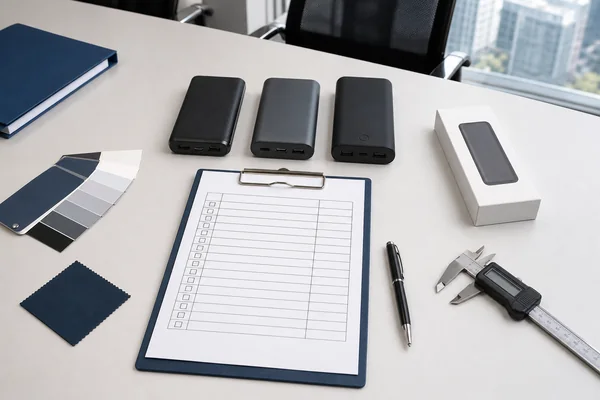
How to Write a Power Bank RFQ: OEM/ODM Specification Checklist for Buyers
A power bank RFQ should give every shortlisted manufacturer the same product, customization and delivery assumptions. Include the target market, quantity, capacity and watt-hours, port functions, charging profiles, cell requirements, dimensions, branding, packaging, compliance documents, sample plan and destination. Ask each supplier to state its exclusions and assumptions.
Without that detail, a low quotation may cover a different cell, lower output profile, generic packaging or fewer test documents. The prices can look comparable in a spreadsheet even though the products are not. The checklist and copy-ready template below are written for OEM, ODM and private-label buyers.
What is a power bank RFQ?
An RFQ, or request for quotation, is the written brief a buyer sends to suppliers for pricing and commercial terms. For a standard private-label power bank, it may fit on two pages. A new enclosure, custom electronics or firmware project needs drawings, interface requirements and an acceptance plan.
The RFQ makes supplier responses comparable; it is not the final purchase specification. After selecting a model and approving samples, move the accepted details into a controlled specification, approved bill of materials and purchase order.
Decide whether the project is private label, OEM or ODM
State how much of the product should change. Factories use terms such as OEM and ODM differently, so describe the work rather than relying on the label.
| Project route | Typical scope | Information the factory needs |
|---|---|---|
| Standard model with branding | Existing hardware, logo and standard packaging | Model, colour, logo file, print method, quantity and destination |
| Configured OEM project | Existing platform with selected capacity, ports, cable, finish or packaging changes | Required configuration, target performance, artwork and approval tests |
| Deeper ODM project | New enclosure, PCBA, firmware, accessory or tooling work | Product requirements, drawings, interfaces, ownership terms, validation plan and development schedule |
YULIDA’s standard branding projects generally start at 500 pieces. Broader colour or packaging changes may start at 1,000 pieces, while deeper product development may start at 2,000 pieces. The final MOQ depends on the selected model, components, packaging and tooling. The power bank OEM/ODM page explains these routes in more detail.
1. Identify the buyer, product use and target market
Start with context. A retail product for the EU, a promotional power bank for a US event and an accessory bundled with industrial equipment may need different packaging, documents and service arrangements.
- Buyer company and contact person
- Product type and intended users
- Countries or regions where the product will be sold
- Sales channel, such as retail, e-commerce, corporate gifts or device bundling
- Estimated first order and annual volume
- Target launch date and requested delivery date
Name the importer or brand owner when known. Compliance, labelling and producer-responsibility duties can depend on who places the product on a market. A factory can quote documents and testing only after the destination and responsible party are clear.
2. Define capacity, energy and battery-cell requirements
Do not write only “10,000mAh power bank.” State the nominal capacity, nominal battery voltage and watt-hours. If output performance matters, request measured usable energy at a defined USB output profile as a separate result.
- Nominal battery capacity in mAh and energy in Wh
- Minimum acceptable capacity, if different from the nominal claim
- Preferred cell format or dimensional limit
- Approved or prohibited cell makers and models, if applicable
- Cycle-life test method and end-of-life threshold
- Cell maker, model and lot traceability required for production
Ask whether the quotation uses a minimum or typical cell capacity. The factory should identify the cell in the approved sample and control later substitutions. Use the power bank battery cell selection guide when you need a deeper cell specification.
3. Specify every port, cable and charging direction
A connector name does not define its behaviour. USB-C may be input only, output only or bidirectional. A built-in cable may charge a phone, recharge the power bank or support both directions. Write each function separately.
| Interface | Questions to answer in the RFQ |
|---|---|
| USB-C port | Input, output or both? Maximum input and output? Required voltage/current profiles? PPS required? |
| USB-A port | Maximum output and supported charging modes? Does it share a total limit with USB-C? |
| Built-in USB-C cable | Output, input or bidirectional? Length, connector style, storage method and bend-life requirement? |
| Built-in Lightning-compatible cable | Required output, device scope and any licensing or component requirements? |
| AC plug | Plug type, input range, charging power, folding mechanism and destination-market requirements? |
For USB Power Delivery, request the actual supported power profiles rather than a single maximum wattage. The USB-IF publishes the USB Power Delivery specification and compliance information. A supplier’s label should match the behaviour measured from the production sample.
If the product has a built-in cable, the built-in-cable power bank guide covers direction, strain relief and sample checks that belong in the specification.
4. State single-port and simultaneous-output behaviour
Two products can both claim 22.5W while behaving differently when more than one output is used. Ask for a port matrix showing the maximum output from each interface alone and the total allocation when two or more outputs operate together.
- Maximum output for every port and built-in cable used alone
- Total output and allocation for each simultaneous-use combination
- Whether fast charging falls back to another profile during multi-device use
- Low-current mode requirements for earbuds or small devices
- Pass-through charging requirement and any limitations
- Automatic shut-off timing and button behaviour
Do not ask for pass-through charging as a checkbox. Define which input and output should work at the same time, the expected power and the thermal acceptance limit.
5. Describe wireless charging and magnetic alignment precisely
For a wireless or magnetic power bank, state the required wireless power, device scope, magnet arrangement, alignment tolerance and case conditions. If Qi or Qi2 certification is required, ask for the exact certification status and a listing that matches the quoted model. The Wireless Power Consortium provides the official Qi specifications and certified-product database.
- Required wireless power levels and receiver compatibility
- Qi or Qi2 requirement, if applicable
- Magnetic holding and alignment test method
- Charging through the specified case thickness
- Foreign-object and temperature behaviour to be evaluated
- Wireless and wired simultaneous-use requirements
A marketing phrase such as “magnetic fast charging” is not an acceptance criterion. Ask the factory to identify the mode, test devices, input conditions and measured result.
6. Set dimensions, weight, materials and appearance
Provide maximum dimensions and weight rather than asking for a compact product. If the factory proposes an existing model, request a controlled drawing. For a new enclosure, include the allowable envelope, connector positions and any keep-out areas.
- Length, width, thickness and dimensional tolerance
- Maximum finished weight
- Housing material and surface finish
- Colour reference, such as an approved physical sample or Pantone reference
- Display type, LED behaviour and button position
- Drop, abrasion or other durability checks required for the project
Colour on a monitor is not a production standard. Approve a physical colour sample when the finish matters, and record whether later lots must match that sample under defined lighting.
7. Separate product branding from packaging artwork
Control product printing and packaging as separate workstreams. For the device, state the logo position, maximum print area, print method, colours and artwork format. Specify the retail box, manual, labels, inserts and shipping marks in their own fields.
- Logo file in vector format and approved placement
- Printing, laser marking or other branding method
- Retail packaging structure and artwork responsibility
- Manual languages and legal or recycling marks
- Barcode, SKU, serial or batch-code format
- Master-carton quantity, marks and pallet requirements
Ask the supplier to quote artwork setup, printing plates, packaging samples and any minimum order for custom packaging as separate lines. This makes the cost easier to revise when the box changes but the power bank does not.
8. Define the compliance-document scope by market
List the destination markets and sales channel before requesting a document package. Do not send a generic list of abbreviations and assume every report applies. Ask the factory to state whether each document is existing, included in the price, charged separately or dependent on a new sample.
- Exact product and battery models covered by each report
- Applicant, manufacturer and laboratory names
- Report or certificate number and issue date
- Changes that would require review or additional testing
- Who prepares declarations, labels and technical documentation
- Testing cost, sample quantity and estimated schedule
UN 38.3 addresses transport testing for lithium cells and batteries; it is not a general product safety certificate. IEC 62133-2 covers safety requirements and tests for portable sealed secondary lithium cells and batteries. Requirements for placing products on a market must be reviewed for the exact configuration and responsible economic operator. See the power bank certification guide before finalizing the RFQ document list.
9. Request a sample and acceptance plan
Ask for sample price, build time, shipping method and what the sample represents. A hand-built engineering sample may not use final tooling, packaging or production processes. Record those differences.
The RFQ should name the tests used for approval: dimensions, weight, capacity, usable energy, charging profiles, simultaneous output, wireless behaviour, temperature, protection functions, cable checks and appearance. After approval, identify one unit as the golden sample and attach the signed specification. The power bank sample approval checklist provides a step-by-step review.
10. Ask for an itemized commercial quotation
A single unit price hides assumptions that often surface later as surcharges or disputes. Ask the supplier to break out the following items:
- Unit price at the requested quantity and agreed volume tiers
- Sample, artwork, printing plate, tooling and engineering charges
- Packaging, accessories and spare units included
- Testing and documentation charges
- Payment terms, quotation validity and currency
- Incoterm, named place and freight exclusions
- Production lead time and the event that starts the schedule
- Warranty, defect handling and replacement process
For example, “FOB Shenzhen” and “DDP buyer’s warehouse” do not include the same services or risk allocation. State the named place and ask what is excluded. For cost categories and MOQ effects, use the custom power bank cost guide.
11. Clarify packaging, transport and delivery assumptions
Power banks contain lithium batteries, so the shipping route affects documentation, packing and lead time. Give the destination, preferred transport mode and any warehouse restrictions. Ask who arranges dangerous-goods handling and which documents will travel with the shipment.
- Ship-to city, country and postal code
- Air, sea, rail or courier preference
- Retail units per inner box and master carton
- Carton dimensions, gross weight and pallet format
- Required transport documents and document provider
- Requested inspection date, ship date and delivery date
IATA’s battery guidance is revised for the applicable regulations and should be checked for the actual shipment. Do not copy a previous shipping instruction when the battery, pack, route or carrier has changed.
How to compare supplier replies
Send the same RFQ revision to every shortlisted supplier and issue written clarifications to all of them. Then compare the replies line by line. A blank field is an unanswered requirement, not an automatic acceptance.
| Comparison item | Supplier A | Supplier B | Buyer decision |
|---|---|---|---|
| Exact model and configuration | |||
| Cell maker, model and minimum capacity | |||
| Port profiles and simultaneous output | |||
| Included compliance documents | |||
| Branding and packaging scope | |||
| Sample and production schedule | |||
| Unit price, NRE and tooling | |||
| Incoterm and exclusions | |||
| Warranty and change control |
Before paying a tooling deposit or placing a large order, verify the company, production site and testing capability. The power bank manufacturer audit checklist covers that separate due-diligence step.
Copy-and-paste power bank RFQ template
POWER BANK REQUEST FOR QUOTATION

Buyer company:
Contact person:
Target market(s):
Sales channel / intended use:
Target launch date:

PROJECT SCOPE
Preferred existing model or reference:
Project route: standard branding / configured OEM / ODM development
First-order quantity:
Estimated annual quantity:

BATTERY
Nominal capacity:
Nominal energy (Wh):
Minimum acceptable capacity:
Cell format or dimensional restriction:
Cell maker/model/lot traceability requirement:
Cycle-life requirement and test method:

WIRED CHARGING
USB-C input profiles:
USB-C output profiles:
PPS requirement:
USB-A output modes:
Built-in cable type, direction and power:
Single-port maximum output:
Required simultaneous-output combinations:
Pass-through or low-current mode requirement:

WIRELESS / MAGNETIC FUNCTIONS
Required wireless power and test devices:
Qi or Qi2 requirement:
Magnet and alignment requirement:
Case compatibility requirement:

MECHANICAL AND APPEARANCE
Maximum dimensions:
Maximum weight:
Housing material and finish:
Colour reference:
Display, LED and button behaviour:
Durability tests:

BRANDING AND PACKAGING
Logo method, size and position:
Retail packaging:
Manual language(s):
Barcode / SKU / batch code:
Accessories:
Master-carton and pallet requirements:

COMPLIANCE AND VALIDATION
Required destination-market documents:
Required battery and transport documents:
Sample quantity and approval tests:
Golden-sample and change-control requirement:
Pre-shipment inspection requirement:

COMMERCIAL AND DELIVERY
Requested price tiers:
Sample / tooling / NRE breakdown:
Payment terms:
Requested Incoterm and named place:
Ship-to location:
Transport mode:
Required ship or delivery date:
Warranty and defect-handling requirement:

SUPPLIER RESPONSE
Please identify the quoted model, answer every field, and list all deviations,
assumptions, optional costs, exclusions and document limitations.
Common RFQ mistakes
- Requesting a price for “10,000mAh PD power bank” without port profiles or a target market
- Comparing quotations that use different cells, accessories or packaging
- Using connector names as proof of input, output or charging-protocol support
- Asking for every familiar certification abbreviation before choosing the model
- Leaving simultaneous output, pass-through behaviour and cable direction undefined
- Approving a product photo instead of a working sample and written specification
- Accepting an unpriced assumption that the cell or PCBA may change according to availability
- Comparing unit prices without tooling, tests, freight terms or document costs
Frequently asked questions
What information is required for a power bank quotation?
At minimum, provide the target market, quantity, capacity, required ports and power, customization scope, packaging, compliance-document expectations, destination and requested delivery date. Add drawings and acceptance tests when the product needs engineering changes.
Why do quotations for the same capacity differ so much?
Capacity is only one cost item. Cell model, PCBA, charging profiles, enclosure, finish, cables, packaging, testing, quantity and trade terms can all differ. Ask each supplier to quote the same written configuration and disclose assumptions.
Should buyers request certifications before selecting a model?
Buyers should state the destination and required compliance outcome early. The supplier can then identify existing model-specific documents and quote any new testing. Final document coverage should be checked against the selected model and production configuration.
How should USB-C PD requirements be written?
State whether USB-C is input, output or bidirectional. List the required voltage/current profiles, maximum power, PPS requirement and simultaneous-output behaviour. Do not use “USB-C” or “PD” alone as the acceptance condition.
Can a buyer send a rough RFQ before choosing a model?
Yes. Mark unknown fields as open and ask the factory to propose options. Separate supplier recommendations from confirmed requirements, then issue a revised RFQ before comparing final quotations.
Does an RFQ commit the buyer to place an order?
An RFQ normally requests information and pricing; the contract effect depends on its wording and applicable law. State that the RFQ is for evaluation if that is the buyer’s intent. Commercial commitments should appear in the signed purchase order or contract.
Official reference sources
- USB-IF USB Power Delivery specification library
- Wireless Power Consortium Qi specification resources
- IEC 62133-2:2017+A1:2021 consolidated version
- UN Manual of Tests and Criteria, Revision 8 and Amendment 1
- IATA Battery Guidance Document for the 2026 Regulations
- Regulation (EU) 2023/1542 concerning batteries and waste batteries
Standards, regulations and transport instructions change. Confirm the applicable edition and market obligations for the quoted model before production and shipment.
Prepare a comparable power bank RFQ for YULIDA
Send the completed checklist with any reference model, drawing or packaging artwork. With the same inputs in one file, YULIDA can identify a suitable existing platform, flag requirements that need development and return a model-specific quotation covering MOQ, samples and documents. Review the typical custom power bank manufacturing timeline before setting the requested delivery date.
Send your power bank RFQ to YULIDA with the target market, quantity and required functions.
Official sources and verification
These primary sources support standards, compatibility, safety, or transport statements discussed in this article. Confirm the current requirement for the exact product model and destination market.
- USB Implementers Forum — USB Type-C and USB Power Delivery specifications and guidance.
- Wireless Power Consortium — Qi and Qi2 standards, certification, and wireless-charging information.
- International Electrotechnical Commission — International electrotechnical standards and standard scopes.
- International Air Transport Association — Lithium-battery transport requirements and industry guidance.
