







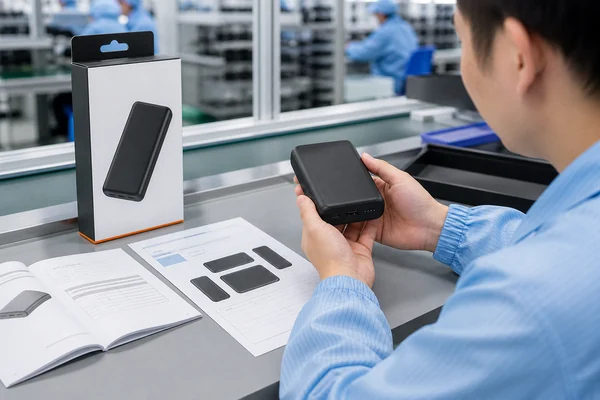
What Information Must Appear on a Power Bank Label? Rating, Packaging and User Manual Checklist for Importers
A power bank artwork review can go wrong even when every individual statement looks plausible. The rated capacity may describe the internal cells, while the input and output table describes the ports. A recycling symbol may belong on the battery, while a lithium battery mark belongs on the shipping package. A test report may exist, but that does not automatically authorize a certification logo on the product.
Review four items separately: the product rating label, retail packaging, user instructions and transport packaging. The checks below are intended for OEM artwork approval; they are not a universal legal template. Final requirements depend on the destination market, product configuration, sales channel and the economic operator named on the product.
The short answer: what normally appears on the product
A controlled power bank rating label will normally identify the product and state its electrical ratings. The starting checklist is:
- brand or product name;
- model number or another unique product identifier;
- nominal cell capacity in mAh and nominal battery voltage;
- rated battery energy in Wh;
- input ratings for each charging port or built-in cable;
- output ratings for each port, cable and wireless charging function;
- maximum combined output where ports share a power budget;
- manufacturer, importer or other responsible-party details where the target market requires them;
- batch, serial or date code used for traceability;
- applicable conformity, collection and recycling markings supported by the product’s compliance file;
- essential warnings that must remain with the product.
Use this list as an artwork-control baseline, then adapt it for the destination. The same wording and marks should not be copied unchanged across the EU, Great Britain, the United States, Australia and other markets.
Separate the artwork into four controlled layers
Ask the supplier to submit four artwork files or four clearly separated pages in one approval pack. Combining everything into one PDF without naming the surface creates avoidable confusion.
| Artwork layer | Main purpose | Typical content |
|---|---|---|
| Product rating label | Identify the exact unit and its electrical characteristics | Model, capacity, Wh, port ratings, traceability and required marks |
| Retail packaging | Explain the offer and carry information that cannot fit on the product | Contents, features, languages, operator details, warnings and barcodes |
| User manual | Tell the user how to operate, charge, store and dispose of the product | Instructions, limitations, warnings, troubleshooting and declarations |
| Transport package | Support handling and dangerous-goods shipping | Shipping description, package marks, labels and carrier data when applicable |
The same model number must connect all four layers to the quotation, bill of materials, test reports and shipping documents. If the factory uses an internal code and the buyer uses a retail model, record both in the approval sheet.
Use the model number to connect the compliance records
The model number connects the physical unit to its battery cell, PCB, enclosure, firmware, test report and declaration. A sales name such as “10K Magnetic Power Bank” is too vague when several housings or charging profiles share that description.
Use one controlled model identifier on the unit and in the compliance file. If different capacities use the same enclosure, give them distinct model codes. If a material, cell or wireless module changes, document whether the change creates a new model or a controlled revision. This decision should be made before mass production, not after a customer complaint.
Capacity, voltage and watt-hours must describe the same battery
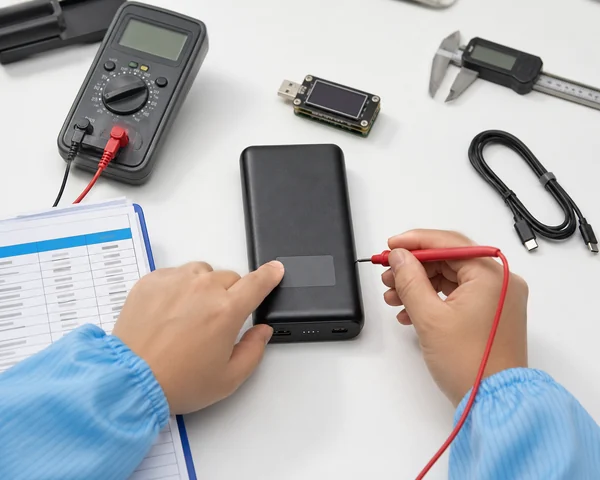
The mAh figure printed on a power bank usually describes the internal battery at its nominal voltage. It does not mean that the same mAh value will reach a phone at 5V. Conversion losses, cable resistance, power-management overhead and the cut-off point reduce usable output.
Watt-hours provide the better cross-check:
Wh = nominal voltage × amp-hours
For example, 10,000mAh equals 10Ah. At a nominal cell voltage of 3.7V, the rated energy is 37Wh. A label that says 10,000mAh, 3.7V and 22.5Wh contains an obvious conflict. Ask the supplier to stop the artwork and trace the source data rather than correcting one number by guesswork.
Do not confuse cell capacity with rated output capacity
Some markets, standards or sales channels may ask for a rated output capacity in addition to nominal cell capacity. These are different measurements. Rated output capacity should state the output condition used for the measurement, such as voltage and current. It should not be presented as a second unexplained mAh number.
When comparing samples, measure usable energy under a defined load and record the result in Wh. The power bank quality testing guide explains how to compare rated energy, conversion efficiency and charging behaviour without relying on the display percentage alone.
Input and output ratings must follow the actual port logic
List each port or built-in cable by function. A USB-C connector may support input only, output only or both directions. USB-A is commonly output only, but artwork must follow the circuit rather than a general assumption.
For a USB-C PD product, the label or manual should present the supported voltage and current profiles in a readable form. Do not add the wattage of every port and call the total the product output. Many designs share one converter or thermal limit, so simultaneous output can be lower than the sum of the individual maximums.
Built-in cables need a direction check
A moulded USB-C cable may charge a phone, recharge the power bank or do both. The retail box, label and manual must use the same description. Test direction, supported protocols and maximum power on a production-equivalent sample. A cable icon is not proof of bidirectional charging.
Wireless output needs its own claim
State the supported wireless charging power separately from wired output. Magnetic alignment does not by itself prove a Qi or Qi2 certification claim. If the artwork uses a scheme logo or certification wording, verify the exact model against the scheme owner’s authorization or certified-product record.
Manufacturer and importer details depend on who places the product on the market
Private-label buyers often assume the factory name can be omitted because the buyer’s brand appears on the front. That assumption can change the buyer’s legal role. Under EU product rules, an importer or distributor that places apparatus on the market under its own name or trademark, or modifies it in a compliance-relevant way, may take on manufacturer obligations.
Decide in writing which company is the manufacturer, importer and local responsible economic operator for each destination. Then place the required legal name and contact details on the correct surface. Do not wait until packaging is printed to settle this point.
Traceability codes should lead back to production records
A batch or date code is useful only when someone can use it. The factory should be able to connect the code to the production date, cell supplier and lot, PCB revision, firmware version, inspection records and shipment. The buyer should retain the approved code format and a sample photograph.
Choose a code that remains legible after normal handling. Laser engraving, durable printing and an adhesive rating label have different strengths on painted metal, ABS and textured surfaces. Include adhesion and rub resistance in the sample review.
EU battery labels have their own timetable
The EU Battery Regulation applies directly to batteries and adds requirements beyond the electrical product label. Since 18 August 2025, batteries must carry the separate collection symbol. The regulation sets minimum symbol proportions and allows the symbol to move to packaging when it would be smaller than 0.47 × 0.47cm on the battery. Batteries above specified cadmium or lead thresholds also require the relevant chemical symbol.
The general battery information label and the capacity label for rechargeable portable batteries apply from 18 August 2026 or 18 months after the implementing act referred to in Article 13(10) enters into force, whichever is later. Treat this as a conditional date, not a blanket deadline.
Annex VI Part A lists manufacturer identification, battery category and identification, place and date of manufacture, weight, capacity, chemistry, specified substance information, a usable extinguishing agent and critical raw materials above the stated threshold. From 18 February 2027, batteries also require a QR code providing access to the applicable information. The regulation says labels and the QR code should be visible, legible and indelible on the battery, with packaging and accompanying documents used when product placement is not possible or warranted.
Because implementing measures and guidance can affect the final format, importers should review the current consolidated regulation when approving production artwork. See the official EU Battery Regulation consolidated text.
CE marking is not a decoration
A CE mark indicates that the manufacturer has applied the relevant EU conformity-assessment process and takes responsibility for compliance with applicable EU harmonisation legislation. It should not be added because a buyer expects to see it or because another model passed testing.
For apparatus within the EU EMC Directive, manufacturers must identify the apparatus, provide their name and postal contact address, prepare the technical documentation and EU declaration of conformity, and affix CE marking after conformity has been demonstrated. The directive allows identification or contact information to move to packaging or an accompanying document when the product’s size or nature does not permit placement on the apparatus. Instructions and required information must be supplied in a language the destination market can understand. Review the official EMC Directive alongside other legislation that applies to the exact power bank.
Great Britain and Northern Ireland need separate checks
Do not treat the United Kingdom as one marking route. Great Britain and Northern Ireland have different market-access arrangements. Current UK guidance explains when UKCA or CE marking can be used for products placed on the Great Britain market, how markings should be displayed and which sector rules control placement.
For UKCA marking, the official guidance says the marking must be visible, legible and indelible, with a minimum height of 5mm unless a sector rule states otherwise. Some temporary placement provisions run until 11pm on 31 December 2027. Confirm the product’s applicable regulations, destination and economic operator before approving one UK artwork for every channel. Use the current UKCA guidance rather than an old packaging template.
FCC identification depends on the authorization route
The United States does not have one federal power-bank label template. FCC requirements depend on the radio-frequency functions and the authorization procedure that applies to the equipment. Wireless power-transfer devices can fall under FCC Part 15 and/or Part 18, depending on design and operation.
Equipment subject only to Supplier’s Declaration of Conformity must be uniquely identified by the responsible party. The familiar FCC logo is voluntary for SDoC equipment. Certified equipment uses an FCC Identifier under the certification rules. Never copy an FCC ID from a similar product, and do not assume that changing the coil, control board or enclosure leaves an authorization unchanged. Match the shipped model to the applicable filing, test data and responsible-party information.
For a model with wireless charging, confirm the applicable rule part and authorization route with the test laboratory before locking artwork. The FCC’s wireless power transfer guidance is a useful starting point.
UN 38.3 is test evidence, not a retail certification logo
UN 38.3 refers to transport testing for lithium cells and batteries. The buyer should obtain the correct test summary and check that it covers the cell and battery configuration being shipped. There is no universal “UN 38.3 certified” logo that must be printed on the power bank or retail box.
Keep the test summary in the document pack and link it to the model and battery specification. If a supplier offers a generic report with a different cell, energy rating or pack configuration, resolve the mismatch before shipment.
The lithium battery mark belongs to the transport package when required

The lithium battery mark used under air-transport rules is a package mark. Its use depends on the UN number, packing instruction, section, battery configuration and package contents. It is not a substitute for the product rating label, and it should not be added to retail packaging simply to make the product look compliant.
Ask the freight forwarder or dangerous-goods specialist to confirm the current package marks, labels, documentation, state-of-charge limits and packing conditions for the actual route. The IATA lithium battery guidance document explains how the package configuration affects the requirement. Shipping rules are updated regularly, so do not reuse last year’s carton by default.
RoHS and other claims need supporting records
RoHS is a substance-restriction requirement, not a universal EU product logo. A printed “RoHS” symbol does not replace material declarations, test reports or a conformity assessment. The same principle applies to claims about recycled content, flame-retardant materials, Qi compatibility and airline acceptance.
Build a claim-to-evidence table. For every logo or statement, record the applicable market, legal or scheme basis, report or certificate number, covered model and expiry or review date. If the evidence does not cover the shipped configuration, remove the claim until the gap is closed. Our guide to power bank certifications provides a broader document checklist.
What belongs on the retail box
The retail box can carry detailed information that would be unreadable on a compact power bank. It should still match the unit inside. A useful packaging review includes:
- brand, product name, model, colour and capacity version;
- clear package contents, including cable type and accessories;
- input, output and shared-power claims consistent with the rating label;
- manufacturer, importer and responsible-party details required for the market;
- destination-language warnings and disposal information;
- barcode, SKU and batch or date code where used;
- only those conformity and scheme marks supported by the model file;
- country-of-origin wording where applicable.
Marketing copy needs the same control as technical data. Do not say “65W output” if that figure is input only, or “Qi2” when the design is merely magnetically aligned. Photographs should show the correct port layout and included cable.
What belongs in the user manual
A manual should let a user operate the product without guessing. The exact content depends on the product and market, but a power bank manual commonly covers:
- product diagram and function of each port, button, display and indicator;
- how to recharge the power bank and charge connected devices;
- supported wired and wireless modes and simultaneous-output limits;
- safe operating, charging and storage conditions;
- warnings about heat, fire, water, impact, disassembly and damaged batteries;
- what to do if the unit swells, leaks, overheats or stops responding;
- cleaning, disposal and recycling instructions;
- technical ratings that agree with the product label;
- company contact and required regulatory statements;
- instructions in the language or languages required by the destination market.
Do not hide a safety limitation in tiny packaging text while the product page makes a broader claim. The web listing, box and manual should state the same limits.
Run a consistency check across six records

Many artwork errors begin with mismatched source data. Compare the following six records side by side before sample approval:
| Record | Fields to compare |
|---|---|
| Approved specification | Model, cell, capacity, energy, ports, protocols and materials |
| Product label | Model, mAh, voltage, Wh, input, output and marks |
| Retail box | Model/version, features, ratings, operator details and languages |
| User manual | Port functions, limitations, warnings and technical data |
| Compliance file | Covered model, photos, hardware revision and test configuration |
| Shipping file | Battery description, Wh, UN number, packing route and package marks |
Mark every difference as accepted, corrected or technically justified. A report that says 37Wh cannot support a shipment label that says 38.5Wh without an explanation and supporting model data.
Check the physical label on a finished sample
A PDF can be perfect while the production label fails. Review a sample applied to the final surface and inspect:
- font size and legibility under normal lighting;
- contrast against the enclosure colour;
- print sharpness and spacing around required marks;
- adhesion, rub resistance and resistance to normal cleaning;
- placement after assembly, including curved surfaces and seams;
- barcode and QR-code scanning from an ordinary phone or scanner;
- batch-code readability and connection to factory records;
- the exact capacity, colour and port configuration of the sample.
Photograph the approved label at close range and in its full-product context. Keep both images with the signed sample record. The pre-production sample checklist shows how to turn this approval into a controlled reference for mass production.
Use a copy-ready artwork approval sheet
An approval email that says “looks good” does not identify what was checked. Use a short form that records the controlled files and the basis for approval.
Product identification
- Buyer SKU:
- Factory model:
- Capacity and colour:
- Hardware and firmware revision:
- Destination market:
Controlled artwork
- Product label filename and revision:
- Retail box filename and revision:
- Manual filename, language and revision:
- Master-carton filename and revision:
Evidence reviewed
- electrical specification and port test results;
- applicable declarations, reports and certificates;
- UN 38.3 test summary and battery specification;
- economic-operator and destination-language review;
- physical sample photographs and label durability check.
Record the approver, approval date and any open conditions. State that no component, rating, wording or mark may change without written review. The same controls should appear in the power bank OEM manufacturing agreement.
Common label mistakes importers can catch early
- Wrong Wh calculation: mAh, nominal voltage and Wh do not agree.
- Port ratings copied from another model: the label lists a PD profile that the firmware does not support.
- Individual outputs added together: the declared total exceeds the shared converter limit.
- Unsupported scheme logo: the artwork displays Qi2, FCC ID or another mark without model-level evidence.
- UN 38.3 treated as a logo: a test requirement is turned into a misleading retail claim.
- Transport mark printed on the product: the purpose and placement of the package mark are misunderstood.
- Missing economic-operator details: nobody has confirmed who is legally placing the private-label product on the market.
- One-language manual: the product ships to markets that require instructions users can understand.
- No production traceability: the printed batch code cannot be connected to cell and inspection records.
- Artwork changed after testing: a cell, board, coil or enclosure revision is not reviewed against the compliance file.
When to approve artwork in an OEM project
Approve provisional layout after the specification is frozen, then approve final text and marks after the applicable evidence and economic-operator details are confirmed. Do not release mass printing until a production-equivalent sample proves that the label fits, remains readable and matches the actual electronics.
A practical order is: written RFQ, feasibility review, sample specification, compliance plan, test evidence, final artwork, physical sample approval and mass-production release. If you are still comparing suppliers, begin with a detailed power bank RFQ checklist.
Questions importers ask about power bank labels
What information must appear on a power bank label?
The exact legal list depends on the market and product configuration. A normal starting point is model identification, nominal capacity and voltage, Wh, input and output ratings, traceability data, required economic-operator details, applicable collection symbols and any conformity marking supported by the product file.
Must both mAh and Wh be shown?
Wh is central to lithium-battery transport classification and is a useful check on capacity claims. Many buyers specify both mAh and Wh on the product. Market rules may add more detailed capacity-label requirements, so confirm the destination requirement and make sure mAh, nominal voltage and Wh agree.
Can certification marks appear only on the box?
It depends on the mark and the rule that controls it. Some laws allow information to move to packaging or accompanying documents when product placement is not possible because of size or nature. That is not a general permission to move every mark. Check the applicable legislation before choosing the surface.
Is UN 38.3 a logo that should be printed on the product?
No. UN 38.3 refers to lithium battery transport testing. Importers should obtain the correct test summary and verify that it covers the shipped battery configuration. Do not invent or copy a “UN 38.3 certified” product logo.
What information goes on the shipping carton?
The requirement depends on the battery, package contents, quantity, transport mode, UN number and packing instruction. The lithium battery mark and dangerous-goods labels are transport controls, not retail decoration. Ask the responsible forwarder or dangerous-goods specialist to approve the final carton for the route.
Can one power bank label be used worldwide?
Sometimes a common base label can support several markets, but a worldwide label should not be assumed. Languages, economic-operator details, conformity routes, battery collection symbols and packaging rules vary. Build a market matrix and approve each version against the destination requirements.
Prepare the label before the purchase order is locked
The cheapest time to correct a rating is before printing. Send the supplier the destination list, buyer SKU, required functions, branding scope and expected compliance documents with the RFQ. Ask for editable artwork rather than only a flattened image, and keep revision numbers on every approved file.
For a model-specific YULIDA review, send the target market, capacity, charging profiles, estimated quantity and customization scope through the project inquiry form. With those details, the label, packaging and sample route can be prepared for the selected hardware instead of being adapted from generic artwork at the end.
Official sources and verification
These primary sources support standards, compatibility, safety, or transport statements discussed in this article. Confirm the current requirement for the exact product model and destination market.
- U.S. Federal Communications Commission — Radio-frequency equipment authorization information.
- International Air Transport Association — Lithium-battery transport requirements and industry guidance.
