






Power Bank Storage and Shelf Life: A Bulk Buyer’s Checklist
Store bulk power banks under the finished-product manufacturer’s written conditions, with a defined charge level, inspection schedule and maintenance procedure. Keep each lot traceable and review overdue or abnormal stock before release. There is no single shelf-life figure that tells an OEM buyer how long every power bank can remain untouched in a warehouse.
Before committing to a large order, ask whether the product will still meet the agreed requirements when it reaches the customer. Give the supplier your expected storage period and request supporting evidence for the actual model, battery configuration and operating mode.
This guide covers inventory management for intact finished power banks. Its checklists are buyer-side recommendations, not a warehouse fire-safety design or a transport-compliance procedure.
What does power bank shelf life mean?
Ask the supplier what its shelf-life claim measures. These terms describe different things:
| Term | Meaning for a bulk order | Evidence to request |
|---|---|---|
| Charge retention | How much usable charge remains after a stated period without recharging | Starting condition, storage duration, environment and measurement method |
| Calendar aging | Changes in battery performance over elapsed time, including time spent unused | Relevant storage-aging data and the performance endpoint |
| Maintenance interval | When stock must be inspected or serviced under the approved procedure | A dated schedule, action thresholds and responsible person |
| Warranty period | The coverage offered under the applicable warranty terms | Written terms and the event that starts the coverage period |
Lithium-ion cells can lose capacity and power capability through calendar aging even without regular use. Research on this process does not establish an expiration date for an unspecified finished power bank. Schulze et al., calendar-aging research.
A statement such as “12-month shelf life” therefore needs a starting date and an endpoint. Does it mean the unit will still wake up, retain a specified charge, or deliver a minimum output energy after the prescribed recharge? Does it assume maintenance during those 12 months?
Recharging can restore charge. It does not make the battery newly manufactured or prove that its original performance has been retained.
Put storage requirements in the product specification
Agree on storage conditions before placing the order, especially when goods will pass through a factory warehouse, freight transit and a distributor’s stockroom before sale.
| Requirement | What the supplier should specify |
|---|---|
| Product identity | SKU, cell configuration, PCBA revision and relevant firmware or controller version |
| Environment | Storage temperature, permitted duration at those conditions, humidity or condensation restrictions, and packaging requirements |
| Starting condition | Storage charge target or range, how it is verified, and the required off or low-power mode |
| Time limits | Maximum period without maintenance, review dates and the endpoint of any shelf-life claim |
| Inspection plan | Items checked, sampling method, sample count, acceptance limits and failed-check action |
| Maintenance | Approved charger and cable, charging conditions, target, stopping rule and records |
| Exceptions | Response to overdue maintenance, missing history, environmental excursions or abnormal units |
| Handover | Which party maintains the stock at each stage and who authorizes release |
Add the approved requirements to the power bank product specification. A cell datasheet alone leaves questions about the assembled product’s electronics, packaging and power-management settings unanswered.
Keep charging and storage limits separate. Permission to store a product at a particular temperature does not establish that charging is permitted at that temperature.
Ask who pays for scheduled inspection, opening sealed packs, maintenance charging and repacking. These costs belong in the purchasing discussion if a long sell-through period is expected.
What charge level and temperature should you use?
Use the instructions approved for the selected finished product. Published manufacturer guidance provides examples, but it should not become an unverified specification for another brand or model.
Anker’s Power Bank Safety Guide recommends approximately 60% charge for long-term storage and recharging every three months; it lists an operating and storage range of 0°C to 35°C. Those are Anker’s published recommendations, not universal OEM acceptance limits. Anker Power Bank Safety Guide.
Xiaomi recommends 5°C to 35°C for its Mi 50W Power Bank 20000mAh and advises keeping that model away from heat sources and direct sunlight. Xiaomi’s model-specific storage guidance.
For your order, obtain a written target and a way to check it. If the instruction refers to indicator lights, ask how those lights correspond to the approved storage condition. Do not assume three lights mean the same charge level on every product.
Storage charge and transport preparation also need separate review. Have the logistics team confirm the requirements for the actual shipment rather than treating a warehouse maintenance target as shipping approval.

Why does an unused power bank lose charge?
A finished power bank has more than a battery inside. Its control electronics can consume energy while the product appears inactive. Texas Instruments explains that some disabled circuits still draw current, and that dedicated low-power states can reduce this consumption. TI: quiescent current and shutdown current.
A cell’s self-discharge figure cannot establish the assembled product’s storage performance. Ask for finished-product results in the intended storage mode. The supplier should identify any display activity, automatic wake behavior or connected accessory present during the test.
An indicator reading is not a capacity test. A lower displayed percentage after storage does not, by itself, quantify permanent capacity loss. A return to 100% after charging does not establish the usable energy available at the USB port either.
Compare measurements taken under the same conditions. Where output energy is part of the acceptance requirement, use the agreed power bank capacity-test method and keep the results in Wh with their port, load and endpoint.
Keep a storage history for each inventory lot
Receiving goods should not erase the earlier storage period. Request the factory’s available production, inspection and maintenance dates, then continue the record through your own warehouse.
A usable stock register should contain:
- SKU, lot identifier, quantity and storage location.
- Manufacturing date or traceable date code, receipt date and supplier record references.
- Last inspection and maintenance dates, with the units or sub-lots actually covered.
- Next review date, current release status and unresolved exceptions.
- Storage-condition records, relevant excursions and actions taken.
- Links to dispatches, repacking, returns and stock transfers.
Keep original lot identities when cartons are split or combined. A new carton number should link back to the earlier contents rather than replace their history. The batch-traceability guide explains the links between finished goods and production records.
First-in, first-out rotation is useful within eligible stock. It must not cause an overdue or held lot to ship simply because it arrived first. Review dates and release restrictions need to remain visible to the picking team.
Record environmental conditions where goods are stored. If a relevant limit is exceeded, document the affected locations and time window, then request a disposition decision. Restoring the room temperature does not establish what happened to the products during the excursion.
A stock-control example: maintenance is not a lot-wide reset
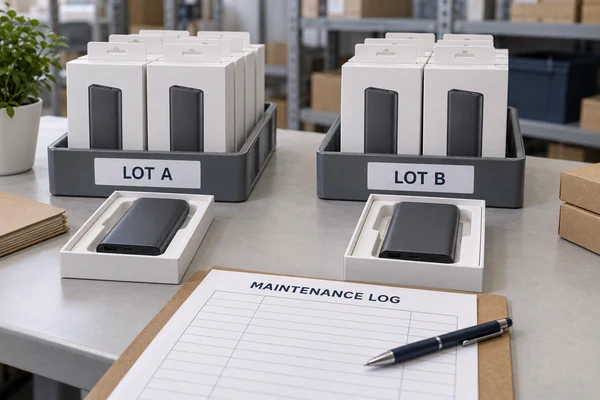
Suppose a distributor holds 1,000 power banks. Lot A contains 300 units and has reached its agreed maintenance date. Lot B contains 700 units and remains within its approved review window. These quantities are hypothetical, not YULIDA inventory data or a recommended inspection interval.
The team completes the prescribed maintenance on 120 units from Lot A. The register should now distinguish:
| Stock group | Units | Recorded status |
|---|---|---|
| Lot A, maintained sub-lot | 120 | Maintenance completed; release checks still apply |
| Lot A, remaining sub-lot | 180 | Maintenance pending; blocked from dispatch under this example’s plan |
| Lot B | 700 | Existing review date retained; subject to its normal release checks |
| Total | 1,000 | Quantities reconciled |
Changing the maintenance date for all 300 units in Lot A would hide 180 untreated units. Updating Lot B at the same time would create a record of work that never happened.
Keep sampling and maintenance coverage distinct. Inspecting selected units may support a lot decision under an agreed sampling plan, but it does not mean every unit received maintenance charging.
What should be checked before stored stock is released?
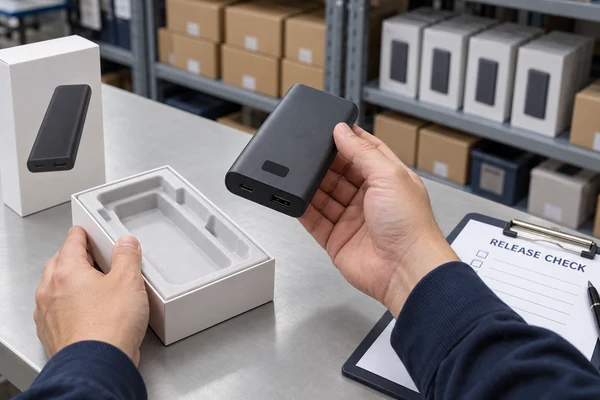
Start with the records. Confirm the SKU, lot, storage history, maintenance status and any hold or recall affecting the goods. Then complete the checks required by the approved plan.
Inspect the packaging and accessible product surfaces for damage, moisture or other abnormalities. Check the identifiers and confirm that the supplied instructions still match the configuration. A repacked carton should retain its link to the original lot.
For units eligible for testing, check the specified wake-up, charging and output behavior with approved equipment. If the plan requires an output-energy test, use its full starting-charge and test conditions. Do not compare a partly charged storage sample with a fully charged capacity baseline.
Record individual failures before any permitted maintenance or retest. A report containing only the final passing result makes it difficult to tell whether the lot had a recurring problem.
Agree in advance what a failed sample means for the remaining stock. The response may involve a broader inspection, supplier investigation or continued hold. Repeatedly replacing failed samples until a set passes is not a defensible acceptance method.
Factory aging-test records remain useful evidence about production. They do not document storage conditions or product changes that occurred afterward.
Handle abnormal stock separately from routine maintenance
Do not put a swollen, leaking, damaged or unusually hot power bank through a routine recharge to see whether it recovers. Australia’s ACCC advises against using power banks with these warning signs. If a unit is smoking or on fire, evacuate and contact local emergency services. ACCC power bank safety guidance.
Block affected inventory from ordinary dispatch and follow the site’s battery-incident procedure. Qualified personnel should determine handling and physical segregation; staff should not improvise by opening cases, bypassing protection or attempting cell recovery.
Routine maintenance of intact, eligible units also needs an approved work area and procedure. Confirm equipment, supervision and stopping criteria with the people responsible for site safety before arranging bulk charging.
For a unit that does not wake up but shows no obvious physical damage, obtain the model-specific assessment procedure. Do not assume it is merely empty or apply an improvised recovery charge. Preserve its identity and storage history for the investigation.
Questions to send the supplier before ordering
Use this request to make the discussion specific:
For SKU [name/revision], we expect approximately [duration] between factory dispatch and customer sale. Please provide the approved storage environment, starting charge condition, power mode, inspection and maintenance schedule, and the evidence supporting any shelf-life claim. Define the claim’s starting date and performance endpoint. Confirm how storage history will be handed over, what happens after missed maintenance or environmental excursions, and which checks authorize release. Please identify any conditions our proposed storage plan does not meet.
Ask for a document revision and named contact. If the factory cannot support the planned stockholding period, resolve that before buying a larger quantity for a lower unit price.
Frequently asked questions
1. How long can a power bank stay in storage without being used?
Use the period supported for its model, starting condition and storage environment. Clarify whether that period includes scheduled maintenance. A warranty duration or cycle-life rating does not answer how long a finished unit can remain untouched.
2. Should bulk power banks be stored fully charged?
Follow the approved storage charge target. Do not choose 100% simply because it gives the highest display reading at dispatch. Obtain separate instructions for long-term storage, maintenance charging and preparation for the intended shipment.
3. Does a sealed retail box prevent battery aging?
No. Packaging does not stop elapsed-time changes inside the battery. Sealed stock still needs traceable dates and the manufacturer’s storage and maintenance instructions. Plan how any required inspection or maintenance will be performed without losing lot identification.
4. How often should stored power banks be recharged?
At the interval specified for the selected model and conditions. Define who tracks the deadline, which units require action and how completion is recorded. A sample inspection should not be recorded as maintenance of the entire lot.
5. Does lower charge after storage mean the power bank is defective?
Not necessarily. Compare the result with the agreed retention requirement and measurement method. Investigate units that fall outside the limit or behave differently from comparable stock; a display reading alone cannot identify the cause.
6. Can an older batch be sold after it passes a charging check?
A charging check alone is insufficient for release. Review its history, applicable holds and all agreed acceptance requirements. If the lot has exceeded its approved storage or maintenance period, obtain a documented disposition before sale.
7. Does maintenance charging restart shelf life or warranty?
Do not treat it as a new manufacturing date. Record maintenance as a separate event and retain the original history. Any revised review date must follow the approved procedure; warranty coverage is a separate matter governed by its applicable terms.
Discuss the storage plan with YULIDA
When contacting YULIDA about an OEM order, include the expected stockholding period, warehouse conditions and sales schedule alongside the product requirements. Ask for the storage instructions and available evidence for the proposed configuration. Confirm maintenance responsibilities before agreeing to the production quantity.
