





How to Choose a Magnetic Power Bank Manufacturer in China: A Buyer’s Checklist
Choose a magnetic power bank manufacturer by verifying the company, the exact product, and the production controls behind its offer. Before approving a bulk order, match the sample to its battery and wireless-charging evidence, test the intended phone-and-case combinations, compare quotations on the same basis, and agree how the factory will manage changes and failed inspections.
A catalogue, certification logo or successful charging demonstration can start the conversation. The purchasing decision needs a traceable evidence file. This guide gives importers, private-label brands and distributors a practical way to build that file and decide which questions must be resolved before production.
Sources reviewed: 8 October 2026. The checklists below are procurement tools. Product approval and shipment acceptance depend on the exact configuration, destination and applicable requirements.
What should you request before comparing magnetic power bank suppliers?
Send the same brief to each shortlisted supplier: target markets, intended phones and cases, desired capacity and dimensions, wireless and wired functions, branding scope, order quantity and delivery destination. Ask the supplier to identify the proposed model and any assumptions behind its quotation.
Use the following evidence register during the first review. Assign each unresolved item an owner and a due date rather than treating a confident sales answer as approval.
| Decision area | Evidence to request | Question to resolve |
|---|---|---|
| Supplier identity | Registered company name, business licence, production address and responsible contacts | Which entity sells the product, and which facility builds it? |
| Product identity | Factory model, buyer SKU, photographs and hardware/firmware revisions | Do the quotation, sample and reports describe the same version? |
| Wireless claim | Exact-model specification and official certification reference where claimed | Which wireless mode and power claim can be supported? |
| Battery and performance | Cell identity, capacity basis, energy rating and test records | What will the approved configuration actually deliver? |
| Production consistency | Controlled-component list, inspection plan and batch records | How will repeat orders match the approved sample? |
| Commercial and transport scope | Itemised quotation, milestones, shipping responsibilities and model-specific documents | What is included, and what remains the buyer’s responsibility? |
For a detailed inquiry format, use the power bank RFQ checklist. At this stage, the goal is comparable responses rather than a long list of suppliers offering different products under the same headline description.
1. Verify the manufacturer and the proposed production facility
Request the company’s registered Chinese name and business licence, then compare those details with the quotation and proposed agreement. Ask the supplier to explain any difference between the contracting company, exporter and factory operator. A trading company can provide a useful sourcing service; the important issue is whether the manufacturing relationship and responsibilities are clear.
A factory visit or live walkthrough should follow the proposed product through the relevant operations. Ask which processes are performed in-house, which are subcontracted, and how outsourced work is inspected. A broad product range, office address or polished video does not settle that question by itself.

- Identify the facility expected to make your order and the people responsible for engineering and quality.
- Request a recent, relevant production or inspection record with confidential customer details removed.
- Ask how the supplier traces a finished batch to its cell lot and approved build revision.
- Confirm how an independent inspector can access the relevant goods and records before shipment.
If the supplier presents ISO 9001 documentation, review the organisation, site, scope and current certificate status. ISO describes ISO 9001 as a quality-management-system standard. Keep that review separate from the evidence supporting an individual power bank’s performance and safety.
2. Verify Qi certification against the exact product
For a model sold as Qi certified, request its Qi Certificate of Registration and follow the certificate’s official product link. Wireless Power Consortium guidance calls for a match in appearance, brand, product name and type number. A company-level logo or the wording “Qi compatible” does not establish certification of the unit offered.
Record the claimed wireless output separately from USB-C output and recharging input. Ask the supplier to state the conditions for each rating and provide evidence for the intended phone combinations. Avoid approving a retail power claim from a charging animation or an unlabelled meter reading.
What changes when you add your own brand?
WPC’s rebranding route permits eligible technically identical variants to be registered without retesting, with a separate Qi-ID for each variant. Its guidance identifies changes to housing shape, connector or charging-surface material as requiring retesting. Confirm the route for the proposed private-label version before approving packaging or tooling.
Keep certification status, trademark wording and measured performance as distinct review items. A supplier should explain any difference between its catalogue model and your branded SKU in writing. Missing or inconsistent records remain open questions until resolved.
3. Evaluate magnetic fit and charging in the intended setup
Define the customer setup before judging magnet strength: phone model, case, charging position, camera clearance and expected handling. Request a holding-force method that identifies the mating surface, pull direction, fixture and sample condition. An isolated magnet grade or force number cannot describe every finished-product combination.
Evaluate comfortable removal as well as secure attachment. Check whether the power bank obstructs buttons or cameras, rocks against the camera housing, or places the phone awkwardly on a desk. Photograph the approved fit so production inspection has a clear reference.
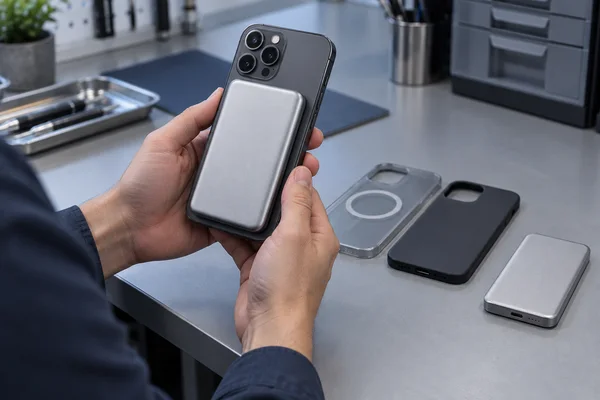
Apple’s wireless-charging guidance identifies thick or metal cases, movement and temperature as possible contributors to charging problems. Therefore, retain the actual phone, case and operating conditions in the test record instead of extending a bare-phone result to all accessories.
For a repeatable charging comparison, record starting charge levels, ambient conditions, software versions, duration and any interruptions. Specify what is measured: USB output energy, wireless transfer at an identified measurement boundary, or charge gained by the phone. Use the same setup across candidates and retain unsuccessful runs alongside successful ones.
Keep abnormal-condition and protection testing with a qualified laboratory or suitably equipped safety team. Do not improvise foreign-object heating tests with coins or foil, open battery packs, or bypass protection while evaluating samples.
4. Check the battery, usable energy and production version
Request the cell manufacturer and model, nominal voltage, capacity basis, pack configuration and watt-hour rating. Clarify whether a capacity figure is minimum, rated or typical. Ask how the supplier records incoming cell lots and prevents unapproved substitutions.
Illustrative calculation: 10,000mAh at a nominal 3.7V equals 37Wh: 10Ah multiplied by 3.7V. This is nominal battery energy for that example, not a measured USB output result or a promise of phone recharges. Different nominal voltages produce different Wh values.
For delivered energy, agree the output mode, load, starting condition, cut-off, temperature and measurement method. For cycle-life claims, identify the charging/discharging conditions and the capacity-retention threshold. Avoid applying one percentage of “usable capacity” or one cycle count to every design.
List the components and revisions that need control: cell, PCBA, wireless controller, coil, shielding, magnets, enclosure and firmware as applicable. A full confidential BOM may not be available, but the purchasing file still needs enough identity and change information to connect production to the approved evidence. The product-specification guide provides a structure for recording accepted requirements.
5. Review safety, inspection and traceability together
Ask for the assessment applicable to the finished model and destination market. Organise the review by requirement, responsible party, covered model and document reference. A cell report, factory-system certificate and finished-product report answer different questions.
WPC explicitly states that Qi certification does not guarantee product safety and that manufacturers remain responsible for applicable product-safety regulations. Include the relevant safety evidence in the file alongside wireless certification.
Ask the factory which checks run on every unit, which use sampling, and what happens when a lot fails. An aging duration alone is incomplete: request the operating conditions, sample coverage, monitored values, acceptance criteria and retained records. Do the same for any claimed end-of-line electrical or wireless test.
A useful traceability exercise starts with a finished carton or unit identifier and follows it back to the production date, build revision, cell lot and inspection disposition. Ask for an anonymised example before relying on the supplier’s claim that it can trace every batch.
Agree defect categories and the inspection method with the quality team. Describe rejection, sorting, rework and reinspection responsibilities in advance. The YULIDA quality-control overview can support this discussion; confirm the plan and available records for the selected model.
6. Classify power-bank cargo correctly before arranging freight
Ordinary lithium-ion power banks shipped as air cargo are classified as UN3480 under Packing Instruction 965. IATA’s 2026 guidance, FAQs D.02–D.05, treats them as batteries; a USB cable or retail bundle with a phone does not turn them into UN3481 equipment shipments. Review the current IATA battery guidance with a competent dangerous-goods shipper.
The normal air-cargo route is cargo aircraft only, with state of charge normally limited to 30%. The applicable packing section, limits, marks, labels and documents require shipment-specific review, including carrier restrictions. IATA cautions that its guidance does not replace regulatory compliance sources. Passenger baggage rules are separate.
Request the applicable UN 38.3 test summary. PHMSA’s test-summary guidance identifies model information, battery description, energy rating, laboratory details and report references among its required elements. A summary may cover multiple products when the required information is present. Ask the supplier to map the offered SKU and battery revision to that coverage and resolve inconsistencies before dispatch.
Record who prepares the shipment, checks the documents and obtains carrier acceptance. A supplier’s broad promise of “battery shipping supported” leaves those responsibilities unsettled.
7. Compare MOQ, price and lead time on a consistent basis
Ask for separate quotations for an existing model with branding, changes to an existing design, and new product development where relevant. Suppliers use OEM and ODM labels differently, so define the work explicitly. Housing changes, new electronics, firmware and packaging may have different minimum quantities and approval steps.
Use an itemised comparison rather than treating one advertised unit price as a market benchmark. The table below is a quotation framework, not a price list.
| Quotation line | Ask each supplier to specify | Comparison risk |
|---|---|---|
| Finished unit | Exact model, configuration, quantity tiers and currency | Different cells, features or quantities make unit prices incomparable |
| Customisation | Artwork, colours, tooling, firmware and engineering charges | A low unit price can exclude essential development work |
| Evidence and testing | Available files, additional work, cost and responsible party | A catalogue claim may not cover the branded production version |
| Packaging and accessories | Included cables, manuals, retail packaging and carton quantities | Freight and retail readiness change with the supplied package |
| Inspection and logistics | Inspection charges, Incoterm and named place, transport scope | Factory dispatch cost and delivered cost cover different obligations |
| After-sales | Claim evidence, remedies, response process and cost allocation | A warranty period alone leaves claim handling unclear |
Request milestone dates for samples, engineering decisions, evidence review, material readiness, production, inspection and dispatch. State which approvals start each clock. A production estimate after sample approval should not be read as an inquiry-to-delivery commitment.
For custom tooling, have the agreement identify ownership, access, maintenance, modification and any exclusivity. Paying a tooling charge does not, by itself, describe those arrangements. Obtain appropriate professional review where contractual rights or liabilities need interpretation.
Use approval gates before placing a bulk order
The following sequence is a buyer’s planning framework. Set the actual approval responsibilities and acceptance rules for your project.
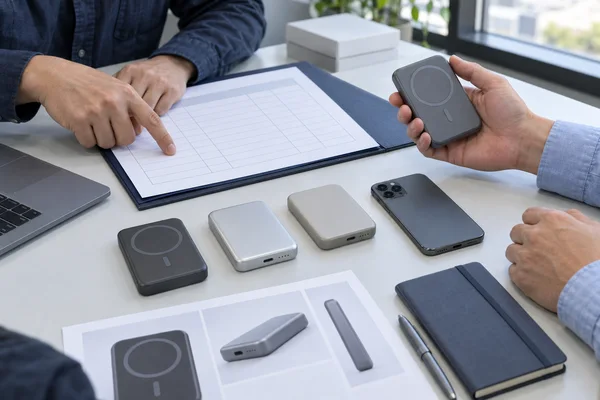
- Shortlist review: confirm the contracting entity, factory role and proposed model. Keep a comparison sheet with evidence references and unresolved questions.
- Sample review: evaluate the requested configuration against the same written requirements. Identify stock samples that differ from the intended production version.
- Evidence review: reconcile product identity, performance claims, applicable reports and branding status. Escalate discrepancies to the responsible engineer, laboratory or compliance adviser.
- Production approval: retain the approved sample reference, specification, artwork, controlled revisions and inspection plan. Record any conditions that remain open.
- Shipment release: review the agreed inspection disposition, batch identity, packing information and route-specific shipping file before authorising dispatch.
Pause the affected approval when a supplier cannot explain a model mismatch, proposes an undocumented cell substitution, or declines the agreed inspection access. Record the missing evidence and the action needed to resolve it. A small trial order still needs the relevant safety, documentation and production controls.
For a YULIDA OEM/ODM inquiry, send the target phones and cases, destination markets, quantity and customisation scope. Request model-specific documents and a milestone quotation so the proposed product can be evaluated against the same checklist.
FAQ
1. How can I tell whether a magnetic power bank supplier is a manufacturer?
Verify the contracting company and ask who operates the proposed factory. Review the relevant production steps, outsourcing arrangements and inspection records through a visit, live walkthrough or independent audit. A business licence or video is one piece of evidence; resolve how the quoted product will actually be made and controlled.
2. What MOQ should I expect for a private-label magnetic power bank?
Request the MOQ for the exact configuration, colour and packaging rather than assuming one industry-wide number. Existing-platform branding, component changes and new tooling can have different thresholds. Ask whether mixed colours or capacities count toward the same minimum and whether samples or trial orders have separate terms.
3. How do I verify a supplier’s Qi2 certification claim?
Obtain the certificate and compare its official WPC record with the offered product. Check the model, brand, appearance and product name. For a private-label version, confirm the applicable registration route and record. Keep certification evidence separate from the phone-specific performance results used to support marketing claims.
4. Is N52 magnet grade enough to approve a magnetic power bank?
No. Approve the finished product using a defined attachment test and the intended phone-and-case combinations. Specify the method, mating surface and handling conditions. Also evaluate alignment, camera clearance and removal comfort. A component grade cannot replace those product-level observations or an agreed acceptance limit.
5. What documents should I request before paying for production?
Request the agreed specification, sample-approval record, applicable model-specific evidence, artwork, inspection plan and itemised quotation. Identify the approved build revision and the process for substitutions. Make unresolved requirements visible before committing to the production version, especially where testing or registration still needs to be completed.
6. Are magnetic power banks UN3480 or UN3481 for air cargo?
Ordinary lithium-ion power banks are UN3480 under PI965, including when supplied with a USB cable or bundled with a phone. Ask the dangerous-goods shipper to confirm the exact shipment requirements and carrier acceptance. Do not use passenger carry-on allowances as instructions for commercial cargo.
7. How long does a custom magnetic power bank project take?
Build the schedule from the actual work: samples, engineering, tooling where needed, evidence review, materials, production, inspection and transport. Ask which approvals each estimate assumes and whether the date means dispatch or arrival. Keep contingency tied to unresolved work rather than relying on one generic factory lead time.
8. What is the strongest reason to delay a bulk order?
An unresolved discrepancy that affects the approved product or its evidence deserves a pause. Examples include reports for an unexplained model, an unapproved battery change or a performance claim that cannot be reproduced under the agreed conditions. Define the corrective evidence and responsible reviewer before restarting the affected approval.
Official sources and verification
These primary sources support standards, compatibility, safety, or transport statements discussed in this article. Confirm the current requirement for the exact product model and destination market.
- Wireless Power Consortium — Qi and Qi2 standards, certification, and wireless-charging information.
- Wireless Power Consortium — Qi and Qi2 standards, certification, and wireless-charging information.
- Apple Support — Device charging features and compatibility guidance.
- International Air Transport Association — Lithium-battery transport requirements and industry guidance.
- U.S. PHMSA — Hazardous-materials and lithium-battery transport information.
