







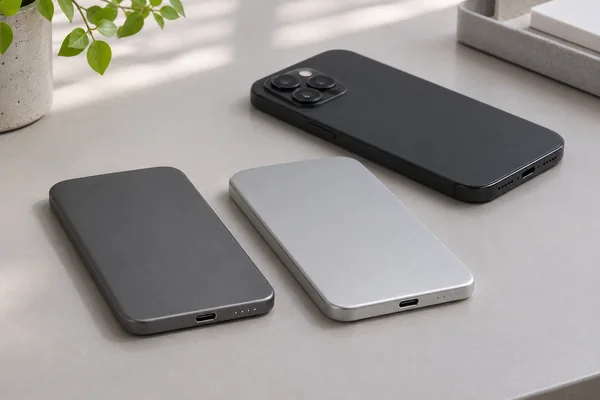
Slim Magnetic Power Banks: 5 Sample Checks Before a Bulk Order
Before placing a bulk order for a slim magnetic power bank, check five things on the exact sample you intend to buy: fit with the target phone and case, stability in the hand, usable output energy, wireless charging continuity, and heat during sustained use. A caliper can tell you how thin the pack is. It cannot tell you whether the pack sits flat below the camera, stays put when the phone goes into a pocket, or keeps charging after the first few minutes.
Start with a sample you can identify. Record the model, capacity variant, enclosure, surface finish and sample revision. If the sample is a generic unit and the bulk order will use a different case finish or branding treatment, state what will change. The verdict should apply to the version you tested, not every model in a catalogue.
1. Measure the pack, then fit it to the phone
Measure both the main body and the thickest point in the closed carry position. Note any raised ring, trim or folded stand that changes the thickness. Record the pack’s weight separately. Ask the supplier to identify the measuring points on the drawing if the dimension will appear on packaging.
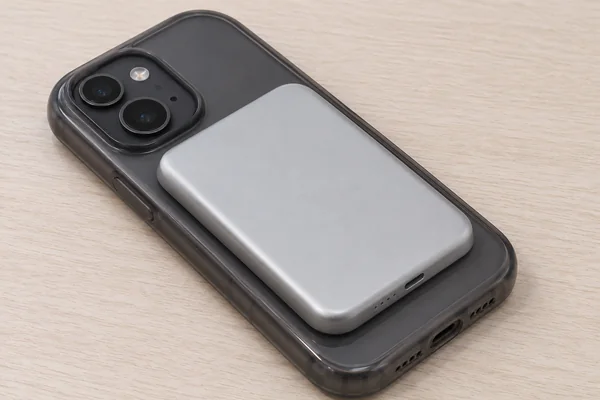
Then attach the pack to the exact phone and case the order is meant to serve. Check whether the upper edge touches the camera surround, whether the pack rocks when lightly pressed at a corner, and whether any overhang interferes with ordinary use. Try the phone bare as a reference, but do not approve a case-dependent combination based on the bare-phone result.
For example, a shorter pack can clear a camera surround that a thinner but taller pack touches. If the fit leaves a gap or forces the pack out of position, record which phone and case produced it rather than marking the entire model range compatible or incompatible.
2. Check whether it stays put in normal use
Listen for the snap, then try the pocket test. A pack can still twist on a smooth case or shift when its lower edge catches on the pocket opening. With the power bank attached, try ordinary handling: pick the phone up, use it one-handed, and slide it into and out of the type of pocket or sleeve your customers use. Note any sliding, rotation or detachment. If the model includes a stand, repeat the check in the intended stand position.
For a model with a stand, use the separate magnetic power bank stand acceptance guide to check hinge movement and stability. If you plan to sell a matched phone case and power bank, use the phone case and power bank bundle sourcing guide to confirm pairings, SKUs and supplier responsibilities.
Use the same phone, case and handling sequence for each supplier’s sample. Keep this separate from a formal holding-force test. If your contract specifies a force, define the direction, fixture and procedure before comparing numbers. A straight pull-off value is not a measurement of sideways slip.
3. Compare usable energy, not just the printed capacity
The mAh on the enclosure usually describes the internal battery at its rated voltage. It does not say how much energy the finished pack will deliver to a device. For a fair supplier comparison, request delivered watt-hours (Wh) from the same output port at the same agreed voltage, load and cutoff. Start with fully charged units and record the conditions.
If the order is for wireless use, add a separate check for the target phone or an appropriate wireless measurement setup. Do not treat a wired USB result as wireless delivery. A phone’s battery percentage gain over a defined interval is useful as a comparison on that same phone under the same conditions, but it is not a direct Wh measurement and should not be turned into a universal recharge count. See Yulida’s power bank capacity testing guide for the measurement boundaries.
4. Verify that wireless charging continues after attachment
Attach the sample to the phone with the intended case on. Record the start time and the phone’s state of charge. Confirm charging begins, then check it at agreed points during the session. Look for interruptions or repeated starts, and note whether a small movement during ordinary handling breaks the connection. Test any different case or phone model your packaging will explicitly name.
Magnetic attachment, charging compatibility and certification are separate claims. If the product will be marketed as Qi or Qi2 certified, use the Wireless Power Consortium’s certification guidance and verify the exact model in its database. A pack can hold firmly without supporting the phone’s intended charging mode or wattage.
5. Record heat and charging behavior over time
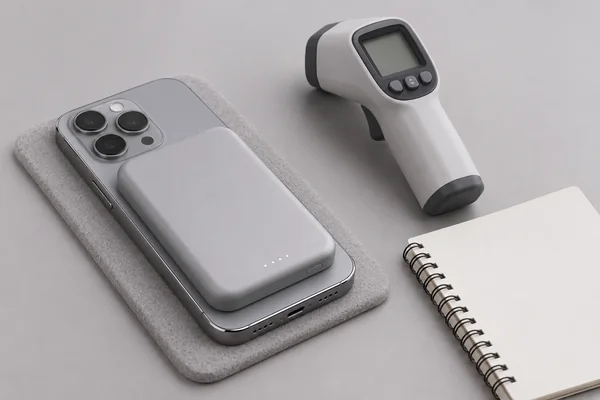
Test each sample in the same room conditions, with the same phone, case, starting charge and usage pattern. For a basic comparison, agree whether the screen stays off or the phone runs a defined task. At the planned checkpoints, record surface readings at the same locations and note any charging slowdown, pause or temperature message. Write down both the observation and when it happened.
The sample’s surface temperature does not by itself give the battery’s internal temperature or show that the product meets a safety standard. The point is to spot practical differences within the agreed use case. Apple, for example, documents temperature-related charging slowdowns and pauses; a phone-side pause is worth recording, not automatically blaming on a defective pack. If a sample shows unusual heat or swelling, stop using it and refer it for qualified evaluation rather than extending the test.
Slim magnetic power bank sample acceptance sheet
Agree on the pass criteria before checking competing samples. Use one row per phone and case combination wherever fit or wireless behavior can vary.
| Check | Record on the sample sheet | Example of an agreed decision rule |
|---|---|---|
| Fit and dimensions | Body and maximum closed thickness; weight; phone and case; camera clearance | Meets the signed drawing and sits flat on the named phone and case |
| Attachment | Movement during the agreed pick-up and pocket-use sequence | No detachment or unacceptable rotation during that sequence |
| Usable energy | Output Wh, port, load, voltage and endpoint | Meets the agreed delivered-energy requirement at the stated setup |
| Wireless continuity | Phone and case; starting charge; duration; stops and restarts | Meets the agreed session criteria on the named combination |
| Heat and sustained use | Room temperature, reading locations and times; any slowdowns or pauses | Meets agreed surface-temperature and charging behavior limits under the same protocol |
Treat missing evidence as pending, not as a pass. Keep the signed sheet and photos with the approved sample. If the enclosure, finish, cell, magnetic assembly or firmware changes, ask which checks need to be repeated before releasing production.
What to send Yulida before requesting a quote
Send the intended phone and case combinations, maximum carry thickness, target capacity variant, expected use, and any claims you want on the packaging. If you’re evaluating a model such as the Yulida AJ01B magnetic power bank with stand, confirm the current drawing and production sample for the exact version rather than relying on older thickness or weight figures. Attach your acceptance sheet so the quotation and sample review refer to the same requirements.
Frequently asked questions
1. Where should I measure the thickness of a slim magnetic power bank?
Measure the main enclosure and the thickest point in the normal closed carry position. Note where each reading was taken and whether it includes a raised ring, folded stand or trim.
2. Can I approve a sample using only a bare phone?
Only if the order is limited to bare-phone use and makes no case claims. If customers are expected to use a case, include the named case and phone combination in the trial.
3. Is magnet strength the same as attachment stability?
No. Magnet strength does not tell you how much a pack will slide or twist on a particular case. The surface finish, fit and force direction matter. Compare samples under the same handling conditions.
4. Should two samples with the same mAh deliver the same energy?
Not necessarily. The label may describe internal battery capacity, not output. Compare delivered Wh from the same port under the same voltage, load and cutoff conditions.
5. Does a charging icon verify the advertised wireless wattage?
No. It indicates that the phone recognizes a charging session. It does not measure received wattage or show that charging continued. Verify claims with the appropriate equipment and stated test conditions.
6. Is there one surface-temperature limit for all slim packs?
Do not assume one limit fits all designs or test conditions. Specify how and where temperature will be measured and use the applicable product requirements and qualified safety evidence for limits.
7. Does a certified sample automatically cover the private-label version?
Do not assume it does. Verify the exact brand and model entry and the wording or marks you plan to use. Ask for clarification if the approved sample, database entry and packaging show different identifiers.
8. When should I retest an approved sample?
Review any change that could affect fit, attachment, output or heat. For example, repeat fit and handling checks after a geometry or finish change, and review charging and thermal evidence if the cell, electronics or firmware changes.
Official sources and verification
These primary sources support standards, compatibility, safety, or transport statements discussed in this article. Confirm the current requirement for the exact product model and destination market.
- Wireless Power Consortium — Qi and Qi2 standards, certification, and wireless-charging information.
- Apple Support — Device charging features and compatibility guidance.
