







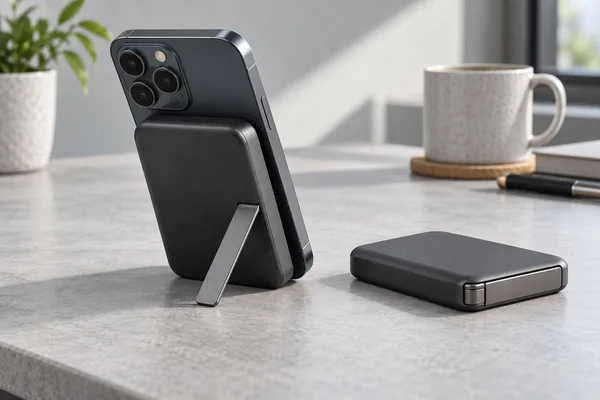
Magnetic Power Bank Stands: Stability, Hinge Durability and OEM Acceptance Checks
A magnetic power bank stand should hold the intended phone and case at the approved viewing positions, remain usable after repeated adjustment, and fold away without damage. Before an OEM order, check those requirements on identified samples and record what changes after cycling. A product photograph cannot show whether the stand will slip when someone taps the screen.
This guide proposes a buyer-side acceptance procedure for integrated stands. It is not an international test standard or a report of YULIDA laboratory results. The buyer, supplier and qualified test provider should agree the sample quantity, loads, cycle counts, conditions and pass criteria for the selected design.
Define the viewing task before testing the hinge
A stand intended for watching a video has a different usability requirement from one advertised for tapping through a recipe or taking a video call. Belkin describes its fold-out power bank stand as a hands-free option for streaming and video calls while charging. That is a useful example of an intended use, not a durability benchmark for another product.
Write down what customers should be able to do. Specify portrait, landscape or both; the supported phone and case combinations; and whether screen interaction is part of the claim. Identify the permitted viewing positions rather than assuming that every mechanically reachable position is suitable for use.
Rotation and tilt need separate definitions. A bracket may rotate around the back of the power bank while its opening hinge sets the viewing position. A full rotation claim does not establish that the assembly can hold a phone at every tilt. Photograph the intended configurations and name each adjustment axis in the test plan.
Build a phone, case and angle matrix
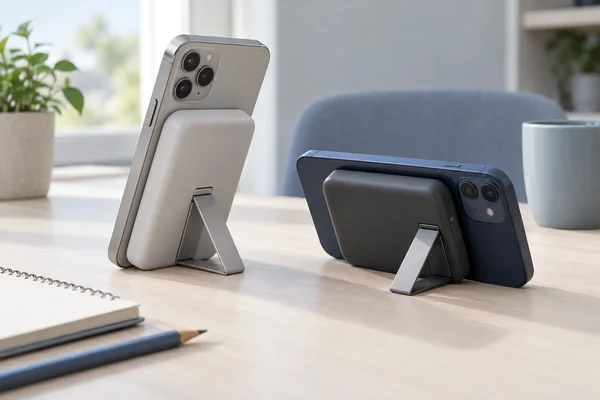
Record the exact phone model, case SKU, combined mass and relevant dimensions. Mass alone is insufficient: a taller phone, raised camera surround or different case contact can change how the assembly sits. Include the combinations at the demanding ends of the proposed range, with an engineering rationale for their selection.
Define how the viewing angle is measured. For example, the plan can measure the screen plane relative to the tabletop. The hinge-opening angle is a different quantity. Use the same reference and instrument before and after cycling so a later inspector can reproduce the result.
Fill in the angles, observation periods and limits in this matrix before testing. These are proposed checks, not universal acceptance values.
| Check | Setup to define | Result to record |
|---|---|---|
| Static support | Phone, case, orientation, viewing position and surface | Angle drift, sliding, rocking, collapse or tipping |
| Screen interaction | Tap location, direction, force or controlled action, and repetitions | Movement, recovery, attachment and retained viewing position |
| Adjustment life | Movement path, load, speed, cycle definition and checkpoints | Operating resistance, play, damage and completed cycles |
| Post-cycle use | The original phone–case–angle combinations | Change from baseline and pass/fail against each requirement |
| Charging while supported | Approved charging mode, position and operating conditions | Charging continuity, thermal observations and stand movement |
Separate hinge movement from sliding and tipping
Start with the assembly on a defined, level surface. Record the surface material, condition and contact points. A result on a high-friction test mat should not be presented as proof of performance on a smooth desk. If the sales claim includes several surfaces, evaluate those surfaces separately.
Set the stand without manually supporting the phone, then observe it for the agreed period. Compare the initial and final screen angles. Check whether the foot moves, the phone rocks, or the hinge gradually closes. Use side-view photographs or video with a fixed reference to distinguish these changes.
Record the failure mechanism rather than writing “unstable.” The entire assembly can tip while the hinge holds its angle. The foot can slide without tipping. The hinge can creep while all contact points remain in place. Each observation points to a different design question and needs its own acceptance rule.
Conduct checks over a protected work area with a catch arrangement that does not support or restrain the sample during normal observation. Do not push an assembled battery product until it falls or breaks merely to find a limit. Any deliberate load-to-failure work requires a separate, appropriately controlled laboratory plan.
Check tapping and ordinary adjustment
If the stand is sold for interactive use, include representative screen touches at identified locations. A tap near the top edge can load the assembly differently from one near the centre. Agree the direction, contact method and repetitions. Where a numerical force is required, the test provider should define an instrumented method rather than relying on how firmly an inspector happens to tap.
Observe whether the stand rocks and settles, slides, changes angle, detaches or tips. Define what movement is acceptable before comparing samples. A temporary movement and a permanent loss of position are different results; both should be visible in the record.
Repeat the approved interaction in portrait and landscape where both are claimed. If a cable is part of the advertised setup, record its routing and slack. A hanging cable can affect the result, but it should not be used as an accidental support or restraint. Evaluate only combinations the supplier permits.
Magnetic attachment remains a separate requirement. Use the existing magnetic alignment and holding-behaviour guide for that assessment. Keep the attachment and stand results separate: either can pass while the other fails.
Define a hinge cycle before quoting a lifetime
“Tested for thousands of cycles” leaves too much unresolved. Specify the starting position, movement path, end position and return. State whether one cycle means a complete open-and-close movement or a different sequence. If the design has both a folding hinge and a rotating joint, give each its own count and record.
Agree whether cycling is unloaded or uses a defined representative load, along with speed, pauses, fixture arrangement and permitted range. The fixture must not clamp the housing in a way that bypasses the support structure being evaluated. Keep movement within the approved range unless a separate misuse test is commissioned.
Select the target count and sample quantity from the intended use and qualification plan. Do not borrow another brand’s angle range or an unrelated hinge’s cycle claim. A bench count also needs a defensible model of adjustment frequency and loading before it can support a claim about years of use.
Inspect at agreed checkpoints, keeping the same sample identifiers throughout. Record completed cycles, interruptions, unusual noise, sticking and visible changes. Do not tighten a joint, add lubricant or replace a foot midway without documenting the intervention. If an intervention is part of an approved maintenance procedure, the resulting claim must reflect that condition.
Compare play, damage and holding behaviour before and after
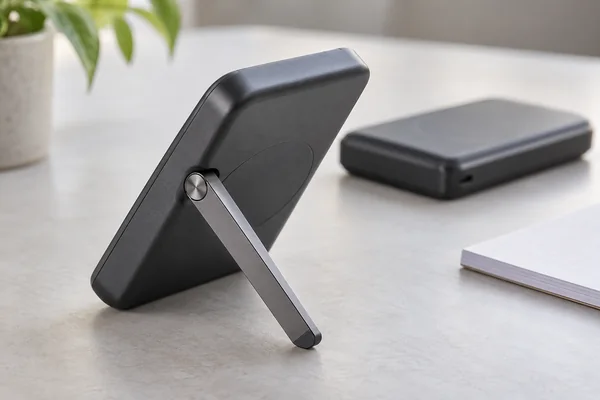
Take baseline measurements before cycling. Record operating resistance using the agreed method, free movement or backlash, closed-position fit and the ability to retain each approved viewing angle. For a force or torque measurement, identify the direction, application point and fixture; otherwise the numbers may not be comparable.
Inspect hinge mounts, pins, bracket edges, fasteners where present, and contact pads. Agree criteria for cracks, deformation, looseness, separation, sharp edges and cosmetic wear. Distinguish an appearance defect from damage that affects support or safe handling. Keep individual results rather than hiding an outlying sample inside an average.
After the specified cycling, repeat the original stability and interaction matrix with the same phones and cases. A joint can still open and close yet no longer hold the approved position. Conversely, a change in measured resistance needs interpretation against both its agreed limit and the actual usability result.
Verify charging in the supported position
Mechanical qualification does not establish charging performance. Run the intended charging setup separately, recording phone and power-bank charge levels, case, ambient conditions, position and duration. Check that the chosen stand position does not disrupt alignment or place unintended pressure on a connector.
Record charging interruptions and any change in viewing position during the session. For temperature measurements, use identified locations and the agreed limits for the construction. The temperature-rise testing guide explains that measurement record. Stop and refer abnormal or damaged samples for assessment rather than continuing a charging check.
Carry the approved stand into production
Attach the method, photographs and sample results to the controlled product specification. Identify the stand drawing, joint construction, housing interface, contact materials and relevant assembly process. Record which combinations passed, which failed and which were not evaluated.
Keep qualification separate from shipment inspection. A destructive or extended cycle test may use dedicated qualification samples; routine inspection needs its own agreed sampling and functional checks. Require review when a supplier changes a hinge, bracket material, contact pad or mounting arrangement. Use the BOM and change-control process to decide which checks must be repeated and which production lots the approval covers.
For a YULIDA project, the AJ01B magnetic power bank is a product reference with a published rotating stand. Its published guidance calls for checking hinge feel and holding behaviour with representative devices at the intended angles; it does not state a hinge-life acceptance count. Send the intended phones, cases, orientations and use requirements when requesting a sample plan. Approve the resulting configuration and evidence before adopting a stand-performance claim.
Frequently asked questions
1. What should an OEM buyer test on a magnetic power bank stand?
Check static support, angle retention, sliding or tipping, ordinary screen interaction, adjustment durability and post-cycle usability. Identify the phone, case, surface and viewing position for each result. Charging performance and magnetic attachment need their own checks alongside the stand assessment. Agree the limits before testing.
2. Does a 360-degree rotating stand support every viewing angle?
No. Rotation around one axis and the tilt that supports a phone are different movements. Identify the joint and reference used for each angle. Approve the intended viewing positions under the actual phone-and-case load rather than treating a rotation description as an all-angle stability claim.
3. How many hinge cycles should a power bank stand survive?
There is no single count established by this buyer procedure. The qualification plan should define the intended use, sample quantity, movement path, load, speed, checkpoints and failure criteria. A cycle count without those conditions is difficult to compare, and it does not directly establish a service life in years.
4. Can a test with one heavy phone cover all supported phones?
Do not assume so. Phone dimensions, case geometry, camera clearance and contact positions can change the result as well as mass. Select representative combinations with a documented rationale and identify the limits of that coverage. Add testing where another combination changes the loading or support arrangement materially.
5. How should screen tapping be included in acceptance?
First decide whether interactive use is part of the product claim. Then define the screen locations, direction, controlled action or measured force, and repetitions. Record temporary rocking separately from sliding, permanent angle loss, detachment or tipping. Use a protected setup and agree the acceptable result before comparing samples.
6. What should be checked after hinge cycling?
Repeat the original phone, case, angle and interaction checks. Compare operating resistance, play, closed fit and position retention with the baseline. Inspect the bracket, mounts and contact pads for damage. A stand that still opens is not necessarily acceptable if it no longer holds the approved configuration.
7. Does stronger magnetic attachment prevent the stand from tipping?
It does not establish that outcome. The phone may remain attached while the complete assembly tips, or the stand foot may slide while the hinge stays in position. Evaluate magnetic retention separately, then assess the supported assembly on the specified surface with its intended phone and case.
8. What should buyers request for YULIDA AJ01B stand approval?
Send the intended phone-and-case list, orientations, viewing positions and interaction requirements. Request the proposed stand configuration and an agreed sample-validation plan, including cycle definition, acceptance limits and production checks. The published rotating-stand description does not establish a verified cycle life or stability result for every device combination.
