







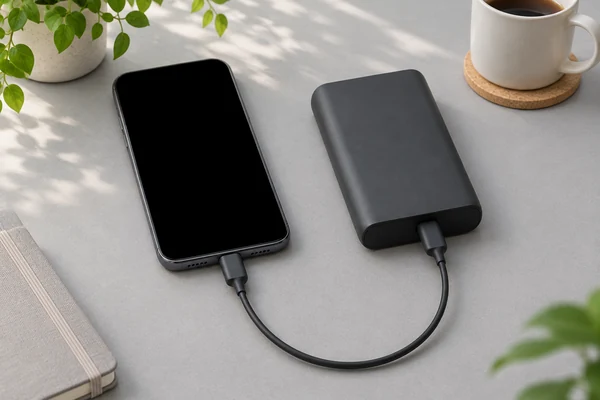
Why Is the Phone Charging the Power Bank Instead?
If a phone appears to charge a USB-C power bank instead of receiving power, the connection may have assigned the phone the source role and the power bank the sink role. Confirm that direction before calling the product faulty. Before an OEM order, check whether the exact device pair works as promised without leaving customers to guess.
This guide concerns wired USB-C connections. It does not diagnose magnetic attachment or wireless charging. Keep any damaged, swollen or unusually hot unit out of a troubleshooting trial and refer it for qualified assessment.
USB-C describes the connector, not a fixed charging direction
A source supplies power; a sink receives it. A dual-role power port can operate in either role under its supported conditions. It does not guarantee that every connection starts in the direction a customer expects.
Renesas explains USB Type-C power roles and role selection, including source and sink preferences. Its explanation also separates power roles from data roles. Whether a device acts as a data host does not, by itself, settle which way electrical power flows. A supported power-role swap is another function to verify, not an automatic capability to infer from a USB-C socket.
Phones can also supply power. For example, Apple documents using iPhone 15 and later to charge supported small USB Power Delivery devices. That establishes that a phone need not always be the receiver. It does not tell us how a particular phone and power bank will select their roles together.
Check the intended connection before testing
Ask the supplier to identify every usable power path: separate USB-C sockets, attached cables and any output-only connections. For each one, record whether it is input-only, output-only or bidirectional, together with its supported profiles and documented user controls.
A port marked only for input is intended to recharge the power bank. A port with input and output ratings still needs a description of how it selects a role. Do not assume that the unit with the higher battery percentage always supplies the other one.
يوضّح YULIDA AJ29 product page, for example, describes a built-in bidirectional Type-C cable. It also says that separate cable input/output profiles and controller behavior require confirmation. Treat that as a question for the proposed production specification, not proof of compatibility with every phone. The attached cable and separate port should have their own entries in the review.
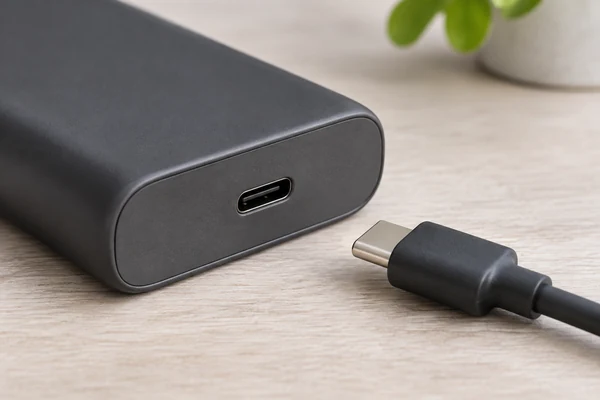
Build a short power-direction review
Use intact samples, the manufacturer’s instructions and equipment suitable for the connection. Have the responsible technical reviewer choose any protocol analyser or directional power measurement. The instrument must support the relevant connection without forcing the role being investigated.
Record the starting arrangement
Identify the power-bank model and revision, phone model and software, cable, selected connection and starting charge levels. Note whether the power bank is awake, whether any documented mode is enabled and whether other devices are connected. Start with the simplest supported one-device arrangement; keep pass-through charging and multi-device operation separate.
Confirm which unit supplies power
Record the indication on each device and the measured direction using the agreed method. If the phone loses charge while in use, that alone does not prove that it is charging the bank: its own workload may exceed the incoming power. Likewise, a display animation is not a measurement of current direction.
A protocol record and a suitable power measurement answer different questions. Ask the reviewer to retain both the established power roles and the observed transfer where needed. Keep the original log, not just a screenshot of a favorable moment.
Repeat the normal situations customers will encounter
Agree a limited matrix of supported starting conditions. This can include different ordinary charge levels, the documented wake procedure and a fresh connection after normal disconnection. Repeat with each phone model the product will name. Record whether charging begins in the intended direction and whether any user action is required.
Check the instructions for the actual phone and power bank before trying a menu setting or button sequence. If the supplier proposes a workaround, ask whether it is an intended supported procedure, then verify that procedure on the identified samples.
Turn observations into a purchasing decision
Decide what the product must do before comparing suppliers. If your brief requires the bank to charge the listed phone after a normal connection with no extra steps, a result that consistently needs an undocumented sequence does not meet that brief. It may still be a technically functioning product, but it is not the configuration you asked to approve.
- When the intended direction is established, retain the device pair, connection and starting conditions with the result.
- If a documented user action is needed, decide whether it is acceptable and include it in the approved instructions.
- If direction varies or evidence is incomplete, keep the combination pending and request a technical explanation or revised configuration.
- If only a different port works, record that supported path rather than approving every connection.
Our قائمة التحقق من مواصفات USB-C PD covers the wider input/output requirements. The question here is narrower: does the chosen connection supply the intended device under the agreed starting conditions?
Keep direction, speed and simultaneous charging separate
Correct power direction does not prove fast charging, rated capacity or successful operation of several outputs. After the direction is established, assess those claims using their own methods. A role-selection problem should not be hidden inside an average charging-time result.
If the use case includes recharging the bank while it powers another device, consult the separate دليل الشحن التمريري. Do not add an external supply during a single-connection diagnosis and treat the changed setup as the same test.
Send a connection-specific OEM brief
عند إرسال YULIDA OEM or ODM enquiry, specify the devices, selected ports or attached cables, intended direction and acceptable user steps. Ask for the supported role-and-profile matrix and results for the proposed hardware and firmware. Approve the instructions alongside the sample so sales and support describe the same behavior. This article does not establish a universal reverse-charging fix or claim that any named YULIDA model exhibits the problem.
الأسئلة الشائعة
1. Why might a phone supply power to a USB-C power bank?
The connection may have established the phone as the power source and the power bank as the sink. Confirm the actual direction and supported roles for that exact combination. A charging icon or changing battery percentage alone is not enough to diagnose the cause.
2. Does a bidirectional port always charge the device I intended?
No. Bidirectional capability means the port can support input and output under its documented conditions. It does not establish which role will be selected with every connected product or whether the user can change that selection.
3. Does the device with the higher battery percentage always supply power?
Do not assume such a rule applies across products. Record both starting charge levels and ask the supplier to explain the behavior of the specified hardware and firmware. Validate the intended combinations rather than deriving a rule from one observation.
4. Will a higher-wattage USB-C cable fix the direction?
A cable’s power capability does not by itself select which device supplies power. Use a compliant cable suitable for the connection, then check port roles and the actual connection behavior. Do not modify a cable or bypass its control connections.
5. Is the USB data host always the power source?
No. Data roles and power roles are separate concepts in USB Type-C and Power Delivery. A host or device label should not be used alone to determine the direction of power flow.
6. Does this behavior prove the power bank is defective?
Not by itself. Compare the observed behavior with the documented port functions and agreed product requirement. Unsupported expectations, a wrong input-only connection or an unresolved compatibility issue need to be distinguished from a confirmed fault.
7. Should the built-in cable and separate USB-C port share one approval?
Only where the evidence explicitly covers both paths. Record each connection separately because its supported input, output and user-control behavior may differ. Do not transfer an external-port result to the attached cable without verification.
8. What should an OEM buyer ask YULIDA to confirm?
Provide the exact phones or other devices, intended charging direction, selected power-bank connection and cable, and expected user steps. Ask for a role-and-profile matrix, identified sample results, limitations and matching instructions for the proposed production version.
المصادر الرسمية والتحقق
تدعم هذه المصادر الأولية ما يناقشه المقال من بيانات تتعلق بالمعايير أو التوافق أو السلامة أو النقل. تحقّق من المتطلبات الحالية للطراز الدقيق للمنتج والسوق التي سيُطرح فيها.
- دعم Apple — ميزات شحن الأجهزة وإرشادات التوافق.
