






How Much Does It Cost to Manufacture a Custom Power Bank in China? OEM Pricing, MOQ & Tooling Guide (2026)
There is no reliable single price for a custom power bank until the specification is fixed. The quote changes with the battery cell, capacity, output power, charging protocols, enclosure, built-in cables, wireless charging, branding, packaging, compliance scope and order quantity. For a useful comparison, send every supplier the same specification and request separate quotations for 500, 1,000 and 2,000 pieces.
A low unit price can hide a different cell, slower charging, simpler protection circuitry, unbranded packaging or missing test documents. Buyers should compare the complete configuration and approval process, not the last number in a quotation.
What does “custom power bank cost” include?
“Custom” covers several levels of work. Printing a logo on an existing model is different from changing the colour, cable, ports, firmware, enclosure or internal electronics. A new mould is a separate development project. Two requests described as OEM orders can therefore have very different budgets and lead times.
A practical quotation normally contains four parts: the product itself, customization, one-time development charges and order-specific services. Freight, duties and local taxes may sit outside the factory quote, depending on the Incoterm.
- Product cost: battery cells, PCB, connectors, wireless-charging components, housing and assembly.
- Customization cost: logo method, colour matching, accessories, labels and retail packaging.
- One-time charges: samples, engineering, artwork setup, tooling, fixtures or model-specific testing.
- Order services: inspection, document preparation, special packing and shipment arrangements.
Why power bank quotations vary so much
Battery cell and rated energy
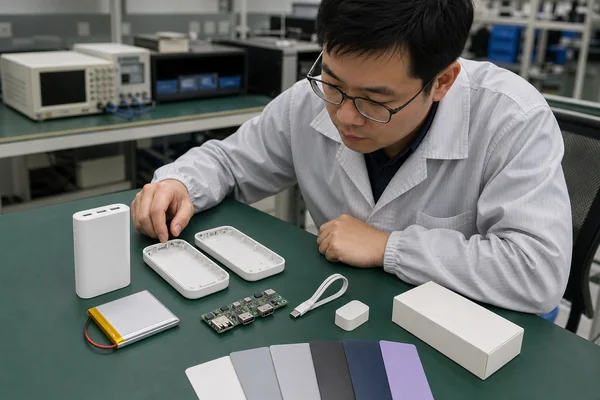
The cell is a large part of the bill of materials, but capacity alone does not define it. Cell format, supplier, grade, cycle-life target, internal resistance and lot traceability all matter. A 10,000mAh label does not prove that two models contain equivalent cells.
Ask the supplier to state nominal energy in watt-hours as well as milliamp-hours. The finished product should then be tested for usable output under a defined load. Our power bank quality-testing checklist explains how to document that test.
Output power, ports and charging protocols
A basic USB output and a high-power USB-C PD design do not use the same electronics. Port count, input power, simultaneous-output behaviour, protocol support, cable rating and thermal design affect the PCB and component selection. If a model includes a built-in cable, confirm whether that cable supports input, output or both.
Do not add the maximum rating of every port and assume the unit can deliver that total at once. The quotation and specification should state the maximum total output, individual port profiles and power-sharing rules.
Wireless charging and magnetic alignment
Wireless models add a coil, control circuit, shielding, thermal considerations and mechanical alignment. Magnetic models also need a defined magnet arrangement and holding-force target. Coil position and enclosure thickness can change charging behaviour even when the quoted wireless wattage looks the same.
Housing, finish and mechanical changes
Existing housings keep development work low. A custom colour adds colour matching and usually a minimum batch requirement. Surface treatments, metal parts, soft-touch finishes and complex printing can add setup steps and raise the reject rate. A new enclosure requires drawings, prototypes, tooling and dimensional approval before mass production.
How MOQ changes the quotation
MOQ is not just a factory rule. It reflects component purchasing, printing setup, packaging conversion, line changeover and the amount of engineering spread across the order. The right starting quantity depends on how far the product moves away from an existing design.
500 pieces: branding an existing platform
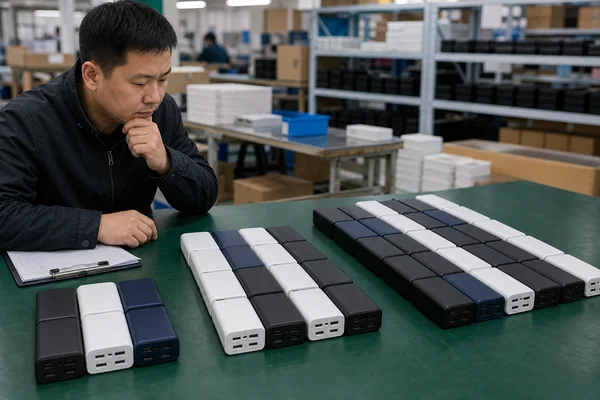
A 500-piece project is usually best suited to an established model with standard internal construction. Typical work includes a logo, label and a practical packaging option. Model availability, logo process and packaging still need confirmation before the MOQ is accepted.
1,000 pieces: more room for presentation changes
At 1,000 pieces, buyers may have more options for colour, packaging, accessories or model-specific presentation. This does not automatically include a new enclosure or redesigned electronics. The quotation should list each approved change rather than use the broad word “customized.”
2,000 pieces: deeper customization may become practical
A 2,000-piece order can make additional engineering or component changes easier to support because setup costs are spread across more units. Tooling, uncommon components and extensive certification work may still require a higher commitment. Treat 2,000 pieces as a quotation tier, not a promise that every redesign fits that quantity.
For YULIDA projects, common starting points are 500, 1,000 and 2,000 pieces, depending on the model and customization depth. The confirmed MOQ belongs in the written quotation together with the exact scope.
OEM, ODM and private-label pricing are not the same
Private-label work starts with a finished platform and changes the brand presentation. ODM work also starts from an existing design, but may allow selected hardware, colour or packaging changes. A full OEM project follows a buyer-controlled specification and can involve new mechanical parts, electronics, firmware or tooling.
The terms are used loosely in sourcing conversations. Instead of relying on the label, ask which parts remain standard, which parts will change, who owns the drawings and tooling, and whether the quoted certification documents cover the final configuration.
When tooling becomes a separate cost
Logo printing does not require an injection mould. A new plastic enclosure usually does. Tooling may also include metal parts, jigs, test fixtures or packaging dies. The buyer should receive a written description of each tool, the number of cavities, expected maintenance, ownership and storage terms.
Do not approve tooling from a rendering alone. Review the mechanical drawing, port positions, cable routing, button travel, display window, magnet layout and assembly method. A prototype can reveal problems that are expensive to correct after hardened tooling is complete.
Sample charges and development work
A standard sample often costs more than the mass-production unit because it is prepared and shipped individually. A customized sample may also require logo setup, colour work, printed packaging or engineering time. Ask which sample charges can be credited against a later order and which are non-refundable development costs.
Keep one approved unit as the golden sample. Record its model, hardware revision, firmware if relevant, cell information, artwork version and approval date. The production lot should be inspected against that sample and the signed specification.
Compliance and transport documents affect cost
Power banks contain lithium batteries, so transport and market-access documents are part of the sourcing plan. The required set depends on the product configuration, target market and sales channel. UN 38.3 transport evidence, an applicable safety standard, EMC work, substance restrictions and local labelling may all be relevant.
Existing reports can reduce time and expense only when they cover the ordered model. A report for another cell, PCB, enclosure or wireless assembly may not apply. Read our power bank certification guide before accepting a generic document package.
Quality control belongs in the budget
Incoming cell checks, in-process testing, ageing, functional inspection and final sampling take time and equipment. Removing those steps may lower a quote on paper, but it also changes what the buyer is purchasing. Ask the supplier to describe the checks included in the unit price and the records available for the order.
For a new supplier, combine product testing with a review of manufacturing capability. The factory-audit checklist for power bank buyers covers company identity, equipment, traceability and change control.
How to compare two power bank quotations
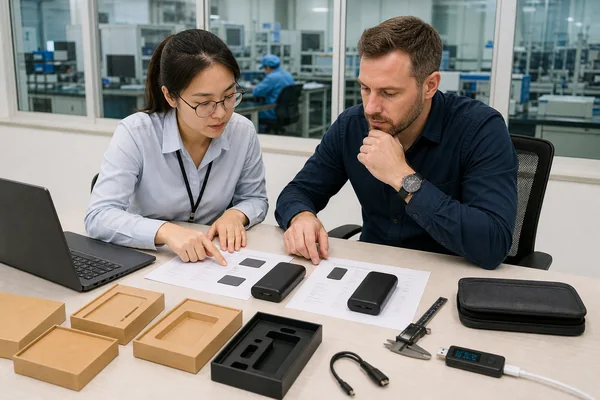
Put each offer beside the same specification. If a field is missing, mark it as unconfirmed rather than assuming it matches. At minimum, compare the following:
- Model number, capacity in mAh and rated energy in Wh.
- Cell supplier or approved cell specification.
- Input, output, port profiles and maximum total power.
- Built-in cable functions and cable power rating.
- Wireless output, coil position and magnetic construction where applicable.
- Housing material, colour, finish, dimensions and weight.
- Logo method, packaging, accessories and carton quantity.
- Compliance documents included and the exact model they cover.
- Sample cost, tooling, engineering and other one-time charges.
- MOQ, lead time, Incoterm, payment terms and quotation validity.
- Inspection method, defect handling and warranty procedure.
A quotation that omits the cell, output profiles or document scope is not ready for a unit-price comparison. Ask for the missing information first.
Ways to reduce cost without weakening the product
The safest savings usually come from reducing unnecessary variation. Use an existing enclosure, keep a standard cell and PCB combination, limit colour changes, choose one proven logo process and avoid packaging that needs a very small dedicated print run.
Do not save money by using an unverified capacity claim, removing protection functions or accepting documents for a different model. Those choices move cost into returns, shipment delays and compliance risk.
Information to send when requesting a quotation
A short but complete request gets a more useful answer than “Please quote your best price.” Send the target market, quantity tiers, capacity, required ports and output, wireless requirement, built-in cable functions, colour, logo, packaging, certifications, target delivery date and preferred Incoterm.
If some choices are still open, say so. Ask the supplier to identify which existing platform comes closest and to separate standard-product cost from optional changes. That makes it easier to remove an expensive feature without restarting the entire quotation.
How YULIDA prepares an OEM or ODM quotation
YULIDA reviews the requested configuration, target market, branding work and quantity before confirming price and MOQ. Projects based on an existing model may start at 500 pieces. Packaging, colour or broader customization may use 1,000- or 2,000-piece tiers. The final requirement depends on the selected model and the work involved.
To request a model-specific quotation, send YULIDA your specification and quantity. Include photos or reference links if they clarify the intended design, but list the required electrical performance in writing.
Frequently asked questions
1. What is the MOQ for a custom power bank?
The MOQ depends on the model and customization. Common YULIDA starting points are 500 pieces for selected existing platforms, 1,000 pieces for broader presentation changes and 2,000 pieces for deeper customization. Tooling or uncommon components may require a different quantity.
2. Why can two 10,000mAh power banks have different prices?
They may use different cells, PCB designs, output protocols, ports, housings, cables and inspection standards. Compare rated energy, usable output, maximum power, construction and document scope instead of capacity alone.
3. Does a custom logo require a new mould?
Usually not. Printing, laser marking and some decorative processes use the existing enclosure. A new enclosure shape or structural change normally requires tooling.
4. Are certification costs included in the unit price?
It depends on the quotation and whether existing documents cover the final model. Ask the supplier to list included reports and separate any new laboratory work or buyer-specific certification.
5. Can the sample cost be refunded after a bulk order?
Some standard sample charges may be credited against an order, while courier fees, custom artwork, engineering and tooling may not be refundable. Confirm the rule before paying for samples.
6. What should a buyer do when one quotation is much cheaper?
Check whether the capacity, cell, power profiles, materials, packaging, test documents, inspection and Incoterm are the same. A lower quote is useful only after the supplier confirms the same scope in writing.
