





Power Bank Flashlights: How OEM Buyers Verify Brightness and Usable Runtime
Before approving a power bank with a flashlight, verify its light output, beam coverage and useful lighting duration as separate requirements. A working LED is only a starting point. Battery capacity and LED wattage do not tell you how well the finished product illuminates a task. Ask for measurements on the proposed production configuration, including the lighting mode and the conditions used to determine runtime.
For outdoor-accessory and emergency-kit buyers, the practical question is not simply “How many hours does it stay on?” It is “How long does it provide enough light for our intended use?” This guide sets out a buyer evaluation plan. It does not claim that a YULIDA model has passed a lighting standard or delivers a specified brightness.
Start with the lighting task, not the battery capacity
Decide whether the light is intended for finding items nearby, illuminating a small work area or directing a beam toward a more distant object. Specify the working distance, required illuminated area, intended positioning and duration. A wide beam and a concentrated beam can serve different tasks even when their total light output is similar.
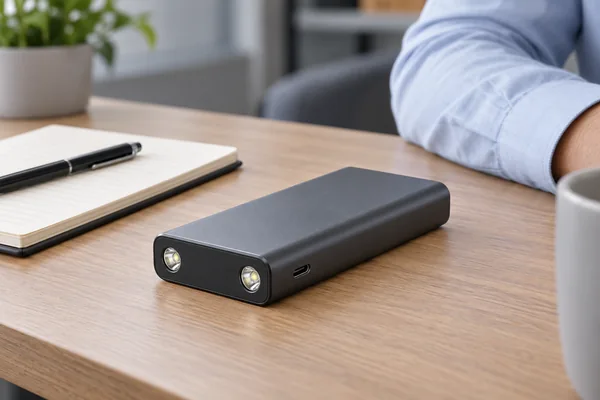
Der YULIDA-Leitfaden zu 2101D foldable solar power bank lists dual LEDs with standard, SOS and strobe modes. Its page explicitly leaves lumen output, beam pattern, runtime and flash timing for verification. The 916 outdoor power bank lists an LED and lighting modes, while the 2201A also lists steady, SOS and strobe operation. These listings establish a lighting function, not a measured illumination level or emergency-performance guarantee.
Use the exact model and selected configuration in the request for quotation. Do not transfer a result between products because their housings or LED arrangements look alike.
Compare the right measurements
Electrical power and light output describe different things. ENERGY STAR’s brightness guidance explains the basic distinction between lumens and watts. A wattage printed beside an LED does not provide the finished lamp’s measured lumen output.
| Measurement or observation | Procurement question it helps answer | What it does not establish |
|---|---|---|
| Electrical power in watts | What electrical load is specified or measured? | Delivered light output or beam usefulness |
| Light output in lumens | How much light does the complete lamp emit under the stated method? | How evenly that light covers the task area |
| Illumination at agreed points | Is the intended surface sufficiently illuminated at the specified distance? | Performance at other distances or orientations |
| Output-versus-time record | Does illumination remain acceptable throughout the required session? | A standard runtime unless that standard’s method was followed |
| Mode and control checks | Can users reliably select steady light, SOS or strobe where offered? | Rescue effectiveness or a guaranteed visibility distance |
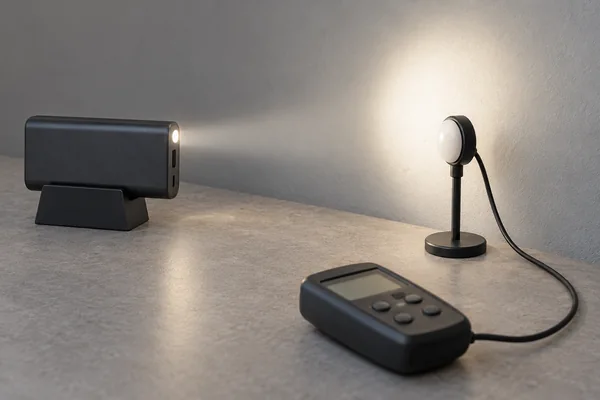
Have a qualified lighting laboratory select the instruments and method for the quantities being reported. A single reading from a handheld light meter is not interchangeable with a total-lumen measurement. NIST’s explanation of luminous-flux measurement describes specialized integrating-sphere and goniophotometric approaches. Photographs can document positioning and beam shape, but camera exposure adjustments make photographs alone unsuitable for quantitative brightness acceptance.
Separate standard runtime from useful runtime
The public description of ANSI/PLATO FL 1-2025 identifies methods for light output, beam distance, peak beam intensity, runtime and other portable-light performance attributes. It also describes reporting for short-duration elevated brightness. If a supplier cites FL 1, request the edition, applicable method, sample identification and report. A standard logo on a specification sheet is not enough.
Petzl’s official explanation of the FL1 protocol describes a runtime endpoint based on output falling to 10% of the initial value. That illustrates why a reported runtime is not a promise that initial brightness remains constant. Petzl’s product-specific performance does not establish any YULIDA result.
For the purchase specification, ask for the brightness curve as well as any reported endpoint. Agree a separate minimum useful illumination level for the task, with its measurement location and distance. Record when the sample falls below that level. Label this a buyer-defined acceptance measurement; do not present it as FL 1 runtime unless it actually follows the applicable standard.
The report should show any initial peak and subsequent decline, including a long period of dim output. Do not add the longest runtime from one mode to the highest brightness from another and present the combination as one operating result.
Build a repeatable sample evaluation
1. Identify the complete configuration
Record the product model, battery configuration, circuit-board and firmware versions, LED assembly, lens or diffuser, and sample identity. Specify whether the sample represents the proposed production build. Changes to the lamp, optical cover or control logic can invalidate a comparison even if the battery capacity is unchanged.
2. Fix the starting and environmental conditions
Agree the charging preparation, starting battery condition, ambient temperature and lighting mode. Record whether solar input, hand-crank input or external USB input is disconnected. Otherwise, a runtime test can unintentionally measure a changing energy supply instead of the stored-energy performance being compared.
Keep the light position, measurement distance, sensor orientation and surrounding-light conditions consistent. Record any cooling arrangement or fixture that could affect operation. Use the supplier’s safe operating limits; do not improvise an abusive battery test to extend this evaluation.
3. Measure the whole session
Record illumination or light output at agreed intervals, including startup and any step-down. Log mode changes, flicker, shutdown and restart behavior. Confirm how the light responds to a normal button press or a brief interruption without resetting the recorded test history.
Agree sample quantities and repeat runs before comparing results. One demonstration unit is useful for screening, but it does not show the variation across production. Keep the original records and identify individual samples rather than reporting only the best result.
Check lighting and phone charging separately
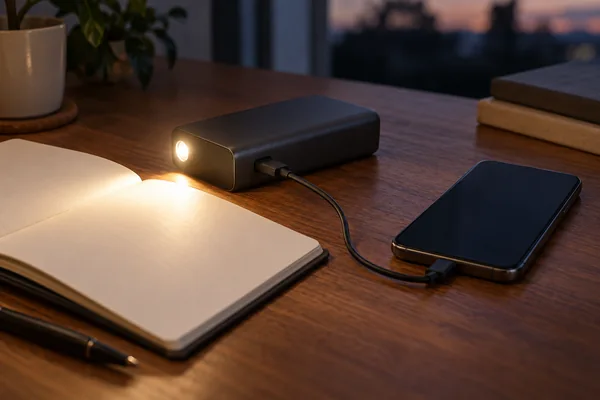
A combined product may be used as a light while a phone draws power. First ask whether that operating combination is supported. Do not infer it from the presence of a USB output and an LED button.
Where supported, compare light-only operation with a defined USB-load condition. Record the output port, cable, load or phone, charging mode and starting state. Observe whether connecting the load changes brightness, limits USB output, disables a function or changes the shutdown sequence. Use separate acceptance requirements for each advertised combination.
This checks how the product shares stored energy and handles simultaneous use. Each function may not reach its individual maximum at the same time. Battery capacity alone cannot predict the result. For electrical delivered-energy measurements, refer to Der YULIDA-Leitfaden zu Leitfaden zur Kapazitätsprüfung von Powerbanks; lighting acceptance additionally needs the optical measurements described here.
If the product also offers solar or hand-crank charging, assess those inputs separately. A lighting session beginning with a charged battery does not prove how much light a short crank session or a period in sunlight can support.
Approve controls and claims before packaging
Include normal use of the controls in sample review. Check the sequence for entering and leaving each mode, the response after switching off, and whether ordinary handling can unintentionally activate the light. Evaluate these against the intended packaging and use scenario rather than prescribing one universal button design.
For a listed SOS or strobe function, ask the supplier to document the programmed pattern and verify it on the sample. Do not infer a signaling range, rescue certification or suitability for regulated emergency equipment from the mode name. If your sales claim requires a particular signaling requirement, identify it separately with the relevant specialist.
The approval record should connect each packaging claim to its evidence: mode, initial light output where measured, sustained behavior, runtime endpoint and test conditions. Keep unsupported numbers off the artwork. Also keep water resistance and cold-weather performance separate; neither is established by a lighting test.
What to send YULIDA for a lighting-focused enquiry
Send the intended task, target market, working distance, illuminated area and required duration. Identify whether phone charging must operate at the same time, which lighting modes matter, and which claims you want to print. Include your preferred model, quantity and any requested control or packaging changes.
Ask which configuration can be proposed and what lighting evidence is available. Use the YULIDA OEM/ODM enquiry to agree sample scope and acceptance criteria before approving a bulk order. If measured brightness or runtime is not available, keep it as an open qualification item rather than treating the product listing as proof.
Häufig gestellte Fragen
1. Does LED wattage tell me how bright the power bank flashlight is?
No. Watts describe electrical power, not measured light output. Request optical measurements for the complete lamp, including its lens or diffuser, operating mode and test conditions. Do not convert a published LED wattage into an assumed lumen rating.
2. Does a long runtime mean the light maintains its initial brightness?
No. Output may change during operation, and runtime depends on the stated endpoint. Ask for the output-versus-time record and a separate buyer-defined useful-light threshold. Keep standard runtime and your task-specific acceptance result clearly labeled.
3. Should buyers compare lumens or illumination on the task area?
Both can matter. Lumens describe total light output, while measurements at agreed positions show how the beam serves the intended task. Define the distance, area and orientation, then ask a qualified laboratory to choose an appropriate measurement method.
4. Can a power bank charge a phone while its flashlight is on?
Only assume this when the selected configuration supports it. Request a combined-operation test with a defined port, cable and load. Record changes in brightness, charging output, runtime and shutdown behavior instead of combining separate maximum ratings.
5. Does an SOS mode make the product approved emergency equipment?
No. A listed mode does not establish rescue effectiveness, visibility distance or compliance with a particular emergency-equipment requirement. Verify its operation and any specific claimed requirement separately before approving the packaging language.
6. Which YULIDA products list a lighting function?
The public 2101D, 916 and 2201A pages list LED lighting and multiple modes. These listings do not establish measured lumen output, beam performance or usable runtime. Request evidence for the exact configuration being quoted.
7. Does a lighting test also verify water resistance or cold-weather operation?
No. Those require their own applicable specifications and evidence. A light working during a normal indoor test does not establish an IP rating, wet-use permission or performance at a lower operating temperature.
8. What should be approved before a bulk order?
Approve the configuration, intended lighting task, measurement method, brightness-over-time results, useful-runtime criterion and required control functions. Add supported light-plus-charging tests where relevant, then ensure each packaging claim matches the approved evidence.
