





Wireless Power Bank FOD: An OEM Buyer’s Verification Checklist
Foreign object detection (FOD) helps a power bank inalámbrico respond to unwanted metal that can absorb energy and heat up in the charging field. For an OEM buyer, “FOD supported” is only a starting point. The useful evidence is a report for the finished model showing what was tested, how the power bank responded and which hardware and firmware were used.
Before placing a bulk order, review that evidence alongside Qi certification claims and normal phone-and-case compatibility. Keep controlled foreign-object testing separate from everyday charging checks.
What does FOD do in a power bank inalámbrico?
During wireless charging, the power bank acts as the transmitter and the phone contains the receiver. Depending on the design and detected condition, the controller may prevent charging from starting, restrict operation or stop power transfer. The supplier should explain which response is expected under each evaluated condition.
Texas Instruments’ bq500215 datasheet gives one engineering example. It describes checks before power transfer and loss monitoring during charging, and notes that excessively sensitive settings can cause false trips. This is an older controller document, not a pass/fail standard for a modern Qi2 power bank. Its thresholds and timing should not be copied into a new product’s acceptance criteria.
Review FOD separately from battery protection and temperature monitoring. A sample that charges a phone successfully has not, by that demonstration alone, verified those protections.
What evidence should a power bank manufacturer provide?
Start with documents for the exact model you plan to buy. The checklist below supports procurement review; it does not replace a certification test standard. The manufacturer and qualified laboratory should confirm which requirements apply to the product and destination market.
| Review item | Evidencias que debe solicitar | Question to resolve |
|---|---|---|
| Identificación del producto | Factory model, buyer SKU, capacity, photographs and build revision | Does the report cover the unit you are buying? |
| Wireless certification claim | Certificado and matching official product record | Can the claimed certification be verified for this model? |
| FOD evaluation | Test method and revision, evaluated conditions, results and limits | Do the measurements support the conclusion? |
| Normal charging | Target phone-and-case matrix, including interruption records | Does the intended setup charge reliably? |
| Fault communication | Indicator behavior, recovery instructions and manual revision | Will the customer know what happened and what to do? |
| Production control | Approved configuration, inspection plan and change procedure | Will production units match the validated design? |
If a report covers a related product family, the supplier needs to explain why it applies to your model. Different names on the sample, certificate and quotation also need resolving before packaging approval. Keep the agreed requirements together using the power bank product-specification guide, and leave missing evidence marked as open.
How should buyers verify a Qi certification claim?
Follow the certificate’s link to the official product record. The Wireless Power Consortium (WPC) verification guidance says the listed product should match the offered unit in appearance, brand, product name and type number. Save that reference with the sample photographs and specification.
“Qi compatible” is not the same claim as Qi Certified. WPC also states that its certification does not guarantee product safety; manufacturers remain responsible for applicable safety regulations. Keep the certification record alongside the separate safety assessments required for the product.
A chipset datasheet describes a component, not the finished power bank. Likewise, a planned certification application is not an issued approval. The supplier’s documents and your packaging claims should reflect the product’s actual status.
How should buyers commission FOD testing?
Foreign-object testing belongs with a qualified laboratory or a suitably equipped product-safety team. Do not improvise heating tests with coins, foil or keys, open battery packs, o disable protection to keep a sample charging.
Before testing begins, agree on the applicable specification, edition and scope. The laboratory should select the test objects, placements, instruments and safeguards. Any departure from the referenced method needs an explanation, including whether it affects the conclusion.
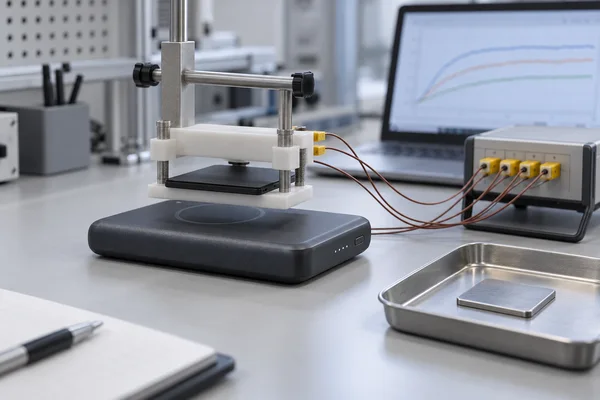
The test brief should cover:
- The models, capacity variants and build revisions being evaluated, plus the basis for the sample quantity.
- The supported wireless modes and any relevant battery-powered, shared-output or pass-through configurations.
- Detection and response before and during power transfer, where applicable.
- Temperature, power and timing records, with measurement locations and equipment identified.
- Acceptance limits and their sources, unresolved issues and any corrective work required.
There is no useful shortcut in copying a temperature limit or shutdown time from another product. The report needs to identify the applicable limit and the condition it covers. A supplier spreadsheet that says only “pass” gives the buyer little to assess.
Check normal phone and case compatibility separately
A power bank also needs to charge reliably in its intended setup. Build a normal-use matrix around the target phones, software versions and approved cases. Include the power bank revision and operating mode, then record starting charge levels and ambient conditions so repeat runs can be compared.
Apple’s wireless-charging guidance advises keeping objects out from between the iPhone and charger. It also identifies thick or metal cases, movement and temperature as possible causes of charging problems. A stopped session therefore does not, on its own, establish an FOD fault.
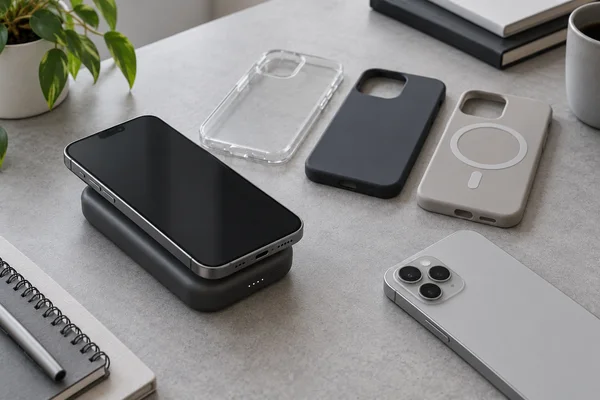
When charging stops unexpectedly, record the setup and what happened. The supplier can then compare the phone’s behavior with the power bank’s indicator and available diagnostics. Keep the cause marked as unresolved until the evidence supports a finding, whether that is foreign-object protection, thermal control or loss of alignment. A flashing LED is only useful if the model’s documentation explains what it means.
Repeated interruptions with a supported case need a documented investigation. If the proposed fix changes hardware or firmware, validate the revised build before approval. Weakening protection just to make that setup charge is not an acceptable fix.
What should the test report contain?
A useful report lets the reviewer connect each result to a specific sample, setup and acceptance limit. The fields below are a reporting checklist, not measured YULIDA results or universal pass values.
| Registro | Details to include | Por qué es importante |
|---|---|---|
| Sample and method | Sample ID, model, hardware and firmware revisions, test-method revision | Identifies the configuration that produced the result |
| Setup | Operating mode, receiver or test fixture, conditions and annotated photographs | Shows what was actually tested |
| Measured response | Values, units, time reference and measurement locations | Supports the description of protection behavior |
| Decisión | Limit and source, result, deviations and reviewer conclusion | Explains the basis for a pass or fail |
| Follow-up | Corrective action, revised sample ID and retest reference | Shows whether an identified problem was resolved |
A video of an indicator changing may document an observation. It cannot, by itself, establish the test conditions, measured temperatures or compliance conclusion. Review the supporting report before treating the demonstration as evidence of approval.
Carry sample approval into OEM production
The approved sample needs a defined production configuration. As appropriate to the design, the controlled record should identify the wireless controller, coil assembly, shielding, enclosure construction and firmware. Agree who can approve substitutions and what evidence is needed before a revised build is released.
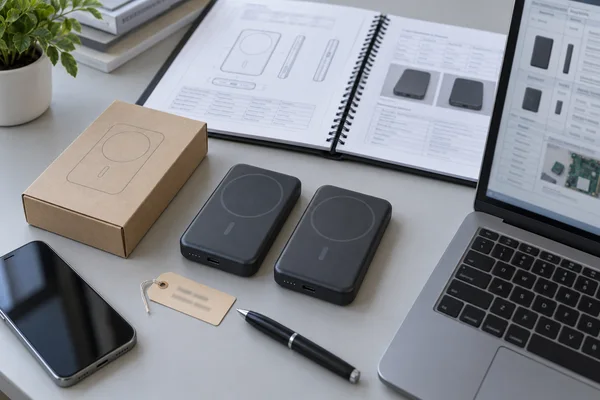
Private-label changes need attention here. WPC’s rebranding guidance allows technically identical variants with the same shape to be registered without retesting, but each variant needs its own Qi-ID. Changes to the housing shape or charging-surface material require retesting under that guidance. Confirm the route for your customization with the supplier or authorized laboratory before committing to tooling.
Routine factory checks serve a different purpose from design validation. Specify which checks run on every unit, which use sampling, how long records are retained and how failed lots are handled. A production functional check does not replace the evaluation used to approve the design.
Include the agreed documents, costs and responsibilities in your RFQ de power banks. For a YULIDA OEM/ODM inquiry, provide the target phones, intended cases, destination markets and customization scope. Model-specific evidence should be part of sample approval, before the production order is authorized.
Preguntas frecuentes
1. What does FOD mean on a power bank inalámbrico?
FOD stands for foreign object detection. It helps the wireless charging system respond to unwanted metal that may absorb energy and heat up in the charging field. The finished model’s documentation should explain its detection and protection behavior.
2. Does magnetic attachment prove that FOD works?
No. Magnetic attachment holds the phone in position; it does not verify the protection response. Review the product’s documentation and applicable test results separately from attachment and charging-compatibility checks.
3. Is a coin demonstration enough to approve a bulk order?
No. One demonstration does not establish the test scope or measured outcome. Approval needs a controlled report covering the applicable conditions. Do not recreate foreign-object heating tests as a casual buyer check.
4. Is there one FOD temperature limit for every power bank?
Use the limit specified by the applicable method for that product and test condition. The laboratory should identify its source. A value copied from another product’s report is not enough.
5. Why might wireless charging stop when no foreign object is visible?
The case, alignment, temperature or another operating condition may be involved. Record the setup and request diagnostic evidence. An interruption or indicator change alone does not reliably identify the cause.
6. Does a Qi certificate replace the other safety evidence?
No. WPC states that certification does not guarantee product safety. Verify the product record and obtain the additional assessments and documents required for the model, intended use and destination market.
7. Can a private-label housing change affect approval?
Yes. WPC’s rebranding guidance requires retesting for specified changes, including housing shape or charging-surface material. Confirm the consequences for certification and validation before approving new tooling or packaging claims.
8. What should I request from a power bank inalámbrico factory first?
Start with the exact model and revision, certification reference, FOD report scope, target phone-and-case matrix and change-control process. Keep missing evidence on the approval checklist until it is resolved.
Fuentes oficiales y verificación
Estas fuentes primarias respaldan las afirmaciones sobre normas, compatibilidad, seguridad o transporte tratadas en este artículo. Confirme el requisito vigente para el modelo exacto de producto y el mercado de destino.
- Wireless Power Consortium — Estándares Qi y Qi2, certificación e información sobre carga inalámbrica.
- Apple Support — Funciones de carga y orientación sobre compatibilidad de dispositivos.
- Wireless Power Consortium — Estándares Qi y Qi2, certificación e información sobre carga inalámbrica.
