





Solar Power Bank with Wireless Charging: OEM Buying Guide
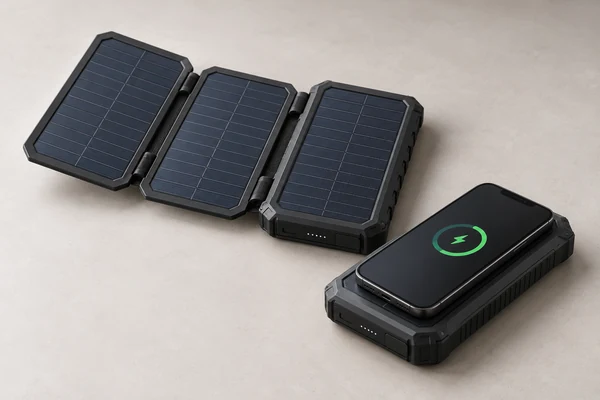
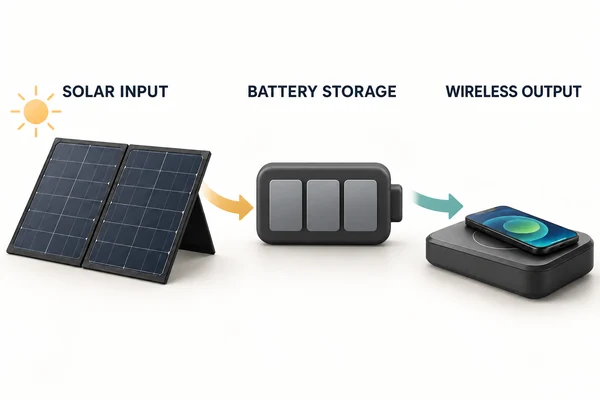
A Batterie externe solaire with wireless charging combines solar input, an internal battery and a wireless output for compatible devices. For an OEM order, check those functions separately: how much energy the panel actually recovers, how much usable energy the battery delivers, and which phones receive the stated wireless output. A 15W wireless label does not mean 15W of solar charging.
The useful buying question is whether the complete product meets your customer’s charging needs under realistic conditions. A charging indicator, a large mAh number and a wireless symbol cannot answer that on their own. Start with the product architecture, then ask for a sample report tied to the exact configuration you intend to sell.
Separate solar input from wireless output
Solar panels convert light into electrical energy that the charging circuit can use to replenish the battery. Wireless output transfers stored energy to a compatible phone. USB input provides another route for recharging the bank, while USB output may charge devices by cable. Each path needs its own specification.
One practical example is YULIDA’s 2101D foldable Batterie externe solaire. Its published specification lists 5.5V, 240mA and 1.32W per panel, alongside wireless output up to 15W. These figures describe different functions. The page does not establish the total-array rating, a solar full-recharge time or Qi/Qi2 certification. Request those details for the proposed version rather than filling the gaps from product photographs.
This guide concerns a combined product. Our wireless power bank vs Batterie externe solaire overview addresses broader category selection; it should not replace a model-specific input and output review.
Choose the solar architecture before comparing quotations
| Architecture | What the buyer should establish | Extra checks |
|---|---|---|
| Small panel built into the enclosure | Whether measured energy recovery is useful for the intended emergency or occasional top-up role | Panel exposure, battery temperature and honest recharge instructions |
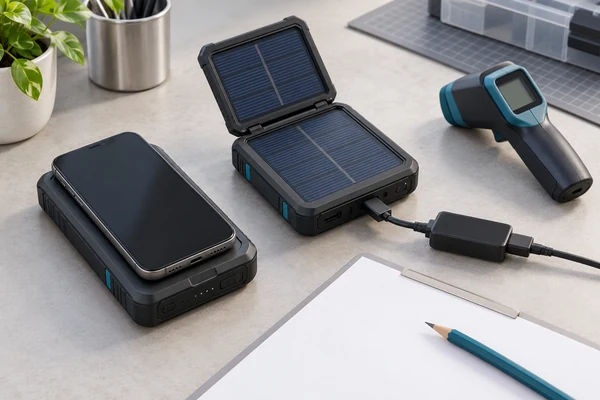
| Built-in foldable solar array | Total-array input and recovery with the panels fully deployed, not just one panel’s rating | Partial shading, fold joints, interconnects and deployed size |
| Separate external folding panel plus a compatible bank | Panel output and bank input compatibility, including voltage, connector and supported protocol | Startup/recovery after shade, cable requirements and safe placement of each component |
A separate panel may allow the battery and phone to remain out of direct sunlight while the panel is exposed, if the product instructions permit that arrangement. It is a different system, not an assumed feature of an all-in-one foldable bank. Do not connect an arbitrary panel merely because its cable fits.
Also distinguish the intended use. YULIDA’s 2201A solar hand-crank model describes solar and hand-crank recharging as supplemental emergency methods. Its page does not list wireless output. It is an example of a different emergency platform, not evidence that every Batterie externe solaire supports wireless charging.
Put comparable specifications on the RFQ
Ask suppliers to complete the same specification sheet. Otherwise, one quotation may describe cell capacity, another USB output capacity, and a third only a peak wireless rating. Similar-looking numbers can hide different products.
| Spécification | Justificatifs à demander |
|---|---|
| Énergie de la batterie | Cell capacity, nominal voltage, rated Wh and the exact battery configuration |
| Usable output | Measured delivered energy or rated output capacity, with voltage, load, cutoff and temperature |
| Entrée solaire | Per-panel and total-array ratings, rating conditions and measured recovery over a stated period |
| USB recharge | Accepted input voltage/current profiles, protocol, required cable and adapter, and measured recharge conditions |
| Wireless output | Supported charging standard, maximum rating, target-device results and sustained behavior |
| Combined operation | Permitted input/output combinations, shared-power limits and any restrictions |
| Operating limits | Charging and discharging temperature limits, protection behavior and user instructions |
| Order identity | Model, battery, board and wireless-module revisions, panel arrangement, enclosure and firmware |
Use Wh to make the energy comparison
Watt-hours equal amp-hours multiplied by nominal voltage. As a hypothetical example, 20,000mAh at 3.7V represents 74Wh of nominal battery energy. This is not a verified Wh specification for the 2101D or a promise of 74Wh delivered to a phone.
Conversion and operating losses matter. Anker’s explanation of rated capacity distinguishes internal-cell capacity from output capacity at another voltage. Request a measured wired result and a separate wireless result for your sample. Dividing the power bank’s mAh label by a phone’s mAh label is not a reliable recharge-count calculation.
For the measurement details, use our guide des essais de capacité des batteries externes. Keep the load and cutoff conditions beside the result so another sample can be tested the same way.
Ask for solar energy recovery, not a universal charging time
A panel rating is a starting point, not a forecast of daily battery recovery. The US Department of Energy explains that actual photovoltaic energy yield differs from laboratory performance and is affected by conditions such as heat, dirt and shading. Those principles apply to the questions a buyer should ask; they are not test results for a particular portable charger.
Require the supplier to record the deployed panel arrangement, light or irradiance conditions, orientation, ambient temperature, panel and battery temperatures, starting state of charge, duration and energy recovered. A photograph of a lit charging LED proves very little about how much charge entered the battery.
For a compact single-panel product, treat solar as a supplemental function unless testing supports a stronger claim. A larger foldable array may recover more energy, but request the complete assembly’s result. Do not multiply an assumed panel count by a per-panel figure and turn that arithmetic into a retail recharge-time claim.
If a supplier quotes a full-recharge time, ask whether it means continuous test illumination, accumulated effective sunlight or elapsed outdoor time. Keep USB recharge time separate. Buyers planning regular off-grid replenishment should specify the required daily energy recovery first, then evaluate an appropriately matched panel-and-bank system.
Verify wireless compatibility and certification separately
Up to 15W is a maximum output claim, not a guarantee for every phone. The device, supported protocol, alignment, case, state of charge and temperature affect the actual result. Apple’s wireless charging guidance illustrates why placement, case interference and temperature belong in a device-specific test plan.
For any Qi or Qi2 claim, request the finished product’s brand, model and WPC ID, then check the Wireless Power Consortium certified-product database. Match the record to the proposed product and ask how it applies to the private-label configuration. A magnetic ring or a general statement that a product is wireless-compatible does not establish certification.
WPC’s Qi overview describes authorized-laboratory certification and distinguishes the Qi family, including Qi2 and Qi2 25W. Avoid using “Qi2” as a substitute for an exact power specification. Certification evidence and your intended-device performance report answer different questions.
Build a compatibility matrix with the phone models and cases your customers actually use. Record whether charging starts, stays connected and delivers the agreed performance over the test period. An initial peak reading or a charging icon is insufficient for approving a sustained-output claim.
Resolve the sunlight and heat trade-off
The panel needs light; the phone and battery still have temperature limits. More heat does not necessarily improve solar performance: DOE’s photovoltaic performance explanation notes the effect of temperature on panel voltage and efficiency. Apple’s temperature guidance also explains that charging can slow or stop when an iPhone becomes too hot. Its limits are not specifications for a YULIDA battery.
Ask the supplier to define safe deployment and charging instructions for the complete product. Do not use a photograph of a phone charging in direct sun as proof that this is an approved operating mode. If solar input and wireless output can run together, test that exact combination within the stated limits. The battery may still discharge when output demand exceeds solar input.
Request documented hot/cold charging limits, cutoff and recovery behavior, plus competent-laboratory evidence for relevant protection claims. A listed temperature sensor does not establish the thresholds or the quality of the thermal design. Our temperature-rise testing guide covers how to define the normal-use test record; abuse and protection testing should be handled by qualified personnel.
Approve a sample with a repeatable test record
Agree the acceptance criteria before samples arrive. Use the same configuration and test conditions for competing offers, and keep a reference sample for production checks.
- Confirm the sample identity against the quotation, battery label, board revision, panel arrangement and proposed packaging.
- Measure usable output energy and USB recharge behavior under the agreed load and input conditions.
- Measure solar recovery, including startup in weak light and recovery after partial shading. Record the conditions, rather than treating the weather as a constant.
- Run the target-phone wireless matrix, including intended cases and alignment. Record sustained behavior and temperature, not just whether charging begins.
- Check only the combined operating modes the supplier permits. Document power sharing; do not add individual maximum port ratings together.
- Review fold-joint, cable and enclosure durability against agreed criteria. Request supporting evidence for any ingress-protection claim and the required port-cover conditions.
- Reconcile certification and target-market documentation with the finished model. Ask the supplier to identify exactly what each report covers and any unresolved gaps.
- Freeze the approved bill of materials, artwork and acceptance record. Require review of relevant changes before production substitutes a cell, board, panel or wireless module.
The test record should show who tested the sample, which equipment was used, the conditions, the result and the pass/fail decision. A screenshot without a sample identifier is difficult to connect to the shipment you will receive.
Prepare an OEM enquiry for YULIDA
For a solar-wireless project, send your target phones, market, intended solar use, required usable energy and preferred product architecture through YULIDA’s contact page. Request a configuration-specific quotation and sample plan. Include MOQ, customization, packaging, lead time, warranty and the documentation you need in the commercial review.
Utilisez le liste détaillée de contrôle pour une demande de devis de batteries externes to keep these requirements in one document. Before approving the order, the solar recovery claim, wireless compatibility statement and packaging should all describe the same tested product.
Questions fréquentes
1. What is a Batterie externe solaire with wireless charging?
It is a battery pack that combines solar input with a wireless charging output. The solar panel replenishes the internal battery; the wireless transmitter charges a compatible device. These are separate power specifications, so the wireless wattage does not tell you the solar collection rate.
2. Does a 15W wireless rating mean the solar panel supplies 15W?
No. A 15W wireless rating describes an output capability under supported conditions. Request the solar panel and total-array ratings separately. The battery can supply more power than the panel is collecting, so it may still discharge while a phone is charging.
3. How long does solar charging take to refill the power bank?
There is no reliable universal time. It depends on battery energy, starting charge, total solar input, sunlight, shading, temperature and charging losses. Ask for measured energy recovery under recorded conditions and a separate USB recharge result. Do not turn a per-panel rating into a full-recharge promise.
4. Will every compatible phone charge wirelessly at the advertised maximum?
No. The phone, charging protocol, case, alignment, battery state and temperature affect actual output. Require a test matrix for the phone models your customers use, with sustained charging results rather than only an initial peak or charging icon.
5. How can an OEM buyer verify a Qi or Qi2 certification claim?
Request the finished product model, brand and WPC ID, then match them to the Wireless Power Consortium certified-product database. Confirm coverage of the proposed private-label configuration. A magnetic ring, component certificate or general compatibility statement does not establish finished-product certification.
6. Can solar input and wireless output operate at the same time?
Only if the specific model supports that combination. Request the permitted operating modes, power-sharing behavior and thermal limits, then verify the approved combination during sample testing. Even when simultaneous operation works, the battery can lose charge if the phone draws more energy than the panel collects.
7. Is a foldable Batterie externe solaire better than a single-panel model?
It depends on the requirement. A foldable design can provide more collecting area, but the useful gain needs measurement, and its hinges and interconnects need durability checks. A separate external panel is another architecture, with its own electrical compatibility and placement requirements.
8. What should be approved before placing a bulk OEM order?
Approve the exact configuration, usable output energy, solar recovery report, target-phone compatibility, thermal and protection evidence, and any certification claims. Keep a reference sample, packaging revision, model-specific documents and change-control requirements with the purchase specification. Leave unresolved claims off the packaging until the evidence is complete.
Sources officielles et vérification
Ces sources primaires étayent les informations de cet article concernant les normes, la compatibilité, la sécurité ou le transport. Vérifiez les exigences en vigueur pour le modèle exact et le marché de destination.
- U.S. Department of Energy — Official solar-energy and photovoltaic technology information.
- Assistance Apple — Fonctions de recharge des appareils et conseils de compatibilité.
- Wireless Power Consortium — Normes Qi et Qi2, certification et informations sur la recharge sans fil.
- Wireless Power Consortium — Normes Qi et Qi2, certification et informations sur la recharge sans fil.
- U.S. Department of Energy — Official solar-energy and photovoltaic technology information.
- Assistance Apple — Fonctions de recharge des appareils et conseils de compatibilité.
