







Are Magnetic Power Banks Worth It in 2026? 5 Pros & 3 Cons
Are magnetic power banks worth it? Yes, for users who value cable-free top-ups, compact portability, and convenient phone use while charging. They are less suitable when maximum energy efficiency, the fastest wired output, universal phone compatibility, or the lowest cost per charge is the priority. For B2B buyers, the right decision depends on the target device ecosystem, charging habits, certification requirements, and expected retail price. This guide compares five practical advantages and three limitations so buyers can choose the appropriate product mix.
What Is a Magnetic Wireless Power Bank?
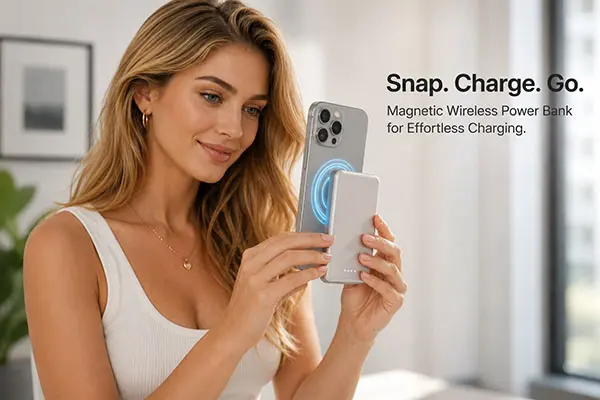
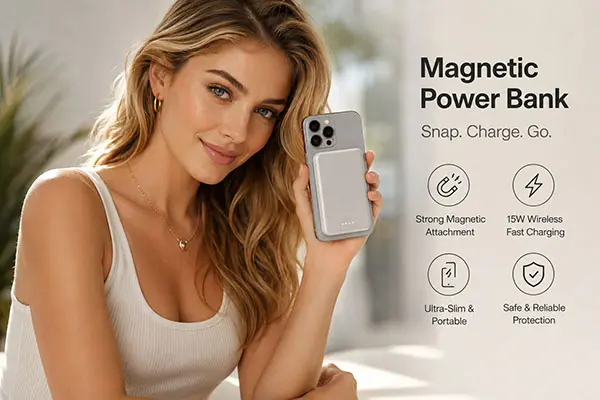
A magnetic wireless power bank is a portable battery that charges your phone wirelessly and sticks to it with built-in magnets. No cable. No plug. Snap it on. Charging starts.
Think of a traditional power bank as battery + USB port. You plug in a cable, you charge. Simple, universal, fast — but you carry a cable, and you can’t use your phone comfortably while it’s tethered.
A magnetic wireless power bank is battery + wireless coil + magnets. You snap it on, it charges. No cable, no plugging, hands-free. But it’s slower, and the magnetic bond only works with compatible phones and cases.
That trade-off — convenience versus raw performance — sits at the heart of every magnetic power bank decision.
The magnetic system has two generations worth knowing:
– MagSafe — Apple’s proprietary magnet ring (iPhone 12+). 7.5W by default, 15W with Apple accessories. Apple-only.
– Qi2 and Qi2.2 — The Wireless Power Consortium’s universal standard. Works with iPhones, Samsung Galaxy, Google Pixel, and any Qi2-certified device. Qi2.2, finalized in late 2024, pushes wireless charging to 25W — a 67% jump over Qi2’s 15W ceiling. That’s why 2026 is the best time yet to buy.
The key difference: MagSafe is Apple-only. Qi2 is everyone. Qi2.2 makes magnetic wireless charging genuinely fast for the first time.
For the deep technical breakdown of how these features work, see how magnetic wireless power bank features work in detail →.
5 Pros of Magnetic Wireless Power Banks
1. No Cables, No Fumbling
This is why magnetic power banks exist. The snap-on experience changes portable charging entirely.
The old way: dig a cable out of your bag, find the right end, plug it into your phone, plug the other end into the battery, try not to tangle the cable while holding both devices. Every single time.
The magnetic way: pull the power bank out of your pocket, place it on the back of your phone, and it clicks into place. Charging starts. Two seconds.
Jake, a sales rep who drives between clients all day, switched after years of fumbling with cables in his car. “I just snap the battery on at a stoplight,” he told me. “By the next appointment, I’ve picked up 15-20%. Zero cables, zero stress.”
For people who charge multiple times throughout the day — commuters, field workers, travelers — eliminating the cable ritual saves real time and real frustration. A magnetic portable charger that snaps on in two seconds beats a traditional unit that takes thirty seconds of cable management every single time.
2. Ultra-Portable, Always With You
Magnetic wireless power banks are compact by necessity. Because they attach directly to your phone, they need to be slim enough that the combo still fits in your hand or pocket. Most Qi2-compatible power banks range from 5,000mAh to 10,000mAh and weigh 100-200g — roughly the weight of a small apple.
Compare that to a traditional 20,000mAh power bank, which is essentially a brick you carry in a bag. The magnetic version slides into a jeans pocket alongside your phone, or clips onto the back and goes with you as a single unit.
This portability factor matters more than most reviews acknowledge. A power bank you don’t carry is a power bank that doesn’t charge your phone. Magnetic models solve the “will I actually bring it?” problem by being small enough to always have with you.
3. Qi2.2 Brings 25W — Fast Enough for Daily Use
Speed was the biggest knock against magnetic power banks for years. 7.5W felt painfully slow. 15W was better but still behind wired charging’s 20-27W. Qi2.2 changes the math.
The Qi2.2 standard raises maximum wireless charging power to 25W — nearly 70% faster than Qi2’s 15W and over 3x faster than the original 7.5W MagSafe baseline. Qi2.2-certified products are already hitting shelves in 2026.
At 25W, a Qi2.2 magnetic power bank charges an iPhone 15 from 0 to 50% in roughly 30-35 minutes. That’s competitive with many wired setups and dramatically faster than the 60+ minutes older 7.5W units required.
The Wireless Power Consortium confirms that Qi2.2 “builds on the convenience and energy efficiency of Qi2 while delivering nearly 70% more charging power.” This isn’t a future promise — certified products are on shelves right now.
4. Smart Safety Features Built In
Modern magnetic power banks aren’t just batteries with magnets slapped on. Qi2.2 certification mandates four critical protections: a 40°C thermal ceiling that throttles charging before your phone gets hot enough to damage its battery; over-voltage and over-current protection that prevents power surges; short-circuit protection that cuts power instantly if a fault is detected; and foreign object detection (FOD) that refuses to charge if keys or coins sit between the coils.
These aren’t optional add-ons — they’re built into every certified unit. No $15 uncertified knockoff from a random marketplace can guarantee the same.
5. A Growing Market Means Better Choices
The magnetic wireless power bank market hit $1.9 billion in 2024 and is projected to reach $3.85 billion by 2031, growing at a CAGR of 10.8% (QY Research). The Qi2-specific segment is even more explosive — Semiconductor Insight estimattes it at $6.8 billion in 2025, heading toward $12.3 billion by 2034 (Semiconductor Insight).
Why does market size matter to you? A growing market attracts competition, innovation, and price pressure. Three years ago, your choices were basically Apple’s overpriced MagSafe Battery Pack or a handful of generic units. Today, you can choose from dozens of Qi2-certified options with varied capacities, designs, and price points. Tomorrow, Qi2.2 brings 25W speed and better thermal management.
For B2B buyers — distributors, brand managers, retail procurement — this trajectory signals a category worth investing in now. Consumer demand is accelerating, standards are maturing, and the quality gap between certified and uncertified units is widening. Our magnetic wireless power bank manufacturers ranking breaks down who’s building Qi2.2-ready products today.
3 Cons of Magnetic Wireless Power Banks
1. Wired Is Still Faster
Even with Qi2.2 pushing wireless to 25W, wired charging remains faster. A good wired setup delivers 27-65W depending on your phone. That means wired can fill your battery from empty to full in 30-45 minutes on high-power devices, while wireless still needs 60-90 minutes for a full charge even at 25W.
There’s another speed factor most people miss: wireless charging wastes significantly more energy than wired. iFixit’s testing on an iPhone 15 found that wireless charging consumed 24.4% to 59% more energy than wired to fill the same battery (iFixit). That excess converts to heat. More heat means thermal protection throttles charging speed more often, so your 25W theoretical maximum becomes a 15-20W practical reality in warm conditions.
If you need to charge as fast as possible — before a flight, between meetings — wired still wins. Magnetic units are fast enough for daily top-ups, but not for emergency speed-charging.
2. Limited Capacity for Heavy Users
Most magnetic wireless power banks top out at 10,000mAh. Popular slim models are 5,000mAh. That sounds reasonable until you understand two things:
Rated capacity ≠ usable capacity. The internal battery operates at 3.7V, but your phone charges at 5V. Voltage conversion alone eats roughly 30-40% of rated capacity. Add wireless efficiency losses, and a 5,000mAh unit might deliver only 2,000-3,000mAh of actual charge — roughly 40-60% of one full iPhone charge.
Physical constraints limit battery size. The magnetic attachment requires the unit to be slim and light enough to stick without falling off. You can’t cram a 20,000mAh cell into a snap-on form factor. The physics don’t work.
Travel photographer Maria learned this the hard way in Iceland: her 5,000mAh magnetic unit gave one 60% charge. By 2 PM, both devices were dead. She bought a 20,000mAh wired power bank at a Reykjavik gas station to survive the afternoon.
For heavy users who burn 150%+ of their battery daily, a single magnetic unit won’t cut it. You’ll need multiple sessions or a supplementary traditional power bank.
3. Compatibility Isn’t Universal Yet
The magnetic attachment system needs two things: magnets in your phone (or case) and compatible wireless charging coils. And right now, not every phone has both.
iPhone 12 and later have built-in MagSafe magnets — snap on any MagSafe or Qi2 unit and it works. Samsung Galaxy S24/S25 and newer support Qi2 magnetic charging, but earlier models need a Qi2-compatible case with embedded magnets. Google Pixel and most other Android phones require a MagSafe or Qi2-compatible case too — without it, magnets won’t align and charging won’t start.
Phone cases are the biggest compatibility trap. Any case thicker than ~3mm without a built-in magnetic ring will likely break the connection. Metal cases, armored cases, and budget cases without MagSafe/Qi2 rings are basically incompatible. You either switch your case or you can’t use the product.
Qi2 adoption is accelerating across Android manufacturers, and Qi2-compatible cases are becoming more common. But in 2026, compatibility still requires checking your specific phone model and case before buying. It’s not universal yet.
For B2B buyers targeting mixed-device audiences, this means stocking both magnetic and traditional options until Qi2 becomes truly ubiquitous.
Magnetic vs. Traditional: Which One Fits Your Life?
| Feature | Magnetic Wireless Power Bank | Traditional Power Bank |
|---|---|---|
| — | ———– | ——– |
| Charging method | Snap-on wireless | USB cable |
| Typical capacity | 5,000-10,000mAh | 10,000-30,000mAh |
| Usable charge* | 40-60% of rated | 65-75% of rated |
| Max speed | 25W (Qi2.2) | 27-65W wired |
| Phone-case requirement | MagSafe/Qi2 case needed | Any case works |
| Portability | Pocket-friendly | Often bag-required |
*Usable charge accounts for voltage conversion and charging efficiency losses.
Decision Matrix — Pick by Scenario
| Your Scenario | Best Choice | Why |
|---|---|---|
| —– | —– | — |
| Daily commuter, short top-ups | Magnetic wireless | Snap-on convenience wins on quick rides |
| Heavy user, 150%+ battery daily | Traditional (or both) | Raw capacity that magnetic can’t deliver |
| Long-haul traveler | Traditional | 20,000mAh+ wins on 12+ hour trips |
| Minimalist who hates cables | Magnetic wireless | Zero cables, pocket-friendly |
| Android user without Qi2 case | Traditional | Magnetic won’t connect without compatible case |
| B2B buyer stocking shelves | Both | Diverse customers need diverse solutions |
Most people end up with both — one for Tuesday, one for vacation. That’s not over-buying. It’s matching the tool to the moment.
4 Things to Check Before Buying
Qi2/Qi2.2 Certification
This is the single most important quality indicator. Qi2 certification means the product has been tested by the Wireless Power Consortium for safety, efficiency, and magnetic alignment. Qi2.2 adds 25W speed capability and the 40°C thermal management requirement.
Uncertified products may skip foreign object detection, over-temperature protection, or proper coil alignment — all of which can damage your phone. The Qi2 logo on the product and packaging is your guarantee. Check certification at the official Qi2 page.
Real vs. Rated Capacity
Every power bank advertises rated capacity — total energy stored at 3.7V. But your phone receives power at 5V, and conversion loses energy. For magnetic wireless units, add wireless efficiency losses on top.
Practical rule of thumb:
– 5,000mAh magnetic unit → roughly 2,000-3,000mAh usable phone charge
– 10,000mAh magnetic unit → roughly 4,000-6,000mAh usable phone charge
If your iPhone has a ~3,300-3,900mAh battery, a 5,000mAh unit gives about one partial charge. A 10,000mAh unit gives roughly one full charge plus a top-up. Don’t buy based on the advertised number alone — calculate what you actually need based on usable capacity.
Magnet Strength & Case Compatibility
Magnet strength determines whether the unit stays attached during real-world use — walking, carrying, mild bumps. Weak magnets mean it slides off when you move, making the “convenience” promise hollow.
What to look for: N52-grade neodymium magnets — the strongest commonly available grade. Quality manufacturers use these; budget units often use weaker N35 or N42 magnets. The magnets should be arranged in the same ring pattern as MagSafe/Qi2, not scattered randomly — proper alignment ensures both strong attachment and efficient coil coupling.
Case compatibility: MagSafe and Qi2-certified cases work. Thick rugged cases without magnetic rings don’t. Metal cases block wireless charging entirely. Thin non-magnetic cases (<2mm) may work weakly — magnet strength determines if the connection holds. According to thermal testing data, just 1mm of thickness change between your phone and the power bank’s coil can significantly affect both charging efficiency and heat dissipation (iFixit wireless charging study). A case that’s marginally too thick doesn’t just weaken the magnetic bond — it can also cause hotter, slower charging.
Manufacturer Reputation & Warranty
The market has a long tail of no-name brands selling uncertified products at bargain prices. These cut corners on magnets, coils, battery cells, and safety circuits — inconsistent charging, premature degradation, and in worst cases, safety hazards.
What reputable manufacturers offer: certifications beyond Qi2 (CE, FCC, RoHS, UN38.3, ISO 9001), meaningful 12-24 month warranties, transparent specifications, and B2B capabilities — OEM/ODM experience, BSCI audit compliance, and flexible customization options like TFT color screens, AC direct charging, or ice-cool thermal designs. Companies like YULIDA Power — a Shenzhen-based OEM/ODM manufacturer with full certification stack — represent the tier that builds Qi2-ready products with proper safety systems and offers OEM/ODM magnetic wireless power bank solutions that generic suppliers can’t match.
The Bottom Line
Magnetic power banks aren’t “better” than traditional ones — they’re different. They win on the daily grind: the commute, the quick stop, the pocket carry. They lose on raw power: speed, capacity, compatibility.
For most people, the answer isn’t “magnetic or traditional.” It’s both — one for Tuesday, one for vacation. Match the tool to the moment.
For B2B buyers: consumer demand is rising, Qi2.2 is raising the quality bar, and the gap between certified and uncertified products is becoming a competitive advantage. Stock both types, prioritize certified products, and contact YULIDA for sourcing inquiries to see what certified Qi2.2-ready manufacturing looks like. Compare the top 10 manufacturers side by side to find the right supply partner.
Frequently Asked Questions
Are magnetic power banks worth the money?
Yes, if you value cable-free convenience and portability. A magnetic wireless power bank saves you from carrying cables, attaches in seconds, and fits in your pocket. But if you need maximum charging speed or high capacity for all-day use, a traditional unit delivers better value per dollar.
Do magnetic power banks damage your phone battery?
No — the magnets don’t damage your battery. The real concern is heat. Wireless charging generates more heat than wired (iFixit documented 24.4%-59% more energy consumption, which converts to thermal output). Qi2.2-certified units include a 40°C thermal cap that throttles or pauses charging when temperatures rise, directly protecting your battery. Buy certified products — uncertified budget units skip these protections.
Can I use a magnetic wireless power bank with any phone case?
Not any case — only MagSafe-compatible or Qi2-compatible cases with built-in magnetic rings. Thick cases (>3mm), rugged cases, metal cases, and budget cases without magnetic rings will break the connection or block wireless charging entirely. Thin non-magnetic cases (<2mm) may work with strong-magnet units, but the connection will be weaker and charging less efficient.
Why is my 10,000mAh magnetic power bank only giving me one full charge?
Because rated and usable capacity are different numbers. The internal battery stores 10,000mAh at 3.7V, but your phone charges at 5V — voltage conversion alone loses ~30-40%. Add wireless efficiency losses, and your 10,000mAh unit delivers roughly 4,000-6,000mAh of actual phone charge. That’s about one full iPhone charge plus a small top-up. Not a defect — it’s physics.
What’s the difference between Qi2 and Qi2.2 magnetic power banks?
Think of Qi2 as the current standard and Qi2.2 as the upgrade. Qi2 delivers up to 15W with mandatory safety features. Qi2.2 raises maximum power to 25W and adds a mandatory 40°C thermal ceiling — faster charging, safer for your battery. Both are certified by the Wireless Power Consortium. Qi2.2 products are arriving on shelves now in 2026.
Is it better to buy a magnetic power bank or a regular one?
It depends on your Tuesday. A magnetic unit wins on convenience — snap-on, cable-free, pocket-friendly. A regular unit wins on speed, capacity, and universal compatibility. Most practical answer: own both. Use magnetic for daily top-ups, traditional for travel or heavy-use days. Our decision matrix above can help you pick based on your scenario.
What should B2B buyers consider when sourcing magnetic wireless power banks?
Five priorities: Qi2/Qi2.2 certification (non-certified = liability), manufacturer compliance (CE, FCC, RoHS, UN38.3, ISO 9001), OEM/ODM capability for product differentiation, supply stability (BSCI audits, ISO certification), and stocking both magnetic and traditional types until Qi2 becomes universally adopted.
Official sources and verification
These primary sources support standards, compatibility, safety, or transport statements discussed in this article. Confirm the current requirement for the exact product model and destination market.
- Wireless Power Consortium — Qi and Qi2 standards, certification, and wireless-charging information.
