






Power Bank vs Wireless Power Bank in 2026: 7 Key Differences You Must Know Before Buying
Which One Should You Buy?
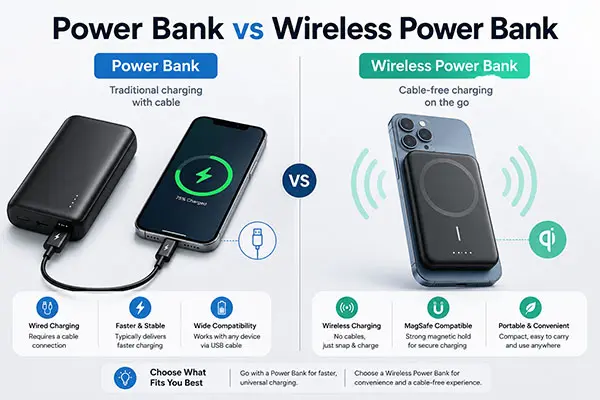
Need the fastest charging, maximum efficiency, and broadest device compatibility? Go with a traditional wired power bank.
Prefer cable-free convenience and magnetic attachment, and don’t mind slightly slower speeds? A wireless power bank, especially a Qi2.2 model, is a solid choice.
Can’t decide? Get a hybrid that supports both wired and wireless charging. Many 2026 models do both well.
Let’s break down the seven key differences so you can pick what fits your needs.
Introduction
It’s 2026, and your phone battery is dying again. You reach for your power bank, but which one do you grab? The one with the cable, or the one you can just slap onto the back of your phone?
This isn’t just a question of preference anymore. The power bank market has evolved dramatically. In 2026, the global power bank market is expected to reach $22.67 billion, with China’s market alone projected at 48.6 billion yuan. And wireless charging has finally caught up, thanks to the new Qi2.2 standard, which delivers up to 25W of wireless power.
But speed isn’t everything. Here are the seven differences that actually matter.
1. Charging Speed: Wired Is Still Faster
Let’s get this out of the way first. Wired charging is faster.
A traditional wired power bank can deliver anywhere from 18W to over 100W of power. Even entry-level wired models typically support 18W or higher. High-end wired power banks like the Anker Nano Power Bank offer rapid 45W charging, and some models push even further.
Wireless charging has traditionally been much slower. Older Qi-standard power banks topped out at around 7.5W to 15W. However, 2026 changes things. The new Qi2.2 certification enables wireless charging speeds up to 25W. That’s more than three times faster than the old 7.5W standard.
Here’s what that means in real life. A Qi2.2 power bank can charge an iPhone 17 Pro to 50% in about 33 minutes wirelessly. A standard 7.5W Qi charger takes about 63 minutes to do the same. That’s a full 30-minute difference.
But compare that to wired charging. The same phone can go from 20% to 78% in just 25 minutes using a 45W wired connection.
If speed is your priority, wired wins. But Qi2.2 has closed the gap significantly.
2. Efficiency: Less Energy Lost with Wired
Every time you charge a device, some energy is lost as heat. Wired charging loses less energy because electricity travels directly through a cable.
Wireless charging is inherently less efficient. Energy is lost during the transfer between the charging coil in the power bank and the receiving coil in your phone. This inefficiency manifests as heat, which brings us to our next point.
Wired power banks deliver more of their stored energy to your device. Wireless power banks waste more energy, meaning you get fewer actual charges per full battery.
3. Heat Generation: Wireless Runs Hotter
Because wireless charging is less efficient, it generates more heat. This isn’t just uncomfortable. It can affect battery health over time.
Heat is the real enemy of battery longevity. Sustained high temperatures accelerate battery degradation, reducing capacity over the long term.
That said, 2026 power bank manufacturers have taken this seriously. Brands like Anker now use graphene cooling layers and dual temperature chips to keep surface temperatures below 104°F during charging. TORRAS claims its MiniMag Pro maintains around 98°F (37°C) even under load. Some models like the Sharge Icemag 3 even include built-in fans for active cooling.
Wired power banks run cooler. Wireless power banks generate more heat, but premium 2026 models have better cooling systems to manage it.
4. Convenience: Wireless Wins
This is where wireless power banks have a clear edge.
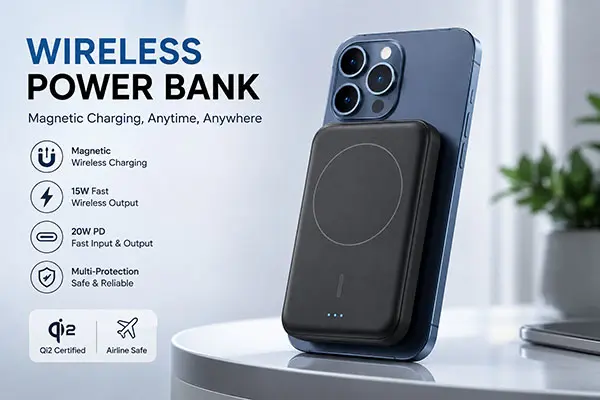
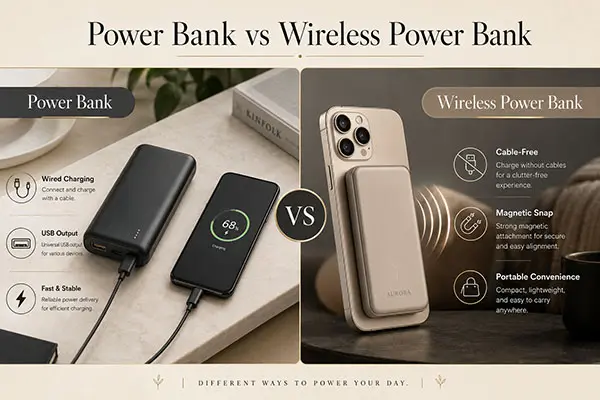
With a wireless power bank, you don’t need to carry a cable, or the right cable. Just attach it to the back of your phone and you’re charging. No untangling cords, no searching for the right USB port, no worrying about cable wear and tear.
Many 2026 wireless power banks also feature magnetic alignment (Qi2 or MagSafe), which locks your phone into the optimal charging position automatically. You don’t have to fiddle with positioning. Just snap and go.
On the flip side, using a wireless power bank means your phone must remain in contact with it at all times. You’re essentially holding two devices together, which can be less travel-friendly than plugging in a cable and tossing both in your bag.
For cable-free convenience and quick top-ups, wireless is hard to beat. For hands-free charging while on the move, wired is more practical.
5. Device Compatibility: Wired Supports Everything
This is a big one.
Wired power banks work with virtually any device that has a USB port, phones, tablets, laptops, earbuds, cameras, gaming consoles, you name it. If it has a USB-C, Lightning, or Micro-USB port, a wired power bank can charge it.
Wireless power banks only work with devices that support wireless charging. Not all phones have this feature, especially older models or budget devices. And if you want to charge your laptop or wireless earbuds? You’ll need a cable anyway.
Even hybrid power banks that offer both wired and wireless charging often have limitations. Some wireless pads only work with specific phone models or brands.
If you have multiple devices or a mix of old and new gadgets, a wired power bank is more versatile. If you only charge one Qi-compatible phone, wireless is fine.
6. Portability and Design: Getting Thinner in 2026
Both types have gotten significantly slimmer in 2026.
Wired power banks are generally slimmer because they don’t need the extra hardware for wireless charging coils. But wireless power banks have made huge strides. The INIU SnapGo Air is just 13.8mm thick, barely half an inch. Xiaomi’s UltraThin Magnetic Power Bank is a mere 6mm thick. Anker’s new models are also pushing the boundaries of thinness.
However, wireless power banks tend to be slightly bulkier overall because of the magnetic ring and charging coil hardware.
Both are portable. Wired power banks are generally thinner, but 2026 wireless models are impressively slim.
7. Price: Wireless Costs More
Wireless power banks are typically more expensive than their wired counterparts with similar capacity. You’re paying for the convenience of cable-free charging and the extra hardware (charging coils, magnets, cooling systems).
That said, prices are coming down. The INIU SnapGo Air (10,000mAh, Qi2.2) is priced around $50. Premium wired power banks with similar capacity can cost anywhere from $30 to $75, depending on features and brand.
Wired power banks offer better value for money. Wireless power banks cost more for the same capacity but deliver added convenience.
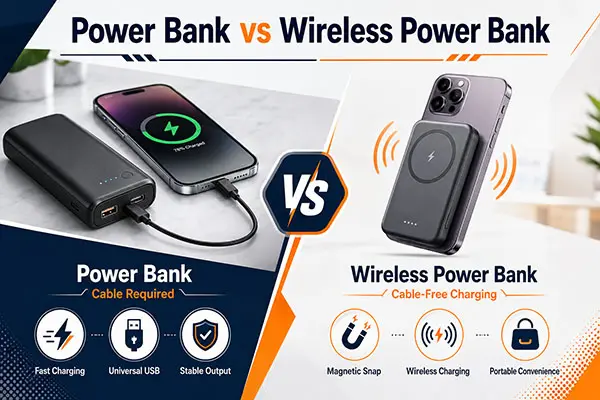
Side-by-Side Comparison Table
| Feature | Wired Power Bank | Wireless Power Bank |
|---|---|---|
| Charging Speed | Faster (18W to 100W+) | Slower but improving (up to 25W with Qi2.2) |
| Efficiency | High, minimal energy loss | Lower, more heat loss |
| Heat Generation | Lower | Higher (improved cooling in 2026 models) |
| Convenience | Needs cables | No cables needed |
| Compatibility | Universal (any USB device) | Qi-enabled devices only |
| Portability | Generally slimmer | Slightly bulkier |
| Price | More affordable | More expensive |
Which One Should You Buy in 2026?
Choose a wired power bank if:
- You need the fastest possible charging
- You charge multiple types of devices (phone, laptop, earbuds)
- You want the best value for money
- You’re okay with carrying a cable
Choose a wireless power bank if:
- You value cable-free convenience
- You only charge one Qi-compatible phone
- You want magnetic snap-on charging
- You’re willing to pay a premium for convenience
Choose a hybrid (both) if:
- You want flexibility for different situations
- You can afford the higher price
- You want both wired and wireless options in one device
FAQ: Power Bank vs Wireless Power Bank
1. Is wireless charging bad for my phone battery?
Wireless charging generates more heat than wired charging, and heat can accelerate battery degradation over time. However, modern phones and power banks have battery management systems that mitigate this risk. For occasional use, it’s perfectly safe. For daily charging, wired is gentler on your battery long-term.
2. How much faster is wired charging than wireless in 2026?
It depends on the power bank. A 45W wired power bank can charge an iPhone 17 Pro from 20% to 78% in 25 minutes. A Qi2.2 wireless power bank (25W) can charge the same phone to 50% in about 33 minutes. Wired is still faster, but the gap has narrowed significantly.
3. Can I use a wireless power bank with any phone?
No. Your phone must support Qi wireless charging. Most modern flagship phones do, but many budget and older models don’t. Always check your phone’s specifications before buying.
4. What is Qi2.2 and why does it matter?
Qi2.2 is the latest wireless charging standard launched in 2026. It enables up to 25W wireless charging, more than three times faster than the old 7.5W Qi standard. It also features improved magnetic alignment and better heat management. If you’re buying a wireless power bank in 2026, look for Qi2.2 certification.
5. Which is better for travel, wired or wireless?
It depends on how you travel. Wireless power banks offer cable-free convenience but require you to hold your phone and power bank together. Wired power banks let you plug in and put both devices in your bag, which is more practical for active travel. Many travelers prefer wired for long flights and wireless for quick top-ups during the day.
6. How do I know if a power bank is safe?
Look for power banks with built-in safety features like overcharge protection, short-circuit protection, overheating protection, and overcurrent protection. In 2026, new safety standards like China’s GB 47372-2026 require stricter testing including nail penetration and thermal tests. Stick with reputable brands like Anker, Ugreen, Xiaomi, or INIU.
7. Should I buy a power bank with both wired and wireless charging?
If your budget allows, yes. Hybrid power banks give you the flexibility to charge wirelessly when it’s convenient and switch to wired when you need speed or are charging multiple devices. Many 2026 models offer both options, giving you flexibility without having to choose.
Final Thoughts
The power bank you choose in 2026 depends entirely on how you use it. If you’re a power user who needs speed above all else, go wired. If you value convenience and hate dealing with cables, go wireless, and make sure it’s Qi2.2 certified. And if you can’t decide, get a hybrid that does both.
One thing is clear. Wireless charging in 2026 is a genuinely viable option, not just a novelty. The gap between wired and wireless is smaller than it has ever been. Whichever you choose, you’re getting a device that’s faster, thinner, and safer than anything available just a few years ago.
Now go charge up, and make the right choice.
Official sources and verification
The following primary sources support the standards, charging, solar-energy, or air-travel guidance discussed in this article. Product performance and compliance still need to be confirmed for the exact model and targetion.
- USB-IF: USB Power Delivery — Official overview of USB Power Delivery and power delivery through USB Type-C.
- Wireless Power Consortium: Qi wireless charging — Official overview of Qi and Qi2 wireless-charging standards and certification.
- FAA PackSafe: Lithium batteries — Current passenger guidance for power banks and other spare lithium batteries.
