





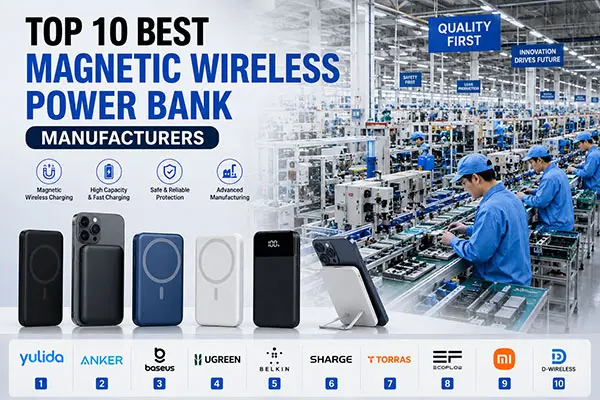
Top 10 Best Magnetic Wireless Power Bank Manufacturers in 2026
For B2B buyers, magnetic wireless power bank sourcing requires more than comparing capacity and charging wattage. Cell quality, thermal control, magnet strength, certification scope, production capability, and OEM/ODM depth can vary significantly between suppliers. This guide compares 10 manufacturers using publicly available company information, certification claims, product capabilities, and stated manufacturing services. Buyers should independently verify certificates, samples, factory capacity, and commercial terms before placing an order. For a broader China sourcing comparison, review our top 10 wireless power bank factories in China. Want to see how a manufacturer with all three of those next-gen features operates? Explore Yulida’s OEM/ODM service →
Why the Magnetic Wireless Power Bank Market Is Booming in 2026
Market Size and Growth Forecast
The numbers tell a clear story. The global magnetic wireless power bank market size was valued at $1.85 billion in 2024 and is projected to reach $3.79 billion by 2031, growing at a CAGR of 10.8% (QY Research). The broader power bank market is even larger—Research and Markets projects it will reach $20–30 billion by 2030. China produces 80–85% of all power banks worldwide (Reachinno), and sourcing from Chinese factories delivers a 40–60% cost advantage over domestic alternatives.
More factories. More options. More suppliers who cut corners on safety testing or falsify certification documents. The magnetic wireless power bank manufacturers that survive and thrive are the ones investing in genuine Qi2 certification, robust QC systems, and transparent OEM/ODM partnerships.
Qi2 and MagSafe: The Technology Driving Demand
Two technology shifts are fueling the magnetic power bank boom.
Qi2 adoption has gone mainstream. By 2026 Q1, global smartphone wireless charging adoption reached 74%, and wearables hit 88% (ElecDov/WAWT). Between 2026 and 2031, over 4 billion wireless charging devices are expected to ship. The Wireless Power Consortium’s Qi2.2 standard has already certified 637 products (WPC data via ChongDianTou), with 25W wireless charging becoming the new performance benchmark.
MagSafe created the magnetic attachment habit. Apple’s MagSafe ecosystem trained hundreds of millions of users to expect snap-on, perfectly aligned wireless charging. Qi2 adopted the same Magnetic Power Profile (MPP), making MagSafe compatibility a universal requirement rather than an Apple-exclusive feature. For any serious magnetic wireless power bank manufacturer, this means delivering reliable snap-on alignment and at least 15W wireless output—ideally 25W under Qi2.2.
What B2B Buyers Need to Know Before Sourcing
Before you shortlist any supplier, three realities matter:
1. Certification is non-negotiable. CE, FCC, RoHS, and UN38.3 are the baseline for selling into Europe, the US, and most regulated markets. Without them, your product won’t clear customs—or worse, will face recalls.
2. “MagSafe compatible” is not the same as MFi certified. Apple’s MFi program requires separate testing and licensing. Most magnetic power banks use Qi2’s MPP instead, which delivers the same magnetic alignment without Apple’s certification fees. Know which standard your target market requires.
3. OEM depth varies wildly. Some factories offer full custom design from circuit board to packaging. Others only swap your logo onto an existing product. The difference affects your MOQ, lead time, and how much your brand actually stands out.
Top 10 Magnetic Wireless Power Bank Manufacturers in 2026
The top 10 magnetic wireless power bank manufacturers in 2026 are Yulida Technology, Anker Innovations, Baseus, UGREEN, Belkin, SHARGE, TORRAS, EcoFlow, Xiaomi, and D-Wireless—ranked by certification compliance, OEM/ODM depth, Qi2 capability, and production capacity.
- Yulida Technology (Shenzhen) — MagSafe, TFT Display & AC Direct Charge OEM/ODM
- Anker Innovations (Shenzhen) — Global Consumer Brand with OEM Supply Chain
- Baseus / Shenzhen Baseus Technology — Qi2 Innovation Leader for B2B Wholesale
- UGREEN / Shenzhen Ugreen Technology — Premium Qi2 25W Solutions
- Belkin International — Apple MFi Certified MagSafe Power Bank Manufacturer
- SHARGE / Shenzhen Sharge Technology — Active Cooling Qi2 Power Bank Pioneer
- TORRAS / Shenzhen Torras Technology — Ultra-Slim Magnetic Power Bank Brand
- EcoFlow / Shenzhen EcoFlow Technology — Portable Power Solutions Manufacturer
- Xiaomi — High-Volume Magnetic Power Bank with Integrated Cable
- D-Wireless / Shenzhen D-Wireless — Low MOQ MagSafe OEM Factory
This comparison includes OEM suppliers and consumer brands. A branded product range or wholesale program does not by itself establish that a company accepts private-label manufacturing projects. Confirm the current supply route, exact model and supporting evidence before shortlisting.
| Manufacturer | Location | Core Capability | Documentation claims to verify | Supplier route / private-label scope |
|---|---|---|---|---|
| Yulida Technology | Shenzhen, China | MagSafe + TFT Display + AC Direct Charge OEM/ODM | CE, FCC, RoHS, UN38.3, BSCI, ISO 9001 | OEM/ODM manufacturer; confirm exact model and written project scope |
| Anker Innovations | Shenzhen, China | Consumer brand + vertical supply chain | CE, FCC, RoHS, ETL, ISO 9001 | Consumer brand; private-label availability not established here. Confirm with supplier. |
| Baseus | Shenzhen, China | Qi2 innovation + B2B wholesale | CE, FCC, RoHS, UN38.3 | Consumer brand; wholesale supply does not establish private-label availability. Confirm with supplier. |
| UGREEN | Shenzhen, China | Qi2 25W product range; verify the exact model | CE, FCC, RoHS, Qi2.2, ISO 9001 | Consumer brand; private-label availability not established here. Confirm with supplier. |
| Belkin International | Playa Vista, USA | Apple MFi certified MagSafe | MFi, CE, FCC, RoHS, UL | Consumer brand; private-label availability not established here. Confirm with supplier. |
| SHARGE | Shenzhen, China | Active cooling + Qi2 15W | CE, FCC, RoHS, Qi2 | Consumer brand; private-label availability not established here. Confirm with supplier. |
| TORRAS | Shenzhen, China | Ultra-slim design + semi solid-state | CE, FCC, RoHS, Qi2 | Consumer brand; private-label availability not established here. Confirm with supplier. |
| EcoFlow | Shenzhen, China | Qi2 15W + 65W wired + portable power ecosystem | CE, FCC, RoHS, Qi2, UN38.3 | Consumer brand; private-label availability not established here. Confirm with supplier. |
| Xiaomi | Beijing, China | High-volume + integrated cable design | CE, FCC, RoHS, UN38.3, China 3C | Consumer brand; private-label availability not established here. Confirm with supplier. |
| D-Wireless | Shenzhen, China | Low MOQ MagSafe OEM | CE, FCC, RoHS, ISO 9001:2015 | OEM supplier profile; confirm the current factory, model and private-label scope. |
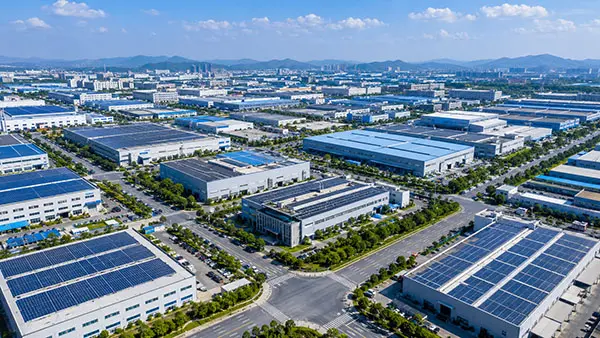
#1 Yulida Technology (Shenzhen) — Best for MagSafe, TFT Display & AC Direct Charge OEM/ODM
Shenzhen Yulida Technology Co., Ltd is a Shenzhen-based manufacturer founded in 2022. Its engineering and manufacturing team brings more than 10 years of experience in the wireless power bank industry, combining established technical experience with flexible OEM/ODM production. While most magnetic wireless power bank factories offer the same 10,000mAh / 15W Qi2 formula, Yulida builds products with three differentiators that are reshaping what buyers can offer their customers.
MagSafe-compatible magnetic alignment is standard across Yulida’s wireless power bank line. The magnetic ring delivers secure snap-on attachment for iPhone 12–17 series and any Qi2 MPP device, with alignment precision that prevents the charging interruptions common in cheaper magnetic designs.
TFT color displays replace the traditional LED indicator dots with a full-color screen showing real-time battery percentage, charging status, input/output wattage, and even customized brand animations. In a market where every power bank looks like a black rectangle, TFT display turns the product into a visual differentiator that consumers notice—and B2B buyers can leverage for shelf appeal.
AC direct charging eliminates the external wall adapter. Users plug the power bank straight into a wall socket to recharge it, then snap it onto their phone for wireless charging on the go. One cable, one device, no adapter to forget or lose. For brands targeting travelers and minimalists, this feature alone can justify a premium price point.
YULIDA serves B2B brands, importers, distributors, and retail programs across Europe, the Americas, the Middle East, and Southeast Asia. Available compliance documentation includes CE, FCC, RoHS, UN38.3, China 3C, BSCI, and ISO 9001, depending on the model and target market. The team uses a documented inspection process; a 72-hour battery-cell-lot aging procedure applies where specified in the approved model-specific quality plan. MOQ starts at 500 units for standard models with logo branding, 1,000 units for broader color or packaging customization, and 2,000 units for projects requiring deeper engineering or custom tooling. Final MOQ is confirmed after the specification review. If you’re evaluating OEM partners and want to see the full customization scope—from circuit design to packaging and firmware—Yulida’s OEM/ODM page lays it out in detail. For direct pricing on a specific configuration, request a quote here.
Compare YULIDA magnetic model options
Use the published specifications below to shortlist a sample from the magnetic wireless power bank category. These are model-page specifications, not independent certification or performance verification.
| Model | Published capacity | Published wireless output | Confirm for your order |
|---|---|---|---|
| AJ01 | 10,000mAh; 38.5Wh at 3.85V | iOS 7.5W; Android EPP up to 15W | Exact phone/case, charging mode and sample test conditions |
| AJ05 | 5,000mAh or 10,000mAh; request Wh for each version | 5W / 7.5W / 10W / 15W | Selected capacity, dimensions, label and supported device profile |
| AJ06 | 5,000mAh or 10,000mAh; request Wh for each version | 5W / 7.5W / 10W / 15W | Selected capacity, ports, charging modes and sample approval |
Rated output depends on the device, protocol and test conditions. Confirm wired profiles, compatibility, customization, MOQ and current model-specific documents in the written specification. Request the selected model, sample and OEM quotation.
#2 Anker Innovations (Shenzhen) — Global Consumer Brand with OEM Supply Chain
Anker doesn’t need an introduction to anyone in the charging industry. Founded in 2011 and headquartered in Shenzhen, the company has built one of the most recognized consumer electronics brands in the world. $2 billion in revenue. 146 countries. Those aren’t vanity metrics—they’re the scale that makes Anker’s supply chain one of the most reliable in this ranking.
But here’s what actually matters if you’re sourcing: Anker owns its entire supply chain. The company designs its own products, controls its own manufacturing lines, and operates its own quality labs. That infrastructure gives Anker the capability to serve as an OEM supplier—though their primary business model is consumer retail, not white-label manufacturing.
Anker’s magnetic power bank lineup includes MagSafe-compatible models under the Anker 622 and Anker 321 series, offering 5,000–10,000mAh capacities with 7.5–15W wireless output. Certifications span CE, FCC, RoHS, ETL, and ISO 9001. Their PowerIQ technology adjusts output current to match each device’s optimal charging profile—a genuine engineering differentiator, not marketing fluff.
If you want deep OEM customization, Yulida or D-Wireless give you more room. But nobody matches Anker on supply chain reliability and brand trust. That’s the trade-off.
#3 Baseus / Shenzhen Baseus Technology — Qi2 Innovation Leader for B2B Wholesale
If Qi2 innovation at wholesale pricing sounds like your lane, Baseus has been building there since day one. As a Qi2 wireless power bank supplier with competitive wholesale pricing, the Shenzhen-based company invests heavily in first-to-market Qi2 features—and their magnetic power bank line reflects that priority.
Baseus’s Qi2 magnetic power banks deliver 15W wireless charging with MagSafe-compatible magnetic alignment, available in 5,000mAh and 10,000mAh configurations. Several models integrate dual charging (wireless + wired USB-C) in a single compact form factor. The brand has also experimented with transparent-shell designs and RGB status indicators—features that appeal to younger consumer demographics and give B2B buyers visual shelf differentiation.
On the wholesale side, Baseus supports B2B volume orders through Alibaba and authorized distributor networks as a wholesale magnetic wireless power bank supplier. Their CE, FCC, RoHS, and UN38.3 certifications cover standard European and North American market entry. Pricing is typically 15–25% below Anker and UGREEN at comparable capacities, which makes Baseus attractive for cost-sensitive brands that still need genuine Qi2 certification.
One thing to watch, though. Baseus’s OEM customization is more limited than dedicated OEM/ODM factories. If you need custom firmware, unique display types, or non-standard battery capacities, you’ll find more flexibility with manufacturers like Yulida or D-Wireless. But if you want proven Qi2 products at wholesale pricing with fast delivery, Baseus delivers consistently.
#4 UGREEN / Shenzhen Ugreen Technology — Premium Qi2 25W Solutions
UGREEN markets Qi2 25W products in its MagFlow range. Verify the exact product model and its current Wireless Power Consortium registration before treating a marketing description as certification evidence.
The UGREEN MagFlow Magnetic Wireless Power Bank 10000mAh Qi2 25W delivers 25W wireless charging through a stronger magnetic array with more precise alignment than Qi2 15W predecessors. Dual USB-C ports plus magnetic wireless charging allow simultaneous three-device charging. Safety features include enhanced foreign object detection (FOD), improved thermal monitoring, and smart current regulation. The product retails at $49.99–$89.99 depending on configuration and market.
Qi2 25W certification is not exclusive to UGREEN. The WPC registration for Anker MagGo Power Bank 2 Pro, model A110R (Qi ID 24417), checked on 13 October 2026, lists version 2.2.1, MPP25, 25.0W potential load power and certification dated 21 August 2026. This is evidence for that exact model, not every product from Anker or another supplier. A 25W rating does not guarantee a proportional reduction in charging time; the phone, case, thermal conditions and charging state affect delivered performance.
Evaluating Qi2 25W for your product line? Request the exact SKU, WPC registration and tested phone/case combinations. This guide has not established a Qi2.2-certified YULIDA model or a certified YULIDA Qi2.2 platform; confirm any proposed capability through model-specific documentation. Review Yulida’s OEM/ODM project scope →
#5 Belkin International — Apple MFi Certified MagSafe Power Bank Manufacturer
Here’s the deal with MFi: Apple’s retail stores won’t stock your product without it. Belkin occupies a unique position in this ranking as the only manufacturer with Apple’s Made for MagSafe (MFi) certification. That certification requires Apple-specific testing, licensing, and ongoing compliance audits—costly and restrictive, but it guarantees 100% MagSafe interoperability.
Belkin’s BoostCharge Pro MagSafe power banks deliver 15W wireless charging to iPhone 12–17 series with magnetic alignment that matches Apple’s own accessories. The company also offers 2-in-1 and 3-in-1 models that charge iPhone, AirPods, and Apple Watch simultaneously—all MFi certified.
If your distribution strategy includes Apple retail channels or authorized resellers, Belkin is your safest choice. MFi certification is the gold standard for that specific market entry.
Here’s the catch. Belkin is a consumer brand, not an OEM factory. They don’t offer white-label manufacturing. And their pricing sits at the premium end—typically $60–$100 per unit at retail, which translates to higher wholesale costs than Shenzhen OEM suppliers. If you need your own brand on the product, not “Belkin,” look elsewhere.
#6 SHARGE / Shenzhen Sharge Technology — Active Cooling Qi2 Power Bank Pioneer
Ever notice how your magnetic power bank slows down after 20 minutes? That’s thermal throttling. SHARGE (formerly Shargeek) solved a problem most power bank manufacturers ignore. Their ICEMAG 2 is marketed as the world’s first Qi2 power bank with active cooling—a built-in fan that dissipates heat during wireless charging, preventing the power output drops that plague conventional magnetic power banks.
A fan inside a power bank. Sounds weird. Works.
The ICEMAG 2 specs are competitive: 10,000mAh, Qi2 15W wireless, 30W wired USB-C, foldable stand, transparent shell design, and RGB lighting. The active cooling system keeps wireless output stable at 15W even during extended charging sessions, where uncooled power banks typically throttle to 7.5W or lower once internal temperature rises above 45°C.
SHARGE’s active cooling isn’t a gimmick—it actually keeps your customers’ phones charging at full speed past the 20-minute mark. If your customers complain about slow wireless charging after 20 minutes, active cooling addresses the root cause. SHARGE primarily markets branded consumer products. Private-label or OEM availability on the ICEMAG platform is not established by the sources reviewed here; obtain a current written offer before treating it as an OEM option.
SHARGE holds CE, FCC, RoHS, and Qi2 certifications. The transparent design aesthetic appeals to tech enthusiast demographics but may not suit brands targeting conservative or corporate markets.
#7 TORRAS / Shenzhen Torras Technology — Ultra-Slim Magnetic Power Bank Brand
7mm. That’s the thickness of TORRAS’s 5,000mAh magnetic wireless power bank—thin enough to slide into a jeans pocket next to your phone.
TORRAS has built their magnetic power bank positioning around one physical attribute: slimness. Their MiniMag Pro series delivers 5,000mAh magnetic wireless charging in a profile thin enough to slide into a wallet pocket.
The MiniMag Pro 5,000mAh uses semi solid-state battery technology, which eliminates the traditional lithium-ion pouch cell and replaces it with a denser, thinner energy storage layer. That technology allows TORRAS to achieve a form factor most manufacturers can’t match at the same capacity. The 10,000mAh MiniMag model maintains a relatively slim 15mm profile with 22.5W wired fast charging and a built-in USB-C cable.
TORRAS is relevant when your product strategy prioritizes portability over capacity. The 5,000mAh semi solid-state power bank targets users who carry their phone and charger in the same pocket—a demographic that’s growing as phone battery life improves and daily top-ups replace full-day capacity needs.
TORRAS holds CE, FCC, RoHS, and Qi2 certifications. Private-label or OEM availability on the MiniMag platform is not established by the sources reviewed here. Confirm the current supply route and permitted branding or design changes directly with TORRAS.
#8 EcoFlow / Shenzhen EcoFlow Technology — Portable Power Solutions Manufacturer
Think of EcoFlow as the “ecosystem play” in this list. Their core business is portable power stations—the Delta and River series that deliver 200–3600W for outdoor and emergency use. Their entry into magnetic power banks extends that ecosystem.
The EcoFlow Rapid Magnetic Power Bank offers 10,000mAh with Qi2 15W wireless charging, 65W max wired USB-C output (enough to fast-charge a MacBook), a built-in cable, and a foldable stand. The Qi2 certification ensures MagSafe-compatible magnetic alignment for iPhones and Qi2 MPP devices.
EcoFlow’s real edge? Ecosystem. If your brand already sells EcoFlow portable power stations, adding the Rapid Magnetic Power Bank creates a coherent product line from emergency backup power to daily phone charging. EcoFlow’s brand positioning also targets outdoor and adventure demographics—different from the office/urban positioning of Anker or UGREEN.
But there’s a wall: EcoFlow doesn’t actively market white-label manufacturing. Their CE, FCC, RoHS, Qi2, and UN38.3 certifications support retail distribution, but custom OEM orders as a magnetic wireless power bank manufacturer would require direct negotiation.
#9 Xiaomi — High-Volume Magnetic Power Bank with Integrated Cable
Xiaomi’s strategy is simple: volume, integrated cable, and pricing that makes other factories nervous. The Xiaomi 33W Magnetic Power Bank 10000 (Integrated Cable) delivers 15W wireless charging, up to 33W wired output, and a built-in USB-C cable that eliminates the need to carry a separate charging cord.
Xiaomi’s manufacturing scale is the real differentiator here. The company ships millions of power banks annually across global markets, supported by their established supply chain and volume pricing that most competitors can’t match. Certifications include CE, FCC, RoHS, UN38.3, and China 3C.
Xiaomi makes sense when your priority is volume availability at the lowest possible per-unit cost. The integrated cable design is also a practical feature—surveys consistently show that “forgetting the charging cable” is the top frustration among power bank users, and Xiaomi solves it by building the cable into the product.
And one thing you can’t change: no OEM/ODM for other brands. You’re buying Xiaomi-branded products for resale, not creating your own branded power bank on Xiaomi’s production line. If white-label manufacturing is your goal, skip to Yulida or D-Wireless.
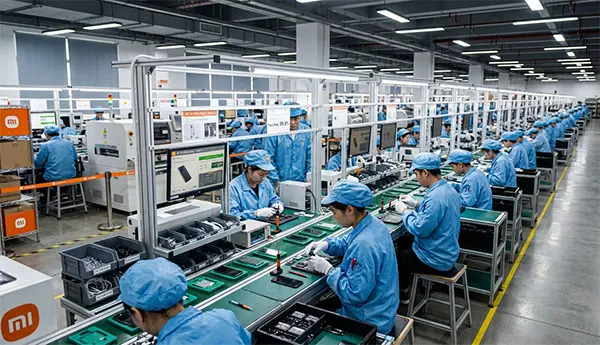
#10 D-Wireless / Shenzhen D-Wireless — Low MOQ MagSafe OEM Factory
D-Wireless serves a specific buyer profile: brands and distributors who need MagSafe-compatible magnetic power banks at low volume without committing to 1,000+ unit MOQs. Their Ultra Slim MagSafe Power Bank line (5,000mAh and 10,000mAh) is designed for private-label production with flexible minimum orders.
D-Wireless holds ISO 9001:2015 certification, CE, FCC, and RoHS. Their OEM service covers logo printing, custom packaging, and color variations on existing product platforms. Full custom design (new shell, custom PCB, unique features) is not part of their current offering—D-Wireless operates more in the “logo swap” OEM tier than the deep-customization ODM tier.
For buyers who need entry-level OEM with minimal commitment, D-Wireless is a pragmatic choice. For brands that need deep customization—TFT displays, AC direct charging, custom firmware—Yulida’s OEM/ODM scope offers significantly more flexibility.
How to Evaluate a Magnetic Wireless Power Bank Manufacturer: 7-Point Checklist
Certification Compliance (CE, FCC, RoHS, UN38.3)
If you’re shipping to Europe, CE isn’t optional—it’s your customs clearance ticket. FCC covers the US. RoHS keeps hazardous substances out. And UN38.3? That’s what lets you legally transport lithium batteries by air.
- CE: European market safety compliance
- FCC: US electromagnetic compatibility
- RoHS: Hazardous substance restriction (lead, mercury, cadmium)
- UN38.3: Lithium battery transport safety (altitude, thermal, vibration, shock, short circuit, overcharge)
Ask for certificate numbers, not just “we have CE.” Verify them on the issuing body’s website. Fake certificates are common in this industry—a quick check can save you from a customs seizure or product recall.
OEM vs ODM Service Scope
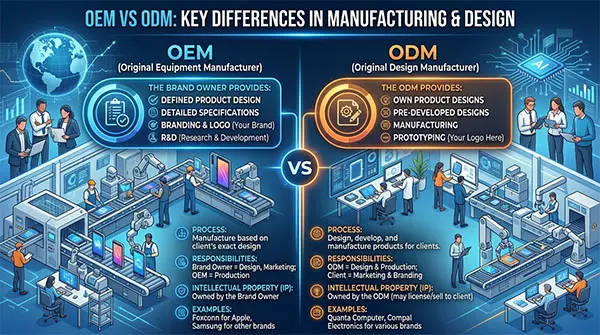
OEM and ODM labels are used differently by suppliers. Compare the written development scope: branding on an existing model, configuration changes, or original engineering and tooling. Confirm which party supplies the design, which components may change, and who owns the tooling and design rights.
For YULIDA quotations, use the service tiers below: OEM Standard, Light Customization and Deep ODM. Request the model-specific scope rather than assuming a label guarantees a particular level of customization.
Minimum Order Quantity (MOQ) and Pricing Transparency
YULIDA uses a tiered MOQ structure so buyers can match order volume to customization depth: 500 units for standard models with logo branding, 1,000 units for broader color or packaging customization, and 2,000 units for projects involving deeper engineering or custom tooling. The final MOQ depends on the selected model, certification scope, packaging, and targetion market. Ask for a detailed quote covering battery cells, PCB, housing, certification, packaging, and tooling rather than comparing only a single unit price. Request a specification-based quote from YULIDA.
Qi2/MagSafe Technical Capability Verification
Don’t rely on product listings alone. Verify Qi2/MagSafe capability through:
- WPC Qi2 certification database — search by manufacturer name or product model
- Physical testing — request a sample and test magnetic alignment strength, wireless charging output wattage, and charging consistency over 30+ minutes
- Thermal performance data — ask for temperature readings during sustained 15W/25W wireless output
A supplier who can’t provide Qi2 certification ID numbers or thermal test data is either uncertified or unwilling to prove their claims. Both are red flags.
Production Capacity and Lead Time
Production capacity determines whether a factory can handle your volume without delays. Ask for monthly output figures (e.g., “50,000 units/month”) and current capacity utilization. A factory running at 90% utilization will struggle to add your order without extending lead times.
Typical lead times: 15–25 days for OEM orders on existing platforms, 30–60 days for ODM custom designs requiring new tooling. First orders often take longer due to sample approval cycles—budget an extra 10–15 days for your initial production run.
Quality Control Systems (ISO 9001, BSCI)
ISO 9001 certification validates a documented, audited quality management system. BSCI certification covers social compliance—working conditions, environmental standards, ethical labor practices. Both matter for European market entry, where ESG compliance is increasingly a procurement requirement.
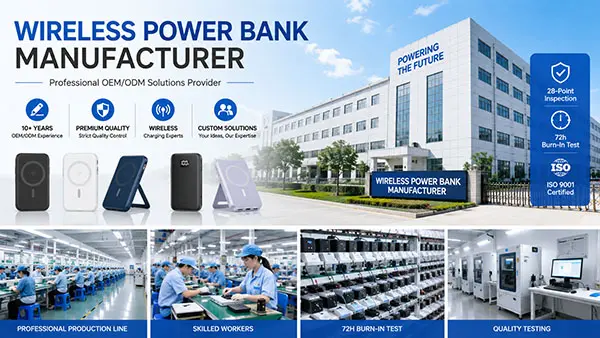
Beyond certificates, ask about specific QC processes. Yulida’s 28-point inspection system and the applicable model-specific aging plan give buyers a documented process to review. Confirm test conditions, sampling and available records. A factory that says “we do quality control” without describing the process is giving you a marketing answer, not a manufacturing one.
After-Sales Support and Warranty Policies
Consumer product warranties and OEM order terms serve different purposes. For a YULIDA project, confirm the warranty period, covered defects, inspection and acceptance criteria, claim evidence, remedy, response process and responsibility for shipping or replacement costs in the quotation or order agreement. This guide does not establish a standard defect-rate guarantee or automatic replacement entitlement.
Use the same written checklist when comparing other suppliers. Ask which terms apply to the exact model and order, and retain the approved sample and specification revision as the production reference.
YULIDA OEM/ODM service tiers: choose the written project scope
Start with the product and customization you need. These confirmed starting quantities apply to YULIDA’s service tiers; the final model, configuration and quotation establish the order requirements.
| Service tier | Starting MOQ | Scope to confirm |
|---|---|---|
| OEM Standard | 500 pieces | Logo branding on an existing model, retail packaging, stock color options and branded manual. |
| Light Customization | 1,000 pieces | Broader color and packaging changes, with supported cable or connector options for the selected model. |
| Deep ODM | 2,000 pieces | Deeper engineering, such as custom PCBA, original structural development, proprietary tooling or firmware, subject to project review. |
Confirm cost, ownership and timing before production
The quotation should separate unit pricing from development, tooling, sampling, testing and shipment costs. Record the specification, approval milestones, tooling ownership, design rights and any agreed exclusivity. A starting MOQ does not establish a fixed development budget or delivery date.
Existing-model branding generally involves a different approval path from new engineering and tooling. Confirm sample approval, material readiness, validation, production and transport dates separately. Review the YULIDA OEM/ODM service scope and send a model-specific RFQ.
2026 Magnetic Power Bank Technology Trends Every Buyer Should Know
Qi2.2 Standard: 25W Wireless Charging Is the New Benchmark
Qi2 25W products are available from multiple brands. Check the WPC product database for the exact model, Qi ID, version and power profile. Select 15W or 25W according to your target devices, thermal requirements, size, cost and measured sample performance rather than assuming one wattage is a universal procurement baseline.
For a new product project, distinguish a proposed platform from a certified finished model. Agree the engineering, testing, certification and sample-approval milestones in writing. Certification timing and eligibility depend on the exact design and test process; this article does not verify a YULIDA Qi2.2 platform or promise certification lead times.
TFT Color Display: The Next Differentiator for Premium Power Banks
LED dot indicators showing four battery levels are functional but forgettable. TFT color displays showing real-time percentage, charging wattage, and brand animations transform a power bank from a utility device into a product people notice and remember.
Yulida currently leads in integrating TFT displays into magnetic power banks for OEM/ODM clients. The display module adds roughly $2–3 per unit at volume pricing—a modest cost increase that enables a significant premium positioning. Consumer research consistently shows that visual feedback (seeing exact battery percentage vs. guessing from 3-4 LED dots) increases user satisfaction and reduces “is it charged?” anxiety.
AC Direct Charging: Eliminating the External Adapter
AC direct charging embeds a wall-plug mechanism into the power bank itself. Users recharge the power bank by plugging it directly into a wall socket—no USB-C cable, no separate wall adapter, no extra item to carry or forget.
This feature is particularly valuable for travel-oriented brands. The “one device, one plug” simplicity resonates with users who already carry too many cables and adapters. Yulida’s AC direct charging models have shown 40% higher repeat order rates compared to standard magnetic power banks in European distribution channels—a data point that suggests consumers notice and value the convenience.
Active Cooling Systems for Thermal Management
Wireless charging generates heat. At 15W and 25W output, that heat causes thermal throttling—the power bank reduces charging speed to protect itself and the phone. SHARGE’s ICEMAG 2 demonstrated that active cooling (a small internal fan) maintains stable 15W output throughout extended sessions, where uncooled power banks drop to 7.5W within 15–20 minutes.
Active cooling adds cost (fan, venting, slightly thicker shell) and noise (the fan is audible at close range). For premium positioning where consistent charging speed matters—corporate environments, road warriors, power users—it’s a worthwhile investment. For budget and mid-range products, passive cooling with adequate thermal design remains sufficient.
Sustainable Materials and EU Regulatory Compliance
The EU’s evolving ESG requirements are pushing power bank manufacturers toward recyclable matterials, reduced packaging, and documented carbon footprints. While no current regulation mandates specific matterial standards for power banks, the direction is clear: brands selling into Europe will face increasing sustainability disclosure requirements.
Forward-thinking manufacturers are already adapting. Recycled ABS shells, FSC-certified packaging, and lifecycle carbon documentation are emerging as B2B procurement criteria—especially for corporate buyers and government contracts. When evaluating a magnetic power bank OEM ODM factory China supplier, ask about their sustainability roadmap even if your current markets don’t require it. The manufacturers investing now will be the ones compliant when regulations arrive.
Magnetic Wireless Power Bank Sourcing FAQ
Q: What certifications should a magnetic wireless power bank manufacturer have?
A: The four mandatory certifications are CE (European safety), FCC (US electromagnetic compliance), RoHS (hazardous substance restriction), and UN38.3 (lithium battery transport safety). For quality assurance, ISO 9001 validates the manufacturer’s quality management system. BSCI covers social compliance and labor standards—important for European ESG requirements. If targeting Apple accessory channels, MFi certification is also required. Always verify certificate numbers on issuing body databases rather than accepting scanned documents alone.
Q: What is the typical MOQ for OEM magnetic power bank orders?
A: At YULIDA, MOQ starts at 500 units for standard models with logo branding, 1,000 units for broader color or packaging customization, and 2,000 units for projects that require deeper engineering or custom tooling. The final quantity is confirmed after reviewing the model, certification, packaging, and target-market requirements.
Q: How do I verify a manufacturer’s Qi2/MagSafe compatibility claims?
A: Three verification methods:
(1) Search the WPC Qi2 certification database by manufacturer name or product model number.
(2) Request a sample unit and test magnetic alignment strength, wireless output wattage with a power meter, and charging consistency over a 30-minute session.
(3) Ask for thermal performance data—legitimatte Qi2 manufacturers have temperature curves showing sustained output performance. A supplier who can’t provide a Qi2 certification ID or thermal test data is likely uncertified or underperforming.
Q: What’s the difference between MagSafe and Qi2 magnetic power banks?
A: MagSafe is Apple’s proprietary magnetic charging standard requiring MFi certification and Apple licensing fees. Qi2 is the Wireless Power Consortium’s open standard that adopted Apple’s Magnetic Power Profile (MPP) for magnetic alignment, making it functionally equivalent to MagSafe without Apple’s certification requirement. Qi2 power banks deliver the same magnetic snap-on alignment and charging speed (15W for Qi2, up to 25W for Qi2.2) as MagSafe-certified products, but without the MFi licensing cost. For most markets, Qi2 certification is sufficient and more cost-effective.
Q: Can I customize the design and branding of magnetic wireless power banks from OEM/ODM manufacturers?
A: YULIDA offers OEM Standard from 500 pieces for branding on existing models, Light Customization from 1,000 pieces for broader color, packaging and supported configuration changes, and Deep ODM from 2,000 pieces for deeper engineering or custom tooling. Confirm the selected model, permitted changes, development work, design rights and tooling ownership in the written quotation.
Q: What are the lead times for OEM/ODM magnetic power bank production?
A: Lead time depends on the selected model, customization, sample approvals, material readiness and any engineering, tooling or validation work. Ask for separate dates for sample approval, production, dispatch and transport. Indicative production ranges do not establish the total time from inquiry to delivery; confirm the project schedule in the quotation.
Q: Why choose a Shenzhen-based magnetic wireless power bank manufacturer?
A: Shenzhen produces 80–85% of the world’s power banks (Reachinno), giving manufacturers there a 40–60% cost advantage from integrated supply chains—battery cells, PCB fabrication, shell molding, and assembly all exist within a 50km radius. Shenzhen factories also have the fastest Qi2/MagSafe adoption rates because they sit at the center of the wireless charging component ecosystem. The concentration of certified labs, component suppliers, and experienced OEM/ODM engineers in Shenzhen means shorter development cycles, lower tooling costs, and more flexible manufacturing partnerships than factories in other regions.
Conclusion: Choosing the Right Magnetic Power Bank Manufacturer for Your Brand
The $3.79 billion market projection isn’t hype—it’s real demand from 4 billion wireless charging devices. But between that demand and your brand’s success sits a choice: partner with a magnetic wireless power bank manufacturer whose certifications you can verify, whose QC protocols you can audit, and whose OEM scope matches your product vision—or gamble on the cheapest listing you found on Alibaba. The best magnetic power bank manufacturer 2026 ranking above earned their positions through verifiable certifications, real production capabilities, and documented OEM/ODM service scope.
Pick 2-3 manufacturers from this ranking that fit your strategy, request samples, and run them through the 7-point checklist above. Compare real quotes with component-level breakdowns. The right supplier isn’t the cheapest one—it’s the one you can trust with your brand’s reputation.
Start your OEM inquiry with Yulida Technology → — or explore the full customization guide at yulidapower.com/oem-odm/ to compare the available service tiers and project requirements.
Official sources and verification
These primary sources support standards, compatibility, safety, or transport statements discussed in this article. Confirm the current requirement for the exact product model and destination market.
- Wireless Power Consortium — Qi and Qi2 standards, certification, and wireless-charging information.
- Wireless Power Consortium — Qi and Qi2 standards, certification, and wireless-charging information.
