




Does Wireless Power Bank Work on All Phones? B2B Compatibility Guide
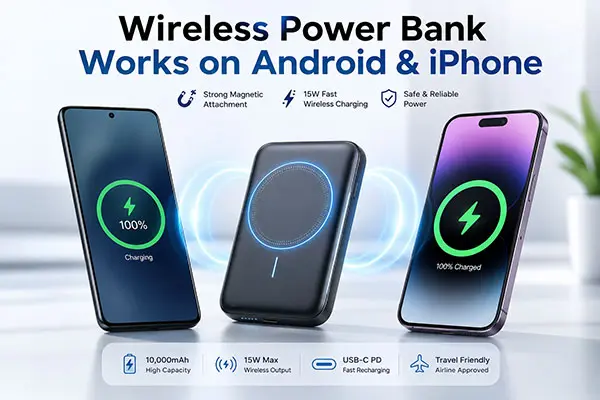
Does a wireless power bank work on all phones? No. Wireless charging only works with phones that contain compatible Qi, Qi2, or MagSafe receiver hardware. Phones without a wireless charging receiver must use a cable or a separate compatible receiver accessory. For B2B buyers, this makes device compatibility a sourcing requirement: the product mix should reflect the phones, cases, charging standards, and price segments used in the target market. This guide explains which phones work, why charging can fail, and when a dual-mode power bank with wireless and wired outputs is the safer choice.
Does a Wireless Power Bank Work on All Phones?
No. A wireless power bank does not work on all phones. It only works with devices that have a built-in wireless charging receiver coil compatible with the Qi standard (or its successors, Qi2 and MagSafe). Phones without this hardware simply won’t charge, no matter how powerful or well-made the power bank is.
The practical breakdown:
- Phones that work: Most flagships from Apple, Samsung, Google, and Huawei, plus select models from Xiaomi, OnePlus, OPPO, and Honor. These have Qi receiver coils built into the battery assembly.
- Phones that don’t work: The vast majority of budget and mid-range phones, particularly brands like Tecno, Infinix, itel, and entry-level models from otherwise-compatible brands. These lack the internal coil entirely.
- The dual-mode solution: Power banks that combine a wireless charging pad with built-in USB cables or ports can charge any phone, wireless or not. That’s why dual-mode (or multi-function) power banks have become the go-to choice for distributors serving mixed device ecosystems.
Want to offer maximum compatibility in a single product? Explore our 3-in-1 wireless power bank lineup — wireless pad plus built-in cables for universal coverage.
Bottom line for sourcing teams: know your market’s device ecosystem before you place an order. A wireless-only power bank is perfect for markets dominated by flagships. A dual-mode unit is the safer bet for markets with mixed or budget-heavy phone populations.
How Wireless Charging Actually Works: The Qi Standard Explained
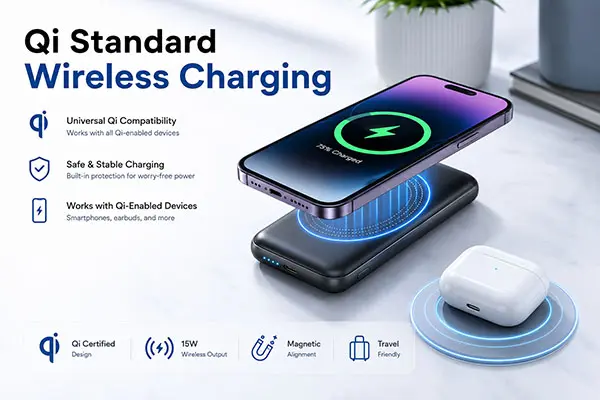
Qi wireless charging is a technology standard developed by the Wireless Power Consortium (WPC) that enables power transfer between two coils — one in the charger and one in the device — using electromagnetic induction. It allows compatible phones and accessories to charge by simply resting on a charging pad, with no physical cable connection required.
Electromagnetic Induction Basics
Wireless charging isn’t magic. It’s electromagnetic induction, a principle discovered by Michael Faraday nearly two centuries ago. Here’s how it works in a power bank context:
The wireless power bank contains a transmitter coil. When you place a compatible phone on the charging surface, the phone’s internal receiver coil sits directly above it. The power bank drives alternating current through its transmitter coil, generating a fluctuating magnetic field. This field induces an electric current in the phone’s receiver coil, which is then converted to direct current (DC) to charge the battery.
Two things must be true for this to work:
- The phone must have a receiver coil. Without it, there’s nothing to “receive” the induced current. No coil, no charge.
- The coils must be close together (typically within 5 mm) and reasonably well aligned. Greater distance or misalignment dramatically reduces efficiency.
This is why a phone without built-in Qi hardware sits on a wireless charger and nothing happens. The magnetic field is there, but there’s no receiver coil to capture it. It’s like trying to tune into a radio station with no antenna.
The WPC and Qi Certification
The Wireless Power Consortium (WPC) is the industry body that developed and maintains the Qi standard. Since its introduction, Qi has become the universal baseline for wireless charging, supported by virtually every phone and charger manufacturer.
Why should procurement teams care about Qi certification? Three reasons:
- Interoperability guarantee: A Qi-certified power bank is tested to work with all Qi-certified phones. You’re not betting on compatibility. You’re guaranteed it.
- FOD (Foreign Object Detection): Certified chargers include FOD, a critical safety feature that detects metal objects (coins, keys, cards) between the charger and phone. Without FOD, a stray paperclip can heat up dangerously. This is a liability issue for any distributor.
- Safety compliance: Qi certification requires adherence to international safety standards including IEC 62368-1, the benchmark for audio/video and IT equipment safety.
You can verify any product’s Qi certification by searching its WPC ID in the WPC Qi certification database. If a supplier can’t provide a WPC ID, that’s a red flag.
Qi vs. Qi2 vs. MagSafe — What’s the Difference?
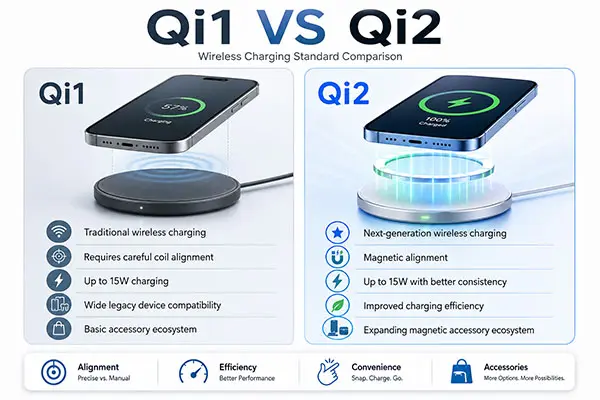
The wireless charging landscape has evolved significantly. Understanding the differences between these three standards is essential for making informed sourcing decisions. The three standards differ in power, magnetic alignment, and compatibility:
| Standard | Max Power | Magnetic Alignment | Key Compatibility |
|---|---|---|---|
| Qi | 15W | No (manual alignment) | Universal baseline — all wireless-charging phones |
| Qi2 | 15W | Yes (Magnetic Power Profile) | Newer iPhones, select Androids (growing) |
| MagSafe | 15W | Yes (N52 neodymium magnets) | iPhone 12 and later |
Qi is the foundation. It uses inductive charging and requires you to manually center the phone on the pad. If the coils aren’t aligned, charging slows dramatically or stops. Qi supports up to 15W, though many phones cap at 5W or 7.5W.
MagSafe was introduced by Apple with the iPhone 12. It adds a ring of N52 neodymium magnets around the charging coil, snapping the phone into perfect alignment every time. This solves the #1 problem with Qi: coil misalignment. However, MagSafe is Apple-proprietary, meaning Android phones don’t benefit from the magnetic alignment even though they still charge via the underlying Qi protocol.
Qi2 is the game-changer for the broader market. Released by the WPC, Qi2 is based on Apple’s Magnetic Power Profile (MPP) but is an open standard. It brings MagSafe-style magnetic alignment to all phone brands, not just Apple. As more Android manufacturers adopt Qi2, magnetic wireless charging becomes a universal feature rather than an iPhone exclusive.
For a deeper dive into what a magnetic wireless power bank is and its key features, see our complete guide.
The practical implication for B2B buyers: a magnetic wireless power bank that supports Qi2 will appeal to both iPhone and Android users, maximizing your product’s market relevance.
Which Phones Support Wireless Charging? Brand-by-Brand Compatibility
The question “does wireless power bank work on all phones?” ultimattely comes down to one thing: does the phone have a Qi receiver coil? Here’s a brand-by-brand breakdown of the current landscape.
| Phone Brand | Supported Series | Qi Support | Max Wireless Wattage |
|---|---|---|---|
| Apple | iPhone 8 and later | Yes (Qi); MagSafe on iPhone 12+ | 15W (MagSafe/Qi2); 7.5W on basic Qi pads |
| Samsung | Galaxy S (from S6), Note, Z Fold/Flip | Yes (Qi) | 15W |
| Pixel 4 and later | Yes (Qi) | 15W (Pixel Stand); 12W on third-party Qi | |
| Huawei | Mate (from Mate 20 Pro), P (from P30 Pro) | Yes (Qi) | 15W (select models); 5W on others |
| Xiaomi | Mi 9 and later, Mix series | Yes (Qi, select models) | 30–50W (proprietary); 10W on standard Qi |
| OnePlus | OnePlus 9 Pro and later | Yes (Qi, select flagships) | 50W (Warp); 15W on standard Qi |
| OPPO | Find X series (select) | Yes (Qi, limited) | Limited Qi support; proprietary fast charge |
| vivo / iQOO | Vivo X90 Pro+ and select flagships | Yes (Qi, very limited) | Limited Qi support |
| Honor | Magic series (from Magic 4) | Yes (Qi) | 15W (select models) |
A few important notes for B2B buyers:
Apple is the most straightforward ecosystem. Every iPhone from the iPhone 8 onward supports Qi wireless charging. Models from the iPhone 12 and later add MagSafe magnetic alignment. You can verify iPhone wireless charging compatibility on Apple’s official wireless charging guide. Any Qi-certified wireless power bank will work with iPhones going back several generations.
Samsung has the longest track record with wireless charging, dating back to the Galaxy S6. Their flagship and foldable lines consistently support Qi at up to 15W.
Xiaomi, OnePlus, and OPPO are more complicated. They support Qi, but their ultra-fast proprietarand wireless charging (30W, 50W, even 80W) only works with their own branded chargers. On a standard Qi power bank, they typically charge at 10–15W. This isn’t a problem. It’s just important to set the right expectations.
Huawei support is inconsistent across models and regions, and newer Huawei devices face chipset-related limitations. Always verify specific models.
Phones That Do NOT Support Wireless Charging
A large portion of the global smartphone market still lacks wireless charging. This is particularly relevant for B2B buyers targeting emerging markets.
Brands that typically don’t incluof wireless charging:
- Tecno: Focuses on budget and mid-range phones for African and South Asian markets. Most models lack Qi hardware.
- Infinix: Similar positioning to Tecno — budget-focused, largely without wireless charging.
- itel: Ultra-budget brand; no wireless charging on any current models.
- Entry-level models from major brands: Samsung Galaxy A-series (most models), Xiaomi Redmi (most models), OnePlus Nord (most models), and OPPO A-series generally omit wireless charging to hit price targets.
If your distribution channel serves Sub-Saharan Africa, where Tecno, Infinix, and itel collectively hold significant market share, a wireless-only power bank will be incompatible with a large percentage of your customers’ phones. The same applies to India, where budget Xiaomi Redmi models dominate. To verify whether a specific phone model supports Qi wireless charging, check its specifications in the GSMArena phone database — the most comprehensive mobile phone specification resource online.
A real-world example: A Southeast Asian retailer ordered 3,000 wireless charging stands for a chain of convenience stores. After launch, customer complaints revealed that over 60% of local phone models, including the best-selling Redmi Note series, didn’t support wireless charging. The retailer switched to dual-mode power banks for their next order and saw return rates drop from 18% to under 2%.
Why Your Wireless Power Bank Might Not Work — Common Issues
Even when a phone technically supports wireless charging, real-world performance can fall short. The most common culprits, ranked by frequency:
Phone Lacks Built-in Qi Hardware
This is the #1 reason wireless power banks don’t work, and it’s also the most fundamental. If the phone doesn’t have a Qi receiver coil, wireless charging is physically impossible. No software update or setting change can fix it.
Approximattely 20.5% of negative reviews on wireless charging products cite “incompatible with some devices.” In most of these cases, the buyer’s phone simply lacks the hardware. This is a consumer education problem, but for sourcing teams, it’s a product selection problem: choose dual-mode products that cover all bases.
Case Interference and Metal Obstructions
Wireless charging relies on magnetic induction, and metal disrupts magnetic fields. The usual suspects:
- Metal phone cases (aluminum, steel backings)
- Magnetic kickstands or card holders attached to the back of the phone
- PopSockets and metal rings (unless specifically designed for MagSafe compatibility)
- Credit cards with RFID chips or magnetic strips stored between the phone and case
Most Qi-certified chargers handle cases up to 3–5 mm thick without issue. But anything with metal, particularly magnetic metal, blocks the charging field. FOD (Foreign Object Detection) exists precisely because of this risk: it shuts down charging before a metal object heats up to dangerous levels.
Coil Misalignment
A number that catches most people off guard: a coil offset of more than 3 mm reduces charging efficiency by over 50%. Move the phone a centimeter off-center and you’ve essentially halved the charging speed, or stopped it entirely.
MagSafe and Qi2 were built to solve exactly this problem. With magnetic alignment, the phone snaps into the optimal position automatically. Without it, users must eyeball the alignment, and they frequently get it wrong.
We saw this play out with a European retailer who sourced 2,000 magnetic power banks for an iPhone-heavy market, then expanded to a Southeast Asian channel where 70% of phones were Androids without Qi2. Alignment complaints spiked. The fix wasn’t a product recall; it was adding clear visual alignment guides to the packaging and switching to dual-mode units for the Asian channel. Returns normalized within six weeks.
If your market skews iPhone-heavy (iPhone 12 and later), a magnetic power bank eliminates the alignment problem entirely. For Android-heavy markets without Qi2 adoption, clear visual alignment guides on the product become important. If you’re weighing whether this feature justifies the cost, see our analysis of whether magnetic power banks are worth it for your product line.
Protocol Mismatch and Speed Throttling
Not all Qi is created equal. A Qi-certified 15W power bank may only deliver 5W or 7.5W to certain phones due to protocol negotiation:
- iPhones cap at 7.5W on standard Qi pads. Full 15W requires MagSafe or a Qi2-certified charger.
- Samsung phones negotiate proprietary fast wireless charging with Samsung-branded chargers but fall back to 5–10W on third-party Qi pads.
- Xiaomi and OnePlus similarly throttle to standard Qi speeds (typically 10W) when using non-branded chargers.
This isn’t a defect. It’s how the Qi protocol works. The charger and phone “handshake” to determine the maximum safe charging rate both can support. The procurement takeaway: set expectations correctly. Your wireless power bank will charge compatibly, but not always at the phone’s maximum speed.
Thermal Throttling
Wireless charging is inherently less efficient than wired charging. 20–30% of the energy transferred is lost as heat. When a phone or power bank gets too hot, both devices throttle charging speed to protect the battery and internal components.
This means a wireless power bank rated at 15W may drop to 5W or even pause charging temporarily during heavy use or in hot environments. In tropical climattes, where many emerging markets are located, thermal throttling can significantly extend charging times.
Three design features that mitigate this:
- Active cooling (fans) in higher-end models
- Heat-dissipating matterials (graphene, aluminum housings)
- Smart thermal sensors that adjust power delivery dynamically
Can You Make a Non-Wireless Phone Work With a Wireless Power Bank?
Wireless Charging Receiver Adapters
Yes, technically. A wireless charging receiver adapter is a thin, flexible pad with a Qi receiver coil that plugs into a phone’s charging port (USB-C, micro-USB, or Lightning) and sticks to the back of the device. It essentially retrofits a non-Qi phone with wireless charging capability.
Pros:
– Costs only a few dollars per unit
– Works with any Qi-certified charger
– Thin enough to fit under most phone cases
Cons:
– Adds a dongle that sticks out of the charging port — unsightly and fragile
– Blocks the wired charging port (you must remove it to use wired charging)
– Charging speed is typically limited to 5W
– Not durable; the thin cable connection breaks easily
– Consumer adoption is low — most people find them fiddly and inconvenient
As a sourcing decision, receiver adapters are a dead end. They’re a niche accessory, not a mainstream solution. If your market has a high percentage of non-Qi phones, you need a different approach.
The Better B2B Solution: Dual-Mode Power Banks
This is where product selection makes or breaks your margins. A dual-mode power bank combines wireless charging capability with built-in wired charging options (integrated cables, USB ports, or both). This means:
- Qi-enabled phones charge wirelessly on the pad
- Non-Qi phones charge via the built-in cables or USB ports
- One product covers 100% of the market
Which is why multi-function power banks now dominate distributor catalogs. Rather than guessing which phones your customers use, you stock a product that works regardless.
For maximum coverage, consider a 5-in-1 wireless power bank that includes wireless charging, multiple built-in cable types, and fast-charging USB ports. One SKU, universal compatibility, zero guesswork.
What This Means for B2B Buyers: Sourcing the Right Wireless Power Bank
Know Your Target Market’s Phone Ecosystem
The single most important step before placing an order is understanding what phones your end customers actually use. Phone ecosystems vary dramatically by region:
- North America & Western Europe: Dominated by iPhones and Samsung Galaxy S-series. Wireless charging penetration is high. Magnetic (MagSafe/Qi2) power banks are in strong demand.
- Sub-Saharan Africa: Tecno, Infinix, and itel hold major market share. Wireless charging penetration is low. Dual-mode or wired-focused products are essential.
- India & South Asia: Xiaomi (including Redmi) leads the market, with Samsung and Realme also strong. Many top-selling models lack Qi. Dual-mode products are the safe choice.
- Southeast Asia: Mixed ecosystems — OPPO, vivo, Samsung, and Xiaomi all have significant share. Dual-mode products address the diversity.
- Middle East: Premium segment skews toward iPhone and Samsung flagships. Wireless charging is viable for higher-end retail channels.
Dubai and Nairobi are 4,000 miles apart, and their phone ecosystems might as well be on different planets. A product that flies off shelves in one may gather dust in the other. Match your product to your market’s phone ecosystem.
Dual-Mode vs. Wireless-Only: The Procurement Decision
For most B2B buyers, the decision comes down to three options:
- Wireless-only (Qi/Qi2/MagSafe): Best for premium markets with high iPhone and Samsung flagship penetration. Lower unit cost, but limits your addressable customer base. Browse our full range of wireless power bank products to compare magnetic, multi-function, and dual-mode options.
- Dual-mode (wireless + built-in cables): The versatile choice. Covers both Qi-enabled and non-Qi phones with a single SKU. Slightly higher unit cost, but dramatically lower return rates and broader market appeal.
- Multi-function (5-in-1 and similar): Maximum versatility. Wireless pad, multiple cable types, fast-charging ports, sometimes additional features like built-in wall plugs. Ideal for retail chains, promotional gifts, and markets with highly diverse phone ecosystems.
Most experienced distributors default to dual-mode or multi-function products because the marginal cost increase is far outweighed by the reduction in returns and customer complaints.
Certification Matters for B2B
When evaluating suppliers, certification should be a non-negotiable requirement, not a nice-to-have. Verify these five things before signing a PO:
- Qi Certification — request the WPC ID and verify it in the WPC database. Uncertified products may work, but they carry safety and interoperability risks.
- FOD: Does the product include Foreign Object Detection? Without it, metal objects between the charger and phone can overheat. That’s a liability concern, not just a feature gap.
- IEC 62368-1: The international safety benchmark for IT and AV equipment. Compliance is required for legal sale in most regulated markets. Verify via the IEC webstore.
- CE, FCC, RoHS: Your supplier should provide actual test reports, not just claims on a spec sheet.
- WPC member status: Members demonstrate commitment to the standard, not just bare-minimum compliance.
A supplier who can’t or won’t provide certification documentation is a liability, not a partner. When evaluating suppliers, look for an established power bank manufacturer with verifiable certifications, manufacturing scale, and export experience. For reliable, certified manufacturing, explore our OEM/ODM services.
Looking for a vetted manufacturing partner? Our guide to wireless power bank factories walks you through what to look for and who to trust.
FAQ — Wireless Power Bank Phone Compatibility
1. Does a wireless power bank work on iPhone?
Yes. Every iPhone from the iPhone 8 onward supports Qi wireless charging and will work with any Qi-certified wireless power bank. iPhone 12 and later models also support MagSafe magnetic alignment, which snaps the phone into the optimal charging position. On a standard Qi pad, iPhones charge at up to 7.5W. With a MagSafe or Qi2-certified charger, they reach 15W.
2. Can a wireless power bank charge a Samsung phone?
Yes. Samsung has included Qi wireless charging in its flagship Galaxy S series since the Galaxy S6, and all Galaxy Note and Z Fold/Flip models support it. Samsung phones charge at up to 15W on Qi-certified chargers. Note that Samsung’s proprietary fast wireless charging only activates with Samsung-branded chargers; on third-party Qi pads, charging speed is typically 10–15W.
3. Do wireless power banks work with phone cases on?
In most cases, yes. Qi-certified wireless chargers are designed to work through cases up to 3–5 mm thick. However, cases containing metal (aluminum, steel backings), magnetic kickstands, or thick wallet-style cases can block the charging field. MagSafe-compatible cases with built-in magnet rings work well with magnetic power banks. If in doubt, remove the case and test.
4. Why is my wireless power bank not charging my phone?
There are several common reasons:
- Your phone does not have built-in Qi wireless charging hardware. This is the most common cause, especially with budget phones.
- The coils are misaligned. Recenter the phone on the charging pad.
- A metal phone case or magnetic accessory is blocking the charging field.
- The phone case is too thick (over 5 mm).
- The power bank’s battery is depleted.
- The phone or power bank has overheated and entered thermal protection mode.
Check each of these in order to diagnose the issue.
5. Can I use a wireless power bank with a phone that doesn’t support wireless charging?
Not directly, but you have two workarounds. Option one: a wireless charging receiver adapter. It’s a thin pad that plugs into your phone’s charging port and adds Qi capability, though these are slow (5W) and fragile. Option two: choose a dual-mode power bank with both a wireless pad and built-in USB cables. Any phone can charge via the wired connection, no Qi hardware required.
6. Is wireless charging slower than wired charging?
Generally, yes. Wireless charging is less efficient than wired charging because 20–30% of the transferred energy is lost as heat. Standard Qi charging delivers 5–15W, while modern wired charging can reach 30–100W or more. However, for most users, the convenience of simply placing a phone on a pad outweighs the speed difference, especially for top-up charging throughout the day. Magnetic alignment (MagSafe/Qi2) helps maintain maximum speed by ensuring optimal coil positioning.
Conclusion: The Universal Compatibility Solution
So, does wireless power bank work on all phones? No, and it likely never will, because compatibility depends on hardware that budget phone manufacturers have little incentive to include. But that doesn’t mean you can’t serve every customer in your market.
Remember the Lagos distributor from our opening? He lost a quarter’s margins on 5,000 units because he didn’t know his market’s phone ecosystem. The Southeast Asian retailer who switched to dual-mode? Return rates dropped from 18% to under 2%.
Same product category. Same technology. The difference was knowing which phones their customers actually carried.
The most successful distributors we work with don’t ask “which phone does this work with?” They ask “which product works with every phone my customers carry?” That mindset separates profitable product lines from returns-heavy inventory.
Ready to source wireless power banks that fit your market? Whether you need MagSafe-compatible magnetic chargers for premium retail or dual-mode multi-function units for universal compatibility, discuss your requirements with our team. Our OEM/ODM team can help you specify the right product, certifications, and features for your target market, backed by full Qi certification and WPC compliance.
Official sources and verification
These primary sources support standards, compatibility, safety, or transport statements discussed in this article. Confirm the current requirement for the exact product model and destination market.
- Wireless Power Consortium — Qi and Qi2 standards, certification, and wireless-charging information.
- Apple Support — Device charging features and compatibility guidance.
- International Electrotechnical Commission — International electrotechnical standards and standard scopes.
