





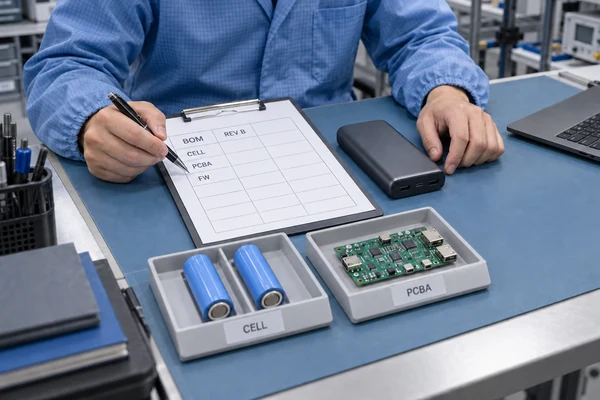
Power Bank BOM and Change Control: How OEM Buyers Approve Cell, PCBA and Firmware Changes
To approve a component change in an OEM power bank, compare the proposed construction with the approved bill of materials, identify the functions and documents affected, review the required validation results, and record the exact production lots authorized to use the change. Approval should name the cell, PCBA and firmware combination. A matching capacity label or enclosure is insufficient evidence that two builds are interchangeable.
Component shortages, discontinued parts and design improvements all create legitimate reasons to change a product. The difficult question is what the buyer needs to see before accepting the new version. A supplier’s description of a replacement as “equivalent” leaves that question unanswered.
This guide sets out a practical review process for OEM buyers. The checklists are suggested purchasing and engineering controls; the agreed specification and applicable certification or transport requirements determine the release conditions for each product.
What is a controlled power bank BOM?
A bill of materials, or BOM, identifies the parts and materials used to build a product. A controlled BOM adds revision history, approval status and rules for permitted alternatives. It should be possible to connect a shipped power bank to the version that authorized its construction.
The commercial model name often stays the same through several production revisions. Keep a separate configuration record that links the buyer’s SKU to the factory model, BOM revision, PCBA revision, firmware and parameter files, artwork and relevant test records.
ISO 10007:2017 provides general guidance on configuration management throughout a product’s life. It is a useful reference for organizing this work, although it does not prescribe a power-bank-specific approval checklist. ISO: configuration management guidance.
For the wider product definition, start with the power bank OEM/ODM specification guide. Use the BOM and change record to keep that definition current through production.
Which parts should require buyer approval before substitution?
Identify controlled items by the consequences of changing them. A small insulation pad can deserve closer review than an expensive display.
| Item | What to identify in the approved record | What a substitution could affect |
|---|---|---|
| Battery cells | Manufacturer, exact model, specification revision, production source where relevant, cell arrangement and approved alternatives | Charging limits, usable energy, heating, fit, cycle life and transport evidence |
| PCBA and power components | Board and assembly revisions, charging and protection ICs, MOSFETs, inductors, current-sense components | Current paths, protection behavior, efficiency and temperature |
| Firmware and configuration data | Release identifier, file hash or other verification method, parameter version and compatible hardware | Charging profiles, power sharing, cutoff behavior, display and standby drain |
| USB connectors and built-in cables | Manufacturer part number, drawing, conductor specification and termination | Resistance, heating, mechanical life and charging compatibility |
| Temperature sensing and insulation | Thermistor specification, location, attachment, insulation material and thickness | Temperature detection, electrical isolation and assembly clearance |
| Enclosure and thermal materials | Resin grade, drawing revision, thickness, adhesive and thermal-pad specification | Mechanical protection, heat transfer, fit and material evidence |
| Wireless assembly, where fitted | Coil, shielding, magnets, controller and firmware combination | Alignment, charging behavior, heating and certification scope |
| Labels and packaging | Artwork revision, model, ratings, warnings, barcode and carton specification | Product identity, user information, traceability and transport protection |
The supplier should still control the rest of the manufacturing BOM internally. The buyer-facing list defines where approval, notification or another agreed review is required.
Record permitted alternatives precisely. Approval of Cell A and Cell B does not automatically authorize mixing them within one battery assembly, or using either with every PCBA and firmware version. State the combinations that were evaluated.
Does the supplier have to disclose the full BOM?
A full manufacturing BOM may include proprietary circuitry and purchasing information. Disclosure is a commercial decision to settle before placing the order.
For a standard OEM model, a controlled-component list can be a workable arrangement if it identifies the parts that matter to the buyer and allows an agreed inspection or audit. An NDA or confidential review by an independent technical assessor may address details the supplier cannot share widely.
The arrangement still needs to answer a practical question: how will an inspector confirm that production uses the approved construction? An internal code such as “premium cell” is useful only if there is a controlled mapping to an identifiable manufacturer and model, with access available to the agreed reviewer.
Put disclosure, substitution and approval responsibilities into the OEM manufacturing agreement.
What is the difference between a PCN, an ECN and a temporary deviation?
Factories use these terms differently, so define them in the project procedure.
| Record | Typical purpose | Buyer decision |
|---|---|---|
| Product change notification, or PCN | Describes a proposed or announced product or process change | Decide whether the change affects the buyer’s product and what review is needed |
| Engineering change request, or ECR | Opens a proposal for technical review | Accept for evaluation, request more information or reject |
| Engineering change notice or order, ECN/ECO | Releases an approved change into controlled documents and production | Confirm the authorized configuration and effective lots |
| Temporary deviation | Permits a defined departure for a limited quantity, period or purpose | Approve the exact limits and expiry conditions, if acceptable |
A component manufacturer’s PCN is evidence for the review. It does not by itself approve the revised component for the finished power bank.
For example, Texas Instruments describes notification of major changes affecting form, fit, function, quality or reliability under its PCN process. OEM suppliers should pass relevant upstream notifications to the person responsible for the affected power bank design. Texas Instruments: product change notifications.
Keep notification and approval separate in the purchase procedure. Acknowledging receipt of a PCN should have a defined meaning, especially when the buyer is still waiting for samples or test results.
What information should a supplier submit with a change request?
A useful request lets the reviewer compare the old and proposed builds without reconstructing the history from chat messages. Ask for:
- Change number, date, reason and responsible engineer.
- Affected buyer SKUs, factory models, orders, markets and current revisions.
- Old and new manufacturer part numbers, drawings, datasheets and firmware identifiers.
- A comparison of changed characteristics, including disadvantages or tighter operating limits.
- Engineering assessment of affected functions, failure modes and supporting documents.
- Proposed validation plan, sample identities, test conditions and acceptance criteria.
- Results already available and items still open.
- Proposed implementation point, existing stock and work-in-progress quantities.
- Identification method for the new construction and the plan for segregation or rework.
- Cost, schedule, approval responsibilities and any requested temporary restriction.
Use a reference to the actual report rather than a checkbox saying “testing passed.” The buyer needs to know what was tested, on which hardware and software, and against which limit.
An unchanged part number also deserves attention when its manufacturer announces a process or production-source change. The scope of the review should follow the change’s possible effect on the product, rather than the number of characters that changed on the purchasing order.
How should buyers evaluate a replacement battery cell?
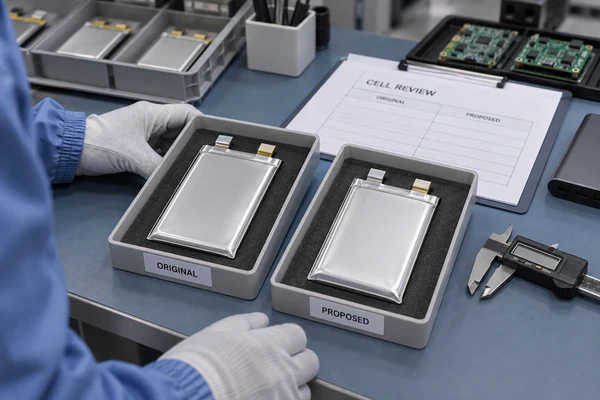
Compare the exact cell specifications and their test conditions. Two cells sold with the same mAh rating can differ in charging voltage, permitted current, resistance, dimensions and behavior near discharge cutoff.
Start with these checks:
- Nominal voltage, charge-voltage limit and nominal energy in Wh.
- Minimum and typical capacity, with the measurement conditions for each.
- Permitted charging and discharging currents and temperature ranges.
- Dimensions and tolerances, terminal or tab construction and fit in the enclosure.
- Resistance characteristics using comparable methods and conditions.
- Cycle-life evidence, storage limits and traceable source information.
- Relevant cell documents and their relationship to the finished battery configuration.
Then review the cell in the complete product. Check whether the charging circuit, protection settings, temperature sensing, interconnects and enclosure remain suitable. A cell datasheet cannot establish the temperature of a finished power bank under sustained output.
Define validation around the differences found. Usable output energy, charging behavior, temperature, sustained load and affected reliability checks may be relevant. The responsible engineer should explain why each test is included or omitted, with certification and transport questions referred to the appropriate reviewer.
Keep original and proposed sample identities separate throughout testing. Compare results under the same conditions, while checking both builds against the approved specification. An aging reference sample can make a weaker replacement look better than it is.
The battery-cell selection guide covers the underlying specification fields in more detail.
How should PCBA and charging-component changes be reviewed?
A pin-compatible IC can have different electrical limits, default settings or timing. Review the exact suffix and datasheet revision, along with the surrounding circuit.
Ask the supplier to mark the changes on the schematic and component list. If the PCB layout changes, include the affected current paths, thermal design, sensing connections and placement. A board photograph helps identify the assembly but cannot replace an electrical review.
The validation plan should connect each difference to a product requirement. For a charging or power-conversion change, this may include startup, charging termination, required input and output profiles, sustained load, multi-port operation, protection response and temperature. Review whether the change also affects EMC or existing safety evidence.
Avoid copying a universal test count into the approval form. A replacement connector and a redesigned power stage need different evidence. If the supplier proposes to omit a check, record the technical reason and the evidence supporting it.
Why does firmware belong in the approved configuration?
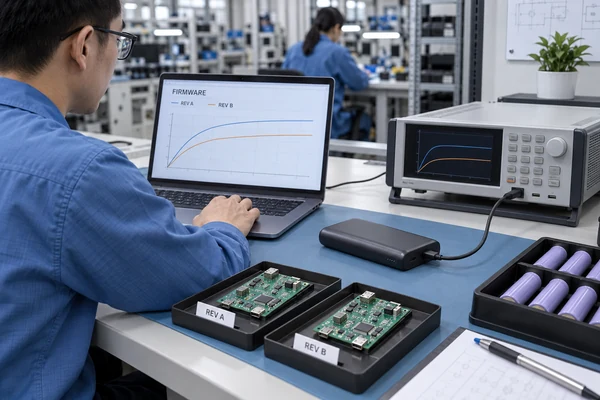
Firmware and parameter files can change product behavior without changing the enclosure or PCB. Depending on the design, they may affect charging limits, advertised USB-C profiles, power allocation, low-current mode, temperature response or the battery display.
Programmable charging hardware illustrates the issue. TI’s BQ25895 documentation describes an I2C-controlled charger with configurable charging functions and temperature monitoring. This is an example of programmable hardware, not a claim that a particular YULIDA model uses this component. Texas Instruments: BQ25895 documentation.
For a firmware release, record the binary identifier or hash, parameter revision, compatible hardware, change description and test-report references. A filename such as final.bin provides little control if its contents can be replaced without changing the name.
The factory also needs a way to verify what was programmed. This may use readback, a reported version, a programming log or another validated method suitable for the device. A file hash identifies a file; it does not prove that every unit received it or that the firmware behaves correctly.
Include regression checks for functions that should remain unchanged. If an update fixes a display issue, establish whether charging and protection behavior can also be affected by the modified code or configuration. For USB-C changes, use the power bank fast-charging test guide to define protocol and device checks.
Which tests should be repeated after a change?
Repeat the evaluations affected by the proposed construction and any additional tests required by the applicable approval scheme. The table below is a planning aid, not a mandatory test schedule.
| Proposed change | Questions for the technical review | Possible verification work |
|---|---|---|
| Different cell model | Are electrical limits, fit and battery construction still suitable? | Charging, usable energy, temperature, sustained load, reliability and transport-type review |
| Different charger or protection IC | Do thresholds, timing, default states and fault responses still meet the specification? | Circuit review, affected electrical and protection tests, temperature and document review |
| PCB layout or power-stage change | Have current paths, sensing, heat transfer or emissions changed? | Load and thermal tests, relevant safety checks and EMC assessment |
| Firmware or parameter update | Which behaviors and hardware combinations are affected? | Version verification, targeted tests and regression testing |
| Connector or built-in cable change | Are electrical and mechanical characteristics equivalent in use? | Resistance, temperature, fit, retention, durability and protocol checks as relevant |
| Enclosure, insulation or adhesive change | Does the change affect isolation, retention, thermal behavior or material evidence? | Construction review and affected mechanical, thermal or safety checks |
| Label or packaging revision | Are product identity, ratings, instructions and protection still correct? | Artwork review, barcode checks and packaging validation where affected |
Specify the sample quantity and selection rationale before testing. Include the exact build, equipment, conditions, limits and treatment of failures. Preserve the original result if a retest is authorized.
Use qualified personnel and suitable laboratory methods for hazardous or destructive battery evaluations. This review guide does not provide an abuse-test procedure.
Does a component change require new certification or UN 38.3 testing?
The answer depends on the change and the scope of the existing evidence. Give the responsible laboratory or certification body the old and proposed construction, affected part specifications and engineering assessment. Ask whether the change is already covered, needs a document revision, or requires further evaluation.
For UL Certified products, UL’s Follow-Up Services checks materials and construction against the certification procedure. UL also provides a process for submitting revisions. A buyer’s commercial acceptance does not update that procedure. UL Solutions: Follow-Up Services, UL Solutions: submitting product revisions.
For lithium-battery transport, review whether the changed cell or battery still belongs to the tested type. The UN Manual of Tests and Criteria, Revision 8, Amendment 1 (2025), changes the wording in 38.3.2.2(c) from “would” to “might” lead to test failure and adds certain repair, refurbishment and remanufacturing changes to its examples. Check the edition incorporated into the rules applicable to the shipment. UNECE: Revision 8, Amendment 1, Section 38.
Request a written assessment linking the changed configuration to its supporting reports and test summary. Record the basis for the decision, including when the reviewer determines that repeat testing is unnecessary.
How should approval move from samples to shipment?
Use distinct approval states so the factory knows what it may do at each stage.
- Register the proposal and identify the currently approved configuration.
- Review the differences and agree on the validation plan.
- Authorize identified samples or a limited pilot build for evaluation.
- Review results, open issues and the effect on supporting documents.
- Approve or reject the production change, naming the configuration and any conditions.
- Release revised documents and identify the first affected production lot.
- Verify that the lot uses the released configuration and meets shipment requirements.
The approval record should name the authorized decision-makers. Engineering reviews technical suitability; quality checks validation and traceability; the responsible compliance reviewer handles document scope; purchasing agrees the commercial effect. One person may cover several roles in a small business, but each decision still needs an owner.
Approval to build evaluation samples should state the quantity and purpose. Any shipment of samples also needs its own applicable transport arrangements. Approval of the engineering change should likewise be distinguished from release of a particular commercial shipment.
How should old and new components be handled during the changeover?
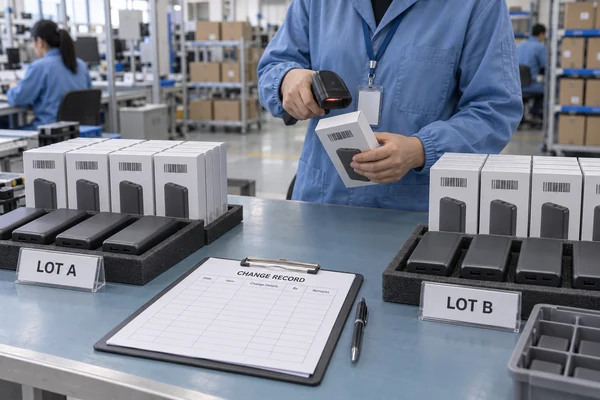
Record the last lot using the old configuration and the first lot using the new one. A calendar date alone can be ambiguous when two shifts, parallel lines or rework stations use different materials.
Before changeover, reconcile incoming stock, issued materials, work in progress, completed goods and service stock. Assign a documented disposition to each affected group. Old parts may remain approved for an earlier configuration even when they are unsuitable for the new one.
Update the manufacturing BOM, work instructions, firmware programming setup, test recipe and inspection checklist together. Check line clearance and the first build under the new revision. Archive obsolete files and remove them from active production use.
For traceability, connect finished serial numbers or a sufficiently controlled lot range to component lots, PCBA revision and firmware. If different approved versions share a commercial SKU, preserve a means of distinguishing them later through internal records or appropriate product identification.
A sample inspection cannot reconstruct missing configuration records. The power bank quality control plan explains how incoming, in-process and outgoing checks support shipment release.
What if a shortage makes the change urgent?
Ask for the remaining quantity of approved material and the order coverage it provides. That establishes how much review time is actually available.
Where an alternative was already qualified, confirm that its approval covers the exact hardware, firmware, market and intended use. Where validation is incomplete, consider a limited evaluation build, a revised delivery schedule or another agreed supply option.
A temporary deviation needs a specific purpose, quantity or lot range, expiry condition and responsible approver. State which requirements differ and what evidence supports acceptance. It cannot waive mandatory safety, transport or market requirements.
Keep the expiry visible in purchasing and production records. Otherwise a one-order exception can become the standard build simply because the next planner copies the previous work order.
Example: a same-capacity cell replacement
Consider a hypothetical OEM order whose approved cell becomes unavailable. The supplier offers another cell with the same stated mAh capacity and a similar outline.
The buyer requests a side-by-side datasheet comparison. The new cell has a lower permitted continuous discharge current. That difference raises a question about the power bank’s required output, particularly as battery voltage falls. The engineer must assess the actual circuit and operating conditions before approving the replacement.
The supplier then proposes a firmware change that reduces output under some conditions. This creates an additional decision: does the revised behavior still meet the buyer’s specification and product claims? Passing a test against a newly reduced limit would not answer that question.
The buyer can reject the proposal or evaluate a clearly defined revised configuration. Any approved outcome should link the cell, PCBA, firmware, agreed performance and relevant document review. The example illustrates a review path; it is not a report of a YULIDA production event or a universal test result.
Copy-and-paste supplier change request template
Use this as the starting point for a project form. Attach the comparison and reports referenced in it.
POWER BANK COMPONENT / FIRMWARE CHANGE REQUEST

Change ID and issue date:
Supplier and responsible engineer:
Buyer SKU / factory model / affected order:
Target market(s):
Reason for change:

CURRENT APPROVED CONFIGURATION
BOM revision:
Cell manufacturer and model:
PCBA revision:
Firmware and parameter identifiers:
Relevant drawing / artwork / report references:

PROPOSED CONFIGURATION
Old and new part numbers or revisions:
Changed characteristics and attached comparison:
Hardware / firmware compatibility restrictions:
Effect on product claims and agreed specification:

VALIDATION AND DOCUMENT REVIEW
Sample identities and build configuration:
Tests, quantities, conditions and acceptance limits:
Report references, results and unresolved issues:
Certification / transport review decision and reference:

IMPLEMENTATION
Requested scope: evaluation / pilot / production / deviation
Quantity, lot range and any expiry condition:
Last old lot / first new lot:
Existing material and work-in-progress disposition:
Updated documents, programming and inspection methods:
Cost and delivery impact:

DECISION
Approved / rejected / more evidence required:
Approval conditions and authorized scope:
Approver names, roles and dates:
First-lot verification and separate shipment-release record:
Frequently asked questions
1. Can a factory change a power bank cell after sample approval?
A factory should follow the substitution rules agreed for the project. If the cell is controlled, the buyer should review the proposed model, technical differences, validation and supporting documents before authorizing it for the specified production configuration.
2. Is the same mAh rating enough to approve a replacement cell?
No. Compare voltage, current limits, capacity test conditions, fit, temperature behavior and relevant documents. Verify the proposed cell in the complete power bank against the approved requirements.
3. Is a pin-compatible charging IC a drop-in replacement?
Pin compatibility alone does not establish equivalence. Electrical limits, default settings, timing and interaction with the surrounding circuit may differ. Review the design and repeat the affected verification.
4. Does a firmware-only change need approval?
It needs the review specified in the project’s change procedure. Identify whether charging, protection, compatibility or other agreed behavior is affected, and record the released firmware and parameter versions with compatible hardware.
5. Does a PCN mean the buyer has approved the change?
No. A PCN communicates a change. The project’s procedure should separately record receipt, technical review and approval for the affected product, orders and lots.
6. Must every change trigger full product retesting?
No. The test scope should follow the technical differences, affected requirements and applicable certification or transport rules. Keep a documented rationale for both repeated and omitted tests.
7. Can a cell’s UN 38.3 report automatically cover the changed power bank?
No. Review the finished battery configuration and whether its tested-type evidence remains applicable. The cell document alone does not establish coverage of every assembly that uses that cell.
8. Can old and new versions use the same commercial SKU?
Sometimes, if the specification, applicable identification requirements and sales arrangements allow it. Production and service records still need to distinguish the actual configurations and their affected lots.
9. Can an approved alternative be used with any firmware version?
Only if that combination is within the approval’s scope. Keep hardware and firmware compatibility restrictions in the released configuration record and production instructions.
10. What should a buyer do after finding an unauthorized substitution?
Hold the affected stock, identify its configuration and lot range, preserve the evidence, and request an engineering and document review. Agree on the disposition and corrective action before releasing the goods.
Prepare the configuration record before the next OEM order
Attach the approved configuration, controlled-component list and change procedure to the purchase specification. Agree on who receives supplier notifications, who reviews evidence, and who authorizes the first affected lot. This gives the supplier a usable process when availability or design requirements change.
For a YULIDA OEM project, provide the target model, capacity, output profiles, markets, order quantity and component restrictions. Ask the team to confirm the proposed configuration, available supporting documents and substitution procedure for the order. Contact YULIDA about a power bank OEM project.
Official sources and verification
These primary sources support standards, compatibility, safety, or transport statements discussed in this article. Confirm the current requirement for the exact product model and destination market.
- UL Solutions — Battery safety standards and technical safety information.
- UL Solutions — Battery safety standards and technical safety information.
