





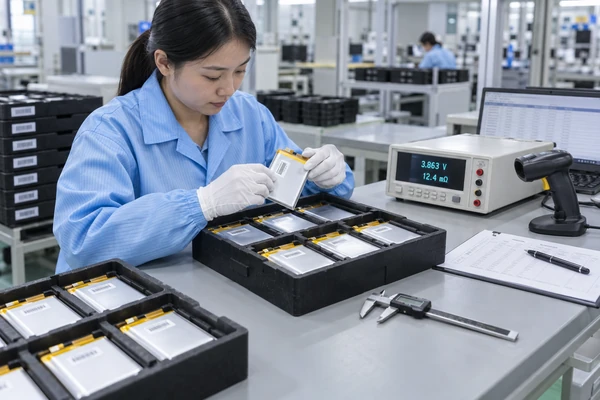
Power Bank Quality Control Plan: IQC, IPQC, OQC and AQL
A power bank quality control plan defines incoming checks (IQC), assembly controls (IPQC), finished-unit tests and outgoing lot inspection (OQC). For each check, agree on the method, frequency, acceptance limit and record. Use AQL sampling for suitable lot-inspection items, alongside the product’s required safety and functional controls.
These controls do different jobs. AQL sampling cannot replace 100% polarity checks, firmware control or safety qualification. A final inspection also cannot recover the evidence lost when cell lots are mixed or weld settings are not recorded. For an OEM buyer, the practical goal is a traceable chain from approved specification to shipped carton.
Buyer checklist: agree these acceptance rules before production
Use this checklist with the approved product specification. Enter project-specific limits and responsibilities; the table does not prescribe one AQL or test limit for every power bank.
| Decision | What to define | Evidence to retain |
|---|---|---|
| Approved construction | SKU, cell, PCBA, firmware, cable and artwork revisions | Signed specification and approved sample record |
| Inspection coverage | Checks on every unit, sampled checks and qualification tests | Control plan with method, frequency and responsible person |
| Performance limits | Capacity, charging profiles, sustained output and temperature conditions | Measured results linked to sample and equipment IDs |
| Lot acceptance | Lot definition, defect classes, standard/edition, sampling plan and acceptance/rejection numbers | Random-sample selection and complete OQC report |
| Failure response | Quarantine, sorting or rework, reinspection and release authority | Original failure, corrective action and retest records |
| Traceability and changes | Component-lot links and written approval for affected changes | Batch records and approved change notices |
Review YULIDA’s factory quality-control process or request the inspection scope and available records for your model.
What does a power bank quality control plan cover?
A usable control plan states what is checked, when it is checked, how it is measured, who makes the decision and what happens after a failure. It applies to the exact SKU and production revision, not just to a family name printed on a sales quotation.
The plan normally covers:
- Approved suppliers, materials and component specifications.
- Incoming inspection and lot traceability.
- First-article approval at line start and after a changeover.
- Controlled assembly parameters and in-process checks.
- 100% end-of-line functions that every unit must pass.
- Sampled performance, workmanship and reliability checks.
- Final random inspection and shipment-release authority.
- Nonconforming-product control, rework and reinspection.
- Engineering change control and record retention.
Each line should have a measurable requirement. “Appearance good” is weak. “No gap above the approved limit sample; logo position within the drawing tolerance; no exposed sharp edge” gives the inspector something to apply.
What is the difference between IQC, IPQC and OQC?
IQC, IPQC and OQC describe inspection at different production stages. They should share the same product specification, defect definitions and sample identity.
| Stage | Main question | Typical power bank controls | Decision |
|---|---|---|---|
| IQC: incoming quality control | Are these materials the approved materials, and are they fit to release to production? | Cell identity and lot, open-circuit voltage, dimensions, PCBA revision, connector and cable checks, plastics, labels and packaging | Release, quarantine or reject the incoming lot |
| IPQC: in-process quality control | Is the line building the product by the approved process? | First article, cell matching, weld parameters, soldering, insulation placement, firmware, torque, adhesive and assembly checks | Continue, stop, correct or contain work in progress |
| End-of-line testing | Does every completed unit perform the required basic functions? | Charging, output, USB protocol profiles, indicators, buttons, standby current and basic protection response | Pass or segregate each unit |
| OQC: outgoing quality control | Does the completed lot meet the release specification? | Random visual and functional inspection, packaging, labels, measurements and selected performance tests | Release or reject the shipment lot |
Some factories use FQC, final quality control, for the finished-unit check before OQC. The name matters less than the boundary. The buyer should be able to see which checks apply to every unit, which use a sample and which are destructive qualification or reliability tests.
What must be frozen before production starts?
Quality control begins with an approved construction. If the product definition is loose, inspectors can only compare one uncertain sample with another.
Freeze these items before mass production:
- Finished-product model, customer SKU and sales region.
- Rated energy in Wh, marketed capacity in mAh and the voltage basis for each claim.
- Cell manufacturer, factory, model, chemistry, grade and permitted production-date window.
- PCBA revision, schematic revision and controlled bill of materials.
- Protection, charging, conversion and USB protocol ICs.
- Firmware version, parameter version and a practical identification method such as a checksum or readout.
- NTC specification, position and attachment method.
- Cell interconnection, insulation, padding, adhesive and thermal materials.
- Enclosure resin, color, finish, dimensions and approved limit samples.
- Connectors and built-in cables, including conductor, length and strain-relief requirements.
- Label artwork, regulatory markings, instructions, accessories and packaging.
Tie the approved sample to those records. A signed golden sample is useful for color, feel and assembly, but it cannot reveal a substituted cell or a firmware change. The specification and revision-controlled records do that work.
YULIDA’s power bank product specification guide explains which commercial and technical fields should be agreed before sample approval.
What should IQC check on incoming materials?
IQC should verify identity first, then inspect the characteristics that could affect safety, function, assembly or appearance. The incoming lot needs a supplier lot number, quantity, receipt date and inspection status. Materials should remain quarantined until they are released.
The exact checks depend on the part:
| Incoming material | Identity checks | Typical inspection or test |
|---|---|---|
| Lithium-ion cells | Manufacturer, factory, model, lot, date code and approved specification | Appearance, dimensions, mass, open-circuit voltage, AC or DC internal resistance by the agreed method, and sampled capacity where specified |
| PCBAs | Supplier, board revision, assembly revision, firmware state and lot | Visual workmanship, component presence and orientation, programming, electrical function and critical-component verification |
| USB ports and built-in cables | Part number, supplier, drawing and lot | Dimensions, contact condition, insertion fit, continuity, conductor resistance and sampled mechanical checks |
| Plastics and metal parts | Material code, cavity, color and lot | Dimensions, surface defects, fit, color against the approved range and material evidence where required |
| Insulation and adhesive | Material, thickness, supplier, shelf life and lot | Dimensions, placement suitability, adhesion or curing checks and storage condition |
| Labels and packaging | Artwork revision, language, SKU and destination | Text, barcode, rating, dimensions, print durability and carton configuration |
A certificate of conformity can support the check, but it should not be the only evidence for a high-risk material. Confirm that the certificate identifies the same manufacturer, part and lot that arrived at the factory.
How should incoming lithium-ion cells be controlled?
Keep cell lots separated and traceable. Record the cell maker, exact model, manufacturing location where relevant, date code and supplier lot. If a production order uses more than one cell lot, the finished-product records should show which serial-number or carton range received each lot.
IQC may include appearance, dimensions, mass, open-circuit voltage and internal resistance. Sampled capacity verification can detect a wrong grade or an abnormal lot, but the method needs a specified charge-discharge profile, temperature, rest time and reference voltage. Otherwise, two laboratories can report different values for the same cell.
Set storage rules as well. Cells need an approved state-of-charge range, temperature and humidity limits, maximum storage time and first-in-first-out control. Damaged, swollen, corroded or deeply discharged cells should enter a segregated review process, not return to the usable rack after a quick voltage check.
Cell qualification documents and transport evidence do not prove that every received lot is identical. Match them to the approved model, then use receiving records and production traceability to control the lots. See the power bank battery-cell selection guide for the design-stage checks that come before IQC.
What should IQC verify on PCBAs and electronic components?
Start with the revision and the critical-part list. A PCBA can look correct while carrying a different protection IC, lower-rated MOSFET, inductor, capacitor, connector or programmed parameter.
Incoming PCBA checks can include:
- Board and assembly revision.
- Required marking or lot code.
- Critical component manufacturer and part number.
- Component polarity, orientation and obvious damage.
- Solder joints, contamination and mechanical workmanship.
- Firmware or parameter version.
- Input, output, standby and protection functions on an agreed fixture.
If the contract invokes IPC acceptance criteria, state the document and revision in the quality agreement. IPC announced IPC-A-610J in 2024 as a post-assembly acceptance standard and IPC J-STD-001J as the related standard for soldering processes and materials. The two are often used together, but neither automatically becomes a contractual requirement simply because the factory knows the documents. IPC: release of IPC-A-610J and J-STD-001J.
Define the product class and any customer-specific criteria before inspection. Also decide how hidden joints are evaluated. Visual inspection cannot see every solder interface or verify a programmed cutoff threshold.
What should IPQC control on the assembly line?
IPQC should catch process drift while the affected quantity is still small. The inspector needs a reaction plan, not just a form to sign at the end of the shift.
Useful IPQC controls include:
- Line clearance before a new SKU or revision starts.
- Material verification against the work order and bill of materials.
- First-article build and approval.
- Cell matching and polarity checks.
- Weld schedule, electrode condition and periodic weld verification.
- Soldering temperature or process settings where applicable.
- Insulation, padding, NTC and adhesive placement.
- PCBA and firmware verification.
- Screw torque, ultrasonic welding or enclosure-closing parameters where used.
- In-process charging, output and current-consumption checks.
- ESD controls and handling of exposed electronics.
- Segregation and identification of reworked units.
Frequency should reflect risk and process stability. A line may check the first unit, then repeat a check every hour, every defined quantity or after a stoppage. A high-risk automated parameter may be recorded for every cycle. Write the rule into the control plan instead of letting each shift improvise it.
How should cell welding and insulation be controlled?
Cell interconnection deserves its own control line because a weak joint can create resistance and heat, while excessive energy can damage the cell terminal or tab.
The work instruction should define the material stack, weld equipment, approved parameter window, electrode maintenance and test method. Depending on the design, verification may use peel testing, pull testing, resistance measurement, visual criteria or a combination. Record the result against the machine, time and production lot.
Do not let a destructive weld check become a ritual performed on an unrelated strip at the start of the week. The test piece, material and setup need to represent the production joint closely enough to provide useful evidence.
Insulation checks should confirm material, position and coverage. Inspect cell edges, tabs, busbars, wire routing, sharp features and the distance between conductive parts. Make sure the NTC touches the intended location and cannot move during enclosure assembly.

When is a first-article inspection required?
Run a first-article inspection at the start of a production lot and after conditions that could change the result. Examples include a model change, material-lot change, fixture adjustment, firmware update, long line stoppage, maintenance or a change of operator on a controlled manual process.
The first article should cover more than appearance. Check identity, construction, basic electrical performance, firmware, labels and packaging. For a high-power USB-C model, confirm the advertised charging and output profiles with a protocol analyzer and an electronic load.
Keep the approved first unit or its complete record available to the line. If the first article fails, stop and contain the units built since the last accepted check. Signing the form after production is finished removes most of its value.
Which tests should every finished power bank pass?
Every unit should pass a practical end-of-line test for faults that are common, detectable and important. The fixture should identify the test recipe by SKU and prevent the operator from using an easier programme.
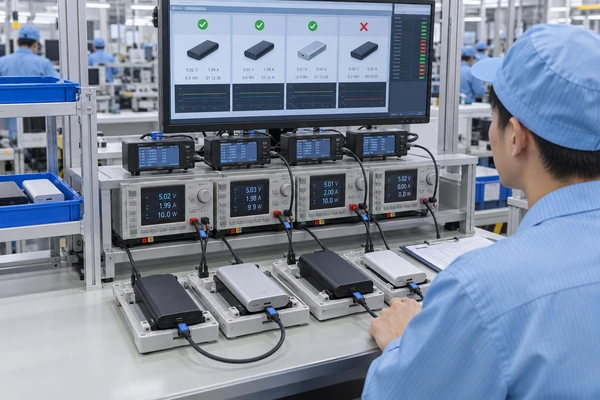
A 100% end-of-line sequence may cover:
- Input charging on the required port or ports.
- Output voltage and current at defined load points.
- Required USB-A and USB-C fixed profiles.
- USB Power Delivery or PPS negotiation where claimed.
- Multi-port behaviour for the combinations selected by the specification.
- Button, display, indicator and low-current mode.
- Standby current or abnormal drain.
- Basic overcurrent or short-circuit protection check using a safe, validated fixture.
- Built-in cable and connector function.
Store measured values when the equipment permits it. A green light alone cannot show whether the result was close to the limit or whether a station repeatedly failed and passed the same unit.
End-of-line testing must remain within the controlled production method. Destructive abuse tests belong in a qualified safety programme, not on an open assembly line. UL describes UL 2056 power-bank testing as covering overcharge and overdischarge protection, short circuit, overload, drop, impact and thermal safety. Those evaluations address a different purpose from routine factory function checks. UL Solutions: UL 2056 power-bank testing.
What should OQC inspect before shipment?
OQC should inspect a randomly selected sample from a clearly defined finished lot. The sample needs to represent all cartons, line periods, colors and other variants in the lot. Selecting the cleanest top cartons near the inspection table is not random sampling.
The outgoing checklist may include:
- SKU, color, quantity and carton range.
- Product construction and approved sample comparison.
- Workmanship, fit, finish, ports, buttons and accessories.
- Label ratings, warnings, barcode and serial or lot code.
- Packaging, assortment, carton marks and shipping protection.
- Product dimensions, mass and selected electrical measurements.
- Charging, output, protocol, indicator and cable function.
- Sampled capacity, sustained output, temperature or ageing tests when required.
- Record review for IQC, IPQC, end-of-line results and open nonconformities.
Different tests may need different sample sizes. A non-destructive visual inspection can use a lot-acceptance plan, while a long capacity test may use a smaller engineering sample defined in the purchase specification. Safety-critical requirements may require separate qualification, periodic verification or zero-acceptance rules.
What is AQL in power bank inspection?
AQL is an index used to select an acceptance-sampling scheme for a continuing series of lots. It helps determine the sample size and the acceptance or rejection number for a defined inspection. It is not permission to ship that percentage of known defective units.
NIST explains the central point plainly: acceptance sampling is used to decide whether a lot is likely to be acceptable, not to estimate the quality of the lot. NIST: What is acceptance sampling?.
The current international reference is ISO 2859-1:2026, published in January 2026. ISO states that the third edition defines AQL-indexed single, double and multiple sampling schemes, includes switching and skip-lot procedures, and replaces the 1999 edition and its amendments. ISO: ISO 2859-1:2026.
If a contract still names ISO 2859-1:1999, the parties should review the transition rather than silently applying a different table. State the standard, edition, inspection level, sampling type, AQL, switching status and lot definition on the inspection instruction.
Does an AQL of 1.0 mean 1% defective products are acceptable?
No. An AQL value indexes a sampling scheme and its operating characteristics across a continuing series of lots. It does not say that the inspector may find and ignore a known 1% defective portion of the shipment.
A sampling plan creates producer and consumer risks. A good lot can be rejected, and a poor lot can be accepted, because the decision is based on a sample. NIST describes these risks through the operating characteristic curve and distinguishes AQL from the lot tolerance percent defective. NIST: types of lot acceptance sampling plans.
This is why the buyer should not write “AQL 2.5” as a complete inspection requirement. The instruction also needs the defect class, inspection level, sampling scheme, switching rules and acceptance and rejection numbers from the selected standard.
How should defects be classified?
Classify likely defects before the inspector opens the first carton. The definitions should describe the consequence, and the inspection checklist should provide product-specific examples.
| Defect class | Practical meaning | Possible power bank examples |
|---|---|---|
| Critical | Could create an unacceptable safety or regulatory risk, or violates a requirement that the contract treats as critical | Wrong or unapproved cell, reversed polarity, exposed conductive part, missing essential insulation, unsafe protection failure, materially false mandatory rating or prohibited transport condition |
| Major | Prevents intended use, materially reduces performance or is likely to cause a return | Unit will not charge, required PD profile missing, capacity below the agreed limit, built-in cable intermittent, severe case gap, wrong accessory or unreadable traceability code |
| Minor | Does not materially affect safe function but falls outside the approved workmanship or appearance limit | Small surface mark outside the permitted location, slight print defect with all text legible, minor color variation beyond the approved range |
These examples are starting points, not universal classifications. A marking issue may be critical in one market and major in another. A cosmetic defect may be major for a premium retail programme with tight appearance requirements. Agree on the list and photographs before production.
For critical defects, many buyers specify zero acceptance or a separate c=0 rule, followed by containment and investigation if one is found. Do not force a safety defect into a routine major-defect AQL simply because the table is convenient.
How should an AQL sampling plan be selected?
Use the current licensed standard and follow its tables and switching rules. The normal sequence is:
- Define a homogeneous lot: exact SKU, revision, production period and quantity.
- Choose the inspection standard and edition.
- Select the inspection level or special level for the characteristic.
- Assign the agreed AQL or another lot-disposition rule to each defect class.
- Use the lot size and level to obtain the sample-size code letter.
- Use the chosen single, double or multiple plan to obtain the sample size and acceptance and rejection numbers.
- Select the units randomly across the lot.
- Record every defect and make the lot decision without changing the plan after seeing the results.
- Apply the standard’s normal, tightened, reduced, skip-lot or discontinuation rules across successive lots where the agreement uses them.
Do not copy an old sample-size chart from an inspection blog and label it ISO 2859-1:2026. The 2026 edition replaced the previous version. The quality agreement should identify the table actually used.
ANSI/ASQ Z1.4 is another attributes-sampling standard used in some supply chains. ASQ describes Z1.4 as providing normal, tightened and reduced plans for a specified AQL. If a buyer uses it, name it explicitly instead of treating all AQL tables as interchangeable. ASQ: Z1.4 and Z1.9 sampling standards.

What AQL should an OEM buyer use for power banks?
There is no universal AQL for every power bank or every defect class. Choose the plan from product risk, market requirements, brand tolerance, process history and the consequence of a missed defect.
A buyer may set stricter rules for safety, core electrical function and mandatory labels than for small cosmetic marks. The actual numbers belong in the quality agreement. Commonly quoted commercial values such as 1.0, 1.5, 2.5 or 4.0 are not automatic recommendations and should not be copied without examining the plan’s operating characteristic and risk.
Some characteristics are better controlled another way:
- Use 100% automated testing for polarity, basic charging, output and programmed identity when the test is reliable and non-destructive.
- Use process monitoring for weld energy, torque, firmware programming and other build parameters.
- Use qualification and periodic reliability testing for abuse, cycle life and other long or destructive evaluations.
- Use a separate zero-acceptance or containment rule for agreed critical defects.
AQL is a lot decision tool. It is not the whole quality system.
Can final sampling replace process control?
No. A final sample can reveal a problem, but it rarely tells the factory when the problem began or which units were affected.
Suppose an OQC sample finds one power bank with intermittent USB-C output. The final inspection can reject the lot. It cannot determine whether the cause was a worn solder fixture during the last hour, an incoming connector lot, contamination on one line, an incorrect firmware batch or repeated rework. That answer comes from material traceability and process records.
Use trend data before the final inspection. Monitor first-pass yield, station failure codes, rework rate, weld results, standby-current distribution and capacity-test results. A lot can pass an AQL sample while the process is moving in the wrong direction.
How should sampled performance tests be handled?
Capacity, sustained power, temperature and cycle-life tests need controlled conditions and a different schedule from quick visual inspection.
For each sampled test, specify:
- Selection frequency and sample source.
- Sample identity and prior conditioning.
- Charger, cable, load and protocol profile.
- Ambient conditions and rest time.
- Measurement equipment and calibration status.
- Charge-discharge cutoff rules.
- Reference voltage used for mAh claims.
- Pass limits and treatment of measurement uncertainty.
- Retest and failure-escalation rules.
Do not swap in a fresh sample after a failure unless the written method permits it and the first result remains in the record. A retest can investigate repeatability; it should not erase evidence.
For detailed methods, see YULIDA’s guides to power bank capacity testing, cycle-life testing and fast-charging testing.
What happens when an OQC lot fails?
Quarantine the lot and open a nonconformance record. The record should identify the SKU, production lot, carton range, failed sample, defect, quantity inspected and the applicable acceptance rule.
Then decide the disposition:
- Reject and rebuild the lot.
- Perform a validated 100% sort for a detectable defect.
- Rework under an approved instruction, then repeat the required tests.
- Use-as-is only with written authorization from the party that owns the requirement and only when safety and regulatory obligations permit it.
- Scrap or otherwise control units that cannot be made compliant.
Find the affected boundary before release. Trace station data, component lots, line time, operator, machine and rework history. If the defect can escape the proposed sorting method, a 100% sort may still be inadequate.
Do not repeatedly draw new samples from the same failed lot until one passes. Reinspection should follow the agreed standard and quality procedure after containment or corrective action. Keep the original failure in the final report.
How should rework be controlled?
Rework changes the product and can introduce new damage. Use a controlled instruction that states who may perform it, which tools and materials are allowed, how many rework cycles are permitted and which inspections must be repeated.
For a power bank, opening the enclosure may affect clips, adhesive, insulation, cells, cables and cosmetic surfaces. Solder rework can expose cells to heat or leave contamination. Firmware reprogramming can change charging, power sharing and protection behaviour.
Mark reworked units in the production record even if the customer does not want a visible external mark. After rework, repeat every check affected by the operation. A replaced PCBA, for example, normally requires firmware verification and full electrical function testing.
How should engineering changes be handled?
No safety-related or performance-related substitution should enter production through a handwritten note at the line. The supplier should issue a change request that identifies the old and new parts, reason, affected models, risk analysis, validation evidence and proposed effective lot.
Review changes to:
- Cells and their manufacturing source.
- Protection, charging and conversion components.
- Firmware and parameter files.
- NTC, insulation and thermal materials.
- Connectors, cables and high-current conductors.
- Enclosure resin, thickness, tooling or closing method.
- Labels, ratings and market-specific instructions.
Decide whether the change needs a new sample, partial verification, reliability testing, compliance review or full requalification. The first production lot after approval should receive the inspection level and monitoring defined by the change plan.
Which quality records should an OEM buyer request?
The buyer does not need every factory form, but the evidence should be enough to trace the shipped units and review important decisions.
Request or retain:
- Approved specification, drawings, bill of materials and revision history.
- Golden-sample approval and signed limit samples.
- Incoming inspection records for cells and other critical materials.
- Cell lot to finished-lot traceability.
- First-article and line-clearance records.
- Controlled process parameters and periodic verification results.
- End-of-line test data and failure-code summary.
- OQC report with random sample IDs, defects and lot decision.
- Capacity, sustained-load, temperature and reliability reports required by the contract.
- Nonconformance, rework and corrective-action records.
- Approved change notices.
- Calibration and fixture-maintenance status for relevant equipment.
- Shipment quantity, carton range and release authorization.
Electronic records should preserve original results, retests and changes. A spreadsheet that contains only manually entered “PASS” values is difficult to audit. Raw station exports and time-stamped measurements are stronger evidence when the equipment supports them.
What should an OEM buyer audit at the factory?
Walk one SKU from receiving to a sealed carton. Choose an actual cell lot, find its incoming record, locate it in work in progress and trace it into finished goods. Then pick a finished serial number and trace backward.
During the audit, check:
- Whether quarantined and released materials are physically separated.
- Whether the line recipe and fixture match the SKU.
- Whether operators can identify the current work instruction.
- Whether first-article approval occurs before volume production.
- Whether failed units are locked out from accidental packing.
- Whether test limits are controlled and changes are logged.
- Whether random OQC samples come from the whole lot.
- Whether rejected lots retain their original failure records.
- Whether component substitutions require written approval.
- Whether recent warranty claims can be tied to exact SKUs and production lots.
Ask the inspector to demonstrate one failure path. A quality system is easier to judge when something goes wrong than when every example has been prepared to pass.
Common mistakes in power bank quality control
Using one checklist for every model
A 10 W promotional power bank, a 65 W USB-C laptop model and a built-in-cable product have different current paths, interfaces and failure modes. Keep a controlled plan for each construction.
Treating a supplier certificate as incoming inspection
Documents help confirm identity and qualification. They do not verify that the delivered lot is correctly labeled, undamaged and within the agreed receiving limits.
Inspecting only appearance at OQC
A clean enclosure can hide low capacity, high standby drain, the wrong PD profile or an unapproved cell. Include measurable electrical checks.
Applying AQL to every safety issue
Some hazards need qualification, process prevention, 100% checks or zero-acceptance rules. A general major-defect AQL is not a shortcut for safety control.
Mixing lots before traceability is recorded
Once cell or PCBA lots are mixed without a record, containment expands. A problem that began with one incoming lot can force a hold on the entire production order.
Allowing unlimited retests
Repeated testing until a unit passes hides intermittent defects. Define retest conditions, record every attempt and investigate repeated failures.
Resampling a failed lot without corrective action
A fresh sample does not change the original evidence. Contain the lot, determine disposition and follow the agreed reinspection procedure.
Frequently asked questions
1. What do IQC, IPQC and OQC stand for?
IQC is incoming quality control, IPQC is in-process quality control and OQC is outgoing quality control. IQC controls received materials, IPQC controls the production process and OQC makes the final shipment-lot decision.
2. Is FQC the same as OQC?
Not always. Some factories use FQC for checks on completed units and OQC for the independent release inspection after packing. Define the responsibility and inspection boundary in the quality plan.
3. Does AQL 2.5 allow 2.5% defective power banks in a shipment?
No. AQL is an index used with a sampling scheme. The sample result decides whether to accept or reject the lot; it does not authorize shipping a known percentage of defective units.
4. What is the best AQL for power banks?
There is no universal best value. Set defect-specific rules based on safety, function, appearance, market obligations, process history and the risks shown by the selected sampling plan.
5. How many power banks should OQC inspect?
The number depends on the lot size, inspection level, sampling standard, AQL and type of plan. Use the current agreed standard to obtain the code letter, sample size and acceptance and rejection numbers.
6. Should critical defects use AQL?
Many buyers use zero acceptance or a separate c=0 rule for agreed critical defects. Safety qualification, process controls and 100% checks may also be required because final sampling alone cannot prevent every hazard.
7. Can OQC replace 100% functional testing?
No. Common, important and quickly detectable functions are usually better tested on every unit. OQC samples the finished lot and checks whether the release requirements are met.
8. Must every battery cell be capacity tested at IQC?
Not necessarily. The control plan may use 100% identity, voltage or resistance screening and sampled capacity tests under a defined method. The decision depends on supplier controls, risk, test time and process history.
9. What should happen after an AQL inspection fails?
Quarantine the lot, record the failure, determine the affected range and choose an approved disposition such as rejection, validated sorting or rework. Reinspection should follow the agreed procedure after containment or corrective action.
10. Does a passing OQC report prove that the product is certified?
No. OQC is a production-lot release activity. Safety, transport, EMC, environmental and market-access evidence must be reviewed under their applicable requirements and for the exact product construction.
Send the quality plan with the OEM purchase specification
Before placing the order, agree on the product revision, critical materials, control points, 100% tests, sampled tests, defect classes, AQL scheme, change-notice rules and records supplied with each shipment. Attach the inspection checklist to the purchase specification so that the buyer, factory and third-party inspector use the same limits.
For a new project, start with sample approval and verify that the approved build can be reproduced on the intended line. Then review the first mass-production lot more closely before using reduced inspection or a less intensive oversight schedule.
Send YULIDA the model or product specification, target market, charging requirements, order quantity and proposed acceptance criteria. Ask the team to confirm the inspection scope, available records and any additional validation needed for the quoted build. Request a model-specific quality plan for your OEM order.
Official sources and verification
These primary sources support standards, compatibility, safety, or transport statements discussed in this article. Confirm the current requirement for the exact product model and destination market.
- UL Solutions — Battery safety standards and technical safety information.
