





MFi certified power bank list: how OEM buyers verify each model
To check an MFi certified power bank list, start with Apple’s MFi Licensed Accessories Search. Match the proposed accessory to its identifying details. A brand name in a buying guide is too broad for approving an OEM order.
First establish what the power bank actually does. A built-in Lightning connector, an Apple Watch charging feature and an ordinary USB-C output call for different questions. This guide helps buyers build a model-level verification record. It does not present an unverified roundup of certified products.
Which power bank features should you check?
La norme MFi FAQ excludes ordinary Recharge USB-C accessories that use no MFi licensed technology or components. Its listed licensed components include Lightning connectors and Apple Watch charging hardware. The following comparison turns that distinction into purchasing questions.
| Proposed product | Relevant check | Question for the supplier |
|---|---|---|
| Recharge USB-C only, with no licensed Apple feature | Outside MFi’s ordinary charging scope | Which USB-C functions and device combinations have been tested? |
| Power bank with a built-in Lightning connector or cable | Check the licensed accessory configuration | Which finished model does your MFi evidence identify? |
| Power bank with an Apple Watch charging feature | Check the Apple charging feature | Which function and model are covered by the claim? |
| Power bank advertised as Qi2 certified | Check WPC registration separately | What is the product’s WPC ID and registered identity? |
| Power bank packaged with a separate Lightning cable | Distinguish the two accessories | Does the supplied record describe the cable, the bank, or both? |
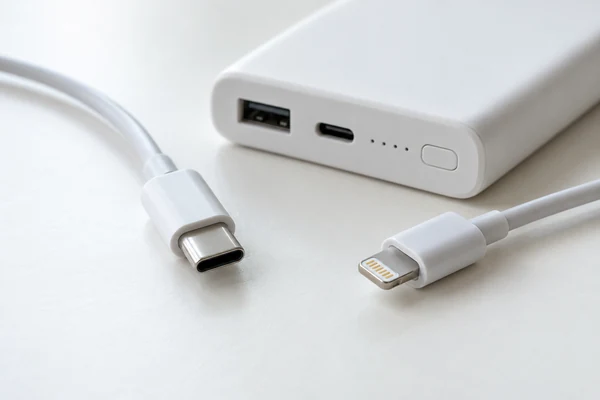
For Qi2, use the WPC certified-product database. Keep its result in a separate field from the Apple record. A product advertised with several charging methods needs a claim-by-claim review.
How to check a model in Apple’s accessory search
Collect the identity before searching
Ask for the brand printed on the retail box, the complete model number and clear photographs of the sample label. Record the supplier’s internal SKU separately if it differs. A commercial nickname such as “10K travel charger” is easy to reuse across several versions.
Open Apple’s search page and use the search choices offered there. Start with the identifying information the supplier provided. If a result is unclear, ask the supplier for the precise searchable identity instead of choosing the closest-looking name.
Compare the record with the order
Place the search result beside the quotation and packaging proof. Check for mismatches in the model and brand. Record what the result actually establishes, including the accessory or feature it describes. Save the check date and the information needed to repeat the search.
For example, suppose a supplier quotes “PB-10C” but sends evidence for “PB-10L.” Treat this as a hypothetical purchasing discrepancy, not a harmless spelling variation. Ask what distinguishes the two versions and which record applies to the sample on your desk.
Handle a missing result without guessing
Apple explains that public listing follows completed certification plus manufacturer opt-in or reporting of sales or distribution. A missing result therefore needs investigation. The search page also says inclusion is not an Apple recommendation or endorsement. See the explanation on Apple’s accessory search page.
Keep the purchasing status as “unresolved” while the supplier checks the identifiers and supplies appropriate evidence. Ask for an explanation that connects the proposed product to the claim. An email saying “our factory is certified” leaves the model question unanswered.
Separate the company, product and packaging claims
La norme program overview describes product planning, development and certification, including review of production-ready samples and packaging. Manufacturing and sales follow completed, Apple-approved certification. Company participation alone is insufficient evidence for an individual product claim.
Ask the supplier to name the organization responsible for the accessory and explain its role. The company issuing your invoice may be different from the licensee. That difference needs documentation, particularly when several factories or intermediaries are involved.
Badge artwork belongs in the approval file too. Review the actual box and user guide that will ship with your order. A photograph of another customer’s packaging does not settle whether your proposed wording and product identity are supported.
Apple’s FAQ describes a route for distributors and resellers to source buyer-branded finished goods through an authorized MFi manufacturer. Confirm who handles those requirements before approving private-label artwork. Avoid treating a new logo as permission to reuse every certification claim from the original product.
MFi, Qi2 and Made for MagSafe need separate evidence
When a quotation uses all three terms, ask the supplier to explain each one in a separate row. Which feature carries the claim? Which model is identified? What evidence will the buyer retain? Do the sample label and proposed packaging say the same thing?
This prevents a common purchasing error: carrying a claim from one part of a multi-function product into every line of its specification. A Watch charging feature does not tell you the iPhone wireless output, and a cable’s evidence does not describe the battery enclosure or USB-C performance.
WPC’s verification guidance asks buyers to match the certificate’s linked record to the actual product. Its guidance also keeps Qi certification separate from applicable product-safety responsibilities. Use the Qi2 wireless-output verification guide for the subsequent performance review.
Keep market compliance and battery-transport documents in the purchasing file as well. The power bank certification guide for importers covers that broader document review.
Build a verification worksheet before the purchase order
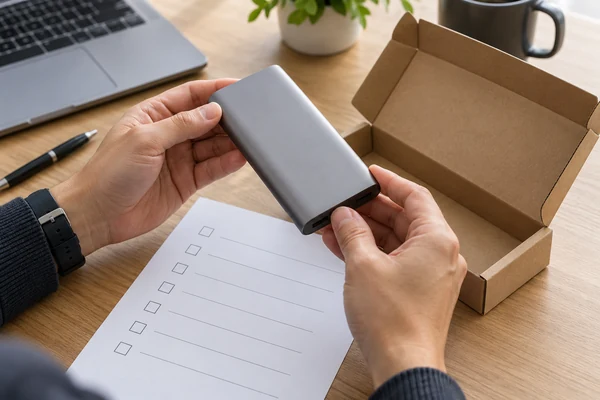
The worksheet below is a recommended buyer control, not an Apple application form. Complete one record for each proposed finished model. Use additional rows when a bundle contains separately identified accessories.
| Champ | Éléments à consigner |
|---|---|
| Order identity | Buyer SKU, retail brand, supplier model and sample reference |
| Responsible parties | Supplier legal name, stated licensee and each company’s role |
| Claim scope | Exact wording and the connector, charging feature or accessory it describes |
| Verification evidence | Search details, date checked, matching identifiers and supporting supplier explanation |
| Artwork | Box and user-guide revisions, proposed badge and approval status |
| Open questions | Mismatch or missing evidence, responsible person and required resolution |
| Release decision | Who approved the claim, for which configuration, and when |
Put this record beside the OEM demande de devis de batteries externes. A supplier can then quote the requested configuration and identify evidence still needed. Keep certification fees or development work as explicit quotation items if they are proposed; do not estimate them from another brand’s retail price.
Before production, reconcile the worksheet with the sample and final artwork. If the connector, bundled cable or model identity changes, reopen the affected claim for review. Preserve earlier records so the team can see what was approved and what changed.
Prepare a model-specific enquiry for YULIDA
Send the intended devices, charging connections, target market and proposed packaging claims through YULIDA’s contact page. Request a response for the exact configuration you plan to purchase, including any unanswered certification questions.
This article does not establish MFi certification for YULIDA or any YULIDA model. The purchasing decision needs model-specific evidence before the claim appears on the order or packaging.
Questions fréquentes
1. Where can I find an MFi certified power bank list?
Start with Apple's MFi Licensed Accessories Search and check the proposed product's identifying details. Use the result for that model, rather than treating a list of familiar brands as certification evidence.
2. Does a USB-C power bank for iPhone need MFi certification?
Ordinary Recharge USB-C accessories without MFi licensed technology or components fall outside the program. Ask the supplier which feature supposedly needs MFi before adding that requirement to your quotation.
3. Does Qi2 certification mean a power bank is MFi certified?
No. Verify a Qi2 claim in the Wireless Power Consortium database. Keep separate records for any Apple-related claim on the same product; one lookup cannot establish both.
4. Is a missing Apple search result proof that a power bank is counterfeit?
No. Public visibility has conditions beyond completion of certification. Check the identifiers with the supplier and keep the claim unresolved until you have adequate evidence. Do not approve packaging from an unexplained screenshot.
5. Can an OEM buyer use the factory's MFi status for a private-label power bank?
Do not assume company status covers your SKU. Establish who is responsible for the buyer-branded accessory and request evidence for its exact configuration and packaging. Apple's FAQ explains the authorized-licensee route for finished goods.
6. Does a certified Lightning cable certify the power bank supplied with it?
A cable record alone does not establish the status of the power bank. Record the cable and bank separately, then ask which accessory and function the supplier's claim covers.
7. Does MFi certification guarantee a particular charging speed?
Do not use a badge as the output specification. Require the stated port or charging-function rating and test the intended device combination under recorded conditions. Keep the performance report alongside the certification evidence.
8. What should I request before approving an MFi claim on a bulk order?
Request the finished-product identity, responsible licensee, covered function, supporting verification record and proposed badge artwork. Assign an owner to unresolved questions and hold the claim until the purchasing and artwork records agree.
Sources officielles et vérification
Ces sources primaires étayent les informations de cet article concernant les normes, la compatibilité, la sécurité ou le transport. Vérifiez les exigences en vigueur pour le modèle exact et le marché de destination.
- Wireless Power Consortium — Normes Qi et Qi2, certification et informations sur la recharge sans fil.
- Wireless Power Consortium — Normes Qi et Qi2, certification et informations sur la recharge sans fil.
