






Power Bank Aging Tests: What OEM Buyers Should Verify Before Shipment
Before accepting a power bank aging test report, confirm what was tested, under which conditions, and what happened to units that failed. Check that the results cover the products proposed for shipment and that unresolved failures have been reviewed. A statement such as “72-hour aging completed” is not enough to approve a batch.
Start with the test object. A report for incoming battery cells does not show that assembled power banks completed a finished-product test. The electronics, ports and firmware need their own specified checks.
This guide explains how to review aging-test evidence for an OEM order. The checklists and numerical example are buyer-side recommendations, not a universal test standard or instructions for running lithium-battery tests. Test profiles and safety controls should be approved by qualified engineering personnel for the exact product.
What does a power bank aging test actually cover?
Ask the supplier what “aging” means in its procedure. The term may describe a period of cell storage followed by measurements, controlled charge-discharge steps, or extended operation of an assembled product. Those activities provide different evidence.
| Test or process | What the record should identify | What it does not establish by itself |
|---|---|---|
| Cell aging or self-discharge screening | Cell model and lot, preparation, observation interval, measurement method and rejection limits | Performance of the assembled power bank’s charging electronics or USB ports |
| Finished-product aging or burn-in | Complete-unit identity, hardware and firmware, operating sequence, load conditions and recorded faults | Long-term service life or performance in operating modes outside the test |
| Cycle-life testing | Identified samples, repeated-cycle profile, measurement checkpoints and end-of-test criteria | That every production unit completed the same endurance test |
| Safety qualification | The tested construction, applicable requirements, methods and report scope | Completion of an order-specific production screen |
Use the procedure name and revision in the purchase documents. “Aging passed” leaves too much room for different interpretations between purchasing, production and inspection.
For the longer-term question of capacity and performance after repeated use, refer to the separate power bank cycle-life testing guide.
Is a 72-hour aging test enough?
Duration alone cannot establish whether the agreed test was suitable or completed correctly. A 72-hour record needs a defined starting point, operating sequence and acceptance criteria. It also needs to identify whether those hours refer to storage, active operation, scheduled rest periods or a combination.
Consider a rack loaded on Monday and unloaded on Thursday. That tells you how long the goods occupied the rack. It does not tell you whether every channel remained connected or completed its programmed steps.
Ask how the system handles interrupted power, disconnected products and restarted tests. An interruption should remain visible in the record, with the reason and the authorized restart or continuation decision.
Agree on the test conditions before production
Put the aging requirement in the spécification produit de la batterie externe. Reference a controlled procedure rather than adding only a number of hours to the purchase order.
| Item to agree | Justificatifs à demander |
|---|---|
| Identification du produit | SKU, capacity variant, approved cell configuration, PCBA and firmware revisions |
| Test population | Which cells or finished units are included, the lot definition, and whether coverage is complete or sampled |
| Starting condition | Required preparation, initial charge condition and any stabilization period |
| Operating sequence | Charge, discharge, idle and rest steps; ports used; input source; load settings; stop conditions |
| Temperature conditions | Ambient range, measurement locations, fixture arrangement and model-specific limits |
| Time and completion rules | Required steps or cycles, valid elapsed time, permitted pauses and treatment of incomplete runs |
| Measurement system | Equipment and channel identification, calibration status, recording interval and procedure revision |
| Acceptance and release | Measured limits, fault categories, failure handling, retest requirements and approval responsibility |
A profile for one configuration should not be applied to another without review. For example, ask how the plan covers a different capacity option or a change to the charging board.
For a multi-port model, identify which port combinations are exercised. A record from one USB output does not demonstrate that simultaneous output or wireless charging was checked. Those functions may have separate tests; the report should say where their evidence is kept.
Do not improvise higher temperatures, abnormal loads or disabled protection functions to make a test “more demanding.” Production screening and deliberate fault testing require different procedures and safety controls.
Read the measurements behind the pass result
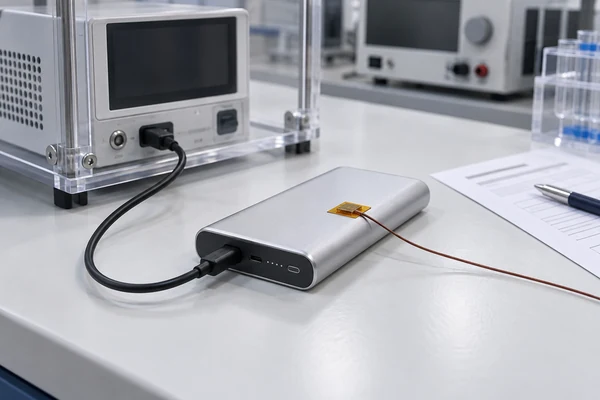
A pass flag should refer to a known limit and test step. Request the underlying measurements for a small, buyer-selected set of records, including a failed or interrupted run where one exists.
For finished power banks, compare the recorded measurements with the limits for each specified step. Check whether unexpected shutdowns or incomplete sequences appear in the results. Ask which voltage, current and temperature checks cover every unit and which come from separate sample tests.
If temperature is recorded, find out where the sensor was placed. A fixture sensor, a housing measurement and an internal component measurement describe different locations. A report headed “temperature passed” should identify the location and corresponding limit.
For cell self-discharge measurements, preparation matters. Keysight’s BT2152A/B guide explains that recent charging or discharging affects voltage relaxation, while state of charge and temperature influence the measurement. An early voltage change should not automatically be treated as an equivalent loss of stored charge. See the Keysight operating guide, pages 51-52.
Ask the supplier to identify its method and how it controls those conditions. A cell-voltage comparison, direct self-discharge measurement and a check of the percentage shown on a power bank display are not interchangeable.
For an assembled power bank, also distinguish cell self-discharge from energy consumed by the electronics in standby. If the order has a storage-retention requirement, specify how it will be evaluated at finished-product level.
Check whether the records cover your actual order
Begin with the production population, then compare it with the test population. If the supplier claims every finished unit was tested, ask for a mapping between those units and valid completed results.
Where individual serial numbers are used, check for missing and repeated identifiers. If tracking is by lot and rack position, ask how the records preserve that relationship when products are loaded, removed, replaced or repacked. A channel number is not a permanent product identifier.
Sampling should be stated openly. A report for selected units can support the agreed sampling plan, but it should not be presented as a record of testing every unit.
Select an item from packed stock and ask for its applicable test record. Then select a record and ask which physical goods it represents. The power bank batch traceability guide explains this two-direction check in more detail.
A rack photograph can help explain the setup. It cannot establish test duration, acceptance limits or batch coverage without the supporting records.
A worked example: separate first-pass results from final disposition
Suppose a hypothetical production lot contains 1,000 uniquely identified power banks. All 1,000 complete their initial specified test. Of those, 980 pass and 20 fail.
After investigation, 12 of the failed units are reworked, each completing one required retest and passing. Five remain on hold and three are scrapped. These numbers are an illustration, not YULIDA production data or recommended acceptance limits.
| Final recorded disposition | Unique units |
|---|---|
| Passed the initial test without rework | 980 |
| Passed the required retest after rework | 12 |
| Still on hold | 5 |
| Scrapped | 3 |
| Total original units accounted for | 1,000 |
The first-pass yield is 980 / 1,000 = 98%. The final passed population is 992 units, or 99.2% of the original lot. Both figures can be correct, but they describe different things.
There are 1,012 completed test attempts in this example: 1,000 initial tests and 12 retests. There are still only 1,000 physical units. Counting test attempts as products would overstate coverage.
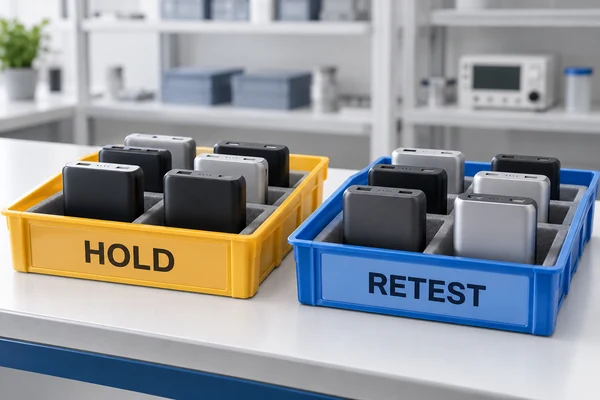
Keep the original failure attached to each reworked unit’s history. The latest pass result should not erase the earlier fault or the repair record.
These totals do not authorize shipment. The quality review must determine whether the failure causes affect other units and whether the agreed release conditions have been met. A recurring fault may require containment beyond the five units already on hold.

What should happen when a unit fails?
The procedure should explain who reviews a failure and how affected goods are kept out of released stock. Ask to see the original result, the investigation and the final disposition.
An apparent product failure may require checking the fixture, cable or measurement channel. If a test result is invalidated because the equipment was at fault, preserve that conclusion and its evidence. Repeatedly rerunning the same unit until it passes would conceal the problem.
For a repaired product, record what changed and which checks must be repeated. A replaced cell, a repaired connection and a firmware update need review against the relevant test plan. The retest scope should follow the repair and any associated risks.
Suspected swelling, leakage or abnormal heating should trigger the facility’s approved battery-safety response. Such units should not be routinely reconnected for another attempt. Handling and investigation belong with trained personnel using suitable facilities.
If a fault recurs, review the affected component lots, configuration and production period. The BOM and change-control guide explains how to keep component substitutions and firmware changes connected to the approved product definition.
Keep aging evidence separate from safety qualification
A production aging report records the scope of a particular manufacturing check. It is not, by itself, proof of product certification or suitability for every target market.
For example, UL Solutions describes UL 2056 power bank testing as covering electrical, mechanical and thermal safety concerns. That is a broader assessment than a time-on-rack statement. See UL Solutions’ overview of power bank safety testing.
IEC 61960-3:2017 covers performance requirements and tests for specified portable lithium cells and batteries. When a supplier cites a standard, request the actual test reference and confirm which components or products the report covers. The IEC publication summary identifies its scope; it does not verify a particular supplier’s batch.
Keep production-screening records separate from qualification reports. Both should identify the relevant configuration. Confirm any market-specific requirements with the responsible compliance specialists.
A concise aging-record request for your supplier
Send this request before the production schedule is finalized, so record access and review time can be agreed:
For this SKU and purchase order, confirm whether the aging procedure applies to incoming cells, assembled power banks or both. Provide the procedure revision, test population, operating conditions and acceptance criteria. Identify completed, failed and interrupted runs, with links to the corresponding products or lots. Retain initial failures alongside any rework and retest results. Before shipment, reconcile the test population with the proposed shipment and identify any unresolved exceptions and the person responsible for release approval.
Ask for a sample export early. Check whether your team can read the identifiers, timestamps, units and status codes without access to proprietary factory software.
Agree how long records will be retained and how the buyer can retrieve them for a later complaint. A dashboard available only during the production week may not be enough for the order’s after-sales needs.
Questions fréquentes
1. What is the purpose of a power bank aging test?
It checks the specified behavior of identified cells or finished products over a defined procedure and observation period. Its value depends on the conditions, measurements and failure handling recorded. Ask which faults the chosen procedure is intended to detect.
2. Does a 72-hour test guarantee that a power bank will not fail?
No. A completed test provides evidence for its defined scope. It cannot establish fault-free performance under every future operating condition or replace separate reliability and safety evaluations.
3. Is cell aging the same as finished-product aging?
No. Cell records concern the tested cells. Finished-product records concern assembled units and the operating modes actually exercised. Check how both sets of records connect to the order.
4. Must every power bank undergo the same aging procedure?
The procedure and coverage should match the approved model, order requirements and applicable obligations. Specify which checks cover every unit and which are sampled; do not assume a single duration or profile suits all products.
5. Can one failed unit be retested and shipped?
That requires a documented review of the failure, any repair, the required retest and the release criteria. A later pass alone does not explain why the unit failed or whether other units are affected.
6. What if the supplier provides only a pass-rate summary?
Request the population behind the percentage, its calculation method and supporting records. Separate unique units from repeated test attempts, and distinguish first-pass results from the final status after rework.
7. What evidence should an OEM buyer request before shipment?
Request the applicable procedure and limits, product-to-record mapping, completed results, failure and retest history, and the release decision. The evidence should reconcile with the goods proposed for shipment.
Confirm the aging-test scope for your YULIDA order
YULIDA’s published processus de contrôle qualité describes a 72-hour battery-cell burn-in procedure. For a specific order, ask the team to confirm the applicable method, coverage and records, including any separate finished-product aging checks. The website description is not the test report for your batch.
Share the target model, capacity option, charging functions and destination market when requesting the plan. Agree on the review documents and shipment-release conditions before production starts.
Contacter YULIDA about model-specific testing and production records.
Sources officielles et vérification
Ces sources primaires étayent les informations de cet article sur les normes, la compatibilité, la sécurité ou le transport. Vérifiez les exigences actuelles pour le modèle précis et le marché de destination.
- UL Solutions — Normes de sécurité des batteries et informations techniques de sécurité.
- Commission électrotechnique internationale — Normes électrotechniques internationales et leurs domaines d’application.
