





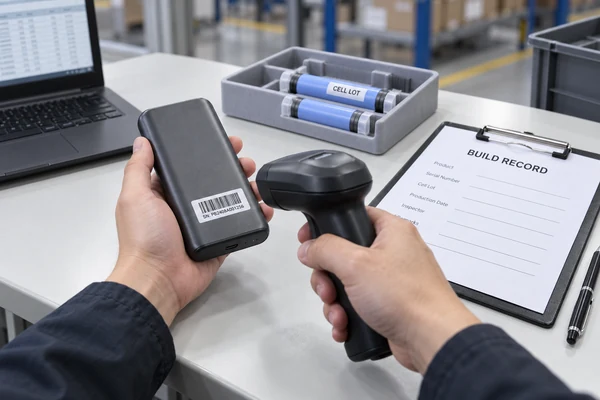
Power Bank Batch Traceability: How OEM Buyers Verify Cell Lots, Serial Numbers and Production Records
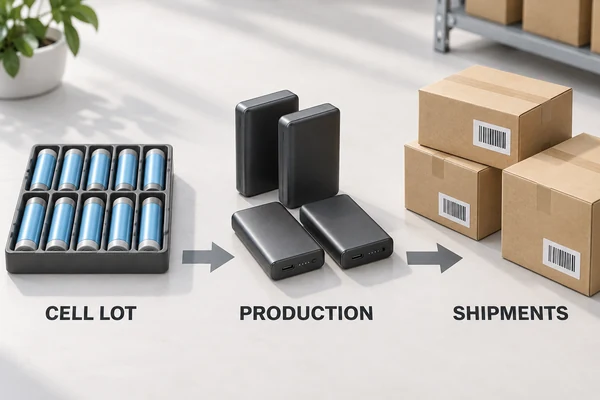
Power bank batch traceability connects a finished product to the components used to build it and to the orders through which it was shipped. An OEM buyer should be able to select a finished unit and check its production history. Starting with a cell lot, the supplier should also be able to identify the finished goods and shipments that used those cells, at the traceability level agreed for the order.
The difficult part is checking whether those connections survive everyday factory work: partially used cell cartons, split production orders, repairs and repacking before shipment.
This guide sets out a buyer-side verification method. The audit checks and numerical example below are practical recommendations, not a universal certification checklist or a statement of any particular factory’s capabilities.
What should a power bank traceability record contain?
Start by separating identifiers that serve different purposes. A commercial model number may remain unchanged across several production runs. An incoming material receipt may cover only part of a supplier’s cell lot. Neither tells you, by itself, which cells were installed in a particular power bank.
| Identifier or record | What it identifies | Ce que l’acheteur doit vérifier |
|---|---|---|
| SKU and configuration revision | The ordered product and its approved construction | The model, capacity option and approved configuration match the order |
| Cell manufacturer’s lot code | A population of cells defined by the cell manufacturer | The original code remains connected to the factory’s receipt and material records |
| Factory receipt number | A specific delivery into stock | Supplier, material part number, original lot code and received quantity are preserved |
| Work order and finished-goods lot | A manufacturing order and a defined output population | Recorded component consumption connects to the relevant output lots or units |
| Finished-unit serial number, where used | One unit within a defined identification system | The complete identifier is unique within that system and retrieves the correct history |
| PCBA and firmware records | The board population or revision and software configuration | The record describes what was actually fitted or programmed, including later changes |
| Carton and shipment references | Packed goods and their dispatch | Carton contents connect to shipped quantities, orders and direct recipients |
GS1 distinguishes product-class identification, batch identification and individual-instance identification. In its system, these can be represented by a GTIN, a GTIN plus batch/lot code, or a GTIN plus serial number. That distinction is useful when deciding what a supplier’s records can actually resolve. GS1 Global Traceability Standard.
A factory may use internal identifiers instead. The buyer still needs a written explanation of their scope: whether a code can repeat across models, suppliers, sites or years, and which fields make the full reference unambiguous.
Agree on the level of detail before production
Ask the supplier a specific question: can it identify the cell lot for each finished unit, or only the possible cell lots for a finished batch?
Both describe a level of traceability. They offer different precision.
Suppose cell lots A and B supply the same work order. If consumption is recorded only against the work order, its finished units may be linked to both possible lots. Adding unique serial numbers to those units does not retrospectively establish which cell lot went into each one.
If unit-level component identification is required, the manufacturing process needs to capture that relationship. If batch-level tracking is accepted, define how lots are separated and how mixed-lot production will be reported. Include subcontracted assembly or rework in that agreement.
Le spécification produit de la batterie externe can define the required identification fields. The approved BOM and change-control process determines which component combinations are permitted. Traceability records then show what was actually built and where it went.
Check backward from a finished power bank
Choose a unit from the actual order population, such as a packed shipment or finished-goods stock. Let the reviewer select it; a supplier-prepared demonstration unit does not test an unexpected lookup.
Photograph its visible identifiers and record the audit cutoff time, including the time zone. Retain the corresponding data export so later stock movements do not change the population being reviewed.
Follow the selected identifier through these records:
- Find the finished lot and production work order. Check the SKU and configuration revision against the purchase order.
- Retrieve the cell consumption records. Follow their references to incoming material receipts and original supplier lot codes.
- Check the PCBA reference and firmware programming record at the agreed level of detail. Include any subsequent repair or reprogramming.
- Retrieve the relevant production and release-test records. Confirm which results belong to the selected unit, which belong to its lot, and which come from sampled units.
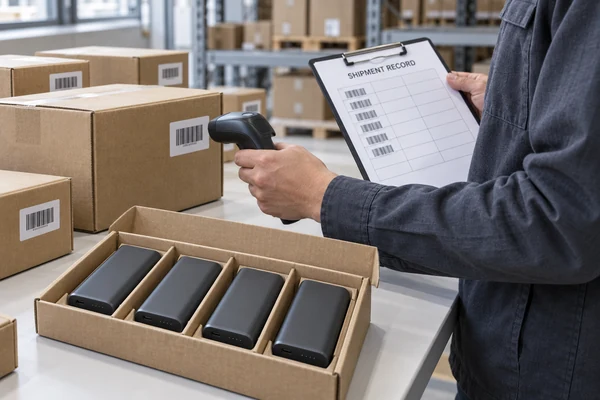
- If the unit is packed or shipped, check the carton contents record and shipment reference.
Pay attention to the difference between material issued to a line and material consumed in products. Some issued cells may have been returned to stock, rejected or carried into another work order. An issue slip alone cannot resolve those outcomes.
A board revision field also needs a credible source. It might come from a controlled assembly record or a verified scan. A firmware filename copied into a spreadsheet may identify the intended release without proving what was loaded. Ask how each field is captured and checked.
Where physical component verification is necessary, use retained samples or a qualified inspection procedure. This document review does not require opening a sealed lithium-battery product at a desk.
Check forward from a cell lot
Now start with an incoming cell lot chosen by the reviewer. Request every work order that consumed it, including orders for other SKUs. Follow those work orders to their output and current disposition.
The result should account for unused cells, documented losses and the relevant product population. Finished products may be in stock, still in production, held for review or already shipped. Reworked products need their component history checked before they are included or excluded.
Ask for the details behind each total. A report stating that 600 units shipped is incomplete if it cannot identify the corresponding shipment lines or recipients at the agreed tracking level.
GS1 describes traceability around recorded events, such as receiving, packing and shipping, and the data that describes each event. This provides a useful way to review a supplier’s process: ask what happened to the material and what record was created at that point. GS1 traceability overview.
A factory’s dispatch records may identify its direct customers or warehouses. Following goods through distributors to later recipients requires those partners’ records; do not assume the factory can identify every end user.
A worked example: reconcile cells, assemblies and shipments
The following numbers are hypothetical. They do not describe a YULIDA production order.
Assume one cell lot contains 2,000 cells and supplies a single product configuration with exactly two cells per power bank. At the audit cutoff, all installed cells remain in their original assemblies; there have been no cell replacements or transfers to other configurations.
| Cell disposition | Quantity of cells |
|---|---|
| Unused and physically accounted for in stock | 120 |
| Documented scrap | 80 |
| Installed in the assemblies being traced | 1,800 |
| Total received | 2,000 |
The material reconciliation is:
2,000 received = 120 unused + 80 scrapped + 1,800 installed.
At two cells per assembly, the installed quantity corresponds to 900 assemblies. Every assembly in the table below already contains its two cells, including those awaiting later production steps.
| Current assembly disposition at the cutoff | Quantity of assemblies |
|---|---|
| Shipped | 600 |
| Released finished stock, not shipped | 240 |
| Work in progress, excluding held units | 40 |
| Quarantined units, excluded from the other rows | 20 |
| Total assemblies | 900 |
These are mutually exclusive states at one point in time. A unit that was repaired and then shipped belongs in the shipped total once. Its repair stays in the event history; it is not counted as another physical unit.
Next, reconcile the 600 shipped assemblies. Suppose the packing records allocate 400 to Order A and 200 to Order B. The traceability export should identify those shipment lines and their included lots or serial numbers.
If the records account for only 590 shipped units, there is an unresolved ten-unit gap. Check dispatch adjustments, repacking, unrecorded transfers and identifier errors. A matching grand total in another spreadsheet does not identify the missing units.
Real orders may use different cell counts, contain mixed cell lots or include component replacements. Reconcile each configuration and movement separately before combining totals. Dividing all consumed cells by one assumed cell count can produce a plausible but incorrect answer.
Preserve the history through rework and mixed lots
Rework can change the answer to a backward trace. If a cell is replaced, the record should preserve the original component reference, the replacement reference, the reason for the change and the subsequent release decision. Record the removed cell’s disposition as well.
For a firmware update, retain the earlier and later versions with the affected unit or lot population. The latest configuration field should not erase how the product was originally built.
During an audit, select at least one applicable exception rather than reviewing only an uninterrupted production run:
- A partly used cell carton returned to stock and later issued again.
- A work order split into several finished lots.
- A finished lot containing more than one component lot.
- A repaired unit released after component replacement.
- A carton opened and repacked before dispatch.
For each case, check whether the records still support the claimed level of precision. If mixed cell lots were tracked only at work-order level, report that broader population. Do not assign individual units to one lot based on production timing alone unless controlled records support the assignment.
The same principle applies to a suspected defect. Uncertain records may require a broader initial containment scope while the quality team investigates; they do not establish that every unit in that scope is defective.

Test the label and the lookup separately
A scanner reading a code proves that the code is readable. The lookup must still return the right record.
Scan a selected product and compare the result with its human-readable identifier. Check leading zeros, spaces and characters that look alike. Then open the associated record and compare it with the physical product and order.
Request a duplicate-identifier check over the relevant population. Define the complete identifier first: a short serial code may be unique only when combined with a model or manufacturer reference.
If a damaged label is replaced, check how the original identity is retained or how old and new identifiers are linked. A replacement label should not leave two active identities for one unit, or accidentally assign one identity to two units.
Consider where the identifier will be available during a warranty claim. A code printed only on a discarded shipping carton may be difficult for a customer to provide. Review product and packaging markings together with the power bank label requirements, and agree on readability checks appropriate to the intended use.
Audit the records behind the report
A summary report is a starting point. Ask for a small selection of the underlying receipt, production and shipment records, then compare them across departments.
| Audit check | Justificatifs à demander | Gap to investigate |
|---|---|---|
| Incoming cell identity | Original supplier lot reference and linked receipt | The internal label replaces the original lot code without a mapping |
| Actual material use | Consumption, returns and scrap records | The report treats all issued material as installed |
| Build configuration | Linked assembly and programming records | Only the intended BOM revision is available |
| Test scope | Results, method revision and applicable unit or lot references | A sample result is presented as a test of every unit |
| Rework history | Component changes and release records | Earlier values have been overwritten |
| Packing and dispatch | Contents lists and shipment lines | Shipped quantities cannot be linked to the included goods |
| Record corrections | Who changed the record, when and why | Records can be edited without a recoverable history |
| Retrieval | Export from a buyer-selected unit and cell lot | Only a prepared example can be demonstrated |
Where the agreed test produces measured values, retain those values with the result and method reference. For a sampled test, preserve the sample selection and its relationship to the lot. The power bank quality-control plan should distinguish individual-unit checks from sampling.
Record when the retrieval started, when usable results arrived and what remained unresolved. Use that performance to agree on a realistic response target. This guide does not prescribe a universal retrieval deadline or sample size.
Does the supplier need a manufacturing execution system?
A manufacturing execution system, or MES, can help capture production events and manage larger record volumes. Its presence does not establish that the required links exist.
For a small, stable operation, controlled linked registers may support the agreed scope. Buyers should still check identifier consistency, restricted editing, change history, backups and whether another trained person can retrieve the records. A workbook that depends on one employee remembering which file to open is a weak basis for an urgent investigation.
Ask for a usable export rather than screenshots alone. Confirm that identifiers survive the export without truncated text or lost leading zeros, and that records remain accessible if the software or service provider changes. A backup should also have a tested recovery process.
Choose the system around the production complexity and evidence required. Software purchasing is a separate decision from whether a particular order can be traced.
Put the retrieval requirements in the order agreement
Before production, agree on the tracking level, required fields and record owners. Define how long records will be retained, when that period starts and how the buyer can obtain them if the commercial relationship ends. Applicable requirements and the product’s service arrangements need to inform those decisions; there is no single retention period proposed here for every power bank order.
Include a procedure for unresolved links. The agreement should say who reviews the discrepancy, who can authorize release and what evidence is needed to close the issue. A documentation gap and a confirmed safety problem require different assessments. An actual safety concern needs prompt escalation through the appropriate quality and product-safety process.
Le contrat de fabrication OEM de batteries externes is a suitable place to document these responsibilities. Use the same identifiers in the warranty-claim process so returned goods can be compared with production and shipment records.
A concise request to a supplier can read:
For the selected SKU and order, demonstrate a backward trace from one reviewer-selected finished unit and a forward trace from one reviewer-selected cell lot. State whether each link is unit-level, lot-level or a broader possible association. Provide the original cell lot references, actual consumption records, build configuration, applicable test and rework records, and packing and shipment links. Reconcile quantities at an agreed cutoff time. Identify unresolved links and confirm the record owner, retrieval target and retention arrangement.
Questions fréquentes
1. What is power bank batch traceability?
It is the ability to connect a defined population of power banks to its component and production records, then follow those products through stock and shipments. The available precision depends on the identifiers and relationships actually recorded.
2. Is a model number enough to trace a power bank?
Usually not for identifying a specific production population. The same model can cover multiple cell lots and manufacturing runs. It needs additional lot or unit identifiers linked to records.
3. What is the difference between a batch number and a serial number?
A batch number identifies a group. A serial number distinguishes an individual unit within a defined identification system. Neither automatically reveals component history without the relevant record links.
4. Does every power bank need a unique serial number?
The required identification level depends on the applicable requirements and the buyer’s agreed control needs. Per-unit serials support individual identification, but they do not prove that component use was recorded at that same level.
5. Can one finished batch contain more than one cell lot?
It can, if the production specification permits it. Record every contributing lot and the relationships captured. If individual allocation is unknown, report the broader possible association instead of claiming exact unit-level traceability.
6. Can a QR code provide complete traceability?
A QR code can carry an identifier or a link. The supporting records determine what can be traced. Test the lookup, its access arrangements and the underlying history as well as the printed code.
7. How should replaced cells be recorded?
Preserve the original and replacement lot references, the affected product identity, the reason and date of replacement, the removed cell’s disposition and the release record. Do not overwrite the earlier component history.
8. How should buyers verify a supplier’s traceability claim?
Select actual products and material lots, request traces in both directions and reconcile the results against source records. Include an applicable exception, such as rework or repacking, rather than accepting only a prepared demonstration.
9. Can spreadsheets be used for traceability?
They may support a limited operation if identifiers, links, edits and access are controlled. Verify retrieval and recovery in practice. As production relationships become harder to maintain, a more structured system may be appropriate.
10. What should happen when quantities do not reconcile?
Document the discrepancy and investigate missing movements, scrap, rework and packing changes. Follow the agreed escalation and release procedure. Do not exclude products from a potentially affected population without supporting evidence.
Confirm the traceability scope for your OEM order
For a YULIDA project, share the target SKU, proposed order quantity and required tracking level with the team. Ask them to confirm the available records and demonstrate an example before those requirements are finalized in the order documents.
You can contactez YULIDA about your OEM order to discuss identification, record access and how a traceability review would be arranged.
