








Comment rédiger une spécification produit pour une commande OEM/ODM de batteries externes ?
En bref : Une spécification de batterie externe prête pour la production identifie le SKU et la révision exacts, le marché cible, la configuration des cellules, les profils des ports, le fonctionnement simultané, les limites de protection, la construction, les fichiers graphiques, l’emballage et les justificatifs de conformité. Elle définit aussi comment chaque exigence sera testée et acceptée. Remplacez les expressions « haute qualité », « charge rapide » et « identique à l’échantillon » par une valeur, une tolérance, une condition d’essai ou une référence maîtrisée.
La spécification devient la référence technique commune à l’acheteur, à l’usine, au laboratoire d’essais et à l’inspecteur. Elle doit correspondre à l’échantillon approuvé, au bon de commande, aux fichiers graphiques et au dossier de conformité. Si ces documents divergent, la production peut utiliser la mauvaise cellule, le mauvais profil de port, la mauvaise étiquette ou le mauvais emballage, alors même que chacun pense avoir respecté la commande.
La démarche ci-dessous aide les importateurs, les marques propres et les équipes d’approvisionnement à transformer un devis accepté en instructions de production OEM ou ODM maîtrisées. Elle comprend une liste de contrôle par rubrique et un modèle de spécification prêt à copier.
Qu’est-ce qu’une spécification produit pour batterie externe ?
Une spécification produit pour batterie externe est le document maîtrisé qui définit ce que le fournisseur doit fabriquer et comment la conformité sera vérifiée. Elle consigne la configuration, les performances mesurables, les matériaux approuvés, l’apparence, les fichiers graphiques, l’emballage, les justificatifs et les règles d’acceptation pour un SKU ou un ensemble clairement défini de variantes.
Une page de catalogue peut décrire une famille de produits ou ses fonctionnalités maximales. La spécification de production a une mission plus précise : identifier la version commandée et fixer les options de capacité, cellule, sens de fonctionnement des câbles, couleur, fonction sans fil, langue de l’emballage et documentation du marché.
| Document | Objectif principal | Éléments à maîtriser |
|---|---|---|
| RFQ | Obtenir des propositions et des prix comparables | Périmètre demandé, quantités, hypothèses et réponse du fournisseur |
| Spécifications produit | Définir le produit à fabriquer | Configuration, exigences mesurables, tolérances et références maîtrisées |
| Échantillon de référence approuvé | Fournir une référence physique pour la production | Apparence approuvée et configuration vérifiée liées à la spécification |
| Bon de commande | Passer la commande commerciale | SKU, quantité, prix, livraison et révisions des documents cités |
| Plan qualité ou plan d’inspection | Définir les contrôles de production et de libération | Étapes d’essai, échantillonnage, classes de défauts, relevés et traitement des lots refusés |
| Rapport d’essais | Consigner les résultats d’une évaluation définie | Identification de l’échantillon, méthode, équipement, conditions, résultats et décision |
Commencez par une demande détaillée : demande de devis de batteries externes. Après avoir choisi un modèle, transférez les exigences acceptées dans la spécification produit maîtrisée, plutôt que de les laisser dispersées entre devis, messages et courriels de fichiers graphiques.
Liste de contrôle pratique pour spécifier une batterie externe
| Rubrique | Informations minimales à consigner | Justificatif ou référence |
|---|---|---|
| 1. Maîtrise documentaire | Titre, SKU de l’acheteur, modèle de l’usine, révision, date, statut et approbations | Historique des révisions et approbation signée |
| 2. Marché et utilisation | Pays de destination, canal de vente, utilisation prévue et exclusions | Plan de conformité propre au marché |
| 3. Batterie | Fabricant et modèle des cellules, configuration, tension nominale, mAh, Wh et traçabilité | Spécification des cellules et relevé du lot de production |
| 4. Interfaces filaires | Sens de fonctionnement, profils tension/courant, puissance maximale et câble fourni | Relevé de l’analyseur de protocole et de l’essai en charge |
| 5. Logique de fonctionnement | Sortie partagée, charge traversante, mode faible courant, affichage et comportement d’arrêt | Matrice des modes et révision du micrologiciel |
| 6. Fonctions sans fil | Mode requis, alignement, aimants, conditions liées à la coque et utilisation simultanée | Liste des appareils d’essai et statut de certification si requis |
| 7. Sécurité et fiabilité | Fonctions de protection, méthode de mesure thermique, exigences de durabilité et de vieillissement | Essais définis et seuils de réussite ou d’échec |
| 8. Conception mécanique | Dimensions, poids, matériaux, finition, couleur et tolérances | Plan maîtrisé et référence physique de couleur |
| 9. Fichiers graphiques et emballage | Révisions du logo, de l’étiquette signalétique, de la notice, de la boîte, du code-barres et du carton | Fichiers approuvés et échantillon emballé |
| 10. Conformité et transport | Justificatifs applicables, modèles couverts, partie responsable et documents d’expédition | Références des rapports, certificats, déclarations et résumés d’essais |
| 11. Acceptation | Méthodes d’essai, tailles d’échantillon, limites, classes de défauts et mesures en cas de refus | Plan qualité et liste de contrôle d’inspection |
| 12. Maîtrise des modifications | Pièces maîtrisées et modifications nécessitant notification, validation ou nouvelle approbation | Révision de la nomenclature et fiche de modification technique |
Le document doit être adapté au projet. Un modèle standard avec logo peut ne nécessiter qu’une spécification courte et des fichiers graphiques maîtrisés. Un boîtier, une PCBA, un micrologiciel ou un système sans fil sur mesure exigera des plans, des tableaux d’interfaces et un plan de validation. Dans les deux cas, un lecteur qualifié doit pouvoir déterminer ce qu’il faut fabriquer et comment l’évaluer.
1. Maîtriser l’identification et la révision du document
Placez un bloc de maîtrise documentaire en première page. Consignez le titre, l’entreprise acheteuse, le fournisseur, le SKU de l’acheteur, le modèle de l’usine, la variante de capacité et de couleur, la révision, la date d’émission et le statut d’approbation. Nommez les personnes autorisées à approuver les modifications.
- Numéro et révision du document
- SKU de l’acheteur et numéro de modèle de l’usine
- Code de variante ou de configuration
- Rédigé, vérifié et approuvé par
- Date d’émission et bons de commande concernés
- Statut : brouillon, examen d’échantillon, approuvé pour production ou obsolète
- Historique des révisions avec une brève description de chaque modification
N’écrasez pas une spécification diffusée sans changer sa révision. Identifiez clairement les fichiers obsolètes et retirez-les des dossiers d’achat, de production et d’inspection. Le bon de commande doit citer la révision approuvée pour qu’une mise à jour ultérieure ne modifie pas implicitement une commande existante.
2. Définir le SKU, le marché cible et la matrice des variantes
Précisez où et comment le produit sera vendu. Le marché cible influe sur les marquages, la langue, les documents, l’emballage et les responsabilités de l’importateur ou d’un autre opérateur économique. Une spécification destinée à un produit promotionnel américain ne doit pas être réutilisée automatiquement pour un SKU vendu au détail dans l’UE.
- Pays ou région de destination
- Canal de vente et utilisateurs visés
- Propriétaire de la marque, importateur ou opérateur économique responsable, si connu
- Produit, câble, accessoires et contenu de l’emballage inclus
- Fonctions et allégations exclues ou interdites
- Conditions d’utilisation et de stockage pertinentes pour le projet
Si un même boîtier est vendu avec plusieurs capacités, couleurs ou versions de câble, utilisez une matrice de variantes. Attribuez un SKU propre à chaque configuration commercialisable et indiquez les champs pouvant différer. N’utilisez pas un seul dossier d’approbation pour les versions de 5 000 mAh et de 10 000 mAh sans identifier, pour chacune, la batterie, les caractéristiques nominales, le poids, les étiquettes et les justificatifs de conformité.
| Champ de variante | SKU A | SKU B | Question de contrôle |
|---|---|---|---|
| Capacité nominale et Wh | À compléter | À compléter | La configuration des cellules correspond-elle à l’étiquette ? |
| Couleur du boîtier | À compléter | À compléter | Existe-t-il une référence physique de couleur approuvée ? |
| Câble intégré | À compléter | À compléter | Le sens de fonctionnement et les protocoles pris en charge sont-ils définis ? |
| Langue des fichiers graphiques | À compléter | À compléter | Les révisions de l’étiquette, de la notice et de la boîte concordent-elles ? |
| Dossier de conformité | À compléter | À compléter | Les justificatifs couvrent-ils cette version exacte ? |
3. Spécifier la cellule, la capacité et l’énergie de la batterie
Ne définissez pas la batterie uniquement en mAh. Consignez le fabricant des cellules, le modèle, la chimie, le format, la quantité, la configuration série/parallèle, la tension nominale, la capacité assignée et l’énergie calculée en wattheures. Précisez si la capacité indiquée est minimale, assignée ou typique et conservez la même base pour le produit, l’étiquette et les relevés d’essai.
- Fabricant approuvé et modèle exact des cellules
- Chimie, format et configuration des cellules
- Tension nominale, capacité assignée en mAh et énergie en Wh
- Capacité minimale des cellules si exigée par contrat
- Limites relatives au code de date, au code de lot et à la durée de stockage
- Exigences de contrôle à réception et de traçabilité des lots
- Méthode d’essai de durée de vie en cycles, points de contrôle et seuil de fin de vie si requis
- Règles concernant les cellules alternatives ou les substitutions
L’énergie nominale de la batterie et l’énergie utile en sortie ne sont pas le même résultat. Si l’énergie utile importe, définissez le port de sortie, la tension, la charge, l’état initial, la condition de coupure, la plage de température, le nombre d’échantillons et la méthode de calcul. Conservez la courbe de décharge brute ou le journal de mesure avec le rapport d’essai. Le guide de sélection des cellules pour batteries externes explique plus en détail la capacité, la durée de vie en cycles et la traçabilité.
4. Rédiger un tableau de profils pour chaque port et câble
Le nom du connecteur ne suffit pas à décrire son comportement électrique. Pour chaque port USB-C, port USB-A et câble intégré, précisez s’il s’agit d’une entrée, d’une sortie ou d’une interface bidirectionnelle. Listez les profils fixes tension/courant requis, la plage PPS si applicable, la puissance maximale, les protocoles concernés et les conditions d’essai.
| Interface | Sens de fonctionnement | Profils requis | Puissance maximale | Justificatifs |
|---|---|---|---|---|
| USB-C1 | Entrée / sortie / les deux | Lister les PDO fixes et la plage APDO PPS si requis | Renseigner séparément l’entrée et la sortie | Capture du protocole et résultat sous charge maintenue |
| USB-A1 | Sortie | Lister les modes et combinaisons tension/courant requis | Renseigner la valeur | Résultat du protocole et de l’essai en charge |
| Câble USB-C intégré | Entrée / sortie / les deux | Lister les profils requis | Renseigner la valeur | Capture du protocole, chute de tension et relevé de durabilité |
| Câble amovible fourni | Accessoire | Connecteur, longueur et courant/puissance assignés requis | Renseigner la valeur | Identification du câble et résultat d’essai |
Le comportement USB Power Delivery doit être vérifié au moyen de la négociation du protocole ainsi que de la tension et du courant en sortie. La bibliothèque documentaire USB-IF publie les spécifications USB Power Delivery et USB Type-C en vigueur. La forme d’un connecteur USB-C ne prouve pas la prise en charge de PD, de PPS, de la charge bidirectionnelle ou d’une puissance donnée.
Consultez le guide dédié aux spécifications USB-C PD des batteries externes pour vérifier les profils, PPS, la sortie partagée et les câbles. Pour un connecteur intégré, définissez aussi la longueur du câble, les exigences relatives aux conducteurs, le rangement, la protection contre les contraintes, la méthode d’insertion ou de flexion et les conditions d’acceptation abordées dans le guide des batteries externes à câble intégré.
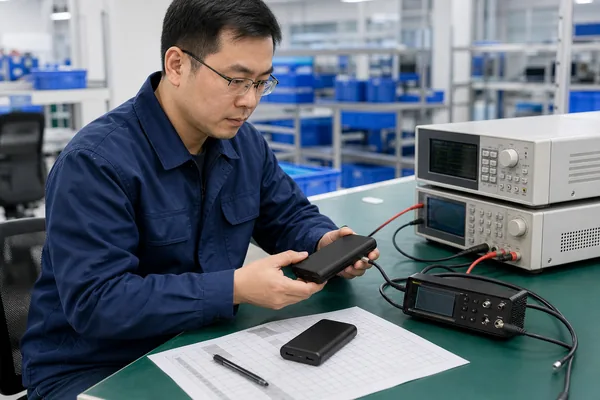
5. Définir la sortie partagée, la logique de charge et le comportement du micrologiciel
La puissance mise en avant décrit généralement une seule condition de fonctionnement. Les produits multiports nécessitent une matrice des modes décrivant ce qui se passe lorsque plusieurs interfaces sont utilisées ensemble. Consignez la puissance totale partagée, sa répartition entre les ports, les priorités, les profils de repli et les sorties devenant indisponibles.
- Chaque entrée et sortie utilisée seule
- Chaque combinaison requise de deux ports ou de plusieurs ports
- Puissance totale partagée et répartition par port
- Renégociation de la charge rapide lors du branchement d’un autre appareil
- Combinaisons et limites d’entrée/sortie en charge traversante
- Activation, durée et sortie du mode faible courant
- Seuils de démarrage et d’arrêt automatiques
- Comportement du bouton, des LED, de l’écran et de l’indication d’état de charge
- Révision du micrologiciel ou du contrôleur utilisée pour l’approbation
Pour un écran TFT ou numérique, définissez les informations affichées, les unités, l’actualisation et l’écart autorisé par rapport à la mesure de référence convenue. « Affichage précis » reste incomplet sans méthode ni tolérance. Si le micrologiciel peut être mis à jour, précisez qui peut diffuser une nouvelle version et quels contrôles doivent être répétés.
6. Spécifier séparément la charge sans fil et les fonctions magnétiques
La puissance sans fil, l’alignement magnétique et la puissance filaire sont des exigences distinctes. Consignez le mode sans fil requis, les conditions d’entrée, le récepteur ou l’appareil d’essai compatible, les conditions relatives à la coque, la position de la bobine, la tolérance d’alignement, le comportement face aux corps étrangers, la disposition des aimants et les règles d’utilisation simultanée.
- Statut Qi ou Qi2 requis, s’il fait partie du projet
- Référence exacte de certification correspondant au modèle lorsqu’une certification est revendiquée
- Mode de puissance sans fil et condition d’alimentation d’entrée
- Appareils récepteurs ou montages d’essai approuvés
- Centre de la bobine, zone de charge et désalignement autorisé
- Matériau et épaisseur maximale de la coque inclus dans les essais de compatibilité
- Disposition des aimants et méthode de mesure de la force de maintien propre au projet
- Points de mesure de température et durée de fonctionnement
- Fonctionnement simultané filaire et sans fil
Le Wireless Power Consortium publie les spécifications Qi et une base de produits certifiés. Une expression comme « charge sans fil magnétique » ne démontre ni la certification Qi, ni la compatibilité des appareils, ni la puissance de charge, ni la force de maintien. Indiquez séparément chaque allégation et les justificatifs correspondants.
7. Transformer les attentes de sécurité et de fiabilité en essais
Listez les fonctions de protection requises pour la conception sélectionnée, notamment les comportements en cas de surcharge, de décharge excessive, de surintensité, de court-circuit et de surchauffe. Associez ensuite une méthode d’essai, un état d’échantillon et une règle de réussite ou d’échec. La fiche technique d’un contrôleur ne prouve pas à elle seule le comportement de la batterie externe finie.
Les limites thermiques exigent la même rigueur. Précisez les conditions ambiantes, le chargeur, le câble, le mode d’entrée ou de sortie, la charge, la durée, le point de mesure et la limite. Une température de surface et une température interne de composant répondent à des questions différentes. L’équipe projet doit fixer des limites adaptées à la conception, aux normes applicables, au marché cible et à l’usage prévu.
- Essai des protections électriques et comportement de reprise
- Essai thermique à charge maximale et en fonctionnement prolongé
- Cycles de charge/décharge lorsqu’un objectif de durée de vie est revendiqué
- Contrôles de chute, de vibration ou de choc pertinents pour l’utilisation normale et le transport
- Contrôles d’insertion des connecteurs, de flexion, de traction ou de cycles de rétraction des câbles
- Exigences de cycles pour les boutons, écrans, charnières, supports ou fiches
- Conditions de vieillissement ou de déverminage en production si convenues
- Limites d’acceptation et traitement après un échec
Les vérifications de l’acheteur ne remplacent pas les essais formels de sécurité ou de transport. IEC 62133-2 porte sur les exigences et essais de sécurité des cellules et batteries secondaires au lithium étanches portables, tandis que la sous-section 38.3 du Manuel d’épreuves et de critères de l’ONU porte sur leurs essais de transport. Déterminez l’applicabilité au produit et au marché exacts plutôt que de recopier une liste générique de noms d’essais.
8. Maîtriser les dimensions, les matériaux, la couleur et la finition
Joignez un plan maîtrisé précisant longueur, largeur, épaisseur, position des ports et du bouton, zone du logo et jeux d’assemblage importants. Consignez les tolérances du produit fini, pas seulement les dimensions nominales. Indiquez le poids maximal lorsque le transport, la portabilité ou une allégation produit en dépend.
- Dimensions hors tout et tolérances
- Poids fini et tolérance
- Matériaux du boîtier, de la vitre, des câbles, des aimants et des pièces métalliques
- Exigences de texture, revêtement, impression et brillance
- Étalon physique de couleur et conditions d’observation
- Position, taille, méthode et couleur du logo
- Limites de jeux, désaffleurements, rayures, bosses, contamination et défauts d’impression
- Échantillon d’apparence approuvé et photographies de référence
Distinguez les limites mesurables du plan des critères visuels de finition. Une référence Pantone dans un PDF peut guider la mise à la teinte, mais l’acheteur doit approuver un échantillon physique de couleur lorsque la constance entre lots importe. Les photographies aident l’inspecteur à repérer un défaut ; elles ne permettent pas, seules, de maîtriser la couleur de manière fiable.
9. Relier chaque fichier graphique et d’emballage à la spécification
Répertoriez chaque fichier approuvé par son nom, sa révision et sa date. L’étiquette signalétique, la boîte de vente, la notice, l’étiquette code-barres et le carton principal doivent indiquer le même modèle, la même capacité, les mêmes wattheures et les mêmes caractéristiques électriques que la spécification produit. Résolvez les divergences avant l’impression ou l’autorisation de production.
| Élément maîtrisé | Champs à vérifier | Référence d’approbation |
|---|---|---|
| Étiquette signalétique du produit | Modèle, capacité, Wh, entrée, sortie, marquages et informations sur la partie responsable | Nom du fichier, révision, date et échantillon physique |
| Boîte de vente | SKU, allégations produit, caractéristiques nominales, contenu, langues et code-barres | Fichier graphique PDF et échantillon emballé |
| Notice d’utilisation | Fonctions des ports, instructions d’utilisation, avertissements et données techniques | Révision du fichier propre à chaque langue |
| Accessoires | Câble, pochette, insert ou autre élément inclus | Référence de pièce et échantillon approuvé |
| Carton principal | Quantité, modèle, poids, dimensions, code de lot et marquages de transport | Fichier graphique du carton et relevé d’emballage |
Utilisez le guide de contrôle de l’étiquetage, de l’emballage et de la notice des batteries externes pour vérifier les informations dans ces documents. Distinguez les exigences de l’emballage de vente de celles de l’emballage et des marquages de transport des batteries au lithium.
10. Constituer un dossier de conformité et de transport propre au modèle
Utilisez la spécification produit pour définir le résultat de conformité attendu, puis reliez-la à une matrice ou à un registre de justificatifs séparé. Pour chaque rapport, certificat, déclaration ou document de transport, consignez le modèle exact, la configuration testée, l’organisme émetteur, le numéro de référence, la date et le responsable du document.
- Marché de destination et catégorie de produit applicable
- Produit, cellule, PCBA et configuration sans fil exacts couverts
- Référence du rapport, certificat, déclaration ou enregistrement
- Demandeur, fabricant, importateur ou autre partie responsable
- Laboratoire ou organisme émetteur et date d’émission
- Marquages et allégations des fichiers graphiques étayés par les justificatifs
- Modifications déclenchant un réexamen de l’applicabilité ou un nouvel essai
- Résumé d’essais UN 38.3 et documents d’expédition propres à l’itinéraire
Aucun certificat unique n’autorise toutes les batteries externes pour toutes les destinations. Le guide de certification des batteries externes explique la correspondance entre modèle et marché. Pour la logistique, utilisez le guide distinct de contrôle des documents d’expédition des batteries externes et confirmez l’itinéraire réel avec le transporteur ou le transitaire spécialisé en marchandises dangereuses.
Pour un projet destiné à l’UE, examinez le texte consolidé en vigueur du règlement (UE) 2023/1542 et les autres textes applicables au produit complet. Ne recopiez pas une date d’étiquetage ou une obligation issue d’une ancienne liste sans vérifier si des actes d’exécution, des dates transitoires ou des modifications ultérieures concernent le SKU.
11. Définir les méthodes d’essai et les critères d’acceptation
Les deux parties doivent savoir comment une exigence sera évaluée. Pour chaque allégation de performance critique, consignez l’équipement ou la méthode d’essai, l’état de l’échantillon, la condition d’entrée, la charge, la durée, le point de mesure, la taille d’échantillon, la tolérance et la règle de réussite ou d’échec.
| Formulation imprécise | Approche adaptée à la fabrication |
|---|---|
| Batterie haute qualité de 10 000 mAh | Identifier la cellule et sa configuration ; préciser la tension nominale, la base de capacité assignée/minimale, les Wh, les contrôles à réception et la traçabilité. |
| Charge rapide 22,5 W | Identifier l’interface, le sens de fonctionnement, les profils tension/courant requis, la durée de maintien, le matériel d’essai et la tolérance. |
| Prend en charge plusieurs appareils | Fournir une matrice de sortie simultanée avec puissance totale, répartition, priorité et comportement de repli. |
| Faible température | Définir les conditions ambiantes, le mode, la charge, la durée, les points de mesure et les limites maximales. |
| Câble intégré robuste | Définir la construction du câble, la méthode de flexion, traction, insertion ou rétraction, les cycles, la taille d’échantillon et les critères d’échec. |
| Couleur identique à l’échantillon | Identifier l’échantillon de couleur scellé, le matériau, la finition, la plage approuvée et les conditions d’observation. |
| Inspection AQL requise | Préciser la norme d’échantillonnage et son édition, la définition du lot, le niveau et le régime d’inspection, les valeurs AQL par classe de défauts, le plan d’échantillonnage et les mesures en cas de refus. |
Utilisez le guide de contrôle qualité des batteries externes en 15 points pour sélectionner les contrôles électriques et de construction. Pour l’inspection avant expédition, associez la spécification à des exemples de défauts et au guide d’échantillonnage AQL et de contrôle qualité.
ISO 2859-1:2026 fournit des plans d’échantillonnage indexés sur l’AQL pour le contrôle par attributs lot par lot. La seule mention « AQL 2,5 » est incomplète. Le document d’inspection doit aussi préciser l’édition de la norme, le lot, le niveau et le régime d’inspection, la classification des défauts et les nombres d’acceptation et de rejet. L’échantillonnage AQL sert à statuer sur un lot ; il ne garantit pas que l’expédition contient exactement le pourcentage de défauts indiqué.
12. Figer les composants maîtrisés et les modifications techniques
Joignez une nomenclature approuvée lorsqu’elle est disponible, ou établissez une liste de composants maîtrisés si le fournisseur ne communique pas la nomenclature complète. Identifiez au minimum les pièces dont la substitution peut modifier la sécurité, la capacité, la charge, la compatibilité, l’apparence ou les justificatifs de conformité.
- Fabricant et modèle des cellules
- Révision de la PCBA et du contrôleur de charge
- Composants de protection et micrologiciel
- Ports USB, câble intégré et câble amovible
- Module sans fil, bobine, aimants et matériaux thermiques
- Résine du boîtier, pièces métalliques, adhésif et revêtement
- Écran, indicateurs et accessoires mécaniques
- Étiquettes, notice, emballage et site de production
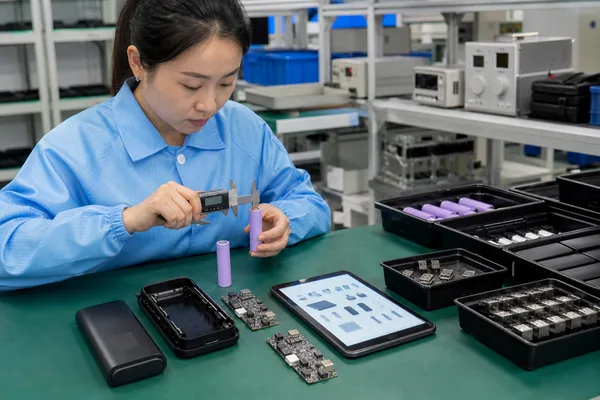
Définissez les modifications interdites, préapprouvées ou soumises à notification écrite et approbation de l’acheteur. Une fiche de modification proposée doit identifier l’ancienne et la nouvelle pièce, le motif, les lots concernés, les effets sur les performances et la conformité, les preuves de validation, les besoins d’échantillons et la date d’application. Le silence ne doit pas valoir approbation, sauf accord délibéré des parties sur ce processus.
Inscrivez l’obligation de maîtrise des modifications dans le contrat de fabrication OEM de batteries externes ainsi que dans la spécification technique. Le contrat régit l’obligation et les recours ; la spécification identifie la référence technique qui ne doit pas changer.
Comment approuver et diffuser la spécification
N’autorisez pas la production sur la base d’un échange de courriels non structuré. Examinez un dossier maîtrisé regroupant la spécification, le plan, la nomenclature ou la liste de composants maîtrisés, les fichiers graphiques et d’emballage, les relevés d’essais, la matrice de conformité et l’identifiant de l’échantillon approuvé.
- Regrouper les exigences. Rassembler les éléments acceptés du devis et les décisions techniques dans un seul brouillon.
- Résoudre les contradictions. Comparer le brouillon avec l’échantillon, l’étiquette, la notice, la boîte, les rapports et le bon de commande.
- Tester la configuration prévue. Consigner la cellule, la PCBA, le micrologiciel, les ports, les câbles et les accessoires utilisés.
- Clore les points ouverts. Attribuer à chaque écart un responsable, une échéance et les justificatifs requis.
- Approuver des références concordantes. Signer la spécification et identifier, si possible, au moins deux échantillons de référence concordants.
- Référencer la version diffusée. Indiquer la révision de la spécification et l’identifiant de l’échantillon dans le bon de commande et l’instruction d’inspection.
- Maîtriser les modifications ultérieures. Mettre à jour la révision et répéter les examens concernés avant application.
Le guide de contrôle pour l’approbation des échantillons de batteries externes explique comment établir le dossier de l’échantillon de référence. Un échantillon étaye la spécification ; il ne doit pas remplacer des limites écrites pour les composants internes ou les performances mesurées.
Modèle de spécification produit pour batterie externe prêt à copier
Utilisez ce modèle comme trame de travail, puis ajoutez les plans, tableaux et méthodes d’essai du modèle choisi. Les responsables de l’ingénierie, de la qualité et de la conformité doivent examiner les champs relevant de leur responsabilité.
SPÉCIFICATION PRODUIT — BATTERIE EXTERNE

MAÎTRISE DOCUMENTAIRE
Entreprise acheteuse :
Fournisseur / site de fabrication :
Numéro de document :
Révision et date :
Statut :
SKU de l’acheteur :
Modèle de l’usine :
Rédigé / vérifié / approuvé par :
Bon(s) de commande concerné(s) :

PROJET ET MARCHÉ
Type de projet : marque propre / OEM configuré / ODM
Marché(s) de destination :
Canal de vente et utilisation prévue :
Importateur / opérateur économique responsable :
Produit et accessoires inclus :
Fonctions ou allégations exclues :

IDENTIFICATION DU PRODUIT
Code de variante / couleur / capacité :
Dimensions du produit et tolérances :
Poids fini et tolérance :
Matériaux du boîtier et de la structure :
Finition de surface et référence physique de couleur :
Numéro et révision du plan maîtrisé :

BATTERIE
Fabricant et modèle exact des cellules :
Chimie et format :
Quantité et configuration des cellules :
Tension nominale :
Base de capacité assignée / minimale :
Capacité nominale (mAh) :
Énergie nominale (Wh) :
Règle relative au code de date et au lot des cellules :
Contrôle à réception et traçabilité :
Cellules alternatives approuvées :
Méthode et limite d’acceptation de durée de vie en cycles, si requises :

ENTRÉES, SORTIES ET CÂBLES FILAIRES
Nom de l’interface et connecteur :
Entrée / sortie / bidirectionnelle :
Profils fixes tension/courant requis :
Plage PPS requise, si applicable :
Puissance maximale d’entrée et de sortie :
Référence, longueur et caractéristiques assignées du câble fourni :
Construction du câble intégré et méthode d’essai de durabilité :
Méthode de capture du protocole et d’essai sous charge maintenue :

MATRICE DES MODES DE FONCTIONNEMENT
Comportement avec un seul port :
Répartition avec deux ports / plusieurs ports :
Comportement en charge traversante :
Mode faible courant :
Démarrage et arrêt automatiques :
Comportement du bouton / des LED / de l’écran :
Révision du micrologiciel ou du contrôleur :

FONCTIONS SANS FIL ET MAGNÉTIQUES
Mode sans fil requis / statut de certification :
Conditions d’entrée et récepteur(s) d’essai :
Position de la bobine et tolérance d’alignement :
Disposition des aimants et méthode de mesure de la force de maintien :
Conditions de compatibilité avec la coque :
Fonctionnement simultané filaire + sans fil :
Méthode de mesure thermique et limites :

PROTECTION ET FIABILITÉ
Essai de surcharge / décharge excessive :
Essai de surintensité / court-circuit :
Comportement en surchauffe :
Essai thermique à charge maximale :
Essais de chute / vibration / mécanique :
Essais de cycles des connecteurs / boutons / supports / fiches :
Exigence de vieillissement ou de déverminage en production :

APPARENCE ET FINITION
Méthode, taille, couleur et position du logo :
Limites de jeux / désaffleurements :
Limites de rayures, bosses et contamination :
Critères de défauts d’impression et de couleur :
Identifiant de l’échantillon d’apparence approuvé :
Fichier de photographies de référence :

FICHIERS GRAPHIQUES ET EMBALLAGE
Fichier et révision de l’étiquette signalétique :
Fichier et révision de la boîte de vente :
Langue, fichier et révision de la notice :
Règle de code-barres / QR / numéro de série / code de lot :
Accessoires inclus :
Unités par carton intérieur et carton principal :
Dimensions du carton et poids brut maximal :
Révision du fichier graphique du carton et des marquages de transport :

DOSSIER DE CONFORMITÉ ET DE TRANSPORT
Matrice de conformité du marché cible :
Références des rapports / certificats / déclarations requis :
Modèles et configurations exacts couverts :
Référence du résumé d’essais UN 38.3 :
Justificatifs de sécurité de la batterie / du produit :
Responsabilité des documents d’expédition :
Modifications nécessitant un réexamen de l’applicabilité ou un nouvel essai :

QUALITÉ ET ACCEPTATION
Document de méthode d’essai et révision :
Taille d’échantillon pour chaque essai de performance :
Matériel et conditions de mesure :
Tolérances de performance et seuils de réussite ou d’échec :
Norme d’inspection et édition :
Définition du lot et niveau / régime d’inspection :
Définition des défauts critiques / majeurs / mineurs :
Valeurs AQL et nombres d’acceptation / rejet :
Processus de traitement des lots refusés, de retouche et de réinspection :
Relevés d’inspection et d’essai requis :

MAÎTRISE DE LA CONFIGURATION ET DES MODIFICATIONS
Révision de la nomenclature approuvée :
Liste des composants maîtrisés :
Révisions approuvées de la PCBA et du micrologiciel :
Alternatives interdites / préapprouvées :
Processus de notification des modifications techniques :
Cas nécessitant échantillons, validation et nouvelle approbation :

AUTORISATION DE PRODUCTION
Identifiant(s) des échantillons de référence :
Référence du rapport d’essai approuvé :
Dossier graphique approuvé :
Dossier de conformité approuvé :
Points ouverts et conditions :
Approbation de l’acheteur / date :
Approbation du fournisseur / date :

HISTORIQUE DES RÉVISIONS
Révision / date / description / approbateur :
Erreurs fréquentes dans les spécifications de batteries externes
- Copier une page de catalogue et la présenter comme la spécification de production
- N’indiquer que les mAh, sans tension nominale, Wh, identification des cellules ni base de capacité
- Utiliser « USB-C PD » sans profils, plage PPS, sens de fonctionnement ni justificatifs d’essai
- Présenter la somme des puissances maximales des ports comme une sortie simultanée
- Approuver un échantillon de boîtier avant l’installation de la cellule, de la PCBA ou du micrologiciel définitifs
- Laisser l’étiquette, la notice et la boîte afficher des caractéristiques différentes
- Énumérer des sigles de certificats sans relier les rapports au SKU exact
- Écrire « inspection AQL » sans classes de défauts, détails d’échantillonnage ni mesures en cas de refus
- Autoriser des composants équivalents sans processus défini de modification et de validation
- Conserver les décisions finales uniquement dans les messages au lieu d’émettre une nouvelle révision
Questions fréquentes
Que doit contenir une spécification produit pour batterie externe ?
Incluez l’identification du document, le SKU exact, le marché, la cellule et l’énergie de la batterie, les profils des ports, le fonctionnement en sortie partagée, le micrologiciel, les fonctions sans fil, les essais de protection et de fiabilité, les dimensions, les matériaux, les fichiers graphiques, l’emballage, les références de conformité, les critères d’acceptation, les composants maîtrisés et les règles de modification.
La fiche technique du fournisseur suffit-elle pour une commande OEM ?
Généralement non. La fiche technique peut décrire une famille de modèles ou des valeurs typiques. Une spécification OEM doit identifier la variante commandée, les composants approuvés, les tolérances, les fichiers graphiques, l’emballage, les méthodes d’essai et les règles de modification en production.
Qui doit préparer la spécification de la batterie externe ?
L’usine fournit normalement les données du modèle et de conception, tandis que l’acheteur définit le marché, le marquage, l’acceptation commerciale et les exigences propres au client. L’ingénierie, la qualité, la conformité et les achats doivent examiner leurs champs respectifs. L’acheteur et le fournisseur doivent tous deux approuver la révision diffusée.
L’échantillon de référence remplace-t-il la spécification écrite ?
Non. L’échantillon de référence est un repère physique, mais il ne révèle pas chaque pièce interne et ne définit pas les tolérances d’essai. Reliez son identifiant à la spécification écrite, à la nomenclature ou à la liste de composants maîtrisés, aux fichiers graphiques et au rapport d’essai.
Chaque couleur ou capacité doit-elle avoir son propre SKU ?
Chaque configuration commercialisable doit être identifiée sans ambiguïté. Des SKU distincts conviennent lorsque la capacité, la cellule, la couleur, le câble, les fichiers graphiques, le marché ou l’emballage changent. Une matrice de variantes maîtrisée peut partager les exigences communes tout en identifiant chaque différence autorisée.
L’usine peut-elle changer une cellule après l’approbation de la spécification ?
Uniquement selon le processus convenu de maîtrise des modifications. La cellule proposée doit être identifiée et examinée quant à sa capacité, ses performances électriques, sa fiabilité, sa traçabilité, sa sécurité et ses effets sur la conformité. L’acheteur peut exiger des échantillons, de nouveaux essais et une approbation écrite avant application.
Quand faut-il figer la spécification ?
Diffusez la révision de production après l’approbation de la configuration prévue, des performances critiques, des fichiers graphiques et des justificatifs requis. Tout achat de matériaux ou démarrage de production antérieur doit être traité comme un risque documenté, et non comme l’acceptation automatique d’exigences inachevées.
À quelle fréquence faut-il actualiser une spécification de batterie externe ?
Actualisez-la dès qu’une exigence approuvée, un composant, un plan, un micrologiciel, une méthode d’essai, un fichier graphique ou d’emballage, ou une base de conformité change. Émettez une nouvelle révision, consignez le motif et identifiez les bons de commande et lots de production qui l’utilisent.
Sources officielles de référence
- Bibliothèque documentaire USB-IF : spécifications USB Power Delivery et documents d’essai
- Wireless Power Consortium : spécifications Qi et ressources sur les produits certifiés
- IEC 62133-2:2017 avec amendement 1:2021 : sécurité des cellules et batteries au lithium portables
- CEE-ONU : Manuel d’épreuves et de critères de l’ONU, révision 8 et amendement 1
- ISO 2859-1:2026 : plans d’échantillonnage indexés sur l’AQL pour l’inspection lot par lot
- EUR-Lex : règlement (UE) 2023/1542 relatif aux batteries et aux déchets de batteries
- Guide IATA sur les batteries au lithium et au sodium-ion pour la réglementation 2026
Les normes, réglementations, programmes d’essai et instructions de transport évoluent. Confirmez l’édition en vigueur, l’applicabilité et les dates d’entrée en application pour le produit, la destination et l’expédition exacts avant d’approuver la production.
Préparer la batterie externe sélectionnée pour une production maîtrisée
Lorsque vous contactez YULIDA, indiquez le modèle sélectionné, la quantité commandée, le marché cible, les fonctions de charge, les fichiers de marquage, le périmètre d’emballage et les exigences d’essai de l’acheteur. Ces éléments permettent à l’usine de fournir les données du modèle, les informations d’échantillonnage et les références de production pertinentes pour le dossier de spécification.
Consultez le périmètre des services OEM/ODM de batteries externes ou contactez YULIDA pour un projet de 500, 1 000 ou 2 000 pièces. La MOQ finale, le périmètre de spécification, la démarche d’échantillonnage, la documentation et les délais dépendent de la plateforme choisie et des modifications demandées.
Sources officielles et vérification
Ces sources primaires étayent les informations de cet article concernant les normes, la compatibilité, la sécurité ou le transport. Vérifiez les exigences en vigueur pour le modèle exact et le marché de destination.
- USB Implementers Forum — Spécifications et recommandations USB Type-C et USB Power Delivery.
- Wireless Power Consortium — Normes Qi et Qi2, certification et informations sur la recharge sans fil.
- Commission électrotechnique internationale — Normes électrotechniques internationales et leurs domaines d’application.
- Association du transport aérien international — Exigences de transport des batteries au lithium et recommandations du secteur.
