






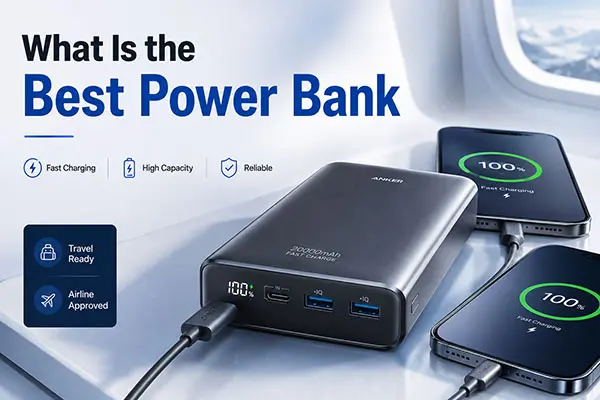
What Is the Best Power Bank for Wholesale Orders? Buyer Checklist
For wholesale buyers, the best power bank is the model and supplier that match the intended devices, sales market, order volume and support requirements. Compare the approved specification, sample performance, documentation, delivery terms and after-sales process before committing to a bulk order.
This guide explains how to compare capacity, charging features, supplier capability and compliance evidence. A supplier’s reputation or a product’s feature list should be checked against the exact configuration you plan to buy.
Start with the intended use and a written specification
Define the devices customers will charge, required USB-C and USB-A outputs, input power, simultaneous-output behavior, cable functions, wireless compatibility, size and weight. Ask the supplier to list each supported voltage and current profile rather than rely on a single maximum-wattage claim.
For magnetic or wireless models, confirm compatible devices and cases, the certified product identity where applicable, alignment requirements and thermal limits. A magnetic attachment feature by itself does not establish a charging certification or a particular charging speed.
Check capacity at the stated voltage
A power bank’s cell capacity and USB output capacity describe different electrical conditions. Compare energy in watt-hours, or compare capacity only when the voltage and test conditions match. For example, a battery rated at 10,000mAh at 3.7V stores 37Wh. At a constant 5V output, that is an ideal maximum of 7,400mAh before conversion losses and the power bank’s own consumption. Actual output depends on the model, load, temperature, cutoff settings and battery condition.
As a real product example, Xiaomi lists its P15ZM power bank at 37Wh (3.7V, 10,000mAh), with a rated output capacity of 5,500mAh at 5V/3A. This is a model-specific specification, not a universal acceptance threshold.
Before a bulk order, request the cell or pack voltage, rated energy, rated output capacity and test method. Fully charge a production-representative sample, discharge it with suitable measurement equipment at the specified output voltage and load, and record output energy in Wh as well as capacity in mAh. Compare the result with the supplier’s stated rating under matching conditions. A lower USB-output mAh figure than the cell mAh rating is not, by itself, evidence of false labeling.
For sample checks, use this resource: power bank quality-testing checklist to organize sample identification, measurements and approval records.
Compare suppliers using evidence
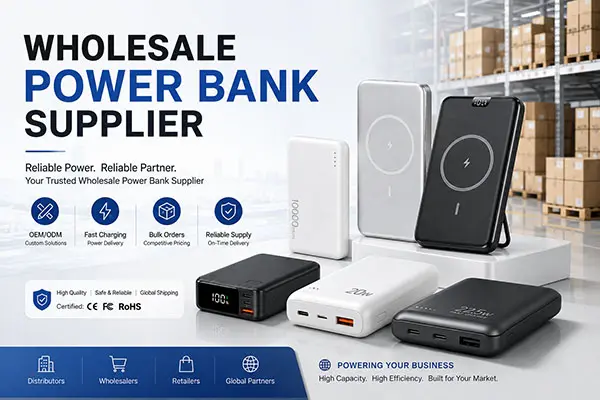
Use the same request for quotation with each candidate. Record missing information as unconfirmed and ask for supporting material before comparing prices.
| What to evaluate | Evidence to request |
|---|---|
| Company and manufacturing role | Legal entity, factory address, manufacturing scope and the relationship between the contracting company and production site. |
| Product configuration | Model, capacity variant, cell or pack specification, PCB and firmware revision, port profiles and approved accessories. |
| Quality control | Incoming, in-process and final inspection plans, sample records, calibration controls, traceability and defect-handling procedure. |
| Compliance scope | Current model-matched reports and declarations, certificate status, covered variants and target-market requirements. |
| Customization | Approved artwork, material and color choices, tooling ownership, change-control process and golden sample. |
| Commercial terms | MOQ, unit price, one-time charges, lead time, Incoterm, warranty and claims process. |
Years in business, customer logos and generic certificate images do not establish the performance of your order. Verify the evidence for the production platform you are buying. The manufacturer-verification checklist provides a practical starting point.
Review compliance for the exact product and market
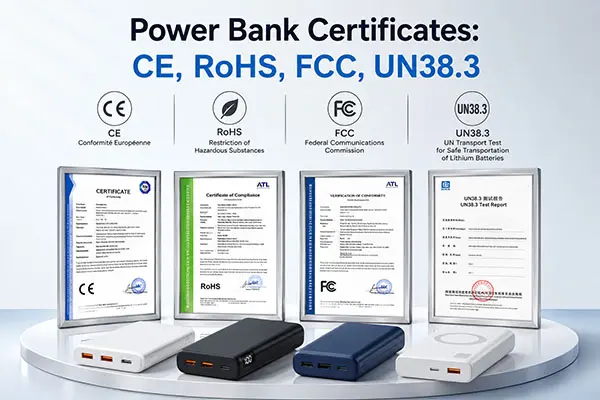
Prepare a requirement list with the importer and responsible laboratory or certification body. Safety standards, electromagnetic compatibility, radio functions, substance restrictions, battery obligations and labeling may apply differently depending on the design and destination.
For the EU, determine the applicable legislation for the complete product, including its electrical ratings, radio functions and supplied accessories. Request the corresponding conformity documentation for the exact model. The European Commission’s Low Voltage Directive guidance sets its voltage scope at 50–1,000V AC or 75–1,500V DC; a low-voltage standalone power bank is not automatically within that scope.
For China, confirm the applicable CCC rules, the certificate’s current status and the transition plan for GB 47372-2026. Our new power bank standard guide explains the published standard and its implementation date. For other markets, confirm the exact applicable requirements rather than reuse a universal certification list.
EU battery labeling dates need individual checks
Under Article 13 of Regulation (EU) 2023/1542, general and capacity labels apply from August 18, 2026 or 18 months after the relevant implementing act enters into force, whichever is later. The QR-code requirement starts February 18, 2027. A QR code is not the same as the battery passport, which Article 77 requires for EV batteries, LMT batteries and industrial batteries above 2kWh. Confirm the current rules for the exact product and placing-on-market date before approving labels.
Air cargo and passenger rules are separate
For commercial air cargo, lithium-ion power banks are classified as UN3480 and follow the applicable PI965 requirements. Obtain the model-matched UN38.3 test summary and confirm state of charge, packing, marking, documentation and carrier restrictions with a qualified dangerous-goods shipper. IATA’s 2026 battery guidance covers classification and transport requirements. Passenger carry-on rules are separate; see FAA PackSafe guidance and the airline’s current policy.
Avoid common sourcing mistakes
- Comparing only unit price: Check the cell, output profiles, accessories, packaging, documents, inspection and freight scope before treating quotations as equivalent.
- Comparing mAh at different voltages: Use Wh and matching test conditions. Do not use 8,000–9,000mAh as a universal USB-output threshold for a 10,000mAh cell rating.
- Assuming a BMS feature proves safety: Request the protection design, applicable test method and model-matched results. Abnormal-condition and destructive testing belongs in a suitably equipped laboratory.
- Approving changes informally: Record the cell, PCB, firmware, materials, artwork and packaging in the approved specification. Require review of substitutions before production.
- Leaving logistics until dispatch: Confirm the route, documentation, packaging and carrier acceptance before the order is ready to ship.
Prepare a useful YULIDA quotation request
Send the target market, devices, required capacity and energy, port profiles, wireless or built-in cable requirements, quantity, branding, packaging, documents and delivery date. YULIDA’s starting MOQ tiers are 500 pieces for standard products, 1,000 pieces for light customization and 2,000 pieces for deeper customization. Confirm the model-specific scope and any tooling requirements in writing.
For this RFQ, review these resources: OEM/ODM service scope, quality-control process and custom power bank cost guide. Then request a model-specific quotation and supporting documents. Product performance and certification remain subject to the exact ordered configuration and evidence.
Frequently asked questions
1. What is the MOQ for a YULIDA wholesale power bank order?
YULIDA’s starting MOQ tiers are 500 pieces for standard products, 1,000 pieces for light customization and 2,000 pieces for deeper customization. Confirm the selected model, packaging, tooling and other project-specific requirements in the written quotation.
2. Can a supplier support OEM or ODM branding?
Ask which changes are available for the selected platform: logo, color, packaging, cables, ports, electronics or enclosure. Approve the exact specification and sample before production; a general OEM/ODM claim does not confirm every requested change.
3. How long will a bulk power bank order take?
Obtain a model-specific schedule covering sample approval, components, artwork, tooling, testing and production. Confirm when the lead-time clock starts and which changes or document requirements could affect delivery.
4. What compliance documents should a supplier provide?
The required documents depend on the exact product, destination market and sales channel. Request model-matched safety and transport evidence, applicable declarations and reports, and verify certificate scope and status rather than accepting a generic collection of logos.
5. How can I verify a power bank’s capacity?
Fully charge a production-representative sample, discharge it at the specified output voltage and load, and record energy in Wh and capacity in mAh. Compare the results with the exact model’s rated output under matching temperature, cutoff and battery-condition requirements.
6. How do cell capacity and USB output capacity differ?
Capacity in mAh must be stated with its voltage. A 10,000mAh battery at 3.7V stores 37Wh. At 5V, that equals an ideal 7,400mAh before conversion losses and the power bank’s own consumption. A lower USB-output mAh figure alone does not prove false labeling.
7. What should buyers check before shipping power banks by air?
For commercial air cargo, lithium-ion power banks are classified as UN3480 and follow the applicable PI965 requirements. Obtain the model-matched UN38.3 test summary and confirm state of charge, packing, marking, documentation and carrier restrictions with a qualified dangerous-goods shipper. Passenger carry-on rules are separate.
Technical and regulatory references reviewed October 11, 2026. Confirm current requirements and document scope before purchase or shipment.
Official sources and verification
These primary sources support standards, compatibility, safety, or transport statements discussed in this article. Confirm the current requirement for the exact product model and destination market.
- International Air Transport Association — Lithium-battery transport requirements and industry guidance.
- FAA PackSafe — Passenger baggage guidance for power banks and spare lithium batteries.
