




What Is the Best Wireless Magnetic Power Bank? A B2B Buyer’s Guide
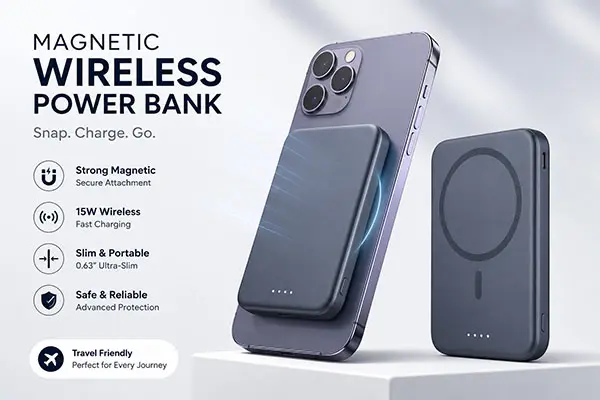
The best wireless magnetic power bank combines a verified wireless-charging standard, capacity and output matched to the intended use, stable magnetic alignment, and model-specific safety and transport evidence. For B2B buyers, “best” also means consistent production, documented quality control, responsive OEM/ODM support, and a competitive total cost beyond the FOB price.
Search results for the “best wireless magnetic power bank” are dominated by consumer reviews. They rank models by how fast they charge an iPhone or whether they look good on a desk. That framework works for end users shopping on Amazon. It falls short for the importers, brand owners, and corporate gift buyers who source thousands of units at a time.
As a manufacturer at YULIDA Power, we see the gap firsthand. A distributor who picks a model based on a 4.5-star rating can still end up with a 4% return rate, a batch that fails customs inspection, or a product that loses Qi2 certification mid-production. The criteria that actually matter at scale are different from what consumer reviewers test.
The global magnetic wireless power bank market is projected to grow from $1.85 billion to $3.79 billion at a CAGR of 10.8%, according to magnetic wireless power bank market research from QYResearch. That growth is pulling in new buyers who need a procurement framework, not another top-ten list.
This guide is that framework — seven criteria, buyer-type recommendations, a specs comparison, factory vetting steps, and sourcing FAQs. If you are asking what is a magnetic power bank and which one is best for your business, the answer starts with measurable procurement standards, not star ratings.
What Makes a Wireless Magnetic Power Bank “The Best”? 7 B2B Evaluation Criteria
For B2B procurement, the best wireless magnetic power bank is defined not by aesthetics or marketing claims but by measurable specifications that affect your cost, compliance, and customer satisfaction. Here are the seven criteria that matter when you are buying at scale.
Qi2 Certification: The Non-Negotiable Baseline
Qi2 is the Wireless Power Consortium’s latest open standard. It uses Magnetic Power Profile (MPP) technology to deliver 15W wireless charging to compatible iPhones, up from the 7.5W cap that older Qi chargers were limited to with Apple devices. This is not a minor spec bump. It cuts charging time by roughly 40% and enables true alignment-based efficiency.
The Qi Certified Product Database currently lists over 2,665 Qi2-certified products across all categories. Power banks account for 22.85% of that total, with 609 certified models from 264 brands. That number is growing rapidly, and it signals a clear market direction: retailers and carriers increasingly require Qi2 certification for shelf placement.
Qi2 certification carries two direct cost implications for your procurement budget. First, certification adds $1.50 to $3.00 per unit to FOB cost, covering WPC membership fees ($18,000 per year for adopter members) and authorized lab testing. Second, uncertified products labeled “Qi2 compatible” face rejection from premium retail channels in North America and Europe. A product without a valid WPC registration number cannot legally display the Qi2 logo.
If you are sourcing wireless power bank compatibility for multi-device markets, Qi2 is the baseline that ensures your product works across iPhone 12 and newer, plus Qi2-compatible Android devices.
Battery Capacity and Real-World Energy Delivery
A 10,000mAh power bank does not deliver 10,000mAh to a phone. Conversion efficiency through the wireless charging coil, voltage regulation, and thermal losses typically reduces usable output to 55 to 60% of rated capacity. A 10,000mAh unit realistically delivers 5,500 to 6,000mAh to a device. A 5,000mAh unit delivers about 2,750 to 3,000mAh, roughly one full charge for a standard smartphone.
The capacity decision should be driven by your target market segment:
- Daily commuter segment: 5,000mAh is the sweet spot. Slim form factor, single full charge, easy pocket carry.
- Travel and heavy-use segment: 10,000mAh provides two to three full charges. Slightly thicker but still pocketable.
- Corporate gift segment: 5,000mAh at a lower price point maximizes customization budget for branding.
Battery cell chemistry also affects your B2B decision. Lithium-polymer (Li-Po) cells dominate the market due to their thin profile and reasonable cost. Semi-solid state batteries are emerging as a premium option, offering better energy density and safety margins.
LFP (lithium iron phosphate) cells provide superior cycle life (2,000+ cycles vs. 300 to 500 for Li-Po) but are heavier and less common in slim magnetic designs. For most consumer-facing magnetic power banks, Li-Po remains the practical B2B choice, with semi-solid as an upgrade path for premium positioning.
Magnetic Alignment Strength and Precision
The magnetic system is what separates a magnetic power bank from a standard wireless pad. Without proper alignment, charging efficiency drops by 15 to 25% and heat generation increases significantly.
The industry standard for magnetic power banks uses N52 or N52H grade neodymium (NdFeB) magnets. N52 offers the strongest magnetic force at room temperature, while N52H maintains performance under higher heat conditions, making it preferable for devices that run warm during wireless charging.
For procurement specifications, the key metric is pull force. A quality magnetic wireless power bank should deliver:
- Bare phone: minimum 8N pull force to prevent slipping during use
- Phone with case: minimum 10N pull force to maintain alignment through case matterial
- Magnetic ring precision: coil-to-coil alignment within 1.5mm tolerance
Weak magnets cause two problems in the field. The power bank shifts during use, interrupting charging and triggering the foreign object detection (FOD) safety cutoff. And misaligned coils waste energy as heat, which reduces battery lifespan and triggers thermal throttling.
At YULIDA, we have tested magnets from over a dozen suppliers. The difference between a genuine N52 magnet array and a lower-grade alternative is immediately visible in alignment consistency testing. We specify N52H across our magnetic product line because the thermal stability margin matters during sustained 15W charging sessions.
Thermal Management Architecture
Wireless charging is inherently less efficient than wired charging. Energy loss through the wireless coil runs 20 to 30%, compared to approximattely 10% for wired USB-C PD. That lost energy converts to heat, and heat is the primary enemy of lithium battery lifespan and user safety.
There are two approaches to thermal management in magnetic power banks:
Passive cooling uses thermally conductive matterials like graphene films, aluminum backings, and thermal silicone pads to dissipate heat away from the coil and battery. This is the standard approach for slim consumer designs. Graphene thermal films can reduce surface temperature by 5 to 8 degrees Celsius compared to designs without dedicated thermal management.
Active cooling adds a micro-fan or Peltier element. This is rare in power banks due to thickness and noise constraints, but some gaming-oriented models use it.
The critical question is not which thermal approach the factory uses but whether they can prove it works. Request third-party thermal test reports showing surface temperature measurements during sustained 15W charging at full battery capacity. A well-designed unit should maintain surface temperature below 42 degrees Celsius during continuous operation. If a supplier cannot provide thermal data, that is a red flag.
Safety Certification Stack
Safety certifications are not optional for international distribution. They are legal requirements that determine whether your shipment clears customs and whether your product can be sold on major platforms.
The essential certification stack for a magnetic power bank includes:
| Certification | Purpose | Market Scope |
|---|---|---|
| CE | Product safety compliance | European Union |
| FCC | Electromagnetic compliance | United States |
| RoHS | Hazardous substance restriction | EU + others |
| UN38.3 | Battery transport safety | Global shipping |
| UL 2056 | Battery system safety | North America premium |
Each certification adds cost and time. CE and FCC together typically add $0.50 to $1.50 per unit. UN38.3 testing adds $300 to $500 per battery model (amortized across the batch). UL 2056 is the most expensive, often adding $2 to $4 per unit, but it opens doors to premium North American retail accounts that require it (see UL’s battery safety testing program for certification scope).
Missing certifications create real business risk. Shipments without UN38.3 can be detained by air freight carriers. Products without CE marking face customs seizure at EU borders. Amazon and other platforms increasingly require FCC documentation for listing approval, and products pulled for non-compliance face account-level penalties.
The IEC 62368-1 safety standard is the underlying technical standard that most of these certifications reference. Understanding it helps you evaluate whether a factory’s safety testing is genuine or surface.
OEM/ODM Customization Depth
B2B buyers rarely want a cookie-cutter product. The ability to customize packaging, branding, and even hardware specifications is a core differentiator when choosing a manufacturer.
Customization typically falls into three tiers:
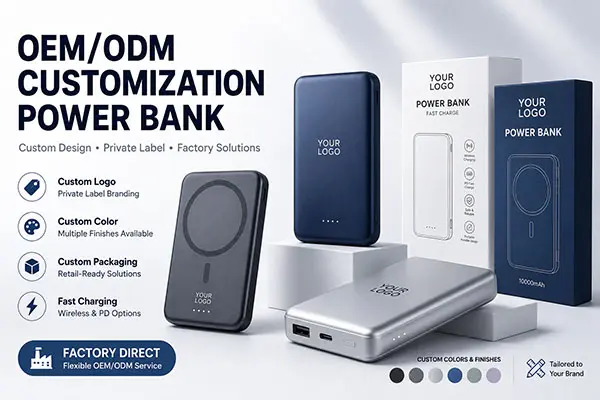
Standard OEM (MOQ: 500 units, lead time: 15 to 20 days): Your logo on an existing product model with standard specifications. This is the fastest and lowest-cost entry point. The factory provides an existing certified platform, and you add branding.
Light Customization (MOQ: 1,000 units, lead time: 20 to 25 days): Beyond logo printing, you can adjust packaging design, include a custom manual, add a gift box, or modify color schemes. The core hardware remains standard, but the presentation is tailored to your brand.
Deep ODM (MOQ: 2,000 units, lead time: 30 to 35 days): You define the product. Custom mold design, unique form factor, specific battery capacity, integrated cables, kickstand features, or proprietary color Pantones. The factory handles tooling, prototyping, and certification under your brand.
A European distributor learned this the hard way. They ordered a standard OEM run of 2,000 units, only to discover that three competitors at the same retail trade show were selling identical units with different logos. The product was technically fine, but the lack of differentiation killed their premium pricing strategy.
They switched to a light customization tier on their next order, adding a unique gift box and integrated cable design. Same factory, slightly higher MOQ, but their retail partners saw a distinct product rather than a commodity.
Explore our OEM/ODM manufacturing services to understand which customization tier fits your procurement timeline and budget.
Total Cost of Ownership Beyond FOB Price
FOB price is the starting point, not the finish line. The true cost of a magnetic power bank procurement includes:
- FOB unit cost: $5 to $22 depending on capacity, features, and customization
- Certification amortization: $0.50 to $4.00 per unit depending on cert stack
- Freight and logistics: 8 to 15% of FOB cost by sea, 25 to 40% by air
- Return rate cost: The hidden killer
The return rate differential between quality and budget suppliers is dramatic. Tier-1 manufacturers with proper quality control maintain defect rates below 0.3%. Budget suppliers cutting corners on cells, magnets, or assembly can see return rates exceed 3%. At a 2,000-unit order, that is the difference between 6 returns and 60 returns.
Each return costs you not just the product replacement but also reverse logistics, customer service time, and reputational damage. A buyer we work with in the Middle East initially sourced from the lowest bidder. Their FOB price was 30% below market average. Within six months, their return rate hit 4.2%. The cost of processing returns, issuing refunds, and managing customer complaints erased their entire savings and then some. They switched to a mid-tier supplier (YULIDA) with a 0.2% defect rate. The higher FOB price was recovered within one quarter through reduced after-sales costs.
Want to see how YULIDA’s quality standards translate to real TCO savings? Browse YULIDA’s magnetic power bank product catalog and request a sample to benchmark against your current supplier.
Best Wireless Magnetic Power Bank by Buyer Type
Different buyer types need different specs. Here is what matters for each segment.
For Importers and Distributors
Importers and distributors need volume, consistency, and broad market appeal. The recommended specification is a 10,000mAh Qi2-certified unit with 15W wireless output and 20W USB-C PD wired output. This dual-mode approach ensures compatibility with the widest range of devices, from iPhone 12+ to Samsung Galaxy S25 to Google Pixel.
The FOB price range for this configuration runs $8 to $14 per unit at a 1,000-unit MOQ. The dual charging mode is a key selling point because it covers users who want wireless convenience and users who need fast wired charging in one SKU. Distributors who carry a single well-specced model can serve multiple retail channels without fragmenting their inventory.
For Brand Owners (Private Label)
Brand owners need differentiation. Upgrading to a 10,000mAh Qi2 unit with an integrated charging cable, a built-in phone stand, and premium packaging creates a product that stands apart on retail shelves and justifies a higher price point.
FOB pricing for this configuration ranges from $14 to $22 per unit. The integrated cable eliminates the most common user complaint (forgotten cables), and the stand adds functionality that converts the power bank from a battery into a desktop accessory. For private label brands targeting premium positioning, these features are worth the additional cost.
For Corporate Gift Buyers
Corporate gift buyers prioritize cost efficiency, portability, and branding space. A 5,000mAh Qi2 unit in an ultra-thin form factor keeps FOB cost in the $5 to $8 range, leaving budget for custom logo printing, branded packaging, and gift presentation.
The slim profile of a 5,000mAh magnetic power bank (typically 8 to 12mm thick) makes it an ideal corporate gift item. It fits in a greeting card envelope, slides into a conference swag bag, and sits unobtrusively on a desk. For bulk corporate orders, the combination of useful technology, compact size, and customization potential is hard to beat.
Top Wireless Magnetic Power Bank Specs Comparison
The table below compares specification ranges across three product positioning tiers. Think of these as procurement reference ranges, not a brand ranking.
| Spec Dimension | Daily Commuter | Travel Premium | Corporate Gift |
|---|---|---|---|
| Capacity | 5,000mAh | 10,000mAh | 5,000mAh |
| Wireless Output | Qi2 15W | Qi2 15W | Qi2 15W |
| Wired Output | USB-C 20W PD | USB-C 20W PD + integrated cable | USB-C 18W |
| Magnet Grade | N52 | N52H | N52 |
| Thickness | 8 to 12mm | 14 to 18mm | 8 to 12mm |
| Weight | 90 to 130g | 200 to 280g | 90 to 130g |
| Certifications | CE, FCC, RoHS, UN38.3 | CE, FCC, RoHS, UN38.3, UL 2056 | CE, FCC, RoHS, UN38.3 |
| FOB Price Range | $5 to $8 | $14 to $22 | $5 to $8 |
How to Evaluate a Wireless Magnetic Power Bank Factory
Choosing the right product specification is half the battle. Choosing the right factory to produce it is the other half. A great spec sheet means nothing if the factory cannot maintain consistency across a 5,000-unit run.
5-Step Supplier Vetting Process
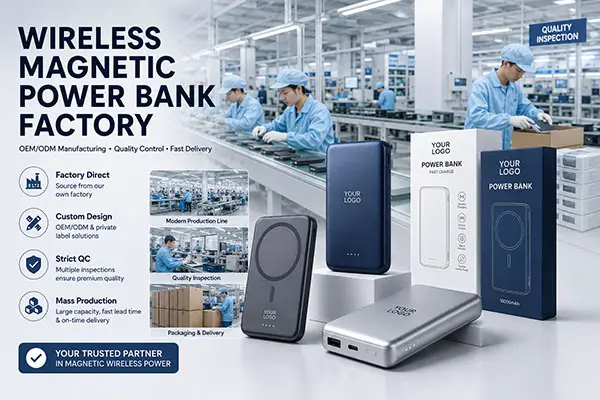
- Verify factory certifications. ISO 9001 quality management certification is the minimum. BSCI (Business Social Compliance Initiative) audit compliance is increasingly required by European retail buyers. Request current certificates and verify them against the issuing body’s database. Expired or forged certificates are more common than you might expect.
- Request third-party thermal test reports. A factory that has invested in proper thermal engineering will have test data ready. Ask for reports from independent labs (not the factory’s own quality department) showing surface temperature readings during sustained 15W wireless charging. The data should cover multiple ambient temperatures and include infrared thermal imaging.
- Check battery cell suppliers. Tier-1 cell manufacturers include ATL (Amperex Technology Limited), CATL (Contemporary Amperex Energy Technology), BYD, and Samsung SDI. These suppliers provide traceable batch numbers, matterial safety data sheets, and consistent quality. If a factory uses unbranded cells or cannot identify their cell supplier, walk away. The battery cell is 40 to 60% of the product’s cost and 90% of its safety risk.
- Confirm aging test protocols. Quality factories perform 72-hour burn-in (aging) tests on production units before packaging. This catches early-life failures that would otherwise become customer returns. Ask to see the aging test area during a factory audit. A factory without aging test equipment is skipping a critical quality gate.
- Start with a 500-unit trial order. Before committing to a 5,000 or 10,000-unit production run, validate the factory with a smaller batch. Test the units yourself. Run them through your own quality acceptance protocol. If the trial batch has issues, you have limited your exposure. If it passes, you proceed with confidence.
For a broader view of the manufacturing landscape, our guide to top wireless power bank factories covers evaluation criteria in depth.
Red Flags That Signal a Bad Supplier
Watch for these warning signs during your supplier evaluation:
- “Qi2 compatible” with no WPC registration number. This means the product has not been officially certified. The factory is using the Qi2 name without paying for testing. Your products will not have a valid Qi2 ID and cannot legally display the Qi2 logo.
- Refusal to provide battery cell batch information. If the factory cannot tell you who made the cells inside their product, they are either using low-grade cells or sourcing from unregulated suppliers. Either way, your safety liability exposure increases.
- No aging test equipment on site. Visit the factory. If there is no burn-in testing area with racks of charging units, quality control is surface.
- Quotes 30%+ below market average. If everyone else is quoting $10 to $14 for a 10,000mAh Qi2 unit and one factory quotes $6, something is wrong. They are cutting corners on cells, magnets, certifications, or assembly quality. The savings will cost you multiples in returns and reputational damage.
Wireless Magnetic Power Bank Market Trends B2B Buyers Should Know
Procurement decisions made today need to hold up for 18 to 24 months on retail shelves. These trends shape what that shelf looks like.
Qi2.2 and 25W adoption is accelerating. The WPC has already introduced the Qi2.2 standard, which pushes wireless charging power to 25W. Qi2 certification continues to expand, with 328 member companies now participating in the WPC ecosystem. As more smartphone models support higher wireless charging speeds, power banks that only deliver 7.5W or 10W will feel increasingly outdated. Specifying Qi2 15W as your minimum ensures your procurement stays relevant.
Semi-solid state battery technology is emerging. Semi-solid state batteries offer higher energy density (more capacity in a thinner profile) and improved safety margins compared to traditional Li-Po cells. While still more expensive, the price gap is narrowing. For premium product positioning, semi-solid state is worth evaluating as a differentiator.
Android magnetic ecosystem is expanding. Samsung Galaxy and Google Pixel are adding native magnetic module support, reducing reliance on magnetic cases for alignment. This opens the Android market to magnetic power banks in a way that was not possible when only iPhone had native MagSafe. For B2B buyers, this means Qi2 magnetic power bank demand will grow beyond the Apple ecosystem, expanding your addressable market.
Integrated cable designs are becoming standard. The most common user complaint about wireless power banks is the need to carry a separate cable for wired charging or recharging the bank itself. Models with integrated USB-C cables are becoming a market expectation rather than a premium feature. Consider specifying integrated cable designs for your next procurement cycle.
Market growth trajectory remains strong. The magnetic wireless power bank market research from QYResearch projects the market to grow from $1.85 billion to $3.79 billion at a 10.8% CAGR. Global production exceeds 41 million units annually with an average price of $45 per unit and gross margins of 30 to 50% for leading manufacturers. This is a growing, profitable market with room for new entrants who get the fundamentals right.
Understanding the wireless power bank vs wireless charger distinction also helps B2B buyers position their product lines correctly for different use cases.
FAQ: What Is the Best Wireless Magnetic Power Bank? A B2B Buyer’s Guide
These are the most common questions about the best wireless magnetic power bank.
What is the best wireless magnetic power bank for iPhone?
The best wireless magnetic power bank for iPhone features Qi2-certified 15W charging, 5,000 to 10,000mAh capacity, and N52 magnetic alignment compatible with iPhone 12 and newer models. Qi2 certification is the critical factor because it unlocks full 15W charging speed on iPhones, whereas non-Qi2 chargers are limited to 7.5W. For B2B buyers sourcing iPhone accessories, specifying Qi2 certification ensures your product delivers the charging speed that iPhone users expect and that retailers increasingly require for shelf placement.
Is a magnetic wireless power bank worth it?
Yes, magnetic wireless power banks are worth it for users who value cable-free convenience and precise coil alignment, which improves charging efficiency by 15 to 25% compared to non-magnetic Qi pads. The magnetic attachment eliminates the most common wireless charging problem: misalignment causing slow or interrupted charging. For B2B buyers, the ROI calculation should factor in higher retail appeal, lower return rates (magnetic alignment reduces user-error returns), and growing market demand. The magnetic power bank buying guide covers the cost-benefit analysis in more detail.
What’s the difference between Qi2 and MagSafe?
Qi2 is an open wireless charging standard by the WPC that delivers 15W to all compatible devices, while MagSafe is Apple’s proprietary ecosystem limited to iPhone 12+ with magnetic alignment and accessory ecosystem integration. The practical difference for B2B buyers is compatibility. Qi2 works across iPhone and Android, while MagSafe is iPhone-only. Qi2 certification costs are lower because it is an open standard, and it future-proofs your product as the Android magnetic ecosystem grows. MagSafe integration adds Apple-specific licensing considerations.
Can a magnetic power bank charge Android phones?
Yes, magnetic power banks can charge Android phones wirelessly at up to 15W via Qi2, but most Android devices require a magnetic case for proper alignment unless they have native magnetic modules. Samsung Galaxy and Google Pixel are adding native magnetic support, which will gradually eliminate the case requirement. For B2B buyers targeting the Android market, bundling a magnetic case or specifying compatibility with MagSafe-compatible cases expands your addressable customer base significantly.
How long does a magnetic wireless power bank last?
A quality magnetic wireless power bank lasts 300 to 500 full charge cycles with proper battery management, retaining approximattely 80% of original capacity after 300 cycles. Battery lifespan depends on cell quality, charging habits, and the battery management system (BMS). Tier-1 cells from ATL or CATL consistently outperform unbranded alternatives. For B2B buyers, specifying a warranty period of 12 months minimum and confirming the BMS includes overcharge, over-discharge, and temperature protection is standard practice.
What capacity magnetic power bank should I buy?
For daily commuting, a 5,000mAh magnetic power bank provides one full phone charge. For travel or heavy use, 10,000mAh delivers two to three full charges while remaining pocketable. Remember that real-world usable capacity is 55 to 60% of the rated capacity due to conversion losses. A 5,000mAh unit delivers about 3,000mAh to your device, which covers most iPhone models for one charge. The 10,000mAh option is better for users who charge multiple devices or need multiple charges between wall outlets.
Are magnetic power banks safe for daily use?
Yes, magnetic power banks with CE, FCC, and UN38.3 certifications are safe for daily use, with built-in protections including overcurrent, overvoltage, and thermal shutdown safeguards. The key is sourcing from manufacturers who implement genuine safety circuits, not just certification paperwork. Ask for the BMS schematic and thermal protection test data. Common safety risks come from counterfeit cells, missing FOD (foreign object detection) circuits, and inadequate thermal management, all of which are eliminated by working with a certified manufacturer.
How do I choose a magnetic power bank manufacturer?
Choose a magnetic power bank manufacturer by verifying ISO 9001 certification, requesting third-party thermal test reports, confirming tier-1 battery cell suppliers, and starting with a 500-unit trial order. The evaluation framework is straightforward but requires diligence. Check factory audit reports, visit the production line if possible, and test samples before committing to volume. Our OEM/ODM manufacturing services page details the documentation and sample process we use to help buyers evaluate YULIDA as a manufacturing partner.
Conclusion
The best wireless magnetic power bank for B2B buyers is not the one with the highest consumer rating. It is the one that combines Qi2 15W certification, appropriate capacity for the target market, N52-grade magnets, a complete safety certification stack, and reliable OEM/ODM manufacturing with defect rates below 0.3%.
The framework matters because the market is moving fast. Qi2 is becoming the baseline, not a premium feature. The Android magnetic ecosystem is opening up. Buyers who apply these seven criteria now will be positioned to capture that growth.
Ready to source the best wireless magnetic power bank for your business? Start with a 500-unit trial order from YULIDA Power to discuss your specifications, request samples, and navigate certification requirements. Our engineering team will help you with customization options and quality assurance protocols from day one.
Official sources and verification
These primary sources support standards, compatibility, safety, or transport statements discussed in this article. Confirm the current requirement for the exact product model and destination market.
- Wireless Power Consortium — Qi and Qi2 standards, certification, and wireless-charging information.
- UL Solutions — Battery safety standards and technical safety information.
- International Electrotechnical Commission — International electrotechnical standards and standard scopes.
- Wireless Power Consortium — Qi and Qi2 standards, certification, and wireless-charging information.
