





What Is a Magnetic Wireless Power Bank? 2026’s Top 5 Features You Must Know
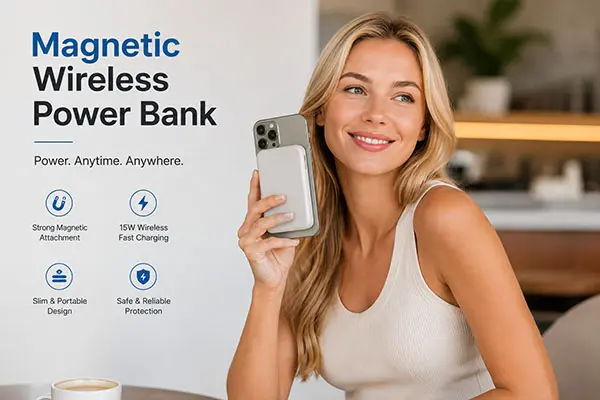
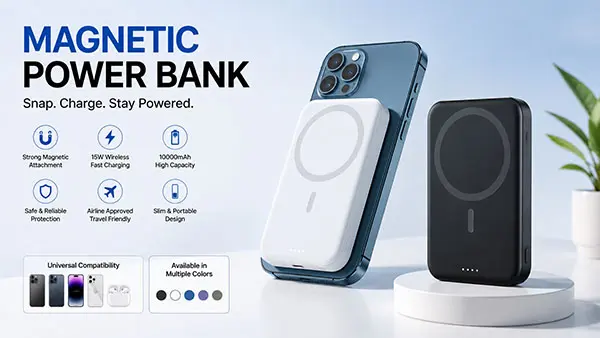
A magnetic wireless power bank is a portable battery device that combines Qi-compatible wireless charging with magnetic alignment technology, allowing it to snap securely onto smartphones for cable-free charging. Featuring built-in magnet rings (MagSafe or Qi2-compatible), it delivers efficient power transfer without manual positioning.
This definition covers the basics, but the engineering reality is far more complex. The market for these devices has grown explosively — and understanding what makes a good one requires looking beyond the marketing claims.
Three years ago, this category barely existed. Today it’s a US$1.85 billion global market, and QY Research projects it’ll hit US$3,793 million by 2031, growing at a CAGR of 10.8%. The magnetic wireless power bank category exploded from a niche Apple accessory into a mainstream product class that now spans hundreds of manufacturers and thousands of SKUs.
Most product listings skip the engineering layer. They tell you it snaps on. They don’t tell you why 40% of that energy disappears before it reaches your phone, or why some units overheat, throttle, and generate 2-star reviews within weeks of launch. This article breaks down the five features that separate a genuinely good magnetic wireless power bank from the ones that erode your brand’s trust.
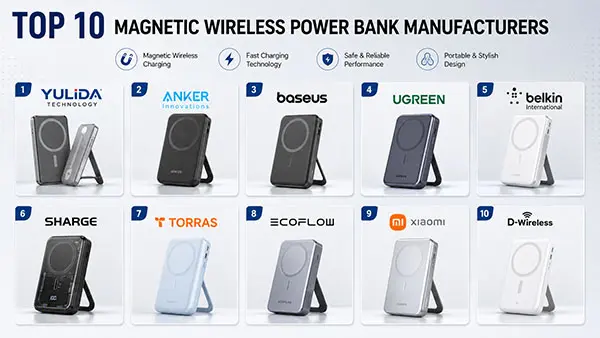
Want to see who’s actually building these products right? Explore our Top 10 Manufacturers guide
Magnetic Wireless Power Bank vs Traditional Power Bank: What’s the Real Difference?
Next time you’re in an electronics store, look at the portable battery section. Two types sit side by side: the classic cabled brick and the magnetic snap-on. They both store energy. They both charge phones. But the gap between them, in user experience, engineering complexity, and commercial positioning, is wider than most buyers realize.
The Convenience Revolution: Snap-On Charging Without Cables
Traditional power banks require a cable. You plug in, you wait, and if you want to use your phone while charging, you’re holding a device tethered to a brick by a wire. It works, but it’s clunky.
A magnetic wireless power bank eliminates that cable entirely. The built-in magnet array aligns the charging coil precisely with your phone’s receiver coil the moment you snap it on. No manual positioning. No “am I charging yet?” guessing. The magnets do the alignment work that your fingers used to.
This isn’t a small improvement. Reachinno’s lab testing showed that misaligned wireless coils can drop efficiency from ~60% down to 45–50%. Magnetic alignment locks the coil position every time, recovering that lost efficiency and making wireless charging actually reliable for the first time.
For B2B buyers, this convenience translates directly into consumer satisfaction and repeat purchases. A product that “just works” out of the box generates fewer returns, fewer support tickets, and more positive reviews. All metrics that protect your brand margin.
Speed and Efficiency Trade-Offs You Should Know
Here’s the uncomfortable truth: even a perfectly aligned magnetic wireless power bank delivers only 55–60% of its stored energy to your phone. That’s not a defect. It’s physics.
Wireless charging loses energy through four mechanisms: electromagnetic induction transfer loss, heat dissipation, voltage conversion inefficiency, and coil non-ideal efficiency. Each stage shaves off a few percentage points, and the cumulative effect is significant. A 10,000mAh magnetic wireless power bank, in real-world conditions, delivers roughly 5,500–6,000mAh to your phone’s battery.
Compare that to a cabled power bank using USB-C PD, which typically achieves 85–90% efficiency. The wired option transfers more energy, faster. A 20W wired charge consistently delivers 18–19W to the device; a 15W wireless claim often settles at 7–10W sustained output once thermal throttling kicks in.
So why does magnetic wireless still win market share? Because efficiency isn’t the only metric that matters. Convenience, portability, and the “snap and go” experience drive consumer preference, and consumer preference drives your sales.
When Magnetic Wireless Makes Sense, And When It Doesn’t
Magnetic wireless power banks shine in specific scenarios: quick top-up charging during short breaks, charging while actively using the phone (the power bank sits flat on the back), travel situations where carrying cables feels like clutter, and social contexts where a cable dangling from your phone looks unprofessional.
They struggle when you need maximum energy transfer, like charging a tablet or keeping a laptop alive. They also struggle with phone and case compatibility: thick or metal phone cases can block the magnetic attachment and interfere with the coil coupling.
The real question for B2B sourcing isn’t which technology wins. It’s which technology your customer actually uses. If your market is iPhone users doing daily top-ups, magnetic wireless is the clear winner. If your market is power users charging laptops and multiple devices, you might need a hybrid product that offers both magnetic wireless and high-wattage USB-C PD ports. That’s exactly where 2026’s best designs are heading. If you want to see who’s building them right, our Top 10 Manufacturers guide breaks down the leading factories.
| Feature | Traditional Power Bank | Magnetic Wireless Power Bank |
|---|---|---|
| Charging Method | USB cable required | Snap-on, cable-free |
| Energy Efficiency | 85–90% | 55–60% |
| User Convenience | Moderate (cable management) | High (instant attachment) |
| Case Compatibility | Universal | Requires thin/magnetic cases |
Feature #1 — Magnetic Alignment Technology: How Magnets Make Wireless Charging Actually Work
Those magnets do real work. They’re the reason this product category exists. Without them, wireless charging from a portable battery is a frustrating exercise in sliding a brick around your phone’s back, hoping you find the coil position.
Why Coil Alignment Is the Hidden Engineering Challenge
Wireless charging works through electromagnetic induction: a transmitter coil in the power bank generates an alternating magnetic field, and a receiver coil in the phone converts that field back into electrical current. The efficiency of this energy transfer depends overwhelmingly on how closely the two coils are aligned and how near they sit to each other.
When coils are perfectly aligned and close (within 3–5mm), transfer efficiency reaches its theoretical maximum for the given coil design. When they’re misaligned by even 5mm, a shift most users wouldn’t notice visually, efficiency drops by 15–25%. At 10mm misalignment, you may lose 30–40% of the potential energy transfer.
This is why early non-magnetic wireless power banks felt unreliable. Users had no visual reference for where the coil sat inside the plastic shell. They’d place the phone, see the charging indicator flicker on, then shift slightly while scrolling and watch it flicker off. The magnets solve this completely. A ring of precisely positioned magnets in the power bank snaps to the corresponding magnet ring in the phone, locking both coils into optimal alignment every single time.
For sourcing professionals: ask your manufacturer how they validate coil-magnet alignment in production. Top-tier factories like Yulida use 28-point quality inspection protocols plus 72-hour aging tests to verify that every unit maintains consistent magnetic force and coil positioning across the full production run. This is the difference between a product that “snaps on fine on day one” and one that stays aligned through 500+ charging cycles. Explore Yulida’s full OEM/ODM magnetic wireless power bank customization capabilities.
MagSafe vs Qi2: Two Standards, One Core Mechanism
MagSafe is Apple’s proprietary standard requiring MFi licensing; Qi2 is the WPC’s open standard offering broader compatibility at lower cost. Both use the same fundamental mechanism: a ring of magnets surrounding a wireless charging coil. The difference lies in governance and ecosystem.
Apple’s MagSafe, launched with the iPhone 12 in 2020, defines a specific magnet layout, force requirement, and communication protocol. Products carrying the “MFi” (Made for iPhone) badge have passed Apple’s testing for magnetic strength, charging performance, and safety. For brands targeting the iPhone user base, MFi certification carries significant consumer trust, but it requires Apple’s approval process and per-unit licensing fees.
Qi2 is the WPC’s open standard that adopts the magnetic alignment concept into the Qi ecosystem. Qi2-certified products work with MagSafe-compatible phones and with any Qi2-compatible Android device. According to the Wireless Power Consortium, Qi2’s Magnetic Power Profile ensures precise coil alignment, with over 13,000 Qi-certified products now on the market. As of early 2026, 269 specifically carry the Qi2.2 25W designation. The Qi2 ecosystem is larger, faster-growing, and doesn’t require proprietary licensing.
The practical reality for B2B buyers: Qi2 certification gives you broader device compatibility and lower certification costs. MFi certification gives you Apple’s explicit blessing and the consumer trust that comes with it. Many leading manufacturers pursue both, Qi2 for global reach, MFi for the premium iPhone segment.
What 2026’s Qi2.2 25W Means for Magnetic Power Banks
The Qi2.2 standard, formally published in December 2024, represents the biggest performance leap in magnetic wireless charging history. It raises the maximum power from 15W (Qi2) to 25W, a 67% increase, and for the first time mandates strict thermal performance requirements: device surface temperature must stay below 40°C during 25W output.
This dual requirement (more power + less heat) is exactly why thermal management became the #3 feature on our list. But from a commercial perspective, Qi2.2 changes the market dynamics entirely:
- iPhone 16 series (except 16e) already support Qi2.2 25W charging, and users can achieve this speed with any Qi2.2-certified third-party magnetic wireless power bank, not just Apple’s own accessory.
- iPhone 17 series supports Qi2.2 25W as well, expanding the compatible device pool further.
- As of February 2026, per WPC database, 637 products have received Qi2.2 certification, covering phones, power banks, car chargers, and desktop stations. The standard is moving from “early adoption” to “mainstream ecosystem” phase.
For B2B sourcing: Qi2.2 certification is no longer optional for any brand that wants to stay competitive through 2026 and beyond. Products limited to 15W Qi2 will increasingly feel slow compared to the 25W alternatives flooding the market. Ask your OEM partner about their Qi2.2 certification timeline and 25W thermal design capability. These are the two factors that determine whether you’re ahead of or behind the curve.
Feature #2 — Battery Capacity and Real-World Performance: Why mAh Numbers Lie
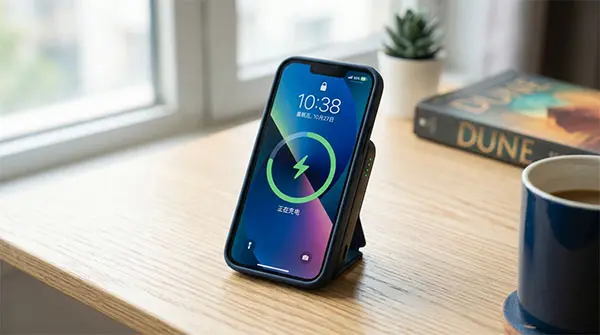
Every listing screams “10,000mAh!” or “20,000mAh!” Those numbers feel authoritative. They’re also lying to you, not intentionally, but by omission.
The 55-60% Efficiency Rule: What Your 10,000mAh Actually Delivers
A 10,000mAh magnetic wireless power bank delivers approximattely 5,000–6,000mAh to your phone, roughly 55–60% real-world efficiency. Here’s the math that most product descriptions skip. A 10,000mAh magnetic wireless power bank stores 10,000mAh at its nominal voltage (typically 3.7V for lithium-polymer cells). But your phone’s battery operates at a different voltage, and the wireless transfer process loses energy at every step.
Reachinno’s controlled lab testing measured real wireless charging efficiency at 55–60% under ideal conditions (perfect alignment, controlled temperature). In everyday use, where the phone shifts slightly, ambient temperature rises, and the power bank warms up during extended charging, efficiency drops further toward 50–55%.
So a 10,000mAh magnetic wireless power bank, in the real world, delivers approximattely 5,000–6,000mAh to your phone. That’s enough to charge most modern smartphones (4,000–5,000mAh battery) from 0% to roughly 80–100% once. Not twice, as the “10,000” on the box might imply.
A 5,000mAh magnetic unit, the compact “snap-on” style that’s become popular, delivers about 2,500–3,200mAh. That’s a meaningful top-up, not a full charge.
This isn’t a scandal. It’s physics. But it becomes a consumer trust issue when marketing matterials imply performance that physics doesn’t allow. B2B buyers who understand this gap can write product descriptions that set accurate expectations, and accurate expectations produce fewer returns and higher review scores.
Ready to source products with honest specs and verified performance data? Explore OEM/ODM options
Choosing the Right Capacity for Your Target Market
Capacity selection isn’t about picking the biggest number. It’s about matching the product to the use case and the customer.
| Target Customer | Recommended Capacity | Rationale |
|---|---|---|
| Daily top-up user (urban, short trips) | 5,000mAh | Lightweight, phone-back mount, one top-up charge |
| Full-day user (travel, long commute) | 10,000mAh | Full phone charge + reserve, still pocket-portable |
| Power user (multi-device, laptop) | 20,000mAh | 2+ phone charges + laptop top-up, backpack carry |
The 5,000mAh segment is the fastest-growing in magnetic wireless power banks precisely because the “snap on, top up, snap off” use case is the most common real-world scenario. Most people don’t need to fully recharge from zero. They need to get from 20% to 70% during a lunch break. A slim 5,000mAh magnetic portable charger does that reliably, and its form factor (roughly phone-sized, 100–150g) makes it something people actually carry daily.
For B2B buyers targeting retail channels, 10,000mAh remains the “safe middle,” enough capacity to feel substantial, enough portability to not feel burdensome. But don’t ignore the 5,000mAh segment’s growth trajectory. That’s where the margin and the volume are both heading.
Battery Chemistry Matters: Li-Po vs Semi-Solid vs LFP
The chemistry inside the battery cells determines three things that directly affect your product’s market position: how thin it can be, how long it lasts, and how safe it feels to a consumer holding it against their phone.
Lithium-Polymer (Li-Po) is the current industry standard for magnetic wireless power banks. Energy density of 130–200 Wh/kg allows thin, flexible cell designs that fit the slim form factor consumers expect. Cycle life of 500–800 charges is adequate for most consumer use patterns. Li-Po supports the high discharge currents needed for 15–25W wireless output. The trade-off: Li-Po is sensitive to overcharge and over-discharge, requiring a robust BMS (Battery Management System) to prevent degradation and safety risks.
Semi-Solid-State batteries represent the next frontier. With energy density of 250–300 Wh/kg, roughly 50% higher than Li-Po, they can pack significantly more capacity into the same physical volume, or shrink the product size while maintaining capacity. Cycle life of 1,000–1,500+ is notably better. Thermal stability exceeds Li-Po, which matters enormously for a device that sits flush against a phone during 25W charging. The catch: current cost is approximattely 1.5× that of Li-Po, and mass production is still ramping up in 2025–2026. This is a premium differentiator, not a budget option.
LFP (LiFePO4) has outstanding cycle life (2,000–3,000+) and the best thermal safety profile of any lithium chemistry. But its energy density of 90–160 Wh/kg makes it physically larger and heavier per unit of capacity, a serious disadvantage for a product category where thinness and lightness are primary selling points. LFP makes sense for large-capacity, stationary power banks where size doesn’t matter; it’s a poor fit for the magnetic snap-on form factor.
For sourcing decisions in 2026: Li-Po remains the pragmatic choice for mainstream products. Semi-solid-state is the premium differentiator for brands positioning at the top of the market. LFP is generally not recommended for magnetic wireless power banks due to form factor constraints.
Feature #3 — Thermal Management: The #1 Reason Magnetic Power Banks Fail
Snap on. 15W starts. 20 minutes later, both devices are warm. The power bank throttles to 7W. The user leaves a 2-star review: “gets hot and stops charging fast.” That sequence plays out thousands of times daily, and thermal management is the single biggest driver of those negative reviews.
I’ve read hundreds of magnetic wireless power bank reviews. The pattern is clear: “gets hot” appears in negative reviews far more often than “slow charging” or “doesn’t hold enough charge.” Thermal management drives more 1- and 2-star reviews than any other factor, and most brands don’t engineer for it.
Why Heat Is the Silent Killer of Wireless Power Banks
Wireless charging generates heat at multiple points simultaneously: the transmitter coil in the power bank, the receiver coil in the phone, the power conversion circuitry, and the battery itself during discharge. When the power bank sits magnetically attached to the phone’s back, you have two heat-generating devices pressed directly against each other with no air gap for dissipation.
This creates a thermal feedback loop. Heat from the power bank transfers to the phone. The phone’s battery temperature rises, triggering the phone’s own thermal protection, which slows down its charging acceptance. The power bank, now facing reduced load, doesn’t cool down as fast because its own heat generation continues.
If the power bank’s thermal protection also engages, charging speed drops further, extending the charging duration and the total heat accumulation time.
The Qi2.2 standard explicitly addresses this by requiring surface temperature below 40°C during 25W output. But meeting this requirement requires deliberate thermal engineering, not just slapping a bigger battery into a plastic shell.
If you’re sourcing magnetic wireless power banks for your brand, discuss your custom requirements with our engineering team to ensure thermal design meets your market’s standards.
Active vs Passive Cooling: What 2026 Models Are Doing Different
Passive cooling, the approach used by most budget magnetic wireless power banks, relies on thermal conductivity through the product’s housing matterial and internal heat spreading layers. Aluminum or zinc alloy housings conduct heat better than plastic. Some designs add graphite sheets or copper foil layers between the coil and the battery to spread heat across a larger surface area, preventing localized hot spots.
Passive cooling works adequately at 5–15W. At 25W, it’s borderline. The math is simple: more watts means more waste heat, which requires more thermal dissipation. A passive-only design at 25W either runs hot (triggering throttling and slow charging) or needs to be physically larger to provide enough surface area for heat dissipation, which undermines the “thin and light” value proposition.
Active cooling approaches are entering the market in 2026. The most practical implementation is a small internal fan that pulls air through ventilation channels in the housing. This adds cost (US$1–3 per unit for the fan and redesigned housing) and slightly increases thickness, but it allows sustained 25W output without throttling. Some manufacturers are experimenting with thermoelectric cooling elements (Peltier modules), though current efficiency and cost make these more suited to premium products than mainstream SKUs.
Hybrid designs, passive heat spreading plus active fan cooling that kicks in only when temperature exceeds a threshold, represent the smartest approach. The fan runs only when needed, preserving the slim profile and quiet operation for routine 5–10W charging while engaging active cooling for demanding 25W sessions.
How to Evaluate a Manufacturer’s Thermal Design Capability
When evaluating OEM/ODM partners for magnetic wireless power banks, thermal management capability should be your top technical assessment criterion. Here’s a practical checklist:
- Thermal simulation data: Does the manufacturer provide thermal modeling results showing temperature distribution across the housing at rated output power? Factories that invest in simulation (using tools like ANSYS or COMSOL) design products that manage heat by intention, not by luck.
- Thermal throttling profile: Ask for the actual power curve, how output wattage changes as internal temperature rises. A flat curve (sustained power) indicates good thermal design; a sharp drop at 35–40°C indicates the product will throttle early and charge slowly.
- Housing matterial choice: Metal alloy housings (aluminum, zinc) dissipate heat 5–10× better than plastic. If the manufacturer only offers plastic shells for products claiming 15W+ output, that’s a red flag.
- Testing protocols: Yulida’s 28-point inspection process includes thermal testing at maximum rated output for sustained durations, plus 72-hour aging tests that reveal long-term thermal behavior. Manufacturers who skip thermal aging tests are shipping products that may develop hot spots after weeks of real-world use.
- Qi2.2 25W readiness: If the manufacturer claims Qi2.2 25W capability, ask for proof of surface temperature compliance (<40°C) during sustained 25W output. This is a certified requirement, not a suggestion.
Feature #4 — Safety Certifications: The Non-Negotiable Checklist for B2B Buyers
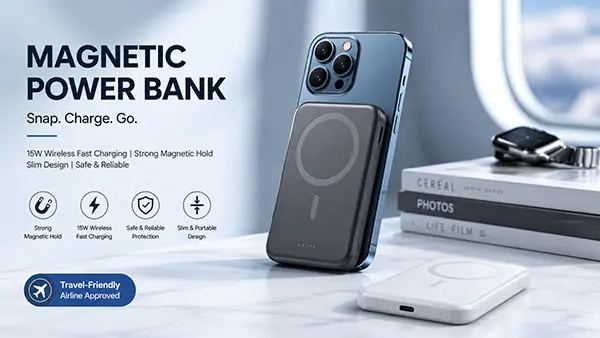
Certifications are paperwork until something goes wrong. Then they’re the reason your shipment isn’t seized at customs, your Amazon listing isn’t delisted, and your customer isn’t posting photos of a melted power bank.
CE, FCC, RoHS, UN38.3: The Four Certifications You Can’t Skip
Four certifications form the mandatory baseline for any magnetic wireless power bank entering international markets:
- CE marking — You need CE marking to sell in the European Economic Area. It confirms compliance with EU safety, health, and environmental protection directives. For wireless power banks, this primarily involves the Low Voltage Directive and EMC Directive. Without CE, European customs will seize non-compliant shipments.
- FCC certification — Required for the US market. Verifies that the device’s electromagnetic emissions don’t interfere with other electronic equipment and that it meets radio frequency exposure limits. Wireless charging devices must pass FCC Part 15 testing for intentional radiators.
- RoHS compliance — Restricts the use of specific hazardous matterials (lead, mercury, cadmium, among others) in electronic products. Required in EU and increasingly adopted globally. A RoHS-compliant magnetic wireless power bank uses lead-free solder, restricted-substance-free plastics, and compliant battery cells.
- UN38.3 — The international transport safety standard for lithium batteries. Without UN38.3 certification, you cannot ship lithium battery products via air freight. This certification requires eight specific tests including altitude simulation, thermal test, short circuit test, and impact test. Every magnetic wireless power bank that crosses an ocean needs this certification.
Skipping any of these isn’t just risky. It’s operationally impossible for legitimatte international trade. Your logistics partners won’t accept non-UN38.3 batteries for air shipment. Your European distributors won’t stock non-CE products. Your US retailers won’t touch non-FCC items.
To see which manufacturers actually deliver on these certification requirements, check our comprehensive Top 10 guide.
Qi2 Certification vs MFi: Which Matters More for Your Brand?
Beyond the regulatory baseline, two optional certifications carry significant commercial weight:
Qi2 certification (through the WPC) verifies that your magnetic wireless power bank meets interoperability and performance standards for the Qi2 magnetic alignment protocol. Benefits: works with all Qi2-compatible devices (iPhone and Android), listed on the WPC’s official product database, lower certification cost than MFi, and growing consumer awareness as Qi2 becomes mainstream.
MFi certification (Apple’s Made for iPhone/iPad/Mac program) specifically verifies compatibility and safety with Apple devices. Benefits: Apple’s explicit endorsement, consumer trust among iPhone users (who represent the largest single device ecosystem for magnetic wireless power banks), and access to Apple’s packaging and marketing guidelines.
The commercial calculus depends on your brand positioning:
- If you’re targeting a global, multi-device audience, Qi2 certification delivers broader compatibility at lower cost.
- If you’re building a premium brand specifically for the iPhone ecosystem, MFi certification carries Apple’s trust signal, which matters disproportionately in the US and Japanese markets where iPhone share exceeds 50%.
- If you’re doing both, pursue Qi2 first (faster, cheaper, broader) and add MFi for premium SKUs targeting Apple-heavy markets.
The cost difference matters for sourcing economics: MFi certification involves Apple’s testing fees, per-unit royalties, and a longer approval timeline. Qi2 certification through the WPC is faster and less expensive. For a new brand entering the market, Qi2 is the pragmatic starting point.
Want to understand the full OEM/ODM certification process? Learn how Yulida handles certification compliance
What Happens When Certifications Are Missing
The consequences of certification gaps aren’t theoretical. They’re documented and repeated across the consumer electronics industry:
Customs seizure: EU customs authorities intercepted over 12,000 non-CE electronic product shipments in 2024. Non-compliant products are seized, stored (at the importer’s expense), and either destroyed or returned. Both outcomes destroy your margin and your timeline.
Amazon delisting: Amazon’s compliance team actively removes products lacking required certifications. A magnetic wireless power bank listed without FCC or CE documentation can be delisted within days of a compliance scan, cutting off your primary sales channel with no appeal process fast enough to save your inventory planning.
Product liability exposure: If a non-certified magnetic wireless power bank causes property damage (overheating, fire) or personal injury, the absence of certifications shifts legal liability squarely onto the brand and the distributor. Insurance policies often exclude coverage for non-compliant products.
Brand reputation damage: Consumer reviewers are increasingly savvy about certifications. A review mentioning “no FCC ID on the label” or “fake CE mark” spreads faster than any marketing campaign you could run.
The bottom line: certifications are not a cost center. They’re a risk mitigation investment that protects your logistics, your sales channels, your legal position, and your brand reputation simultaneously.
Feature #5 — Smart Integration & Design Differentiators: Beyond Basic Charging
So your product works: it snaps on, stays cool, carries the right certifications, delivers honest capacity. “Works” doesn’t sell. “Different” sells. This is where your product escapes the white-label trap.
TFT Color Display: The 2026 Differentiator Nobody Talks About
Traditional magnetic wireless power banks show battery status through four LED dots. Each dot represents approximattely 25%, so you know you’re somewhere between 50% and 75%, but not whether you’re at 51% or 74%. That level of information was acceptable in 2020. In 2026, it feels archaic.
TFT (Thin Film Transistor) color displays transform the magnetic wireless power bank from a blind battery brick into a transparent energy management device. A proper TFT screen shows:
- Exact remaining capacity — precise to 1%, not vague 25% increments
- Real-time input/output wattage — so users know whether 25W fast charging is actually active
- Active port status — which USB-C port is delivering power, at what rate
- Temperature monitoring — internal battery temperature displayed in real-time
- Estimatted charge time — how long until the phone reaches target percentage
This isn’t a cosmetic upgrade. It’s a functional shift that changes how users interact with the product. Instead of wondering “is it charging?” they can confirm it at a glance. Instead of guessing “how much battery is left?” they see the exact number.
Instead of being surprised when the power bank shuts down during a 25W session, they can watch the temperature climb and shift to a lower-power mode proactively.
For B2B differentiation, TFT displays solve a real market problem: most magnetic wireless power bank reviews criticize “no way to tell actual charging speed” or “LED indicators are useless.” Products that eliminate these complaints earn higher review scores, generate fewer support inquiries, and justify higher retail pricing. The TFT display adds roughly US$3–5 to manufacturing cost but can support US$15–30 of retail price premium, a margin expansion that matters enormously at volume. Explore Yulida’s smart integration solutions for magnetic wireless power banks.
Pass-Through Charging, Kickstands, and Multi-Device Support
Three functional features are separating 2026’s best magnetic wireless power banks from the basic snap-and-charge products:
Pass-through charging allows the power bank to charge itself from a wall adapter while simultaneously charging a phone via wireless or USB-C. This eliminates the “charge the power bank overnight, then use it tomorrow” two-step process. Users plug in one cable and both devices fill up. For the B2B buyer, pass-through charging is a feature that competes directly with single-purpose wall chargers, positioning your product as a “charger + portable battery” hybrid that replaces two devices with one.
Kickstands, integrated folding stands that prop the phone up at a viewing angle while it charges, address a specific use case: watching video or reading during a charging session. A magnetic wireless power bank that snaps flat onto the phone’s back works great for pocket charging, but if the user wants to watch a video call hands-free, they need a stand. Products that integrate a kickstand into the power bank’s housing (often as a fold-out section) solve this without requiring a separate accessory.
Multi-device support, dual USB-C PD ports alongside the magnetic wireless charging surface, transforms a single-purpose phone accessory into a versatile power hub. The user snaps the power bank onto their phone for wireless charging while simultaneously plugging a laptop or second phone into the USB-C port. This is where the 20,000mAh capacity products justify their size: they serve as a true multi-device power solution, not just a phone top-up.
Rotating Magnetic Rings and AC Direct Charging: Innovation in Action
Two design innovations that appeared in late 2025 and are gaining traction in 2026 deserve specific attention:
Rotating magnetic rings solve a problem most users don’t think about until they encounter it: the magnetic attachment’s fixed orientation. When a magnetic wireless power bank snaps onto a phone, it locks in one position. If that position blocks the phone’s camera lens, makes the combined unit awkward to hold, or prevents the kickstand from functioning at the desired angle, the user has no choice but to detach and reposition manually.
A rotating magnetic ring, a magnet assembly that can spin 360° while maintaining coil alignment, gives the user positional freedom without sacrificing charging performance. The coil stays aligned because the ring’s center maintains contact regardless of the ring’s rotational position. This is a subtle but genuinely useful engineering improvement, and it’s one of the specific differentiators that Yulida’s magnetic wireless power bank product line has implemented.
AC direct charging, an integrated AC plug that allows the power bank to plug directly into a wall socket for recharging, eliminating the need for a separate charging cable and adapter, addresses the other half of the convenience equation. Snapping the power bank onto your phone is cable-free convenience; plugging the power bank into the wall to recharge should be equally cable-free. Products with fold-out AC plugs (common in markets like Japan and increasingly in Europe and the US) offer a complete cable-free experience: no cable to charge the phone, no cable to recharge the power bank.
These innovations represent the next competitive layer beyond basic specs. When every manufacturer offers Qi2.2 25W, 10,000mAh, and CE/FCC compliance, the differentiators that separate your product from the next listing on Amazon are design features like rotating rings, TFT displays, and AC direct charging. Features that solve real user frustrations and justify premium positioning.
Magnetic Wireless Power Bank FAQ — 7 Questions Buyers and Users Ask Most
1. What is a magnetic wireless power bank and how does it work?
A magnetic wireless power bank is a portable battery that charges your phone by snapping magnetically onto its back, eliminating cables and manual coil positioning. Built-in magnet rings (MagSafe or Qi2-compatible) align the power bank’s charging coil precisely with your phone’s receiver coil, enabling efficient electromagnetic induction power transfer. You attach it, charging starts automatically. No plugging, no aligning, no guessing.
2. Is magnetic wireless charging safe for my phone and battery?
Yes, when the product carries proper certifications (Qi2, CE, FCC). Certified magnetic wireless power banks include safety mechanisms: temperature monitoring that throttles or stops charging if heat exceeds safe thresholds, over-current protection that prevents excessive power delivery, and foreign object detection that stops charging if metal debris sits between the coils. The Qi2.2 standard specifically mandates surface temperature below 40°C during 25W output, providing an explicit safety boundary.
3. Can I use a magnetic wireless power bank with Android phones?
Yes, any Qi2-compatible Android phone works. Samsung Galaxy S24/S25, Google Pixel 9, and most 2024–2026 flagships include Qi2 magnets. For phones without built-in magnets, a thin adhesive ring sticker (about US$2) enables magnetic alignment with any Qi2-certified magnetic wireless power bank. Charging performance is the same as with iPhone. The Qi2 standard is device-agnostic.
4. What certifications should a magnetic wireless power bank have?
The minimum mandatory set for international sales: CE (EU market access), FCC (US market access), RoHS (hazardous substance compliance), and UN38.3 (air transport safety for lithium batteries). For commercial competitiveness, add Qi2 certification (interoperability and performance validation) and optionally MFi certification (Apple device compatibility endorsement). Products missing any of the mandatory four cannot be legally sold in the corresponding market or shipped via air freight.
5. How long does a magnetic wireless power bank last (battery lifespan)?
Battery lifespan depends on the cell chemistry and usage patterns. Li-Po cells (the most common in current products) deliver 500–800 full charge-discharge cycles before capacity degrades to 80% of original. For a user who cycles the power bank once daily, that’s approximattely 1.5–2 years of effective use. Semi-solid-state cells (appearing in premium 2026 products) offer 1,000–1,500+ cycles, roughly 3–4 years. Actual lifespan also depends on charging habits: avoiding full discharge (keep above 20%) and not charging in high-temperature environments extends cycle life significantly.
6. Can a magnetic wireless power bank charge through a phone case?
It depends on the case. Thin cases (under 2mm, non-metallic, no metal plates) generally work fine. The magnetic force is strong enough to hold through a thin polymer layer, and the wireless signal passes through without significant loss. Thick cases (over 3mm), cases with metal back plates, cases with embedded credit card RFID shields, and cases with magnet-interfering matterials will either weaken the magnetic attachment or block wireless charging entirely. Many manufacturers include a magnetic ring sticker for use with incompatible cases.
7. What’s the difference between OEM and ODM for magnetic wireless power banks?
OEM means you control every detail: design, components, matterials, packaging. The factory builds exactly what you specify. You own the design. ODM means the factory already has a working design; you pick your specs, customize packaging, and slap your brand on it. Faster, cheaper, less engineering required.
Most magnetic wireless power bank brands start with ODM (speed to market, lower upfront investment) and evolve toward OEM as they build market knowledge and want specific differentiators. Top manufacturers like Yulida offer both models, allowing brands to scale from ODM entry to OEM differentiation within the same partnership.
Five Features That Define Your Magnetic Wireless Power Bank Strategy
Magnetic alignment makes wireless charging reliable. Qi2.2’s 25W standard and 637+ certified products confirm it’s mainstream, not experimental. Capacity numbers mislead: understand the 55–60% efficiency gap and match your product to your customer’s real use case. Thermal engineering separates products that last from products that get recalled. Certifications (CE, FCC, RoHS, UN38.3) aren’t optional; they’re your legal shield and your logistics prerequisite. And smart differentiators like TFT displays, rotating rings, and AC direct charging pull your product out of the white-label commodity trap.
The magnetic wireless power bank market is growing at 10.8% CAGR toward US$3.79 billion by 2031. The products that capture that growth won’t be the ones with the biggest mAh numbers on the box. They’ll be the ones engineered with honest specs, validated thermal design, complete certifications, and thoughtful differentiators that solve real user problems.
If you’re evaluating manufacturing partners for your next magnetic wireless power bank product, Yulida offers OEM and ODM services with Qi2/MFi certification support, 28-point quality inspection, 72-hour aging testing, and current-generation differentiators including TFT color displays, rotating magnetic rings, and AC direct charging designs.
Ready to find the right manufacturing partner? Explore our Top 10 Magnetic Wireless Power Bank Manufacturers for 2026
Interested in custom OEM/ODM development? Start your project with Yulida
Ready to move forward? Get a quote for your branded magnetic wireless power bank and let our team build the exact product your market needs.
Official sources and verification
These primary sources support standards, compatibility, safety, or transport statements discussed in this article. Confirm the current requirement for the exact product model and destination market.
- Wireless Power Consortium — Qi and Qi2 standards, certification, and wireless-charging information.
