



Wireless Power Bank vs Wireless Charger: B2B Buying Guide
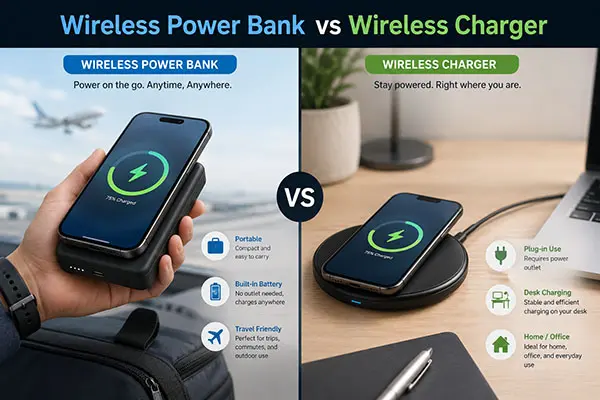
Choosing between a wireless power bank and a wireless charger comes down to one question: does your target market need power on the go or power at a fixed location? For B2B buyers, that use case determines the relevant specifications, certification evidence, MOQ, packaging, and total cost before a production order is placed.
If you’re an importer, brand owner, or distributor evaluating wireless power bank vs wireless charger for your next product line, you already know the stakes. Pick the wrong product category and you’re left with inventory that doesn’t match your market’s actual charging behavior. Pick the right one, and you capture demand at exactly the moment customers reach for a cable. Spec sheets don’t tell the whole story, and most existing comparisons are written for consumers, not for the people signing purchase orders.
This guide gives you a manufacturer’s-perspective decision framework covering eight critical dimensions: technology fundamentals, B2B specifications, certification costs, OEM/ODM customization depth, total cost of ownership, supply chain dynamics, and after-sales strategy. By the end, you’ll have a clear framework for deciding which product to source and how to evaluate the factory behind it.
Wireless power banks are portable battery packs with Qi/Qi2 coils that charge devices without a wall outlet. Wireless chargers are stationary pads drawing wall power for inductive charging. For B2B sourcing, power banks carry higher unit prices and stricter certification requirements, while chargers offer faster lead times and simpler compliance paths.
Want to see how this plays out with real product specifications? Explore our power bank products →
Quick Comparison: Wireless Power Bank vs Wireless Charger
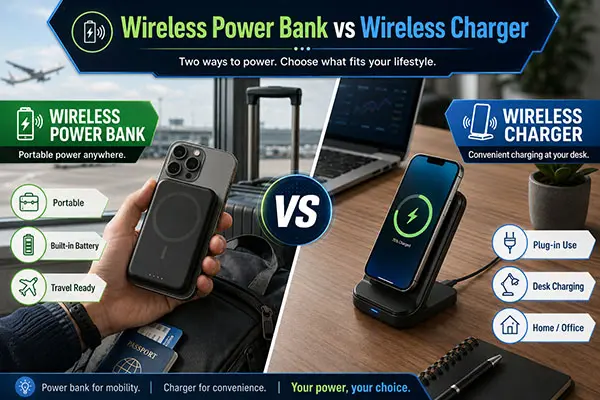
At a glance, the fundamental distinction is portability versus stationary convenience. Power banks carry their own energy; chargers rely on wall power.
Here’s a side-by-side breakdown designed for procurement teams:
| Dimension | Wireless Power Bank | Wireless Charger | B2B Sourcing Impact |
|---|---|---|---|
| Power Source | Internal Li-ion/Li-Po battery | Wall outlet (AC adapter) | Power banks require battery cells + BMS; chargers need only circuitry |
| Portability | Fully portable | Fixed location | Power banks serve mobile/retail; chargers serve office/home |
| Core Components | Battery cell, BMS, TX coil, PMIC | TX coil, PMIC, AC/DC adapter | More components = longer lead time and higher defect surface |
| Typical FOB Price | $8–$18/unit | $9–$18/unit | Prices overlap, but power banks have more customization variables |
| Key Certifications | CCC, CE, FCC, UN38.3, UL 2056 | CE, FCC, Qi/Qi2 | Power banks face stricter battery transport and safety rules |
| Typical MOQ | 500 pcs (standard OEM) | 500 pcs (standard OEM) | Similar baseline, but ODM depth differs significantly |
| Target Market | Travel, outdoor, retail, gifting | Office, hospitality, desk accessories | Determines your distribution channel and pricing strategy |
What Is a Wireless Power Bank?
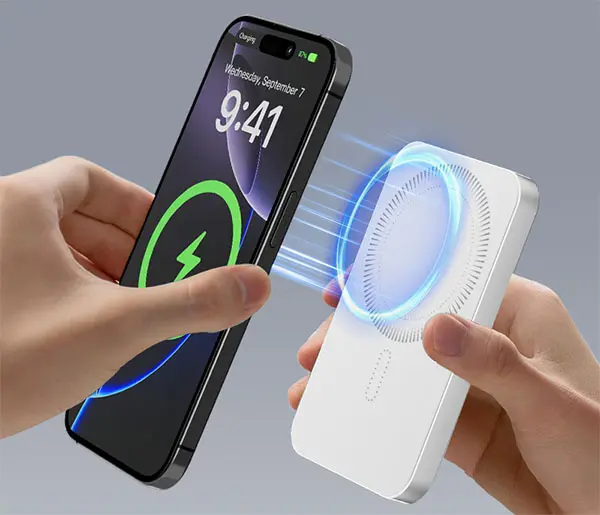
A wireless power bank is a portable battery pack equipped with a Qi or Qi2 transmitter coil, allowing it to charge compatible devices without a cable while carrying its own stored energy.
Core Technology and Components
A wireless power bank combines three technologies that traditionally lived in separate devices: energy storage (lithium-ion or lithium-polymer cells), power management (a Battery Management System or BMS), and inductive power transfer (a transmitter coil operating at 110–205 kHz). The battery stores energy at a nominal 3.7V. When a device is placed on the charging surface, the coil generates an alternating magnetic field that induces current in the phone’s receiver coil, which is then rectified to DC to charge the battery.
The BMS is the unsung hero here. It monitors cell voltage, temperature, charge/discharge rates, and provides overcurrent, overvoltage, and short-circuit protection. Without a properly designed BMS, a power bank is essentially a controlled thermal event waiting to happen, which is exactly why safety certifications matter so much in B2B sourcing.
For buyers evaluating magnetic wireless power bank options, the magnet ring adds another component layer: N52 or N52H neodymium magnets that ensure precise coil alignment with Qi2/MagSafe-compatible devices.
Key B2B Specifications (mAh, Conversion Efficiency, Cell Type, BMS)
When you’re reviewing spec sheets from an OEM, these are the numbers that actually matter:
- Nominal Capacity (mAh): Typically 5,000, 10,000, or 20,000 mAh. Actual usable capacity is only 60–70% of the nominal figure due to voltage conversion losses (3.7V to 5V) and circuit inefficiency. Premium products achieve 85–92% conversion efficiency, so a 10,000 mAh unit delivers roughly 6,300–7,400 mAh. Always ask your supplier for tested conversion efficiency, not just cell capacity.
- Cell Type: Lithium-ion (Li-ion) cells are cheaper and widely available but have a rigid cylindrical form factor. Lithium-polymer (Li-Po) cells are thinner, lighter, and allow custom shapes, which is critical for slim designs and magnetic wireless power bank features like snap-on phone attachments. Li-Po commands a 15–25% price premium but offers better design flexibility.
- BMS Quality: A tier-1 BMS from vendors like TI, NXP, or Silergy costs more but dramatically reduces defect rates. Ask your supplier which BMS IC they use and whether they conduct 100% aging tests on finished units.
- Wireless Output Power: Standard Qi delivers 5W; Qi EPP reaches 15W for compatible Android devices; Qi2 delivers 15W for iPhone 12+ with magnetic alignment. The output wattage directly affects your product’s market positioning and price ceiling.
What Is a Wireless Charger?
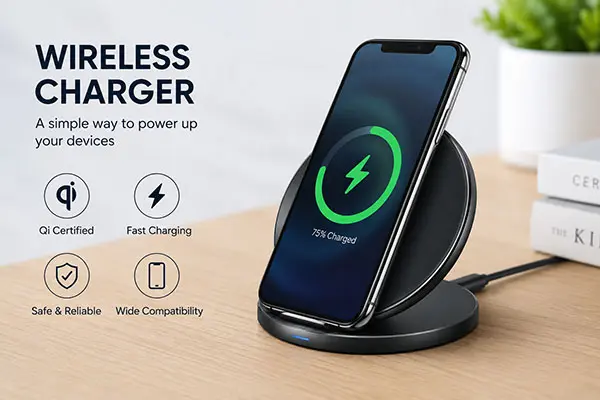
A wireless charger is a stationary device that uses electromagnetic induction to transfer power from a wall outlet to a compatible device. No battery, no portability, just plug-and-charge convenience.
How Inductive Charging Works
The principle is straightforward. A transmitter coil inside the charger, powered by an AC/DC adapter, generates an alternating magnetic field at 110–205 kHz. When you place a Qi-compatible phone on the pad, the receiver coil inside the phone captures that magnetic field and converts it back into electrical energy through rectification. The DC output then charges the phone’s battery under the device’s own battery management control.
Two factors dominate charging performance: coil alignment and thermal management. Misalignment between transmitter and receiver coils can waste 20–50% of transferred energy as heat, which is why Qi2’s magnetic alignment system represents such a significant leap. Thermal management circuits throttle output when temperatures rise, protecting both the charger and the device.
Unlike power banks, wireless chargers don’t store energy. They’re purely conversion devices. This simplifies the component bill dramatically: no battery cell, no BMS, no charge/discharge cycling logic. What you’re really paying for is coil quality, power adapter wattage, and certification.
Key B2B Specifications (Wattage, Coil Count, Qi/Qi2 Certification)
- Output Wattage: Entry-level chargers deliver 5W (standard Qi). Mid-range units push 10–15W (Qi EPP or Qi2). The wattage you choose determines your product’s competitive position. 5W is commodity territory, while 15W Qi2 commands premium positioning.
- Coil Count: Single-coil chargers are cheaper and simpler but require precise phone placement. Multi-coil designs (2–3 coils) allow more placement freedom and can charge multiple devices simultaneously, but they increase BOM cost by $1.50–$3.00 per unit and complicate thermal management.
- Qi/Qi2 Certification: This is non-negotiable for serious B2B buyers. Uncertified “Qi-compatible” products may work, but they lack the safety testing, foreign object detection (FOD), and interoperability guarantees that certified products provide. Qi2 certification through the Wireless Power Consortium (WPC) adds credibility and market access, especially for Apple-adjacent positioning.
- Input Adapter: A 5W charger needs a 10W+ adapter; a 15W charger needs 20W+. Many B2B buyers overlook this, then field complaints about slow charging because the included adapter is underpowered.
8 Key Differences for B2B Buyers
In the wireless power bank vs wireless charger comparison, the differences extend far beyond portability. Each product carries distinct implications for certification, cost, supply chain, and after-sales strategy.
1. Power Source and Portability
Power banks carry self-contained energy; chargers depend on wall power. This single difference cascades into every downstream procurement decision.
A wireless power bank’s value proposition is freedom from the grid. It serves travelers, outdoor enthusiasts, commuters, and anyone who’s watched their battery icon turn red at 3 PM. A wireless charger’s value is effortless charging at a fixed location: the nightstand, the desk, the airport lounge.
Consider this scenario: A European distributor sourced 5,000 wireless charging stands for a retail chain, positioning them as “the last charger you’ll ever need.” Six months later, they discovered their customers were actually buying cheap wired power banks at gas stations for travel use. The charging stands collected dust on shelves while the distributor wrote off €40,000 in dead inventory. The lesson: match the product to the actual use case, not the aspirational one.
2. Charging Speed and Efficiency
Wired charging remains fastest, but Qi2 has narrowed the wireless gap significantly. B2B buyers must understand these speed tiers to position products correctly.
Here’s the real-world charging speed hierarchy, based on testing data from multiple sources:
| Charging Method | Max Power | Battery Charged in 1 Hour |
|---|---|---|
| 5W Qi Wireless | 5W | ~38% |
| 7.5W Qi (iPhone) | 7.5W | ~45% |
| 15W Qi2 / MagSafe | 15W | ~55–65% |
| 18W Wired (USB-C PD) | 18W | ~79% |
| 25W+ Wired Fast Charge | 25W+ | ~85%+ |
The key takeaway for B2B buyers: a 5W wireless charger charges a phone to roughly 38% in one hour, while an 18W wired charger reaches 79% in the same time. That’s more than double the speed. Qi2 at 15W closes much of this gap, but wireless charging still loses 20–50% of energy as heat during transfer.
For wireless power banks, the speed equation gets more complex: the bank’s own battery must supply the coil, adding another conversion layer. A 10,000 mAh power bank with 15W Qi2 output may only deliver 3–4 full phone charges before depletion, depending on conversion efficiency.
3. Device Compatibility and Market Reach
Qi compatibility is nearly universal, but Qi2’s magnetic alignment currently works best with iPhone 12+. Your target market’s device ecosystem should drive your specification choice.
Every iPhone from iPhone 8 onward supports basic Qi wireless charging at 7.5W. Samsung Galaxy devices support Qi at up to 15W (with Samsung’s proprietary Fast Charge 2.0). However, Qi2 magnetic alignment works natively with iPhone 12 and newer, with no case required. Most Android phones still need a magnetic case to benefit from Qi2’s alignment advantages.
This matters enormously for B2B sourcing. If your primary market is the US or Western Europe, where iPhone market share exceeds 50%, Qi2-certified products have strong appeal. If you’re targeting Southeast Asia or markets where Android dominates, standard Qi with multi-coil designs may offer better value. For deeper analysis, check our guide on wireless power bank compatibility.
4. Certification Requirements and Costs
Wireless power banks face significantly more certification hurdles than wireless chargers due to their lithium battery content. Budget accordingly.
Both product types need CE (Europe), FCC (US), and Qi/Qi2 certification from the WPC. But power banks add several layers:
- UN38.3: Mandatory lithium battery transport safety testing. Required for shipping by air, sea, or land. Costs $800–$2,000 per battery model.
- UL 2056: The designated safety framework for power bank battery testing, recognized by the US Consumer Product Safety Commission. (UL Standards)
- CCC (China Compulsory Certification): Under current Chinese regulations, power banks, including wireless and magnetic variants, must carry CCC certification. Products without CCC marks cannot be manufactured, sold, or imported in China. China’s civil aviation authority also prohibits passengers from boarding domestic flights with power banks lacking valid CCC certification, making this a consumer-visible compliance issue.
- IATA Compliance: Lithium battery air transport regulations cap power banks at 100Wh (approximately 27,000 mAh at 3.7V) for carry-on baggage. (IATA)
Wireless chargers sidestep most battery-specific certifications, which simplifies compliance and reduces both cost and lead time.
Ready to source certified products with full documentation? Explore our OEM/ODM services → for end-to-end compliance support.
5. MOQ and Customization Depth (OEM/ODM)
Both products share similar baseline MOQs, but power banks offer deeper customization paths that can differentiate your brand at a cost.
The MOQ structure is consistent across both categories:
| Customization Level | Typical MOQ | What’s Included |
|---|---|---|
| Standard OEM (logo printing) | 500 pcs | Existing mold, custom logo, retail packaging |
| Light Customization | 1,000 pcs | Custom color, minor PCBA adjustments, packaging design |
| Full ODM (custom mold) | 2,000–3,000 pcs | Custom industrial design, PCBA layout, firmware, full tooling |
Power banks offer more customization surface area: battery capacity, cell type (Li-ion vs Li-Po), wireless output wattage, wired output protocols (QC, PD), digital displays, built-in cables, and magnetic attachment design. Each variable opens a differentiation opportunity and a cost line item.
Wireless chargers offer fewer customization variables but excel in aesthetic flexibility: materials (aluminum, glass, fabric, bamboo), form factor (pad, stand, 3-in-1 dock), and coil configuration.
6. Total Cost of Ownership (FOB + Logistics + Returns)
FOB price is only the beginning. Logistics, return rates, and warranty costs can swing your true cost per unit by 30% or more.
Here’s a TCO breakdown that most procurement guides skip:
Wireless Power Bank TCO:
– FOB price: $8–$18/unit (varies with capacity, cell quality, Qi2 certification)
– Air freight surcharge: Lithium battery classification adds $0.50–$2.00/unit for air shipping
– Defect/return rate: Typically 3–5% (battery degradation, BMS failures, charging port issues)
– Warranty replacement cost: $12–$25/unit (you’re replacing the whole product)
– Regulatory documentation: $2,000–$5,000 per product line (UN38.3, CCC, UL 2056)
Wireless Charger TCO:
– FOB price: $9–$18/unit (varies with wattage, coil count, materials)
– Air freight: No battery restrictions. Standard shipping rates apply.
– Defect/return rate: Typically 1–2% (coil failure, adapter issues, surface wear)
– Warranty replacement cost: $9–$18/unit
– Regulatory documentation: $1,000–$3,000 per product line (CE, FCC, Qi/Qi2)
The TCO gap in the wireless power bank vs wireless charger decision is real. A power bank that costs $12 FOB might have a true landed cost of $16–$18 after freight, duties, and expected returns. A charger at the same $12 FOB might land at $14–$15. Over a 10,000-unit order, that’s a $10,000–$30,000 difference.
7. Supply Chain and Lead Time
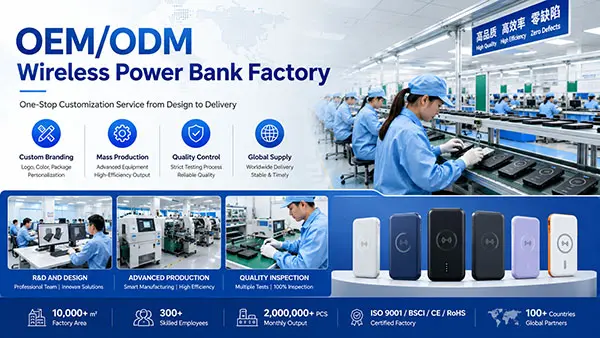
Power banks require battery cell sourcing and aging tests that add 2–3 weeks to production. Chargers can ship faster when speed matters.
A typical production timeline comparison:
| Stage | Wireless Power Bank | Wireless Charger |
|---|---|---|
| Component sourcing | 2–3 weeks (battery cells are the bottleneck) | 1–2 weeks (coils, PMIC, adapter) |
| Assembly + aging test | 2–3 weeks (100% aging test required) | 1–2 weeks (sample testing only) |
| Certification testing | 3–4 weeks (UN38.3, CCC, UL 2056) | 1–2 weeks (Qi/Qi2, CE, FCC) |
| Total lead time | 7–10 weeks (first order) | 3–6 weeks (first order) |
Battery cell supply is the critical path for power banks. When cell manufacturers face capacity constraints, often during peak production seasons, lead times can stretch to 12+ weeks. Building buffer stock or working with a manufacturer who maintains cell inventory is essential.
For buyers evaluating top wireless power bank factories, ask specifically about their cell supplier relationships and whether they maintain safety stock of certified cells.
8. After-Sales and Warranty Considerations
Power banks carry higher warranty exposure due to battery degradation. Negotiate warranty terms that protect your margin without overcommitting.
Battery-powered products have a finite lifecycle. After 300–500 charge cycles, a typical lithium cell retains about 80% of its original capacity. This means a percentage of your power bank inventory will fail within the warranty period through no fault of the manufacturer. It’s chemistry.
Standard warranty terms in B2B wireless charging:
- Wireless power banks: 12-month warranty is standard. Negotiate for 6 months on battery capacity degradation (below 80%) and 12 months on manufacturing defects. Push for DOA (dead on arrival) replacement at 1–2% of order quantity.
- Wireless chargers: 12-month warranty covers manufacturing defects. Return rates are lower, but coil failures and adapter failures do occur. Negotiate spare adapter inclusion at 2% of order volume.
A brand owner we worked with, let’s call her Sarah, launched a line of 10,000 mAh magnetic wireless power banks with a generous 18-month warranty. Within nine months, return rates hit 4.2%, driven by customers who expected the battery to maintain 100% capacity indefinitely. The replacement costs eroded her entire margin for the product line. The fix: clear consumer-facing communication about battery lifecycle expectations and a tiered warranty structure that covers defects but sets explicit capacity degradation thresholds.
Want to understand whether magnetic power banks justify their premium? See our analysis: are magnetic power banks worth it
Qi2 Standard: Why It Matters for B2B Sourcing
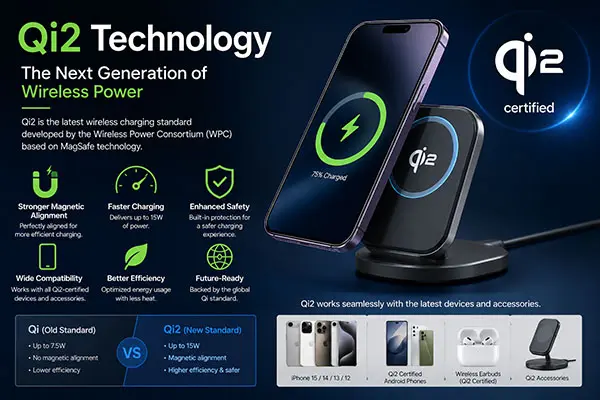
Qi2 doubles wireless charging speed for iPhone 12+ users and adds magnetic alignment. Both features directly impact your product’s market positioning, certification costs, and price ceiling.
The Qi2 standard, developed by the Wireless Power Consortium in collaboration with Apple, brings MagSafe-like magnetic alignment to the open Qi ecosystem. For B2B buyers, this represents a market-positioning decision that goes beyond technology.
| Feature | Qi (Original) | Qi2 | MagSafe (Apple) |
|---|---|---|---|
| Max Power (iPhone) | 7.5W | 15W | 15W |
| Magnetic Alignment | No | Yes | Yes (Apple only) |
| Cross-Brand Support | Yes | Yes | No |
| Certification Body | WPC | WPC | Apple MFi |
| Typical Cost Impact | Baseline | +$1.50–$3.00/unit | +$3.00–$5.00/unit (licensing) |
What Qi2 means for your sourcing decision:
- Speed parity with MagSafe: iPhone 12+ devices charge at 15W with Qi2, double the 7.5W of standard Qi. This is a marketable feature that justifies premium pricing.
- Certification investment: Qi2 certification through the WPC requires additional testing for magnetic alignment, power profile, and interoperability. Budget $3,000–$6,000 per product and 3–4 weeks for certification.
- Android market gap: Most Android phones don’t yet have native Qi2 magnetic modules. If your market is Android-heavy, Qi2’s magnetic benefit is limited unless you bundle magnetic cases, which adds cost and complexity.
- Future-proofing: Qi2 is backward compatible with Qi, meaning a Qi2-certified product works with all existing Qi devices at their native speeds. This makes Qi2 the safer long-term specification choice.
For buyers weighing Qi2-certified magnetic power banks sourcing, Qi2 certification is increasingly becoming a market expectation rather than a premium feature, especially in North American and European markets.
Which Should You Source? Decision Framework by Buyer Type
Your buyer profile, not the product specs, should drive your sourcing decision. Different business models demand different products.
For Importers and Distributors
Importers and distributors need products that move fast through retail channels and minimize return exposure. Recommendation: lead with wireless power banks (5,000–10,000 mAh, Qi2-certified) as your primary SKU, supplemented by wireless charging stands as a secondary line. Power banks have higher retail velocity and consumer demand urgency. The higher TCO is offset by faster sell-through and better margins. Keep charger MOQs smaller to test market response before scaling.
Key metrics to track: sell-through rate by SKU, return rate by product type, and average time-to-reorder from your retail partners.
For Brand Owners (Private Label)
Brand owners need products that reinforce brand identity and create ecosystem lock-in. Recommendation: develop a unified wireless charging ecosystem: power bank + charging stand + car mount, all sharing consistent design language and Qi2 certification. This maximizes OEM/ODM customization value and creates cross-sell opportunities. Start with the power bank (higher margin, stronger brand association) and expand into chargers as the brand gains traction.
Work with a manufacturer offering OEM/ODM services that can support both product categories under one design system. This reduces tooling costs and ensures component consistency across your line.
For Corporate Gift Buyers
Corporate gift buyers need products that impress recipients, display branding prominently, and have low defect risk. Recommendation: wireless chargers with custom logo engraving are the safer choice. They’re simpler to certify, have lower return rates, and the stationary nature means the brand logo is visible on a desk daily. If the gift program includes travel-oriented recipients, magnetic wireless power banks at 5,000 mAh offer a compelling alternative: compact, premium-feeling, and highly portable.
Keep MOQs realistic: 500–1,000 units is sufficient for most corporate gift programs, and standard OEM customization (logo, color, packaging) is usually enough.
Supplier Evaluation Checklist
A systematic evaluation framework prevents costly sourcing mistakes. Use this checklist before signing any purchase agreement.
| # | Evaluation Criteria | What to Verify |
|---|---|---|
| 1 | Manufacturing certifications | ISO 9001, ISO 14001, BSCI or SEDEX audit reports |
| 2 | Product certifications | CE, FCC, RoHS, Qi/Qi2 (WPC database verifiable), CCC for China market |
| 3 | Battery cell suppliers | Brand-name cells (Samsung, LG, ATL, Lishen), not generic or unbranded |
| 4 | BMS IC vendor | Tier-1 suppliers (TI, NXP, Silergy, Richtek), not unknown brands |
| 5 | Aging test protocol | 100% aging test on finished units, minimum 4–8 hours per unit |
| 6 | Quality control system | AQL 2.5 acceptance sampling, in-line QC checkpoints, final OQC |
| 7 | Production capacity | Verified monthly capacity vs. your peak demand (request factory tour or video audit) |
| 8 | Sample quality | Request 3–5 samples; test charging speed, heat dissipation, cycle life |
| 9 | Communication & documentation | English-language spec sheets, test reports, compliance certificates provided proactively |
| 10 | After-sales support | Clear warranty terms, DOA policy, spare parts availability |
A supplier that scores well on eight or more criteria is worth a serious conversation. One that struggles on battery cell sourcing or BMS quality is a risk regardless of how attractive their FOB price might be.
Wireless Power Bank vs Wireless Charger: Certification Matrix
Certification costs and timelines differ significantly between product types. Plan your compliance budget before finalizing your product specification.
| Certification | Wireless Power Bank | Wireless Charger | Cost Impact |
|---|---|---|---|
| CE / FCC / RoHS | Required | Required | $1,000–$2,000 per product |
| Qi / Qi2 (WPC) | Required for wireless charging | Required for wireless charging | $3,000–$6,000 (Qi2 adds premium) |
| UN38.3 (Battery Transport) | Required | Not applicable | $800–$2,000 per battery model |
| UL 2056 (Power Bank Safety) | Required for US market | Not applicable | $3,000–$8,000 |
| CCC (China Market) | Required (mandatory) | May be required depending on classification | $2,000–$5,000 |
| PSE (Japan) | Required for Japan market | Required for Japan market | $2,000–$4,000 |
The certification burden for wireless power banks is roughly 2–3x that of wireless chargers when you factor in battery-specific testing. If your target market doesn’t require UN38.3 or UL 2056, you can defer those costs, but most global markets do require them for legitimate retail distribution.
FAQ: Wireless Power Bank vs Wireless Charger
These are the most common questions B2B buyers ask when evaluating wireless power bank vs wireless charger options.
1. Can a wireless power bank replace a wireless charger in my product lineup?
Not entirely. A wireless power bank can serve as a wireless charger when placed on a desk and connected to wall power (if it supports pass-through charging), but it’s optimized for portability, not stationary use. Most power banks lack the thermal management and continuous-duty design of dedicated chargers. For a complete product lineup, offer both: power banks for mobile use and chargers for fixed locations. This captures both demand segments without cannibalizing either.
2. What certifications do I need for wireless power banks vs wireless chargers?
Both products require CE, FCC, RoHS, and Qi/Qi2 certification. Wireless power banks additionally require UN38.3 (battery transport safety), UL 2056 (US power bank safety standard), and CCC (China mandatory certification). Wireless chargers skip most battery-specific certifications, reducing both cost and lead time. Budget $5,000–$15,000 total for power bank certifications versus $2,000–$6,000 for chargers, depending on your target markets.
3. What is the typical MOQ for custom wireless power banks vs wireless chargers?
MOQs are similar across both categories. Standard OEM (logo printing on existing molds) starts at 500 pcs. Light customization (custom colors, minor spec adjustments) requires 1,000 pcs. Full ODM (custom mold, unique industrial design, custom firmware) requires 2,000–3,000 pcs. The key difference is that power bank ODM projects typically take 2–4 weeks longer due to battery cell sourcing and additional certification testing.
4. How does Qi2 affect my sourcing decision for wireless charging products?
Qi2 doubles the wireless charging speed for iPhone 12+ devices (from 7.5W to 15W) and adds magnetic alignment, making it a significant market differentiator. For B2B buyers targeting North American or European markets where iPhone share is high, Qi2 certification is increasingly expected rather than optional. It adds $1.50–$3.00 per unit in component costs and $3,000–$6,000 in certification fees, but enables premium pricing positioning. For Android-heavy markets, standard Qi may still be sufficient.
5. Which has a lower defect rate: wireless power banks or wireless chargers?
Wireless chargers typically have lower defect rates (1–2%) because they have fewer failure-prone components: no battery cells to degrade, no BMS to fail, no charge cycling. Wireless power banks see defect rates of 3–5%, primarily driven by battery degradation over time, BMS failures, and charging port wear. To minimize power bank defects, specify tier-1 battery cells and BMS ICs, require 100% aging tests, and set realistic warranty terms that account for natural battery capacity decline.
6. What are the FOB price differences between wireless power banks and wireless chargers?
FOB prices overlap significantly. Wireless power banks range from $8–$18/unit depending on capacity (5,000–20,000 mAh), cell type, and Qi2 certification. Wireless chargers range from $9–$18/unit depending on wattage, coil count, and materials. However, the true cost gap widens when you factor in air freight surcharges for lithium batteries, higher defect/return rates for power banks, and additional certification costs. Expect power banks to have 15–25% higher total landed cost than chargers at comparable retail price points.
7. Can I source both products from the same OEM/ODM manufacturer?
Yes, and it’s often advantageous. Manufacturers like those listed among top wireless power bank factories frequently produce both wireless power banks and wireless chargers, sharing common components (coils, PMICs) and quality systems. Sourcing from one factory simplifies quality control, reduces communication overhead, and can unlock volume-based pricing across your entire product line. Verify that the factory holds relevant certifications for both product categories and has demonstrated production capability for each.
8. What warranty terms should I negotiate for wireless charging products?
For wireless power banks, negotiate 12-month coverage for manufacturing defects and 6-month coverage for battery capacity (defined as capacity below 80% of nominal). Request DOA replacements at 1–2% of order quantity and spare units at 2–3%. For wireless chargers, 12-month defect coverage is standard with DOA replacements at 1%. Always include a clear definition of what constitutes a “defect” versus normal wear, and require your supplier to provide test reports documenting the failure mode for any warranty claim.
Conclusion
The choice in the wireless power bank vs wireless charger debate isn’t really about which technology is “better.” It’s about which product fits your market, your margins, and your operational capacity.
Here’s the framework in five points:
- Power banks serve mobile demand; chargers serve stationary demand. Match the product to your customers’ actual charging behavior.
- Power banks carry 2–3x the certification burden. Budget for UN38.3, UL 2056, and CCC in addition to standard CE/FCC/Qi.
- Qi2 certification is becoming a market expectation in iPhone-dominant regions. Factor the $1.50–$3.00/unit premium into your pricing model.
- Total cost of ownership, not FOB price, determines profitability. Power banks typically cost 15–25% more fully landed than chargers at comparable spec levels.
- Supplier quality matters more than product choice. A tier-1 factory producing either product will outperform a cut-rate factory producing the “right” product.
The wireless charging market keeps expanding. B2B buyers who move quickly can lock in strong supplier relationships and favorable product positioning before competition intensifies. Whether you’re launching your first private-label power bank or expanding into charging accessories, the right manufacturing partner makes all the difference.
Contact yulidapower.com today → to request OEM/ODM quotations, product samples, and a customized sourcing plan for your wireless charging product line. Our factory team will walk you through specifications, certifications, and MOQ structures tailored to your market and budget, with no guesswork, just first-hand manufacturing expertise.
Official sources and verification
These primary sources support standards, compatibility, safety, or transport statements discussed in this article. Confirm the current requirement for the exact product model and destination market.
- Wireless Power Consortium — Qi and Qi2 standards, certification, and wireless-charging information.
- UL Solutions — Battery safety standards and technical safety information.
- International Air Transport Association — Lithium-battery transport requirements and industry guidance.
