







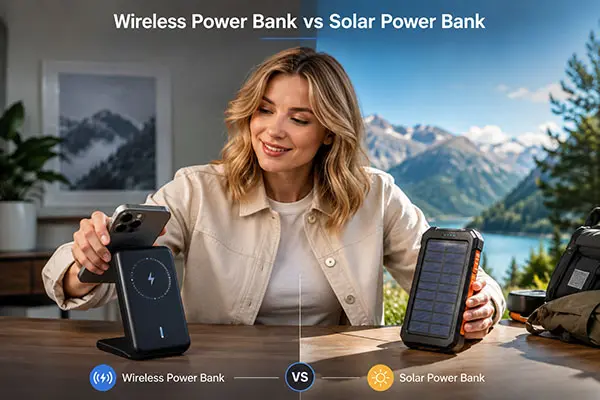
Wireless Power Bank vs Solar Power Bank: 5 Differences Specs Won’t Tell You
Which one should you buy?
- Pick a wireless power bank if you commute, work in an office, or mostly stay in the city. It charges fast, works every time, and you just drop your phone on it. For most people, this is the practical choice.
- Pick a solar power bank if you spend real time outdoors, camping, or need backup power somewhere with no wall outlets. It fills a specific niche, and it does that job well.
For commuting and everyday urban use, a wireless power bank is usually the more practical choice. A solar power bank is better treated as a specialized outdoor backup, because sunlight, panel area, and weather conditions limit how quickly its battery can be replenished.
Let’s get into the five differences that actually matter.
Introduction
Walk into any electronics store or scroll through Amazon, and you’ll see two types of power banks that seem to do the same thing. Portable power, anywhere, anytime. But wireless and solar power banks are completely different products once you look past the marketing.
The specs will tell you about milliamp-hours, output wattage, and charging standards. What they skip is how these devices actually perform in real life, when you’re rushing to catch a train, stuck in a tent during cloudy weather, or trying to charge your phone while walking.
This article breaks down five real-world differences that specs leave out, so you can pick the one that fits your life.
The 5 Key Differences
1. Charging Speed
Solar charging is painfully slow. A typical 10,000mAh solar power bank takes 25 to 50 hours of direct sunlight to fully charge itself. That’s three to six days of perfect sunshine, assuming you get any.
A wireless power bank plugs into a wall outlet and charges in 2 to 4 hours. Even the wireless output to your phone, usually 5W to 15W, is faster than what most solar panels can deliver.
If you’re counting on solar to charge your power bank before a trip, you’ll be waiting. A lot. The solar panel on most portable chargers is simply too small to generate meaningful power in a reasonable timeframe.
2. Convenience vs Self-Sufficiency
One keeps you tied to wall outlets. The other frees you from them, but with major trade-offs.
A wireless power bank is incredibly convenient for daily use. You drop your phone on it, no cables needed. It works for desk workers, commuters, and anyone tired of fumbling with charging cables. But if the battery runs out and you’re nowhere near an outlet, you’re stuck.
A solar power bank can theoretically keep you powered indefinitely as long as the sun is shining. For backpackers, campers, and emergency preppers, that independence matters. The catch is you’re trading speed and reliability for freedom.
3. Real-World Charging Efficiency
Both are less efficient than wired charging, but for very different reasons.
Wireless charging loses about 20% to 30% of energy as heat. That 10,000mAh power bank might only deliver 7,000mAh to your phone. That’s the price of cable-free convenience.
Solar charging has a bigger problem. The sun doesn’t always cooperate. Cloud cover, tree shade, the angle of the panels, and even the time of day all affect output. On a partly cloudy day, your solar power bank might generate less than half its rated power.
4. Durability and Weather Resistance
These two are built for completely different environments.
Most wireless power banks are designed for indoor use. Offices, homes, coffee shops. They have sleek glass or plastic finishes and aren’t particularly rugged. Drop one on a hiking trail and it might crack.
Solar power banks are usually built with outdoor use in mind. Many are water-resistant, dust-proof, and shock-proof with rugged exteriors and covered ports. Some even have built-in compasses or flashlights. But that durability adds weight and bulk, and they tend to look less refined.
5. Price and Value
You’re paying for very different things.
A qualitand wireless power bank at 10,000mAh typically costs $25 to $50. You’re paying for fast charging, convenience, and reliable performance.
A comparable solar power bank with the same capacity runs $40 to $80 or more. You’re paying for the solar panel, the rugged build, and the off-grid capability. You’re not getting faster charging or better performance. In fact, you’re usually getting slower charging for more money.
At-a-Glance Comparison
| Feature | Wireless Power Bank | Solar Power Bank |
| Charge Speed (Self) | 2-4 hours (wall outlet) | 25-50 hours (sunlight) |
| Best For | Daily commuters, office workers, travelers | Campers, hikers, emergency prep |
| Charging Efficiency | ~70-80% (heat loss) | Highly weather-dependent |
| Durability | Standard (indoor use) | Rugged, often water-resistant |
| Price (10,000mAh) | $25-$50 | $40-$80+ |
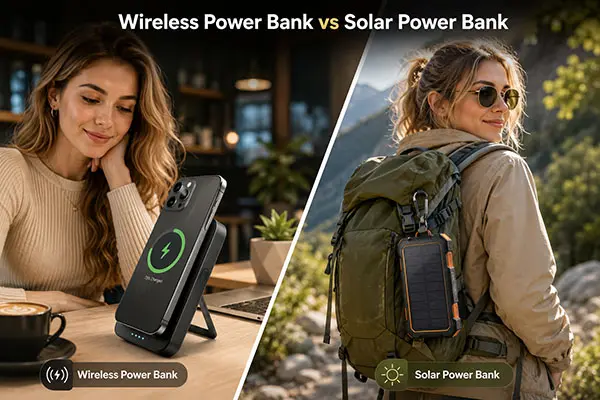
Which One Should You Buy?
Pick a wireless power bank if you:
- Mostly charge at home, in the office, or in coffee shops
- Value speed and convenience
- Hate carrying extra cables
- Want reliable, predictable performance
- Are buying for everyday use
Pick a solar power bank if you:
- Go camping, hiking, or backpacking regularly
- Need power in remote areas without outlets
- Are preparing for emergencies or power outages
- Are willing to wait hours (or days) for a full charge
- Understand it’s a specialty tool, not a daily driver
If you’re not sure which one to get, go with the wireless power bank. It’s the practical choice for most people. Solar power banks are genuinely useful for specific situations, but they’re not the everyday workhorse that marketing photos make them seem.
FAQ: Wireless Power Bank vs Solar Power Bank
1. Can a solar power bank charge wirelessly?
Some premium solar power banks incluof wireless charging capabilities, but most do not. If wireless charging matters to you, check the product specs carefully before buying.
2. How long does it take to charge a solar power bank fully?
Under optimal direct sunlight, expect 25 to 50 hours for a full charge. With clouds or shade, it can take even longer, sometimes several days.
3. Is wireless charging bad for my phone’s battery?
Wireless charging generates more heat than wired charging, and heat can degrade battery health over time. Modern phones manage this well, though. The convenience usually outweighs the minor battery impact for most users.
4. Which is better for travel?
For most travelers, a wireless power bank is better. It charges quickly in hotels and airports, and you can use it on the go. Solar power banks only make sense if you’re traveling off-grid for extended periods.
5. Can I use a solar power bank indoors?
Yes, you can charge it via USB just like any other power bank. The solar panel is an additional feature, not the only way to charge. But if you’re mostly charging indoors, paying extra for a solar panel you’ll rarely use doesn’t make much sense.
6. How many times can a power bank charge my phone?
A 10,000mAh power bank can charge most smartphones about 2 to 3 times fully. Wireless charging is less efficient, so expect closer to 2 full charges. Solar charging doesn’t change the capacity, it only affects how you refill the power bank itself.
7. Are solar power banks worth the extra money?
Only if you actually need off-grid charging. For everyday use, the extra cost isn’t justified. You’re paying for a feature you probably won’t use, and getting slower performance in return.
8. Which lasts longer?
Both use lithium-ion or lithium-polymer batteries with similar lifespans, around 300 to 500 charge cycles. The difference is the solar panel itself, which can degrade over time with exposure to the elements. A wireless power bank kept indoors will likely outlast a solar power bank left out in the sun and weather.
Final Verdict
Specs are useful, but they don’t tell the whole story. A wireless power bank and a solar power bank might look similar on paper. Both have batteries, both charge phones, both are portable. But they serve completely different purposes.
The wireless power bank is your everyday companion. Fast, convenient, reliable. The solar power bank is your wilderness tool. Slow, independent, rugged.
Pick based on your actual lifestyle, not the spec sheet. And if you’re still torn, remember this. You can always get a wireless power bank for daily use and a small solar panel for emergencies. You don’t have to pick just one. But if you do, make sure it’s the right tool for the job.
The following primary sources support the standards, charging, solar-energy, or air-travel guidance discussed in this article. Product performance and compliance still need to be confirmed for the exact model and targetion.Official sources and verification
