



What Is a Qi2.2 Power Bank? The 25W Magnetic Standard Explained for B2B Buyers
In July 2025, exactly two power banks in the world held Qi2.2 certification. Nine months later, 148 certified models from 79 brands were on the market, and 84 of them had been certified in the first four months of 2026 alone. That is the fastest feature migration the magnetic charging category has recorded, and it frames every sourcing decision a brand will make through 2027.
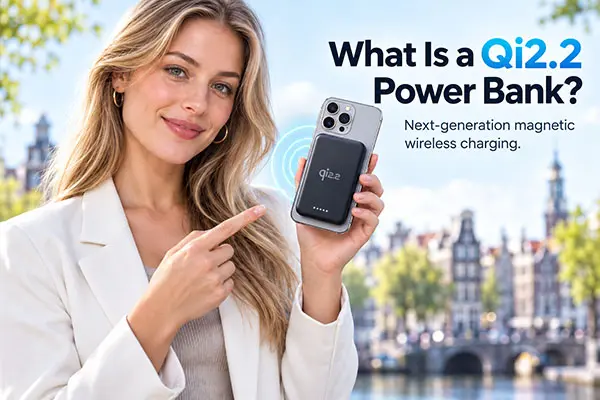
A Qi2.2 power bank is a magnetic wireless power bank built to the Qi2.2 standard published by the Wireless Power Consortium (WPC). Released in July 2025, Qi2.2 raises the wireless output ceiling of the Magnetic Power Profile (MPP) from 15W to 25W and tightens the thermal and alignment rules that keep the extra power safe. If you have specified magnetic power banks since 2023, you were working with Qi2 at 15W. This is the next generation, and it is already mainstream.
This guide covers what Qi2.2 changes, how the hardware differs inside, which phones charge at the full 25W today, and what B2B buyers should verify before placing an OEM order.
What Is Qi2.2?
Qi2.2 is the third release in the Qi2 wireless charging family from the WPC, the industry body that has governed Qi since 2010. Each release defines how a transmitter, meaning the power bank, and a receiver, meaning the phone, negotiate power, how the magnetic alignment system keeps the coils centered, and how the pair handles heat and foreign objects.
Three things define the 2025 release:
- 25W output on the Magnetic Power Profile. Qi2.0 and Qi2.1 topped out at 15W. Qi2.2 raises MPP to 25W, a 67 percent increase in available wireless power.
- Tighter thermal management. Pushing 25W through a phone back generates more heat, so the release strengthens heat dissipation and temperature monitoring requirements.
- Backward compatibility. A Qi2.2 power bank charges Qi2 phones at 15W and original Qi devices at 5W to 15W depending on their receiver profile. Nothing in a current catalog gets left behind.
One naming note that trips up buyers: Qi2.2 is a standard version, not a certification mark. The logo you see on retail packaging is the WPC Qi2 Certified mark, with the version recorded in the product database. When a factory says a build is Qi2.2 certified, ask for the Qi ID and check it in the WPC database before you commit to tooling.
The Qi Timeline: 5W to 25W in Fifteen Years
The Qi standard has moved through five major versions since 2010. The table below shows the progression that leads to Qi2.2.
| Version | Year | Max wireless output | What changed |
|---|---|---|---|
| Qi (BPP) | 2010 | 5W | First inductive charging standard |
| Qi EPP | 2015 | 15W | Extended power profile for phones |
| Qi2.0 | 2023 | 15W | Magnetic alignment arrives, MPP created |
| Qi2.1 | 2024 | 15W | Alignment and automotive refinements |
| Qi2.2 | 2025 | 25W | MPP raised to 25W, tighter thermal rules |
Two regulatory milestones sit alongside this timeline. In February 2025 the International Electrotechnical Commission published the IEC 63563 series, which adopts Qi2.0 into the international standards system; Europe carries it as EN IEC 63563. And in China, the mandatory national standard GB 47372-2026 for power bank safety takes effect on April 1, 2027, layering smart management requirements on top of whatever Qi version a product carries. A Qi2.2 build sold into China after that date answers to both documents.
How 25W Magnetic Charging Actually Works
MPP charging depends on three coordinated systems:
- Magnet array. A ring of magnets in the power bank snaps onto a matching ring in the phone or case. Centered coils transfer energy efficiently, while misaligned coils waste it as heat.
- Power negotiation. The transmitter and receiver exchange capability data over Bluetooth Low Energy before and during charging. The phone states what it can accept, and the power bank delivers up to that level, 25W included.
- Thermal supervision. Both sides monitor temperature continuously and throttle power when the surface climbs past comfortable limits. This is why the extra 10W arrived with stricter heat rules rather than as a simple firmware bump.
A practical note for anyone evaluating spec sheets: peak wattage and sustained wattage are different numbers. A 25W rated power bank may hold its peak only during the first minutes of a charge cycle, then settle lower as the battery fills and heat builds. iPhone 16 and 17 models negotiate their own curves, so field performance depends on the receiver as much as the transmitter. Honest factories share their thermal test logs instead of a single peak figure, and those logs belong in your qualification file.
Qi2.2 vs Qi2.0: What Actually Changed for Buyers
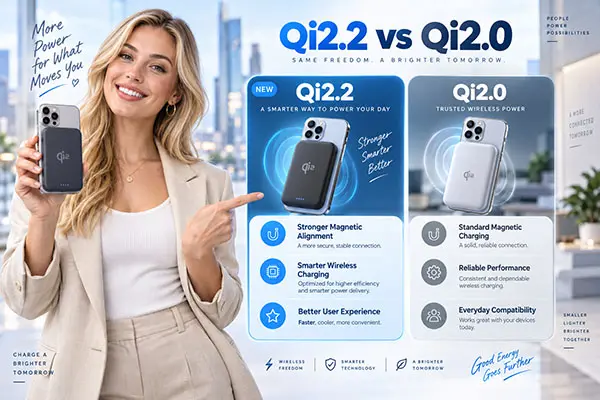
| Feature | Qi2.0 (2023) | Qi2.2 (2025) |
|---|---|---|
| Max wireless output | 15W | 25W MPP |
| Magnetic alignment | Yes | Yes, refined tolerances |
| Thermal requirements | Standard | Stricter monitoring and limits |
| Full-speed phone support | iPhone 12 to 15 series | Compatible iPhone 16 and 17 models, Pixel 10 Pro XL; iPhone Air is limited to 20W |
| Component maturity | Mature, cost optimized | Second generation MPP chips, premium priced |
| Works with older Qi devices | Yes, at their rated speed | Yes, at their rated speed |
The buyer-facing summary: Qi2.2 buys you 67 percent more wireless power headroom, a certification that matches what current flagship phones accept, and a bill of materials roughly one component generation behind the peak. Qi2.0 builds remain certifiable and still sell at mid-market price points, but the launch calendar visible in 2026 certification data has already shifted to 25W.
Which Phones Charge at 25W Today
The receiver side of the market moved quickly after the standard shipped:
- iPhone 16, 16 Plus, 16 Pro, and 16 Pro Max received Qi2.2 certification between September and November 2025.
- iPhone 17 Pro and 17 Pro Max followed in January 2026.
- Google Pixel 10 Pro XL cleared certification in August and September 2025, making it the first Android flagship at 25W.
iPhone Air supports Qi2 wireless charging up to 20W with a compatible charger, not 25W. Actual charging power depends on charger compatibility, alignment, temperature, and battery level. Older hardware still works, just slower. iPhone 12 through 15 models charge at 15W through MPP because that is what their receivers accept. Non-magnetic Android phones charge through the plain Qi fallback path when the coil geometry permits, and case makers sell magnetic rings that bring older phones onto the magnetic path.
For B2B planners the installed-base math is straightforward. Compatible iPhone 16 and 17 units accumulate through 2026 and 2027 and can use up to 25W; iPhone Air supports up to 20W. A Qi2.2 SKU positioned now rides that curve instead of chasing it.
What Is Inside a Qi2.2 Power Bank?
Five component groups dominate the design:
- MPP transmitter chipset. The chip that negotiates power and enforces thermal limits. Current parts are rated for 25W operation with the margin the new thermal rules demand.
- Coil and magnet assembly. A transmitting coil paired with a magnet ring matched to phone geometry. Alignment tolerance is tighter than Qi2.0 because waste heat at 25W leaves less room for error.
- Battery cells. Lithium-polymer remains the volume choice. Semi-solid-state cells are appearing in 2026 certified models, offering higher energy density and better abuse tolerance in slimmer bodies.
- Thermal path. Aluminum housings have become common in premium Qi2.2 builds because metal spreads coil and cell heat better than plastic.
- USB-C PD port. Typically 30W for input and output, used for wired charging of the phone and recharging of the bank. Most certified models support simultaneous wireless plus wired output.
Two design directions stand out in the current certification list. Slim bodies around 10,000mAh dominate the capacity mix, accounting for 22 of the certified models that carry a capacity in the product name. And a growing share of premium builds pair the 25W radio with a TFT or LCD display for percentage and fault readouts. That display pairing is where differentiation is heading, because the screen adds perceived value and lines up naturally with the smart management features China pushes toward with GB 47372. We covered the display side in our TFT power bank design guide.
Certification Data: 148 Models in Nine Months
The WPC certification database tells the clearest story about where this market is going. Figures compiled by Chongdiantou, a Chinese outlet that tracks WPC certification listings, show the following curve:
- July 2025: the first two Qi2.2 power banks complete certification, with a UGREEN model first through the door.
- December 2025: 64 models certified, representing 10.51 percent of all Qi2 certified power banks, per Chongdiantou’s year-end market review.
- April 2026: 148 models from 79 brands, after 84 new certifications in the first four months of the year, more than the entire second half of 2025.
Brand concentration is moderate at the top. Loowoko holds 22 certified models, Baseus and CIO hold 7 each, and Hasmine, WEIDULI, INIU, and UGREEN hold 5 to 6 each. Below that sits a long tail of brands with one or two models. For a buyer, the concentration matters less than the volume. 148 certified builds means MPP transmitter chips, certified coil assemblies, and proven reference designs are all available at production scale, which was not true in 2025.
New entries increasingly show three traits: slimmer chassis, semi-solid-state cells, and built-in cables. Those are the traits to expect in 2027 quoting rounds, and they are worth writing into a product brief now so a factory quotes against them.
What Qi2.2 Means for Your Next OEM Order
Four decisions frame a Qi2.2 sourcing project:
- Market mix. If your sell-through skews toward current iPhone flagships, 25W support is table stakes for premium positioning in 2026 and 2027. If your mix is older iPhone or non-magnetic Android, Qi2.0 remains a defensible cost choice.
- Price tier. The MPP chipset, tighter tolerance coil and magnet assembly, and metal thermal path add bill of materials cost over a Qi2.0 build. Budget for a premium rather than treating it as a like-for-like swap.
- Certification ownership. WPC certification requires membership and testing through an authorized lab. Some brands certify under the factory Qi ID for speed; others hold their own. Confirm which model your project uses before the tooling deposit.
- Validation depth. Ask any candidate factory for thermal logs at sustained 25W, not just the certificate. The gap between peak and sustained performance is where low-cost builds hide their weaknesses.
On the factory side, the practical questions are the standard OEM ones: minimum order quantity, sample validation before mass production, and the QC regime behind the spec sheet. Our guide to magnetic wireless power bank manufacturers covers the vetting checklist in depth. Thermal behavior at 25W is the most worth-probing area, because it is where component quality shows first. Compare our magnetic wireless power bank models and request model-specific wireless output, compatibility, certification and thermal test evidence. A cooling feature or product name alone does not establish Qi2 25W support or sustained charging performance.
Certifications That Stack With Qi2.2 for Export
Qi2.2 covers the wireless protocol. Shipping the product still requires the same regulatory stack as any lithium battery export:
- CE and FCC for the European Union and United States, covering electromagnetic compatibility and safety.
- UN38.3 transport testing for air freight of lithium cells, without which no forwarder will accept the cargo.
- RoHS for restricted substances in the EU.
- GB 47372-2026 for China domestic sales from April 2027, which adds smart management requirements on top of the charging standard.
We maintain a full breakdown of what certifications power banks need and a country-by-country compliance map for buyers planning multi-region launches. When EU regulators ask which technical standard the wireless function follows, reference the IEC 63563 series; carrying the Qi2.2 certificate plus IEC 63563 alignment in your documentation package shortens that conversation.
Should You Wait for 50W?
The next power step is already in development. Industry reporting around WPC working documents points to a 50W profile in prototype validation, with thermal testing and cross-brand compatibility work underway. The pattern from previous releases is consistent: validation first, then certification support, then flagship phone support, then volume accessory supply, spread over roughly two years.
Applied to this cycle, 50W volume availability lands late 2027 at the earliest, with realistic sourcing windows opening in 2028. Waiting for it means skipping the entire 25W window in which 148 models and 79 brands already compete, and in which each compatible iPhone 16 and 17 sold adds to the 25W addressable base.
The approach most brands are taking: launch Qi2.2 SKUs now on modular transmitter designs, so a 50W refresh later becomes a board swap rather than a full retool. Ask your OEM partner whether their current platform was designed with that upgrade path in mind. It is a fair question to put to any factory quoting your 2027 calendar.
Frequently Asked Questions
1. Is Qi2.2 backward compatible with Qi and Qi2 phones?
Yes. A Qi2.2 power bank negotiates the highest level the receiver supports: up to 25W on compatible iPhone 16 and 17 models, up to 20W on iPhone Air with a compatible charger, 15W on 15W Qi2 devices, and 5W to 15W on original Qi receivers depending on their profile. No adapter is needed.
2. Do Android phones work with Qi2.2 power banks?
Non-magnetic Android phones charge through the plain Qi fallback path when coil position allows, at up to 15W for EPP receivers. Magnetically, the Pixel 10 Pro XL is the current certified Android flagship, and case-mounted magnetic rings bring other models onto the magnetic path.
3. Is 25W wireless charging safe for phone batteries?
Yes, within the standard’s control system. The transmitter and receiver exchange thermal data continuously and throttle power when surface temperatures rise, and foreign object detection cuts power when a metal object sits between the coils. Phone-side battery management also tapers the charge rate as cells fill, independent of the wireless link.
4. What is the difference between Qi2.2 and MagSafe?
MagSafe is Apple’s brand implementation built on the magnetic alignment architecture that Apple contributed to the Qi2 standard. Compatible MagSafe-capable iPhone models accept up to 25W wireless charging when the accessory is driven by a 30W or higher power source, which converges with what Qi2.2 delivers. In practice, a compatible Qi2.2 certified power bank can provide up to 25W on supported iPhone 16 and 17 models. iPhone Air supports Qi2 and MagSafe charging up to 20W with compatible charging equipment; actual power depends on charging conditions.
5. How much does Qi2.2 certification cost and how long does it take?
Costs break into WPC membership, test lab fees, and engineering time for any pre-test fixes. Factories with existing Qi2 lines reuse much of the test setup, which shortens the cycle to weeks rather than months. Ask a candidate factory which of their existing Qi IDs cover builds close to yours; that answer predicts both cost and timeline.
6. Can a Qi2.2 power bank charge laptops or tablets?
Wirelessly, no. MPP is designed for phones and small accessories. Through the USB-C port, most Qi2.2 models deliver 30W Power Delivery, which handles tablets and some lightweight laptops. Certified models typically support simultaneous wireless and wired output for two-device charging.
7. Should buyers wait for 50W before placing an order?
No. 50W remains in validation testing, with volume supply realistically a 2028 event. Qi2.2 is the volume standard for the 2026 and 2027 window, the certified supply base is mature, and modular designs preserve a later upgrade path.
Planning a Qi2.2 Launch?
The 25W window is open now. YULIDA Power manufactures magnetic wireless power banks on Qi2.2-ready platforms, from 500-piece OEM runs to full ODM programs, with certification documentation, thermal validation logs, and sample units available for qualification. Talk to our OEM/ODM team about your 2027 launch calendar, browse the current magnetic power bank range, or check the FAQ page for quick answers on MOQ and sampling.
Official sources and verification
These primary sources support standards, compatibility, safety, or transport statements discussed in this article. Confirm the current requirement for the exact product model and destination market.
- Wireless Power Consortium — Qi and Qi2 standards, certification, and wireless-charging information.
- International Electrotechnical Commission — International electrotechnical standards and standard scopes.
- Apple Support — Device charging features and compatibility guidance.
