




How to Choose a Magnetic Power Bank Manufacturer from China: A Sourcing Checklist
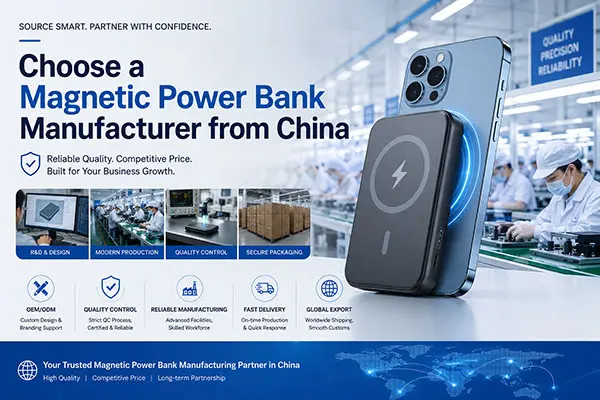
To choose a reliable magnetic power bank manufacturer from China, verify the factory’s legal identity, confirm claimed Qi2 or MagSafe credentials for the exact model, test magnetic holding force against the approved sample and intended phone cases, audit battery-cell traceability, review BMS protection, inspect production consistency, validate UN 38.3 transport evidence, and assess OEM/ODM capability before placing a bulk order.
China has a large and diverse power bank supply base. Importers, brand owners, corporate gift buyers, and distributors should compare suppliers using model-specific documentation, engineering capability, production control, export experience, and total project cost rather than headline pricing alone.
The problem is that many suppliers listed as “manufacturers” on B2B platforms are actually trading companies. Generic sourcing guides tell you to “check certifications and MOQ,” but they skip the magnetic-specific technical checks that separate a dependable supplier from one who ships inconsistent coils, weak magnets, and failed safety tests. This checklist covers eight critical evaluation points, plus pricing benchmarks, Qi2 verification steps, red flags, and a 10-step workflow.
The 8-Point Magnetic Power Bank Sourcing Checklist
1. Verify Factory Authenticity — Real Manufacturer vs Trading Company
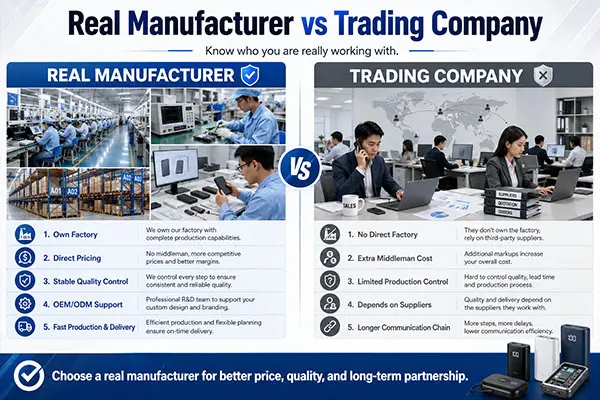
Confirming you’re dealing with an actual factory — not a trading company — is the first step when evaluating any magnetic power bank manufacturer China listings present on B2B platforms. Industry data suggests that approximattely 30% of suppliers claiming to be manufacturers are actually trading companies, and the ratio is even higher in some consumer electronics categories.
Trading companies aren’t fraudulent — they aggregate demand and handle communication. But they add 15–30% markup, offer limited quality control visibility, and can’t accommodate deep customization. Here’s how to tell the difference:
- Business license scope: Request the Chinese business license and check the registered scope. Real manufacturers list production/manufacturing . Trading companies list trading/import-export. Cross-check the Unified Social Credit Code on the National Enterprise Credit Information Publicity System.
- Product range focus: Genuine factories specialize. If a supplier lists 500 unrelated products, they’re a trading company. A real magnetic power bank manufacturer focuses on charging products and battery technology.
- Factory location: Manufacturers sit in industrial zones like Bao’an or Longhua in Shenzhen. Trading companies register in downtown office towers.
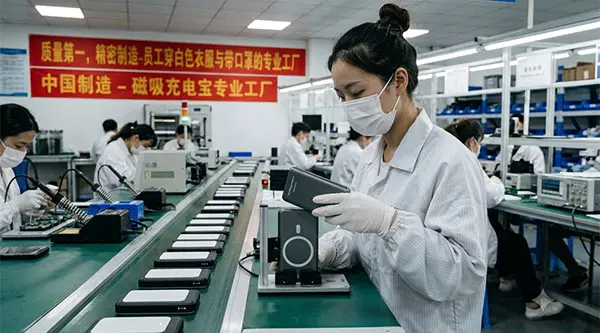
- Video factory tour: Ask for a live walkthrough of the production floor. A legitimatte factory shows SMT lines, assembly stations, and aging test racks within 48 hours. A trader stalls or offers a video that skips the production floor.
A European distributor we’ll call “Marcus” learned this the hard way. He found a supplier on a B2B platform offering magnetic power banks at 20% below market price, with “Verified Manufacturer” badges. After transferring a $15,000 deposit, his sample arrived with misaligned magnets that couldn’t hold an iPhone securely. When he demanded a factory visit, the supplier admitted they sourced from three different factories and couldn’t guarantee coil placement consistency. Marcus lost his deposit and three months of lead time.
2. Assess Magnetic Technology Capability
The magnets, coil alignment, and charging efficiency determine whether your product works flawlessly or generates customer complaints. A capable MagSafe power bank OEM factory should discuss these specifications in technical detail.
Magnet grade and retention force: Magnets should be N52 grade neodymium — the strongest commercially available. Ask for the retention force specification. A quality product delivers at least 10N of holding force. Below that, the phone slips during movement and charging interrupts. Some factories cut costs with N42 or N35 magnets, producing noticeably weaker adhesion.
Coil alignment precision: The wireless charging coil must be positioned with sub-millimeter accuracy relative to the magnet ring. Misalignment reduces efficiency and increases heat. During a factory audit, check whether the line uses coil positioning fixtures — jigs that hold the coil in exact alignment during assembly. Factories that place coils by hand without fixtures will have significant unit-to-unit variation.
Charging efficiency and thermal management: Wireless charging is inherently less efficient than wired, with energy loss converting to heat. A well-designed product achieves at least 75% charging efficiency. Ask about thermal management — NTC temperature sensors, insulation matterials, and heat dissipation design. The best wireless magnetic power bank models demonstrate what proper thermal engineering looks like.
Want to see how properly engineered magnetic power banks perform? Explore our magnetic wireless power bank product line for specifications and test data.
3. Verify Battery Cell Quality and Traceability
The battery cell is the heart and most expensive component of a magnetic power bank. A reliable magnetic power bank manufacturer China buyers choose should provide full cell transparency.
Cell manufacturer identity: Ask which company produces the cells. Top-tier manufacturers include ATL, BYD, Lishen, and BAK — companies with rigorous quality control and published datasheets. If the supplier says “generic” or “varies by batch,” that signals inconsistency.
Cell datasheet: Request the specification sheet listing nominal capacity, voltage, charge/discharge cut-offs, cycle life (typically 300–500 cycles to 80%), and operating temperature range. Note that rated capacity delivers only 60–70% as usable output due to voltage conversion and circuit losses — a 10,000mAh cell might deliver 6,000–7,000mAh to a phone.
Batch tracking: Confirm the factory maintains batch-level traceability. Each cell lot should link to the manufacturer’s production date, lot number, and incoming inspection records. This enables targeted recalls rather than full-product-line recalls. Cells should also comply with IEC 62133-2, the international safety standard for lithium-ion batteries.
4. Confirm Qi2 and MagSafe Certification Status
Qi2 is the wireless charging standard from the Wireless Power Consortium (WPC), and it’s the certification that matters most. The WPC database currently lists over 2,554 Qi2-certified products. Qi2.2, the latest revision, supports up to 25W — a significant jump from Qi2.0’s 15W.
Certification claims are easy to fabricate. Here’s how to verify:
- WPC database check: Every Qi2-certified product appears in the WPC Qi Certified Product Database. Search by product name or model number. If the product isn’t listed, the claim is false. This takes 60 seconds.
- MagSafe compatibility vs certification: “MagSafe compatible” means magnets align and the device charges wirelessly, but without Apple MFi certification there’s no guarantee of optimized charging speeds. Ask whether the supplier has or plans to pursue MFi certification if your market includes Apple users.
- Certification scope: Confirm certification covers the exact model you’re buying. Suppliers sometimes hold Qi2 for one product and apply the logo to their entire catalog.
- Qi2 vs Qi1: Qi1 doesn’t include magnetic alignment. A product certified only to Qi1 is a wireless charger with magnets glued on — not a true magnetic power bank.
For a deeper comparison, see our guide on wireless power bank vs wireless charger to understand the technical differences.
5. Evaluate BMS Safety Design and Engineering Depth
The Battery Management System (BMS) protects against overcharge, over-discharge, overcurrent, short circuits, and thermal runaway. A Qi2 power bank manufacturer worth partnering with should demonstrate genuine engineering depth.
BMS IC part number: Ask which IC the product uses. Reputable manufacturers include TI, NXP, Richtek, and Silicon Mitus. If the supplier can’t name the IC, they’re likely using unbranded components with unknown protection thresholds. The datasheet should specify overvoltage protection (typically 4.28V–4.35V), undervoltage cutoff (2.5V–3.0V), and current limits.
Foreign Object Detection (FOD): FOD detects metallic objects between the phone and charging surface and shuts off power to prevent overheating. IEC 62368-1 Clause 9.6 defines FOD testing requirements with specific test objects (steel disks, aluminum rings, foil) and temperature thresholds. Ask for FOD test results. If the supplier doesn’t know what FOD is, find another supplier.
Protection documentation: Request a table showing each protection function, trigger threshold, and response. Suppliers who can’t provide this are buying complete PCB assemblies from third parties and don’t control the safety design. The BMS should include at least one NTC temperature sensor on the cell surface, with thresholds around 45°C for charge reduction and 60°C for cutoff — preventing thermal runaway, the most dangerous lithium-ion failure mode.
6. Audit Production Consistency and Quality Control
A factory can produce one perfect sample and still fail at scale. Production consistency is what separates a professional magnetic wireless power bank factory China buyers rely on from a workshop that assembles by hand.
ISO 9001 and SOPs: ISO 9001 is the baseline quality management certification — its absence is a warning sign. Request SOPs for key stages: cell incoming inspection, SMT assembly, coil placement, welding, aging test, and final QC. SOPs should be documented, version-controlled, and posted at each workstation.
Aging tests: Every unit should undergo aging tests — multiple complete charge/discharge cycles monitoring output voltage, temperature, wireless function, and LED performance. Ask about duration (4–8 hours minimum), sample rate (100% or statistical), and pass/fail criteria. Factories that skip aging tests ship dormant defects.
Coil placement consistency: For magnetic power banks, coil placement is the top source of quality variation. Randomly sample 10 finished units and measure coil center offset from the magnet ring center. Variation should be under 0.5mm. Greater variation means the factory isn’t using positioning fixtures.
Only about 12% of electronics suppliers pass comprehensive factory audits covering all these dimensions. For a broader view of qualified factories, see our top wireless power bank factories guide.
7. Validate Shipping and Transport Compliance
Magnetic power banks contain lithium-ion batteries classified as Class 9 dangerous goods. Shipping non-compliant products can result in charge seizure, fines, and carrier blacklisting.
UN38.3 test report: Mandatory for all lithium battery transport — air, sea, and land. It covers eight test items: altitude simulation, thermal cycling, vibration, shock, external short circuit, crush, overcharge, and forced discharge. The report must be from a CNAS-accredited laboratory and match the exact battery model in your shipment.
IATA packing instructions: For air freight, the IATA Lithium Battery Guidance classifies ordinary lithium-ion power banks as UN 3480 batteries under PI 965, even when packed with phones or charging cables. They are not batteries contained in equipment under PI 967. Confirm the applicable PI 965 section, state-of-charge limit, packaging, documentation, and operator restrictions with a qualified dangerous-goods shipper. Passenger-baggage rules are separate.
MSDS and hazmat labeling: The MSDS must follow GHS format (16 sections) covering battery type, rated energy, state of charge, hazard classification, and emergency procedures. For ordinary lithium-ion power banks, use UN 3480 and the labels, marks, and documentation required by the applicable PI 965 section, including Cargo Aircraft Only requirements; confirm shipment-specific requirements with the carrier. Ensure all documents show consistent product names and model numbers — mismatches trigger customs holds.
8. Assess OEM/ODM Customization Depth and IP Protection
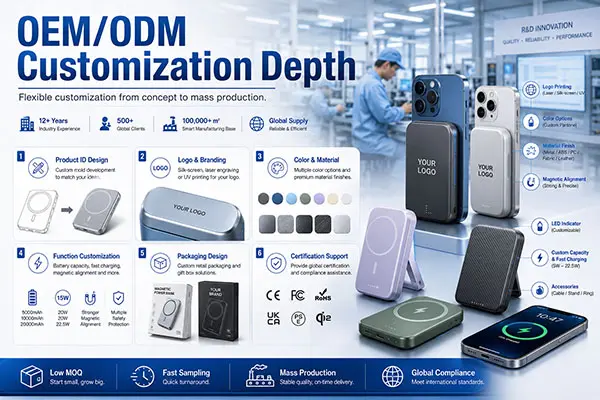
The final point evaluates whether the factory can deliver genuine customization, not just logo printing on a stock product. A power bank OEM ODM Shenzhen partner should offer real engineering collaboration. Every magnetic power bank manufacturer China buyers shortlist should be evaluated on this dimension.
R&D team depth: Ask how many engineers and what specialties they cover (hardware, firmware, structural, RF). A factory with 5+ R&D engineers handles custom PCB layouts and firmware modifications. One with 1–2 “engineers” is likely reselling reference designs.
Tooling ownership: For custom housings, ask who owns the injection molding tooling. Factory-owned tooling means you own the design; shared tooling means competitors can buy the same shell. Full custom OEM requires MOQ of 1,000–3,000 units; standard ODM can go as low as 500 units.
IP protection: Sign an NDA before sharing designs or specifications. Register your trademark in China (first-to-file jurisdiction) before production. A professional factory has an NDA template ready and won’t resist signing yours.
Firmware and packaging: In-house firmware engineers can customize battery display behavior, charging priority, and LED patterns. Factories that handle packaging in-house — printed boxes, multilingual manuals, barcodes, warranty cards — streamline the path to retail-ready product.
Ready to discuss your custom specifications? Learn about our OEM/ODM customization capabilities and how we handle tooling, firmware, and packaging under one roof.
FOB Shenzhen Pricing Benchmarks
These benchmarks help you evaluate whether a quote is competitive or suspiciously low. Prices reflect typical FOB Shenzhen pricing for magnetic power banks by capacity and feature tier.
| Capacity & Feature | FOB Price Range | Typical MOQ | Notes |
|---|---|---|---|
| 5,000mAh magnetic, 7.5W Qi | $4.50–$7.00 | 500–1,000 | Entry-level, basic magnet |
| 5,000mAh Qi2, 15W magnetic | $6.00–$9.00 | 500–1,000 | N52 magnets, FOD |
| 10,000mAh Qi2, 15W magnetic | $8.00–$12.00 | 500–1,000 | Popular B2B configuration |
| 10,000mAh Qi2.2, 25W magnetic | $11.00–$16.00 | 1,000–2,000 | Latest standard, premium |
| 10,000mAh full custom OEM | $12.00–$18.00 | 2,000–3,000 | Custom housing, firmware |
Quotes significantly below these ranges should trigger scrutiny — the supplier may be using substandard cells, omitting FOD, or skipping aging tests. The question of are magnetic power banks worth it depends on whether engineering and safety features justify the premium over basic wired models.
How to Verify Qi2 Certification — Step by Step
Qi2 certification is the most important credential when evaluating a magnetic power bank manufacturer China has to offer. Follow these steps to verify any supplier’s claim:
- Go to the WPC Qi Certified Product Database.
- Search by the supplier’s company name or the exact model number from your spec sheet.
- Check the status — it should show “Active,” not “Expired” or “Withdrawn.”
- Verify the Qi version (Qi2.0 or Qi2.2) and registered power profile (5W, 15W, or 25W).
- Cross-reference the model number with your sample, spec sheet, and packaging artwork.
- If unlisted, ask for the WPC member ID and Qi2 registration number. Contact WPC directly if needed.
- Check the certification date — recent certifications indicate the factory keeps pace with standard updates.
This process takes under five minutes and eliminates the most common certification fraud in the industry.
Red Flags: Signs to Walk Away
If you encounter any of these during supplier evaluation, consider it grounds to walk away:
- Price 30%+ below market: No legitimatte magnetic power bank manufacturer China offers will quote a 10,000mAh Qi2 model under $5.00 FOB. The cell alone costs $2.50–$4.00 wholesale. Low prices almost always mean counterfeit cells or skipped safety components.
- No WPC database entry: A supplier claiming Qi2 certification but absent from the WPC database is lying. There is no legitimatte reason for this discrepancy.
- Refusal to allow factory audit: If a supplier declines an on-site or third-party audit, they’re hiding something. Professional manufacturers welcome audits.
- Vague spec sheets: “Famous brand cell” instead of naming the manufacturer, or “standard BMS” instead of IC part numbers, means the supplier is hiding poor component choices.
- No UN38.3 report: Transport compliance is non-negotiable. Without a valid UN38.3 report, the product cannot legally ship internationally.
- Inconsistent samples: If three samples have different magnet strengths, coil positions, or charging speeds, the factory lacks production consistency. This problem multiplies at scale.
- Pressure to skip steps: A supplier pushing you to skip samples, audits, or certification verification “to save time” is not your partner.
10-Step Magnetic Power Bank Sourcing Workflow
- Shortlist 5–8 suppliers from B2B platforms, trade shows, and direct Google searches. Include at least two not on major platforms.
- Verify factory authenticity using business licenses, product range analysis, and video factory tours.
- Request technical spec sheets covering magnets, cells, BMS, and Qi2 certification.
- Verify Qi2 certification in the WPC database using the exact model number.
- Order paid samples from 3–5 suppliers. Test magnet retention, charging speed, heat, and FOD.
- Conduct a factory audit covering ISO 9001, SOPs, aging tests, and coil placement consistency.
- Negotiate pricing, MOQ, and lead time using FOB Shenzhen benchmarks as reference.
- Sign NDA and IP agreements before sharing custom designs or brand artwork.
- Place a trial order (500–1,000 units) to validate production consistency at scale.
- Implement pre-shipment inspection (AQL 2.5) before the trial order ships.
This workflow typically takes 8–12 weeks from shortlist to trial order shipment when sourcing from a magnetic power bank manufacturer China buyers can verify. For help evaluating whether magnetic power banks fit your strategy, our guide on wireless power bank compatibility breaks down which devices your customers can charge.
FAQ: How to Choose a Magnetic Power Bank Manufacturer
1. What is the minimum order quantity for a magnetic power bank from a Chinese manufacturer?
MOQ typically ranges from 500 units for standard ODM to 1,000–3,000 units for full custom OEM. Standard ODM means selecting an existing factory design with logo and color customization. Full custom OEM involves unique housing, custom PCB, firmware, and tooling. Some factories offer lower MOQs (100–300 units) for trial orders, but expect a 15–25% per-unit premium at those volumes.
2. How do I verify that a Chinese supplier is a real manufacturer and not a trading company?
Check the business license scope, product range, factory address, and technical response depth. Real manufacturers list production in their business scope, specialize in a narrow category, register in industrial zones, and answer detailed questions about IC part numbers and cell specifications. A video factory tour showing SMT lines and aging test racks is the fastest verification. Cross-check the Unified Social Credit Code on the National Enterprise Credit Information Publicity System.
3. What certifications should a magnetic power bank have?
At minimum: Qi2 (WPC), CE, FCC, RoHS, and UN38.3 transport certification. For specific markets, add UKCA (UK), PSE (Japan), and BIS (India). Battery cells should comply with IEC 62133-2. For Apple users, MFi certification ensures optimized MagSafe charging. Any magnetic power bank supplier China buyers consider should also carry safety marks for the targetion country’s customs and retail requirements.
4. What is the difference between Qi2 and MagSafe certification?
Qi2 is an open WPC standard; MagSafe is Apple’s proprietary ecosystem with MFi certification. Qi2-certified products appear in the WPC database and work with any Qi2-enabled device. MagSafe requires Apple’s MFi program and Apple-approved components. A product can be Qi2-certified and “MagSafe compatible” without MFi — it charges iPhones wirelessly but doesn’t carry Apple’s official endorsement.
5. How much does it cost to manufacture a magnetic power bank in China?
FOB Shenzhen pricing from a magnetic power bank manufacturer China ranges from $4.50–$7.00 for a 5,000mAh basic model to $8.00–$12.00 for a 10,000mAh Qi2 model. Premium configurations with Qi2.2 (25W), custom housing, and full OEM customization range from $11.00–$18.00. Cell grade, IC selection, magnet quality, housing matterial, certification scope, and order volume all affect pricing. Quotes significantly below these ranges typically indicate compromised components.
6. Can I air-ship magnetic power banks from China?
Yes, but only with proper UN38.3 certification, MSDS, and IATA-compliant packaging. Magnetic power banks contain lithium-ion batteries classified as Class 9 dangerous goods. Air freight requires a valid UN38.3 report, GHS-format MSDS, air transport appraisal, and hazmat labeling (Class 9 label, UN number, lithium battery mark). Ordinary lithium-ion power banks are shipped as UN 3480 under PI 965, including when packed with phones or charging cables. Applicable dangerous-goods requirements and operator restrictions must be checked for each shipment; passenger-baggage rules are separate. All document details must match exactly — discrepancies trigger customs holds.
7. How long does it take to produce a custom magnetic power bank order?
Standard ODM orders take 20–30 days; full custom OEM takes 45–75 days. Standard ODM uses existing molds requiring only logo printing and packaging customization. Full custom OEM involves tooling, PCB layout, firmware development, certification testing, and pilot production. Add 2–4 weeks for Qi2 certification if the design is new. Always build buffer time for sample revisions.
8. What quality tests should a magnetic power bank pass before shipment?
Products should pass aging tests, FOD function tests, magnet retention force tests, coil alignment checks, and full BMS protection validation. Aging tests involve multiple charge/discharge cycles monitoring output and temperature. FOD tests verify metallic object detection. Magnet retention should measure at least 10N. Coil alignment variation should be under 0.5mm. Charging efficiency should exceed 75%. The factory should document all test results.
Looking for a reliable magnetic power bank manufacturer with in-house R&D, Qi2-certified products, and full OEM/ODM capabilities? Browse our complete range of power bank products and request a sample to experience the difference engineering depth makes.
Official sources and verification
These primary sources support standards, compatibility, safety, or transport statements discussed in this article. Confirm the current requirement for the exact product model and destination market.
- International Electrotechnical Commission — International electrotechnical standards and standard scopes.
- Wireless Power Consortium — Qi and Qi2 standards, certification, and wireless-charging information.
- International Air Transport Association — Lithium-battery transport requirements and industry guidance.
