







How to Choose a Power Bank with Built-In Cable for OEM Orders
A built-in cable solves a familiar customer problem: there is no loose charging lead to forget or lose. For an OEM buyer, however, the attached cable becomes part of the product rather than an accessory. Its connector, charging direction, power rating, strain relief, and behavior alongside other outputs all need to be specified and tested.
The points below are the ones worth settling before approving a private-label model, a working sample, or a production inspection plan.
What counts as a built-in cable power bank?
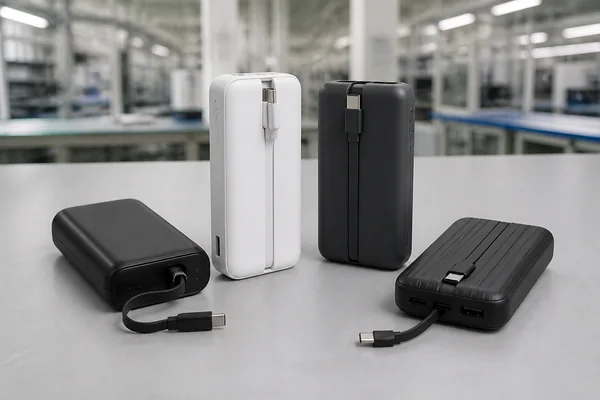
The term covers several designs. Some models have one short output cable fixed to the enclosure. Others use two cables or turn the cable into a carrying strap. A few combine the attached lead with USB ports or wireless charging. The cable may provide output only, input only, or work in both directions. Product photographs rarely settle those details.
Start with the customer rather than the enclosure. A commuter model may suit a compact body and short USB-C cable. A travel kit may need two connector types. On a higher-capacity model, the cable anchor and shared-output behavior deserve more attention because users are more likely to charge several devices.
Write the cable function into the approved specification
“Built-in USB-C cable” is not a complete requirement. The specification should state the connector, cable length, rated power, supported direction, and charging protocol. If the same cable recharges both the power bank and a phone, write down both functions. If it only provides output, say so plainly in the manual and on the packaging.
USB-C describes the connector, not the charging power by itself. The USB Implementers Forum publishes separate matterial for the USB Type-C connector system and USB Power Delivery. A reversible USB-C plug does not automatically mean that every PD voltage, current, or direction is supported.
| Decision | What to record | What to verify on the sample |
|---|---|---|
| Cable role | Input, output, or bidirectional | Test every stated direction with the intended device and charger |
| Connector | USB-C or another specified connector | Fit, orientation, compatibility, and labeling |
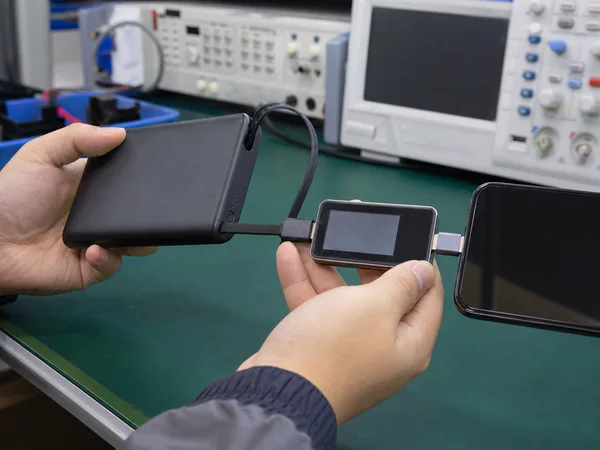
| Power | Rated voltage, current, protocol, and maximum watts | Negotiated output and temperature under the agreed load |
| Mechanical design | Length, storage position, strain relief, and pull requirement | Bending, insertion, pull, storage, and normal handling |
| Multiple outputs | Total output and power allocation | Cable plus ports or wireless charging in the combinations users will try |
Capacity and charging power are separate buying decisions
Capacity is usually advertised in milliamp-hours, while transport documents and technical comparisons often use watt-hours. Neither figure shows how much energy reaches a phone after voltage conversion and normal system losses. Ask for the cell specification and nominal voltage, then check the rated energy and the test method behind any usable-capacity claim.
Charging power needs the same care. A product may have a high-rated USB-C port but a lower-rated built-in cable, or the reverse. Total power may drop when the cable and another output operate together. Put individual-port ratings and simultaneous-output behavior in the approved specification instead of relying on the largest wattage printed on the sales sheet.
Built-in cable designs available for different projects
YULIDA’s built-in cable power bank category currently includes compact and dual-cable models, along with solar, magnetic wireless, and display-based versions. Buyers can compare several platforms before committing to an enclosure.
- The AJ08 built-in cable power bank is listed in 10,000mAh and 20,000mAh versions with a stated 22.5W configuration.
- The AJ10 3-in-1 power bank combines a 10,000mAh format with built-in cable functions.
- The AJ11 dual-cable model is listed in 10,000mAh and 20,000mAh versions with an LED display.
- The A217 strap-cable model uses the cable as part of the carrying design and includes a digital display.
Use these pages to build a shortlist. The approved order specification still needs to confirm the capacity, connector functions, charging protocol, firmware version, included accessories, and documents for the quoted configuration.
Cable durability needs its own acceptance criteria
A detachable cable is easy to replace. A failed built-in cable is more likely to send the whole power bank back, even when its battery and USB ports still work. Give the cable its own line in the inspection plan.
The test method depends on the design. Useful checks include repeated bending near the strain relief, a defined pull force, connector insertion, and charging under load. Also inspect the cable after it has been removed from and returned to its storage slot many times. A strap-cable design needs a separate handling test because users will lift the product by the loop. Before production, agree on the sample size, number of cycles or applied force, and pass criteria. “Durable cable” by itself is not an inspectable requirement.
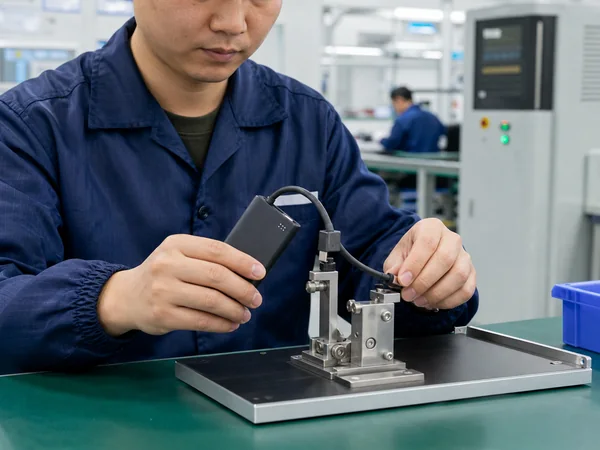
Review the broader YULIDA power bank quality-control process when preparing the inspection plan. Third-party inspection can also be included if it is part of the order agreement.
Documents should match the final battery and electronics
Lithium-battery transport evidence follows the tested battery type and configuration. The current UNECE Manual of Tests and Criteria contains subsection 38.3 for lithium cells and batteries. IATA also explains that manufacturers and distributors must make the relevant UN 38.3 test summary available for the cell or battery type used in transport.
A change to the cell, battery assembly, PCBA, enclosure, or plug arrangement can affect which evidence applies. Request the current files for the quoted model instead of accepting a certificate from a similar-looking product. Transport records and market-compliance reports serve different purposes; one does not replace the other.
For passenger use, IATA currently directs travelers to carry power banks in hand baggage and check airline-specific rules. Airline and national requirements can change. The current IATA passenger guidance is a better reference than packaging text copied from an older product.
See the power bank certifications and compliance guide for the difference between CE-related evidence, FCC reports, RoHS documentation, UN 38.3 transport evidence, and other model-specific files.
What changes at each OEM level?
YULIDA uses three starting tiers for OEM enquiries. Standard models with logo branding start at 500 pieces. Broader color or packaging changes usually start at 1,000 pieces, while projects involving deeper engineering or custom tooling start at 2,000 pieces. The final MOQ still depends on the model, certification scope, packaging, and target market.
Separate the project into two documents: the product specification and the artwork or packaging files. The specification controls function and acceptance. Artwork controls appearance and printed information. When one PDF tries to do both jobs, electrical or cable details are easily lost during revisions.

A practical RFQ checklist
A useful request for quotation gives the factory enough information to identify the right platform. Start with the target market, order quantity, capacity, charging power, connector mix, and cable functions. Then add the required ports, any display or wireless function, branding method, packaging, and document list. If several outputs must work at the same time, say so. The factory also needs to know whether you want a standard model, a firmware change, or a new mechanical design.
Once a model is selected, approve a working sample and a written specification. Reference both in the final purchase order. A later change to the cable, cell, or firmware then becomes a controlled revision rather than an informal substitution.
Review YULIDA’s OEM and ODM options or request a model-specific quotation.
FAQ: Choose a Power Bank with Built-In Cable
1. What is the MOQ for a built-in cable power bank?
Standard logo and branding projects start at 500 pieces. Custom colors, packaging, firmware, PCBA work, cable changes, and tooling are reviewed separately and may use a different MOQ.
2. Can the built-in cable recharge the power bank?
Some cables support input and output, while others provide output only. Confirm the direction and charging rating for the exact model.
3. Does a built-in USB-C cable always support USB Power Delivery?
No. USB-C identifies the connector. PD support, voltage profiles, current, direction, and maximum power depend on the product design and firmware.
4. Can the cable and USB ports charge several devices at once?
That depends on the model. Ask for the permitted output combinations, total output, and power allocation when more than one device is connected.
5. Is the labeled battery capacity the same as usable output capacity?
No. The cell capacity and rated energy are measured at the battery’s nominal conditions. Voltage conversion, circuitry, cable resistance, temperature, and device charging behavior affect the energy delivered at the output.
6. Which shipping documents should a buyer request?
Request the current UN 38.3 test summary and the transport documents required for the exact battery and shipment. Market-specific compliance files should also match the final product configuration and target market.
Official reference sources
- USB-IF: USB Type-C cable and connector specification
- USB-IF: USB Power Delivery overview
- UNECE: UN Manual of Tests and Criteria, Revision 8 and Amendment 1
- IATA: traveling with portable electronic devices and power banks
Before ordering or shipping, confirm the current specification and report scope for the exact product. Check the latest transport rules and target-market requirements as well.
Official sources and verification
These primary sources support standards, compatibility, safety, or transport statements discussed in this article. Confirm the current requirement for the exact product model and destination market.
- USB Implementers Forum — USB Type-C and USB Power Delivery specifications and guidance.
- USB Implementers Forum — USB Type-C and USB Power Delivery specifications and guidance.
- International Air Transport Association — Lithium-battery transport requirements and industry guidance.
